If you told your CFO that 166 billion dollars in unconstitutionally seized capital is currently sitting in a government portal, they'd likely dismiss it as a high-stakes tax scam. But following the Supreme Court’s landmark February 2026 ruling, these funds aren't a speculative "play." They represent a legitimate, non-dilutive financing event for your business. You know that any mention of "found money" triggers immediate skepticism from leadership. They fear the specter of a Customs audit or the complexity of managing GAAP gain contingencies on the balance sheet. It's a valid concern, especially when internal resources are already stretched thin.
This guide equips you with the financial logic and accounting insights necessary for presenting tariff recovery opportunity to CFO stakeholders with absolute authority. We'll show you how to frame this as a risk-free path to capital recovery that includes a 6 percent interest rate on corporate overpayments. You'll learn how to navigate the CAPE portal requirements and the current DOJ appeal landscape without disrupting your daily operations. By the end, you’ll have a strategic framework to transform a regulatory victory into a multi-million dollar refund for your bottom line.
Key Takeaways
- Leverage the February 2026 Supreme Court ruling to frame tariff recovery as a non-dilutive capital event rather than a speculative tax play.
- Master the GAAP "Gain Contingency" rules to provide your CFO with clear timelines for when recovered capital can be recognized on the balance sheet.
- Address executive skepticism by presenting tariff recovery opportunity to CFO stakeholders as a necessary hedge that preserves your right to capital amidst ongoing DOJ appeals.
- Utilize a structured five-slide presentation roadmap to quantify the refund potential, including the current 6 percent interest rate paid on corporate overpayments.
- Align corporate incentives by adopting a contingency-based recovery model that secures millions in capital with zero upfront financial risk or internal headcount.
The IEEPA Ruling: Framing the $80B+ Capital Recovery Opportunity
On February 20, 2026, the U.S. Supreme Court delivered a landmark 6-3 ruling that fundamentally reshaped the landscape of American trade law. The court determined that the International Emergency Economic Powers Act (IEEPA) does not grant the executive branch the authority to impose tariffs without specific, pre-existing Congressional triggers. This decision invalidated the legal foundation for billions in duties collected over the previous two years. It was a constitutional correction that transformed a significant corporate expense into a massive reclamation opportunity.
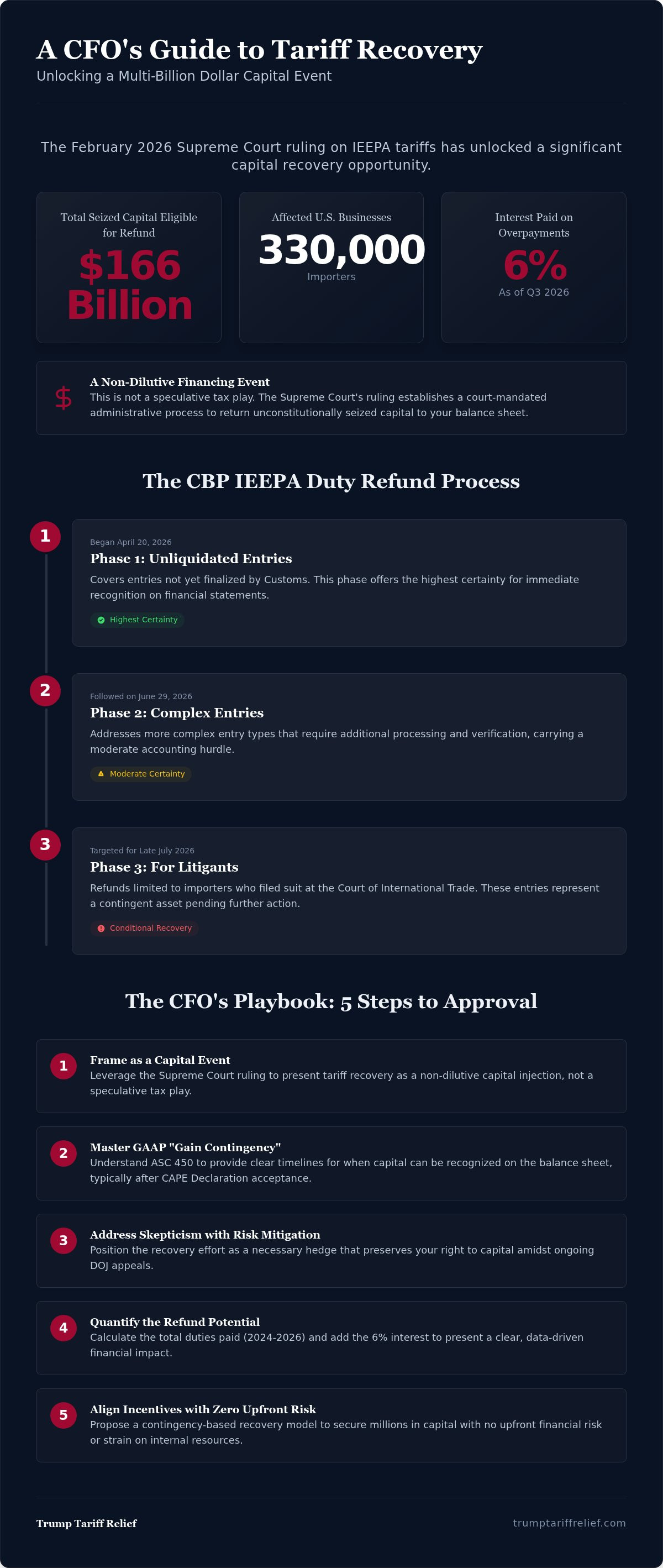
The scale of this "found money" is staggering. U.S. Customs and Border Protection (CBP) collected approximately $166 billion in IEEPA duties from an estimated 330,000 importers. When you're presenting tariff recovery opportunity to CFO leadership, precision is your greatest asset. It's essential to distinguish these IEEPA-specific claims from Section 301 China tariffs. While Section 301 remains subject to its own complex litigation, the IEEPA ruling is a settled constitutional fact. This capital was unconstitutionally seized, and it's now eligible for return to your balance sheet.
The Legal Precedent: Why This Time is Different
Following the Supreme Court’s decision, the Court of International Trade (CIT) issued a directive on March 4, 2026, ordering CBP to initiate the refund process. This created a universal injunction, meaning the benefits aren't restricted solely to the original litigants. If your entries are unliquidated or meet specific timeline criteria, the law is now on your side. This isn't a speculative tax strategy; it's a court-mandated administrative process. For a comprehensive breakdown of the statutory limits the court identified, review our IEEPA explained resource to ground your pitch in legal reality.
The Financial Scale: Assessing Your Firm’s "Dead Capital"
To begin your internal assessment, calculate the total IEEPA duties your firm paid between 2024 and 2026. This figure represents "dead capital" that is currently providing zero utility to your operations while sitting in government accounts. In most organizations, this recovery will dwarf other EBITDA-improving initiatives currently under consideration. This is interest-bearing capital; as of Q3 2026, the interest rate paid on corporate overpayments of customs duties is 6 percent. When presenting tariff recovery opportunity to CFO stakeholders, frame this as a high-yield asset recovery. Every day you delay the filing is another day your capital remains trapped in a federal portal instead of funding your next growth cycle.
Accounting Logic: Recognition, Measurement, and Gain Contingency
When presenting tariff recovery opportunity to CFO leadership, the most pressing question you’ll face isn't if the money is owed, but when it can hit the financial statements. Under GAAP, specifically ASC 450, these refunds are classified as gain contingencies. This means recognition cannot occur simply because a legal victory has been secured. The income must be realized or realizable before it moves from a footnote to the balance sheet. For most importers, this threshold is met once a "CAPE Declaration" is submitted and accepted within the ACE portal, signaling that the claim is no longer subject to significant administrative dispute.
The probability of recovery varies across the three phases established by the CBP IEEPA Duty Refund Process. Phase 1, which began on April 20, 2026, covers unliquidated entries and offers the highest certainty for immediate recognition. Phase 2 followed on June 29, 2026, addressing more complex entry types. Phase 3, targeted for late July 2026, presents a higher accounting hurdle. Since the government currently limits Phase 3 refunds to importers who filed suit at the Court of International Trade, CFOs must evaluate whether their specific entries meet the "realizable" criteria or if they remain a contingent asset pending further litigation. If your tariffs were originally capitalized into inventory, the refund will likely require an adjustment to the carrying value or a reduction in Cost of Goods Sold (COGS) for the current period.
The Loss Recovery vs. Cost Recovery Model
Your CFO must determine if the refund should be treated as a recovery of a prior period loss or a reduction of current period costs. This decision impacts EBITDA and tax liability differently. While the principal refund is often non-taxable as a return of capital, the 6 percent interest paid on corporate overpayments is generally treated as taxable income in the year it's received. For a detailed breakdown of how these variables affect your specific claim, consult our Tariff Refund Assessment to ensure your numbers are audit-ready. A proactive approach here helps you identify recovery opportunities before the fiscal year-end close.
Cash Flow Presentation and Disclosure Requirements
Categorizing these funds on the Statement of Cash Flows is a matter of significant auditor scrutiny. Most firms will classify the refund as an operating cash flow, as it represents the recovery of a previous operating expense. However, if the tariffs were paid on capital equipment, the recovery might be better suited for the investing section. Footnote disclosures must be drafted with precision; they should acknowledge the Supreme Court ruling and the company’s intent to recover, but avoid guaranteeing a specific receipt date. Management’s intent is a primary factor in audit readiness. Demonstrating a structured, documented path toward recovery proves to external auditors that the company is actively pursuing its fiduciary duty to reclaim unconstitutionally seized capital.
Addressing CFO Skepticism: Risk Mitigation and DOJ Appeals
When presenting tariff recovery opportunity to CFO leadership, the most immediate hurdle is often a "wait and see" mentality regarding the pending Department of Justice (DOJ) appeal. This caution is understandable but strategically flawed. The government is currently challenging the Court of International Trade’s (CIT) authority to order refunds for entries that liquidated more than 80 days before the ruling. If you wait for a final appellate decision, you risk missing the Tariff Refund Statute of Limitations. Filing now acts as a strategic hedge. It preserves your legal standing and ensures your firm is "in line" for capital recovery regardless of how the Federal Circuit eventually rules.
Another common concern involves the fear of Customs "retaliation" or triggering an invasive audit. You must clarify that claiming a court-ordered refund is a standard procedural right, not a red flag for enforcement. CBP is currently managing a massive, automated administrative wave involving over 20 million unliquidated entries. Your claim is a data-driven request within the CAPE portal, not a discretionary event that invites subjective scrutiny. In the current regulatory environment, the only true risk is the opportunity cost of leaving interest-bearing capital in the U.S. Treasury’s accounts.
The DOJ Appeal: Strategic Implications for Phase 3
The DOJ’s primary argument targets "finally liquidated" entries, contending that once an entry is closed for more than 80 days, it's beyond the CIT's reach. This creates a high-stakes environment for Phase 3 claims. Fortune 500 CFOs are increasingly utilizing "protective filings" to ensure they aren't locked out of recovery if the government loses its appeal. It's a low-cost insurance policy for millions in potential refunds. Importers must remember that the 180-day protest window remains a non-negotiable deadline for preserving the right to challenge a liquidation and secure your place in the refund queue.
Operational Risk: Minimal Impact on Internal Teams
Neutralizing the "we don't have the bandwidth" objection is critical for securing approval. Explain that the heavy lifting of documentation management and data extraction is handled by an external engine. Specialized recovery partners interface directly with the Automated Commercial Environment (ACE) portal to identify every eligible entry and calculate the 6 percent interest owed. This process requires almost zero internal headcount or disruption to daily operations. Review our How It Works page to show your CFO how this partnership functions as a seamless extension of your tax and legal teams.
The Presentation Roadmap: 5 Slides to CFO Approval
Success in presenting tariff recovery opportunity to CFO stakeholders depends on clarity and the removal of perceived friction. Your pitch deck should move from the legal catalyst to the financial bottom line in five punchy slides. Slide 1 establishes the February 2026 Supreme Court ruling as the definitive trigger for eligibility. Slide 2 quantifies the total recovery amount, including principal and interest. Slide 3 contrasts the risk-free contingency model against the high cost of inaction. Slide 4 outlines the implementation via the CAPE portal, and Slide 5 delivers the final recommendation: file immediately to secure your place in the 2026 recovery queue.
Slide 2 Deep-Dive: Quantifying the Interest Component
CFOs are naturally focused on the time value of money. Under 19 U.S.C. § 1505, CBP refunds include interest calculated from the date the duties were paid. For the quarter beginning July 1, 2026, the interest rate paid on corporate overpayments of customs duties is 6 percent. This isn't a negligible figure. On a multi-million dollar claim, the interest alone can often offset the entire cost of the recovery effort. Use our tariff recovery for importers guide to benchmark these figures against industry standards. It transforms the conversation from "maybe we get some money back" to "we are reclaiming a high-yield asset."
Slide 4 Deep-Dive: The CAPE Portal and Data Security
Data integrity and security are paramount when presenting tariff recovery opportunity to CFO teams. The Consolidated Administration and Processing of Entries (CAPE) system operates within the existing ACE portal, ensuring that your trade data remains within a secure, government-sanctioned environment. A specialized partner manages the technical submission but does not own your proprietary data. You'll need to prepare the Required Documents for IEEPA Tariff Refund, such as entry summaries and proof of payment, to ensure total audit readiness. This integration minimizes the burden on your IT and trade compliance teams, allowing them to focus on core operations.
Ready to build your business case? Get a preliminary assessment today to quantify your firm's specific recovery potential and secure the capital your business is owed.
The Business Case for a Contingency-Based Recovery Partner
The success-fee model isn't just a pricing structure; it’s a strategic alignment that mirrors your CFO’s primary objectives. By removing upfront financial risk, you transform a complex legal reclamation into a "free option" for the business. When you're presenting tariff recovery opportunity to CFO leadership, the absence of an hourly bill removes the highest barrier to entry. This model ensures that we only profit when your capital is successfully restored to your balance sheet, making it a true off-balance-sheet project until the point of realization. It positions the recovery effort as a high-reward venture with zero impact on the current fiscal year's budget.
Many firms mistakenly assume their current Customs Broker is the natural choice for this task. While brokers are excellent at daily logistics and entry filings, they aren't constitutional litigators or recovery specialists. This recovery hinges on navigating the CIT universal injunction nuances and the technicalities of the CAPE portal, areas that fall outside standard brokerage services. Handling this in-house is equally perilous. The hidden costs of technical errors, missed deadlines, and the sheer opportunity cost of diverting your finance team from core operations can far exceed any perceived savings. Trump Tariff Relief acts as a force multiplier, providing the specialized engine needed to reclaim capital without adding a single person to your internal headcount.
Contingency vs. Hourly: The ROI Analysis
The "Zero Upfront Cost" argument is your most persuasive tool. Unlike traditional law firms that demand retainers regardless of the outcome, a contingency partner absorbs the risk of the DOJ appeal and any administrative delays. This approach provides your company with specialized legal and trade expertise that would otherwise be cost-prohibitive. If your executive team has technical questions regarding the mechanics of the refund or the specific legal triggers, our FAQ section provides the definitive rebuttals needed to satisfy audit and legal committees alike.
Next Steps: Securing a Preliminary Assessment
The final step in presenting tariff recovery opportunity to CFO stakeholders is providing them with hard, company-specific data. You don't need to guess your eligibility or the potential refund amount. By initiating a risk-free audit, you can obtain the precise numbers required to move from a conceptual discussion to a formal filing. Our team provides a 48-hour turnaround for eligibility verification, extracting the necessary data from the ACE portal to build your business case. Don't let your firm's capital sit in a government account while the 2026 statute of limitations approaches. Secure your firm’s preliminary assessment today and take the first step toward reclaiming what is rightfully yours.
Secure Your Firm’s Capital Recovery Today
The 2026 Supreme Court ruling has transformed unconstitutional tariff payments into a legitimate, interest-bearing asset for your business. By presenting tariff recovery opportunity to CFO leadership through the lens of risk-mitigation and non-dilutive financing, you move the conversation from speculation to strategic execution. You now have the framework to address GAAP recognition concerns and the logic to overcome skepticism regarding DOJ appeals. The only remaining variable is the speed of your filing before the statute of limitations expires.
Our team provides specialized IEEPA expertise and handles comprehensive data management through the CAPE portal, ensuring a seamless path to restoration. Because our model is contingency-based, there's no recovery and no fee; your firm incurs zero upfront financial risk. Take the final step in your strategic roadmap by securing the hard data you need for your executive team. Get a Free Preliminary Assessment for Your CFO Presentation and start reclaiming the millions your company is owed. It's time to bring that capital back where it belongs.
Frequently Asked Questions
Is the China tariff refund real or a scam?
The refund is a legitimate legal recovery following the Supreme Court’s February 20, 2026, ruling that invalidated IEEPA-based duties. It's an administrative process managed through the CBP's CAPE system within the existing ACE portal. While Section 301 China tariffs remain distinct, these IEEPA-specific claims are settled law. Over 56,000 importers have already registered to reclaim their portion of the 166 billion dollars collected.
What is the deadline for filing an IEEPA tariff refund claim in 2026?
Deadlines are entry-specific, based on the 180-day window following the liquidation of each individual customs entry. For unliquidated entries, the process is immediate via Phase 1 of the CAPE rollout. However, the government’s appeal of the CIT order makes proactive filing urgent. Delaying your submission risks missing these strict statutory windows as more of your entries reach final liquidation status and become harder to recover.
How long does it take for the U.S. Treasury to issue a refund check?
Refunds are issued electronically via ACH, typically within 45 to 60 days of a successful CAPE declaration. Electronic payments are processed through the Automated Commercial Environment (ACE) portal once your banking information is verified. While Phase 1 and 2 entries are moving quickly, complex Phase 3 entries may face delays due to the ongoing DOJ appeal. Ensuring your ACH registration is active is the fastest path.
Can our internal legal team handle the IEEPA claim without external help?
While possible, internal teams often lack the specialized data extraction tools needed to identify every eligible entry across millions of records. When you're presenting tariff recovery opportunity to CFO stakeholders, emphasizing an external engine ensures accuracy and prevents technical errors that lead to claim denials. Most internal teams find that the opportunity cost of manual data management far outweighs the benefits of a specialized contingency partnership.
What happens if the DOJ wins its appeal against the CIT injunction?
A DOJ victory would likely limit refunds to only those importers who filed individual lawsuits at the Court of International Trade. If the government successfully appeals, "finally liquidated" entries for non-litigants may become permanently ineligible for recovery. This is why protective filings are critical. By taking action now, you preserve your firm’s legal standing and ensure your claim is recognized before the legal landscape potentially shifts back.
How are contingency fees calculated for tariff recovery services?
Fees are typically a percentage of the total capital recovered, including the 6 percent interest paid by the Treasury. This success fee structure makes presenting tariff recovery opportunity to CFO leadership much easier, as it requires zero upfront budget. The fee is simply an off-balance-sheet deduction from the newly recovered capital. It aligns incentives by ensuring you pay nothing unless a refund is successfully deposited.
Do we need to file a separate lawsuit to be eligible for the refund?
Currently, most importers can recover via the administrative CAPE process, but Phase 3 entries may eventually require litigation. Under the current CIT universal injunction, many importers can claim refunds without individual suits. However, the government’s position as of August 2026 is that Phase 3 refunds for older entries are reserved for importers with active CIT cases. A preliminary assessment can determine if your profile requires a legal filing.
Will filing for a refund trigger a broader Customs audit of our entries?
No, filing a CAPE declaration for a court-ordered refund is a procedural right that doesn't inherently trigger an audit. CBP is processing these refunds as a massive administrative wave involving over 20 million entries. The process is automated and data-driven, focusing specifically on the unconstitutional IEEPA duties. Reclaiming these funds is a standard exercise of your fiduciary duty and isn't viewed by the government as a red flag.
Ready to find out what your business may be owed?
Check My Eligibility