
What if the millions your company lost to federal trade duties over the last few years weren't a cost of doing business, but a recoverable asset? Most executives accept these payments as sunk costs, buried under layers of federal bureaucracy and the threat of high legal fees. It's a frustrating reality where compliance often means letting go of capital that rightfully belongs on your balance sheet. However, the regulatory landscape shifted on February 20, 2026, opening a massive window for financial restoration.
You can now reclaim these overpaid IEEPA duties using a model that eliminates the traditional barriers of hourly billing and financial risk. This article will explain how performance based tariff recovery works as a strategic alliance, allowing you to outsource the entire documentation and filing process to trade experts. We will preview the critical 180-day protest window, the advantages of a contingency-fee structure, and the exact steps required to identify your eligibility before these statutory deadlines expire for good.
Key Takeaways
- Identify the specific HTS codes and entry dates that qualify for recovery under the landmark 2026 Supreme Court decision.
- Learn how performance based tariff recovery provides a high-reward partnership by eliminating upfront retainers and focusing on actual capital restoration.
- Master the documentation requirements, including Customs Form 7501, needed to successfully navigate the federal bureaucracy and the CAPE system.
- Grasp the critical differences between the 180-day protest window and the three-year statute of limitations to ensure no claim is left behind.
- Evaluate the financial advantages of a success-based model that protects your current cash flow while pursuing millions in overpaid duties.
What is Performance Based Tariff Recovery for IEEPA Claims?
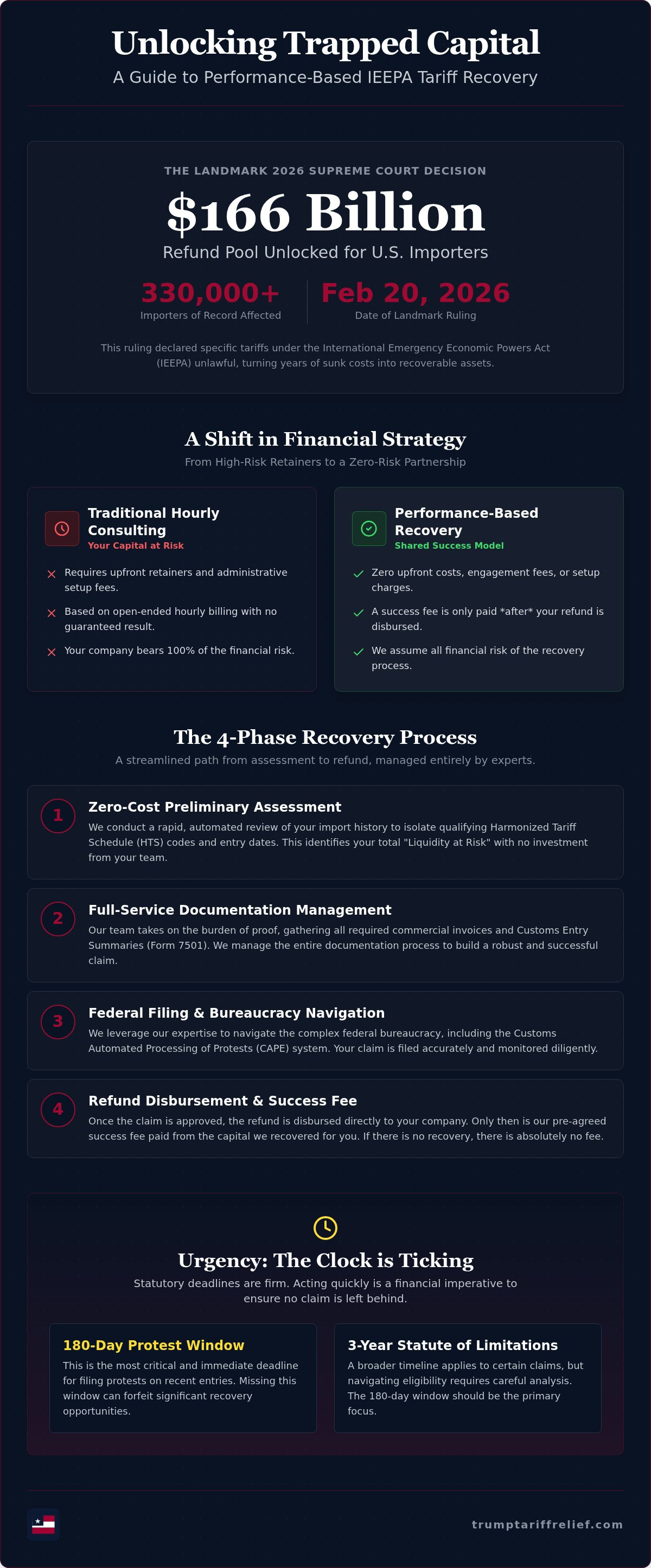
The landscape of international trade changed permanently on February 20, 2026. On that day, the U.S. Supreme Court issued a landmark ruling declaring that specific tariffs imposed under the International Emergency Economic Powers Act (IEEPA) were unlawful. This decision didn't just highlight a regulatory overreach; it unlocked a staggering $166 billion refund pool earmarked for over 330,000 importers of record. For most corporations, these funds represent trapped liquidity that has been sitting on the government's balance sheet for years. performance based tariff recovery is the specialized mechanism that allows your business to reclaim this capital without the traditional financial barriers of legal retainers or hourly consulting fees. It's a contingency model where the service provider's compensation is tied directly to the actual refund secured, shifting every ounce of financial risk away from your company and onto the trade experts handling the claim.
The Shift from Passive Compliance to Active Recovery
Most customs brokers are built for compliance, not litigation or retroactive recovery. Their primary objective is to ensure your goods move across the border without delay, which usually means paying duties first and asking questions later. Specialized recovery experts operate with a different mandate. We look backward to identify where the law was misapplied, turning your past tax expenditures into current assets. IEEPA recovery is the specialized legal and administrative process of reclaiming duties paid under the International Emergency Economic Powers Act that the courts have now deemed unconstitutional. By moving from a passive compliance posture to an active recovery strategy, you're no longer just following rules; you're exercising your rights to restore corporate liquidity.
Key Elements of a Performance-Based Agreement
A legitimate performance-based model aligns the interests of the recovery team with those of the client. It's built on a "success fee" structure, which means the service provider only earns a fee after the refund is successfully disbursed. This alignment is critical because it eliminates the financial friction that often prevents companies from pursuing federal claims. If there's no recovery, there's no cost. Key features of this partnership include:
- Zero upfront costs: There are no engagement fees, administrative charges, or setup costs to begin the recovery process.
- Elimination of hourly billing: Your balance sheet is protected from open-ended legal bills that offer no guaranteed result.
- Comprehensive management: The provider handles the entire Tariff Eligibility Assessment and the complex federal filing process.
This structure ensures that the trade experts take on the heavy lifting and the bureaucratic risk. Your business remains focused on its core operations while a dedicated team works to win back your overpaid duties.
How the Contingency Model Works: From Assessment to Refund
Many companies view the federal refund process as a labyrinth of red tape. They worry that the effort to reclaim overpaid duties will cost more in man-hours than the eventual payout. A contingency fee arrangement effectively dismantles this barrier. It allows your business to leverage specialized trade expertise without risking corporate capital. The performance based tariff recovery process is structured into four distinct phases designed to maximize your return while minimizing your operational involvement. By aligning our success with yours, we ensure that every action taken is focused on one goal: restoring your trapped liquidity.
The Zero-Cost Preliminary Assessment
We begin by identifying your "Liquidity at Risk." This involves a rapid, automated review of your import history to isolate qualifying Harmonized Tariff Schedule (HTS) codes and entry dates impacted by the February 20, 2026, ruling. By focusing on these specific data points, we can quickly identify the "low-hanging fruit" in your tariff spend. This initial phase requires zero investment from your team; it's a diagnostic tool that provides a clear picture of exactly how much capital is recoverable from the federal treasury before any formal filings begin.
Full-Service Documentation Management
Once we've established eligibility, the burden of proof shifts to the importer. Gathering commercial invoices and Customs Entry Summaries (Form 7501) can be an administrative nightmare for internal teams already stretched thin. Our experts handle the heavy lifting by organizing complex data sets into CBP-ready filing packages. The performance based tariff recovery model ensures that the burden of proof doesn't become a burden on your budget. You can learn how our process works in detail, but the core benefit remains the same: we manage the bureaucracy while you manage your business.
Following the audit, we move into Phase 3: Strategic Filing. This is where we submit formal protests and claims directly to U.S. Customs and Border Protection. We don't just file and forget. In Phase 4: Refund Securitization, our team tracks every claim through the federal system until the Treasury issues your check. This end-to-end management ensures that technical errors or missing ACH information, which currently accounts for $1.7 billion in delayed refunds nationwide, don't lead to claim denials or delayed payments. If you want to see if your entries qualify, you can start a preliminary tariff eligibility assessment today to secure your place in the refund queue.
Performance Fees vs. Hourly Consulting: A Financial Comparison
Choosing how to pursue an IEEPA refund is as much a financial decision as it is a legal one. Traditional law firms typically rely on hourly billing. This structure places the entire financial burden on your company's balance sheet before a single dollar is recovered. This "Retainer Risk" creates a significant barrier; you're essentially gambling corporate capital on a favorable outcome from a complex federal bureaucracy. In contrast, performance based tariff recovery operates on a success-only basis. This model offers a technically infinite ROI because the initial investment is zero. If there's no recovery, there's no fee. This alignment ensures your recovery partner is motivated by results, not just billable hours.
The Hidden Costs of Traditional Legal Retainers
Hourly billing often includes research, filing, and ongoing correspondence with U.S. Customs and Border Protection. These costs accumulate regardless of whether the claim is accepted or denied. Many businesses fall into a "sunk cost" trap. They continue paying high legal fees simply to justify the initial expenditure. Beyond the cost, traditional firms often lack the specialized trade-automation tools required to process thousands of entries efficiently. Without these tools, the manual labor required for a comprehensive audit drives up hourly costs. This often makes the pursuit of moderately sized claims financially unviable for the importer.
The Capital Efficiency of Results-Oriented Advocacy
A contingency model bypasses the typical "Budget Barrier" that often stops recovery efforts. Most CFOs are reluctant to approve new, open-ended legal spend for uncertain returns. Because performance-based fees are deducted from the recovered amount, they don't impact your current operational cash flow. This allows you to preserve liquidity for core business needs while the recovery process moves forward. There's also a clear psychological advantage to this partnership. Your advocate is in the trenches with you. Their revenue depends entirely on your financial restoration. You can explore our IEEPA expertise to see how this results-oriented approach navigates the post-2026 regulatory environment. This specialized focus ensures every claim is optimized for maximum recovery without the risk of an empty-handed legal bill.
The 2026 Window: Why Speed is a Financial Imperative
The 2026 window isn't just an administrative timeline; it's a rapidly closing door on your company's capital. While the Supreme Court's February 20, 2026, decision established the illegality of these duties, the mechanism for recovery is governed by strict statutory clocks. If you miss these windows, your right to a refund effectively expires. This reality makes performance based tariff recovery a critical strategic choice. You need a partner who can move faster than the bureaucracy to ensure your claims are filed before the clock runs out. Waiting even a few weeks can mean the difference between a full recovery and a permanent loss of liquidity.
Mastering the 180-Day Protest Deadline
Liquidation is the formal process where U.S. Customs and Border Protection finalizes the duty calculation for an entry. Once an entry liquidates, the statutory countdown begins. You have a finite amount of time to challenge that calculation. Identifying which of your entries are currently within this protestable window requires a deep dive into your import data. Many businesses lose out because they don't realize that once an entry is "finally liquidated" without a protest, the government's hold on those funds often becomes permanent. You can read more about The Critical Deadlines for IEEPA Claims to understand how these timelines intersect with your specific import history.
Navigating the 2026 Recovery Landscape
The sheer volume of claims, affecting over 300,000 importers, has created a "First-In, First-Out" reality within the federal system. Early filers aren't just getting processed; they're avoiding the massive backlog that is currently stretching disbursement timelines. The February 2026 ruling has fundamentally shifted the burden back onto the government, but the CAPE system is already showing signs of strain under the $166 billion refund pool. Importers have exactly 180 days from the date of entry liquidation to file a valid protest for a refund. Waiting until the end of the three-year statute of limitations for broader claims is a dangerous gamble. It leaves your capital at the mercy of shifting political winds and administrative delays.
By utilizing a performance based tariff recovery model, you ensure your documentation is prioritized. We don't just wait for deadlines; we anticipate them. This proactive approach is the only way to navigate a landscape where $1.7 billion in refunds is already being held up due to simple administrative errors like missing ACH information. If you're ready to secure your place in the queue, you should start your eligibility assessment now before your protest windows close for good.
Securing Your Refund with Trump Tariff Relief
Restoring your corporate liquidity requires more than just a general understanding of trade law; it demands a specialized focus on the specific administrative mechanics of IEEPA claims. Generalist firms often lack the granular expertise or the proprietary trade data tools necessary to identify every qualifying entry across a complex, multi-year import history. By choosing performance based tariff recovery through Trump Tariff Relief, you're partnering with a team that has spent years preparing for the fallout of the February 20, 2026, Supreme Court decision. We don't just file paperwork. We weaponize trade data to turn your past overpayments into future growth capital.
Our 'No-Risk' promise is the cornerstone of our advocacy. We operate under the belief that you've already been penalized enough by unlawful tariffs. Therefore, we assume all the financial risk of the recovery process. If our team doesn't successfully recover your money, you owe us nothing. This model forces us to be more thorough, more aggressive, and more accurate than any hourly-based consultancy. We win only when you win, ensuring that our incentives are perfectly aligned with your bottom line.
Why Importers Trust the Performance-Based Model
The success of a recovery claim often hinges on transparency and the ability to navigate the CAPE system's phased rollout. Importers trust this model because it removes the friction of upfront costs and provides a clear, results-oriented path to restoration. We've seen businesses reclaim millions by simply auditing their history for misapplied HTS codes that fell under the IEEPA umbrella. This transparency allows your executive team to track progress without worrying about mounting legal bills. If you're still weighing the legal landscape, you can read our FAQ for more clarity on how we manage the federal filing process.
Getting Started: Your Preliminary Assessment
Initiating your risk-free audit is a streamlined process designed to respect your time. To begin, your team only needs to provide basic import data, specifically your HTS codes and entry dates from the impacted period. Our proprietary tools then cross-reference this data against the CBP's CAPE declarations to determine your total 'Liquidity at Risk.' This audit is the first step in reclaiming what is legally yours. Once eligibility is confirmed, we take over the documentation management and federal protests, leaving you free to focus on operations. For a deeper dive into the recovery process, consult The 2026 Guide to Reclaiming Your Capital. The window to act is narrowing, and the sooner your assessment is complete, the faster your refund check can be issued.
Restore Your Corporate Liquidity Before the Window Closes
The Supreme Court's ruling has created a rare opportunity to reclaim capital that belongs on your balance sheet. You've seen how the 180-day protest window and the phased CAPE rollout make timing the most critical factor in your success. By utilizing performance based tariff recovery, you eliminate the financial risk of hourly legal fees and place the burden of proof on a team of specialized trade experts. It's a high-stakes environment where waiting simply isn't an option if you want to avoid the growing federal backlog.
Our contingency-fee model ensures that you only pay when your refund is successfully disbursed. There are no upfront costs or hourly billing cycles to worry about. We handle the complex documentation audit and the strategic filing, allowing you to focus on your company's growth while we secure your past overpayments. It's time to turn your trade debt into future capital and right the financial wrong of unlawful duties.
Start Your Risk-Free IEEPA Preliminary Assessment today and let us navigate the bureaucracy for you. Your capital is waiting, and we're ready to help you win it back.
Frequently Asked Questions
Is performance based tariff recovery actually zero risk for my company?
Yes, it is zero risk because the contingency model eliminates the need for any capital outlay. Trump Tariff Relief assumes all administrative and legal costs associated with the filing process. If a refund is not secured, the client owes nothing. This structure protects your balance sheet from the "Retainer Risk" typical of hourly legal services. It ensures we are fully motivated to achieve a successful recovery via performance based tariff recovery for your business.
How much does a performance based tariff recovery service cost?
There are no upfront costs or hourly billing requirements for our services. Instead, we operate on a success-based fee structure where our compensation is a percentage of the total refund amount recovered from the U.S. government. This ensures that the recovery process is self-funding. You only pay a fee after the government disburses the funds, making the service accessible to businesses without impacting current operational cash flow or requiring CFO-level budget approval.
What is the deadline for filing an IEEPA tariff refund claim in 2026?
The most critical deadline is the 180-day statutory limit to protest liquidated entries following the February 20, 2026, Supreme Court ruling. While a broader three-year statute of limitations exists for certain IEEPA recovery claims, waiting increases the risk of entry liquidation becoming final. Prompt action is essential to ensure your claims are processed before these technical windows close and to avoid the growing federal backlog that is currently affecting over 300,000 importers nationwide.
Can we still claim a refund if our imports were through a third-party broker?
Yes, as long as your company is the Importer of Record (IOR) for the goods, you are eligible to claim a refund. Third-party brokers facilitate the movement of goods, but the legal right to the duty refund belongs to the entity that paid the tariffs to U.S. Customs and Border Protection. Our team specializes in coordinating with your past records to gather the necessary documentation regardless of which broker handled the original entry summaries.
How long does it take for the government to issue the refund check?
Valid IEEPA refunds are generally issued within 60 to 90 days after a CAPE declaration is accepted by CBP. However, this timeline can be extended if the government requests additional documentation or if there are administrative delays in the Treasury disbursement process. Using a specialized recovery service ensures that your filing is technically perfect, minimizing the risk of delays caused by missing ACH information or data errors that often plague unmanaged corporate claims.
What documents are required to start a performance-based recovery assessment?
To initiate your preliminary assessment, we primarily require your import data, specifically the Harmonized Tariff Schedule (HTS) codes and entry dates for the impacted period. We will also need your Customs Entry Summaries (Form 7501) and commercial invoices to complete the full documentation audit. Our proprietary trade data tools allow us to quickly analyze these documents to identify qualifying entries and determine the total liquidity at risk that is currently held by the treasury.
Does the contingency model cover Section 301 China tariffs as well?
Our primary focus is on IEEPA Tariff Refund Recovery following the 2026 legal catalyst. While Section 301 tariffs are a related trade issue, the specific legal mechanism for recovery depends on current federal rulings and the status of ongoing litigation. We recommend a comprehensive Tariff Eligibility Assessment to determine which of your specific duty payments are currently protestable and eligible for recovery under the performance based tariff recovery model to maximize your total refund potential.
What happens if our IEEPA refund claim is denied by the government?
If a claim is denied, our team analyzes the denial to determine if a further protest or legal challenge is warranted. Under our contingency-fee model, you are protected from financial loss in the event of a denial. Since we only get paid if you do, we take every possible step to ensure the claim meets all technical requirements for the CAPE system. You won't be billed for the time or resources spent on unsuccessful filings.
Ready to find out what your business may be owed?
Check My Eligibility