
What if a tariff charge that may qualify for a refund can’t be connected to the customs entry and payment records that support it? For many import teams, invoices, entry summaries, broker statements, and payment confirmations are scattered across systems and file formats. Organizing import records for a refund claim is more than a filing task. It creates a traceable record of each charge and makes the evidence easier to review. Missing or inconsistent documents don’t determine eligibility on their own, but they can make a claim harder to assess and prepare.
You already know import records need to be accurate. The challenge is bringing them together and reconciling details that don’t line up cleanly. This guide explains how to build a consistent, searchable record set, link source documents to customs entries and duty payments, and identify gaps early. You’ll also learn how a clear evidence trail can support a tariff eligibility assessment and documentation review, without treating organized files as a guarantee of recovery. When records span teams and systems, professional support can help manage documentation and filings as part of the recovery process. The goal is a clear, reviewable package your business can use to evaluate a potential claim.
Key Takeaways
- Organizing import records for a refund claim starts with an entry-centered index that makes each record set searchable and reviewable.
- Use consistent file names and a controlled master index to connect source documents with the entries they support.
- Compare customs, finance, procurement, and logistics records, and log mismatches instead of assuming their details align.
- Run a quality check for missing or duplicate files, unclear identifiers, and unresolved exceptions before preparing a reviewer handoff.
- Package the index, source files, exception log, and review assumptions together; organized records support assessment but don’t establish eligibility by themselves.
Why organizing import records matters for a refund claim
Import records often sit across finance, logistics, procurement, customs files, and email. A refund review needs more than a collection of documents. It needs a traceable record set: source documents linked to the relevant entry data, payment evidence, and review notes. With organizing import records for a refund claim, the goal is to make each potentially relevant charge understandable and verifiable, not simply to gather files in one place.
Entry-level traceability gives a reviewer a clear path from a tariff amount to the entry and the records behind it. A folder of unindexed invoices and statements may contain useful evidence, but it leaves the reviewer to guess which documents relate to which entries. A structured record helps surface missing details and inconsistencies sooner. It supports review; it does not decide whether a claim qualifies or guarantee recovery.
What a refund-ready import record set should show
For each entry under review, make it easy to locate the importer, entry identifier, relevant dates, tariff amounts, and the sources supporting those details. Those sources may include an entry document, a supplier invoice, a customs statement, payment evidence, or an internal review note. The point is to show how the records relate, rather than assume that documents stored in different systems will match automatically.
If an identifier is unclear, a payment cannot be tied confidently to an entry, or a supporting file is missing, flag the issue. Don’t fill gaps with assumptions. A visible exception gives the reviewer a precise question to investigate and keeps uncertain information from appearing settled.
Why entry-level organization beats a document dump
An index lets a reviewer follow a charge back to its source: identify the entry, open the corresponding records, and inspect the payment evidence and notes. That structure makes the evidence easier to search, compare, and discuss, especially when records come from multiple teams. It also separates what the documents show from what still needs review.
Organization is not a claim decision or a refund calculation. It prepares the facts for assessment; eligibility depends on the circumstances and applicable requirements. For IEEPA context, see this IEEPA tariff explanation. Duty drawback is another customs refund concept; the duty drawback program provides background, but it should not be confused with every tariff refund pathway.
When records span systems or require reconciliation, a structured package can support focused documentation review and recovery work. The next step is to build an entry-centered filing structure that makes those connections consistent.
Build an entry-centered filing system for import records
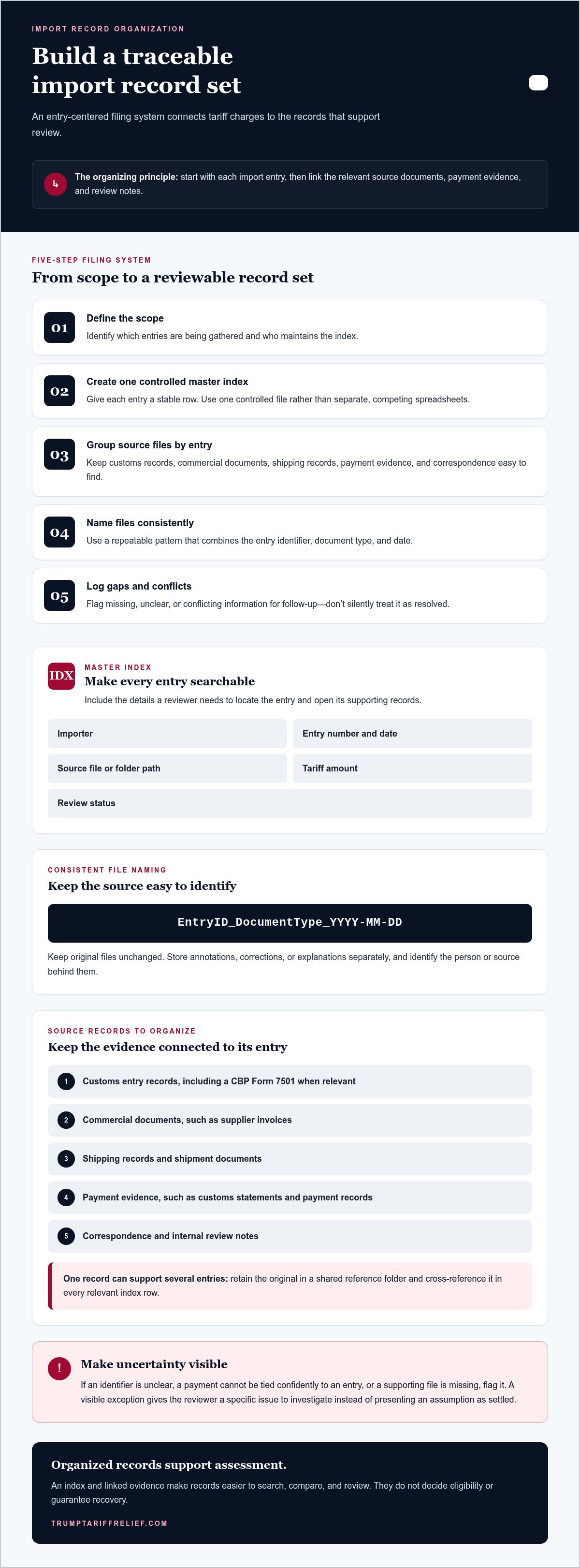
A reliable filing system starts with one question: which import entries are under review? Define that scope before collecting files, then give each entry a stable row in a controlled master index. That row becomes the reference point for documents held by different teams and in different systems. A consistent structure makes organizing import records for a refund claim manageable without assuming every entry has identical supporting records.
- Define the scope. Record which entries are being gathered and who maintains the index.
- Create the master index. Use one controlled file with a stable row for each entry, rather than separate competing spreadsheets.
- Group source files. Organize records by entry, with clear categories for customs entry records, commercial documents, shipping records, payment evidence, and correspondence.
- Name files consistently. Use a repeatable pattern that combines the entry identifier, document type, and date.
- Log gaps. Mark missing, unclear, or conflicting information for follow-up instead of silently treating it as resolved.
Create a searchable index and consistent file names
Include fields such as importer, entry number, entry date, source file, tariff amount, and review status. Add a folder path or file reference so a reviewer can open the supporting record directly. For example, a filename might follow the pattern EntryID_DocumentType_YYYY-MM-DD. Keep original files unchanged; store annotations, corrections, or explanations separately and identify the person or source behind them.
Recordkeeping rules can affect how import records are maintained and produced. Use the official import recordkeeping requirements as a reference, and check current requirements for your circumstances. For document categories to consider, use the required IEEPA refund documents checklist.
Group source records without losing context
Within each entry’s folder, separate customs records, invoices, shipping documents, payment evidence, and communications. A CBP Form 7501, the entry summary, may be a relevant record; verify its applicability to the entries and review at hand. If one invoice, payment record, or shipment document supports several entries, keep the original in a shared reference folder and add a cross-reference in every relevant index row. That preserves context without creating multiple untracked copies.
When records are spread across systems or need reconciliation, structured customs documentation management can support a focused review and recovery process.
Reconcile import records so every charge has a clear trail
An entry index shows where records are. Reconciliation tests whether the details in those records connect. Compare customs, finance, procurement, and logistics information, but don’t assume each system uses the same identifiers, dates, or descriptions. For each figure, record its source and whether the match is confirmed, unresolved, or needs additional context.
Match entry data to commercial and payment evidence
Start with the entry identifier and date, then compare them with available invoices, shipment records, customs documents, and internal payment references. Trace each tariff-related charge to the entry it appears to support. In the working table, preserve the value as shown in each source rather than replacing differences with a single assumed figure.
Field labels and system terminology can change. Before documenting CBP or ACE-specific steps, verify the current terminology and data fields against official materials. The aim here is a reliable evidence trail, not a particular software workflow.
A reconciliation table could include these columns:
| Entry identifier | Invoice reference | Assessed duties | Payment record | Review status and notes |
|---|---|---|---|---|
| Entry ID from source | Invoice number and date | Amount and document source | Payment reference and source | Confirmed, unresolved, or needs context |
Illustrative example only, not a client result: a customs record lists assessed duties of $1,200, while a finance record shows a payment of $1,150 tied to a broader reference. Don’t adjust either figure to make them match. Mark the difference unresolved, note the source of each amount, and identify what supporting detail is needed to explain the relationship.
Record discrepancies instead of hiding them
Use an exception log alongside the reconciliation table. Capture mismatched dates, duplicate files, unclear amounts, and missing references, then assign each issue an owner, source, status, and next action. This separates three useful outcomes:
- Confirmed match: the records align, and the sources are documented.
- Unresolved difference: sources conflict or don’t yet connect.
- Needs context: a record may be relevant, but its meaning or relationship isn’t clear.
This discipline is central to organizing import records for a refund claim: it preserves what the evidence actually shows and directs attention to the gaps that need review. Keep ruling analysis separate from record matching; consult the IEEPA ruling overview for background, while using the reconciliation record to document the source trail.
Quality-check, protect, and preserve the claim record set
Before a reviewer relies on the files, check both the evidence and the controls around it. A careful quality check helps expose gaps while there’s still time to locate source records, clarify conflicting details, or explain why a document is unavailable. It also keeps estimates and assumptions from being mistaken for verified facts.
Run a final completeness and consistency check
Review the master index entry by entry. Each entry should point to its supporting files or contain a clear note identifying what’s missing. Confirm that records are legible, identifiers and dates follow consistent formats, and duplicates are identified rather than mistaken for separate evidence. Check that every unresolved issue has an exception status and hasn’t disappeared during file cleanup.
- Completeness: Each indexed entry has linked records or a documented missing-record note.
- Legibility: Files open correctly, and important text and figures can be read.
- Duplicate detection: Repeated files are marked or consolidated without losing their source context.
- Consistency: Entry identifiers, dates, and amounts are recorded in a uniform format.
- Exception status: Open questions remain visible and distinguishable from resolved items.
- Evidence labels: Verified facts are clearly separated from estimates, assumptions, and unresolved questions.
Preserve originals as received. If a record needs a correction or annotation, retain the original and document the change separately. This protects the source trail and makes it easier to distinguish the underlying record from later review notes. These controls strengthen organizing import records for a refund claim by making the package more dependable and easier to inspect.
Control access and maintain a reliable audit trail
Limit access according to each person’s role, and share customs and financial records only through company-approved channels. Keep a change history that records who added, replaced, or annotated a file and when. Back up the index and supporting records using approved business procedures, and ensure the responsible team can retrieve the set if a primary storage location becomes unavailable.
Preserve records under applicable company retention policies and current legal requirements. Don’t assume one retention period applies to every document or situation. Confirm which requirements govern the records in scope, and keep the file set accessible for the required period.
Once the record set is checked and controlled, see how the recovery process works.
Turn organized import records into a review-ready refund claim
A well-organized record set is ready for review, not automatically ready for approval. It gives a qualified reviewer a clear way to assess the facts, trace entries to source evidence, and identify unanswered questions. Organizing import records for a refund claim supports that review, but it doesn’t establish eligibility or guarantee a refund.
Prepare a concise handoff for professional review
Package the records so a reviewer can understand the scope without reconstructing your filing system. Include the controlled master index, organized source files, exception log, and a short cover sheet. The cover sheet should identify the business, summarize the entries in scope, point to document locations, and call out unresolved exceptions. Keep assumptions concise and label them clearly, so they aren’t mistaken for verified facts.
Make the index the navigation point: each material field should lead to its supporting record or show that evidence is missing. If a payment reference covers multiple entries, or a source uses a different identifier, explain the connection in the notes rather than relying on the reviewer to infer it. For broader context on the recovery process, see the IEEPA refund claim process overview.
Know what happens after records are organized
Once the package is assembled, case-specific review determines which records matter, how the facts fit together, and whether additional evidence is needed. That assessment is separate from file organization. Clear records help the reviewer work from documented facts, while the review itself considers the circumstances of the claim.
Trump Tariff Relief manages eligibility assessment, customs documentation, and government filings for recovery clients. The team can work through the documentation and filing process without promising eligibility, a particular recovery, or an outcome. The firm’s contingency-fee model has no upfront costs; a fee applies only if a refund is successfully recovered.
If you’re ready to move from scattered records to a structured review, review how tariff refund recovery works.
Put Your Records to Work
A clear, entry-centered record set gives reviewers a practical trail from tariff charges to supporting documents and payment evidence. A consistent index, documented discrepancies, and a final quality check can make the file package easier to assess. That’s the value of organizing import records for a refund claim: better visibility into the evidence and gaps, without mistaking organization for proof of eligibility or a guaranteed refund.
If records are scattered across teams or don’t reconcile cleanly, professional support can help move the review forward. Trump Tariff Relief manages documentation and government filings as part of its recovery process. There are no upfront costs, and a fee applies only if a refund is successfully recovered.
Review your tariff refund claim options and take a clear next step toward assessing your records. A more organized file can put your business in a stronger position to understand what the evidence supports.
Frequently Asked Questions
What records should I organize for a tariff refund claim?
Gather records that connect each entry under review to its commercial documents, customs information, and payment evidence. Depending on the entry and review, useful sources may include entry records, supplier invoices, shipping documents, duty statements, payment confirmations, and relevant communications. Keep an index that identifies each file’s source and the entry it supports. If a record is missing or unclear, note the gap rather than treating an incomplete file set as complete.
How should I organize import records for a refund claim?
Organize records by entry and maintain one controlled master index with a stable row for each entry under review. Include identifiers, dates, source-file references, relevant amounts, and review status. Use consistent file names that combine the entry identifier, document type, and date. Keep original records intact, and store annotations or corrections separately. This structure makes organizing import records for a refund claim more traceable and helps reviewers locate supporting evidence efficiently.
Can I file a refund claim if some import records are missing?
Missing records don’t, by themselves, determine whether a claim can be filed or whether it qualifies. Record what’s absent, identify which entry it relates to, and note what has been done to locate or verify the information. Don’t fill gaps with estimates presented as facts. A case-specific review can assess the available evidence, identify what additional documentation may matter, and distinguish a documented gap from an unresolved discrepancy.
Do I need CBP Form 7501 for a tariff refund claim?
CBP Form 7501, the entry summary, may be relevant to reviewing an import entry, but don’t assume it is required or sufficient for every tariff refund claim. Applicability depends on the records and circumstances under review. If you have the form, link it to the corresponding entry in your index and preserve its source. Verify current CBP procedures and document requirements for the specific claim before relying on a particular form.
How do I reconcile customs records with accounting records?
Compare customs entry identifiers and dates with invoice references, shipment records, internal payment references, and the amounts shown in accounting records. Record where each figure came from, since systems may use different labels or group charges differently. Mark each comparison as confirmed, unresolved, or needing context. If amounts or dates conflict, preserve both source values and log the discrepancy with an owner and next action instead of forcing a match.
What should I do with duplicate or inconsistent import documents?
Don’t delete or overwrite a document simply because another copy appears to match. Identify duplicates in your index, preserve the source context, and note which copy is being used for review. For inconsistencies, retain the original records and log the conflicting fields, such as dates, entry references, or amounts. Separate verified corrections and explanations from the source files so reviewers can see what the documents originally showed and what remains unresolved.
Should I use a spreadsheet or document management system for claim records?
Either can work if the record set stays controlled, searchable, backed up, and linked to its source files. A spreadsheet may suit a smaller review when one designated owner can maintain the index and track exceptions. A document management system may be more practical when several teams need controlled access, version history, or shared file management. Choose a method your business can maintain consistently, and follow approved security and retention practices.
Ready to find out what your business may be owed?
Check My Eligibility