
The obvious choice isn’t always the safest one: filing a tariff refund claim in-house may preserve control, but it can also pull finance, trade, and legal teams away from core work. The right in-house vs outsourced tariff refund filing model depends on the claim’s complexity, your team’s capacity, and who will take clear responsibility for each step.
If you’re unsure what the claim requires or who should manage the records and filing, that uncertainty is understandable. Refund pathways and documentation requirements can vary, and an outside provider’s experience and fee structure deserve careful review before you delegate the work.
This article compares both approaches across control, workload, specialized knowledge, and fees. You’ll see what your team must handle in-house, what oversight outsourcing still requires, and what to verify before authorizing a provider, including the scope of support and when fees apply. The goal is a practical decision based on your business’s needs, not a one-size-fits-all answer.
Key Takeaways
- Use claim volume, record quality, staff capacity, and internal expertise to decide which filing model is practical for your business.
- Compare in-house vs outsourced tariff refund filing by defining who prepares, reviews, submits, and oversees the claim.
- Before delegating work, confirm the provider’s relevant experience, exact scope, data-handling practices, and communication process in writing.
- Review fees and responsibilities before sharing records or authorizing an engagement, including when a fee becomes payable.
- A tariff eligibility assessment can help clarify whether specialized support may suit your claim and internal resources.
In-House vs. Outsourced Tariff Refund Filing: What Is Actually Being Compared?
The choice isn’t simply between doing everything yourself and handing everything over. In-house filing means your company’s staff coordinate claim preparation, review, and submission. Outsourced filing means assigning specific, agreed tasks to a specialist provider. In either model, your business remains responsible for its records, decisions, and oversight of the engagement.
That distinction matters in in-house vs outsourced tariff refund filing. The comparison is about managing a tariff refund claim, not hiring a provider for routine customs brokerage or all legal work. The tasks assigned to an outside specialist can vary, so confirm the scope rather than assuming every provider handles the same work.
What work does a tariff refund filing involve?
At a high level, a claim may involve checking potential eligibility, locating relevant entry and payment records, preparing claim materials, submitting them through the applicable process, and following up as needed. The requirements and sequence depend on the claim type and current government procedures, which should be checked before filing.
For example, a business might have finance or trade staff assemble records while an internal reviewer or outside specialist helps assess them and coordinate preparation. The company still needs to know what has been submitted and retain access to the underlying documentation. For background on IEEPA-specific recovery, see this overview of how tariff refund recovery works.
Not every duty recovery route is the same. Duty drawback, for instance, concerns recovery of duties on imported goods that are later exported. It should not be treated as interchangeable with an IEEPA tariff refund claim. Confirm which process applies to the specific claim.
What does “outsourced” mean in this comparison?
Outsourcing means assigning defined work, not transferring ownership of the business’s claim or records. A provider might support eligibility assessment, documentation management, or filing tasks, but its role, authority, and decision rights depend on the written agreement. Your company should know who gathers records, who reviews the materials, who can authorize submission, and who handles follow-up.
Specialist support can complement internal oversight. Your team can stay involved without coordinating every technical task itself, provided responsibilities are clear and information remains accessible. Before authorizing work, confirm the provider’s relevant experience and the exact services included. A clear scope shows what your staff will retain, what the provider will handle, and where accountability remains.
In-House Tariff Refund Filing: Control, Capacity, and Workload
Keeping tariff refund filing in-house can give your company direct control over decisions and review. Staff who already manage import and payment records may understand how those documents connect to accounting systems, suppliers, and internal approvals. That familiarity can make it easier to spot gaps, coordinate across departments, and keep leadership informed.
But control only helps if someone has the capacity and expertise to do the work carefully. A claim can require staff to locate and reconcile entry and payment records, prepare materials for review, and track follow-up. Those tasks compete with routine finance and trade responsibilities. If records are spread across systems or teams, organizing them may take more effort than expected.
When does an in-house approach make sense?
Internal handling may be practical when trained staff have time alongside their regular duties, relevant records are accessible and traceable, and the company can assign clear review and approval responsibilities. These are operational considerations, not legal eligibility rules. A designated lead can maintain continuity, coordinate colleagues, and flag unresolved questions before they slow the process.
Set roles before work begins: assign an internal owner to coordinate the claim, a reviewer to check the supporting materials, and a decision-maker or specialist contact to handle escalations.
What can strain an internal team?
Fragmented records, a high volume of entries, unclear ownership, and competing deadlines can turn a manageable filing task into a sustained workload. Staff may need to reconcile information held by finance, trade, and other teams before a reviewer can assess whether the documentation is complete. A tariff refund recovery overview can help your team understand where eligibility assessment and documentation support fit into the process.
Separate administrative coordination from specialist judgment. Internal staff may be well placed to collect records and confirm business details, while questions about claim interpretation or filing strategy may call for specialized trade or legal review. Don’t assume that familiarity with import records alone covers every issue.
Before deciding, map the expected work against available staff time and identify where your team would need outside help. A tariff eligibility assessment may help clarify whether specialized support fits your claim and internal capacity. That distinction is central to in-house vs outsourced tariff refund filing: the choice isn’t only who prepares documents, but whether your business can sustain the coordination, review, and escalation the claim requires.
Outsourced Tariff Refund Filing: Expertise, Scope, and Oversight
Outsourcing can shift defined claim tasks to a specialist, giving your team support with complex records or filing work while preserving internal oversight. The value depends on the provider’s actual experience and agreed responsibilities, not simply the label “specialist.” No outside engagement guarantees acceptance or recovery. Your business still needs to review the arrangement, provide accurate information, and make decisions reserved to it.
Which tasks might a specialist manage?
Depending on the engagement, support may include assessing potential eligibility, managing customs documentation, and assisting with government filings. Ask precisely who will gather and organize records, prepare and check claim materials, submit them, and monitor follow-up. Confirm which tasks remain with your staff and how the provider will raise missing information or questions that require your decision.
For a clearer picture of the stages involved, review this tariff refund process overview. Compare that outline with the provider’s written scope. Capabilities and qualifications vary, so confirm relevant IEEPA refund experience and the work included before authorizing access to records.
How should a business assess control and fees?
Delegating work doesn’t mean giving up every control. Before signing, determine what the provider is authorized to do, which records it can access, how often it will report progress, and which decisions require your approval. Establish a clear contact for questions and an escalation path if the claim’s status or supporting documentation needs attention.
Fee structures also differ. Trump Tariff Relief states that it works on a contingency-fee basis, with no upfront costs and payment only if a refund is successfully recovered. That describes the company’s stated model, not a promise that a claim will qualify or produce a refund. For any provider, get the terms in writing and check:
- How the success fee is calculated and what amount it applies to.
- What event triggers payment and whether any exclusions apply.
- Who pays any costs outside the stated fee, if applicable.
- How either party can end the engagement and what happens to records or work already completed.
A clear agreement makes in-house vs outsourced tariff refund filing easier to assess: you can weigh the workload transferred against the oversight retained and the terms accepted. If you’re considering outside help for an IEEPA claim, review the provider’s IEEPA refund recovery process and confirm its current scope and fee terms directly.
How to Choose: Match the Filing Model to Your Business
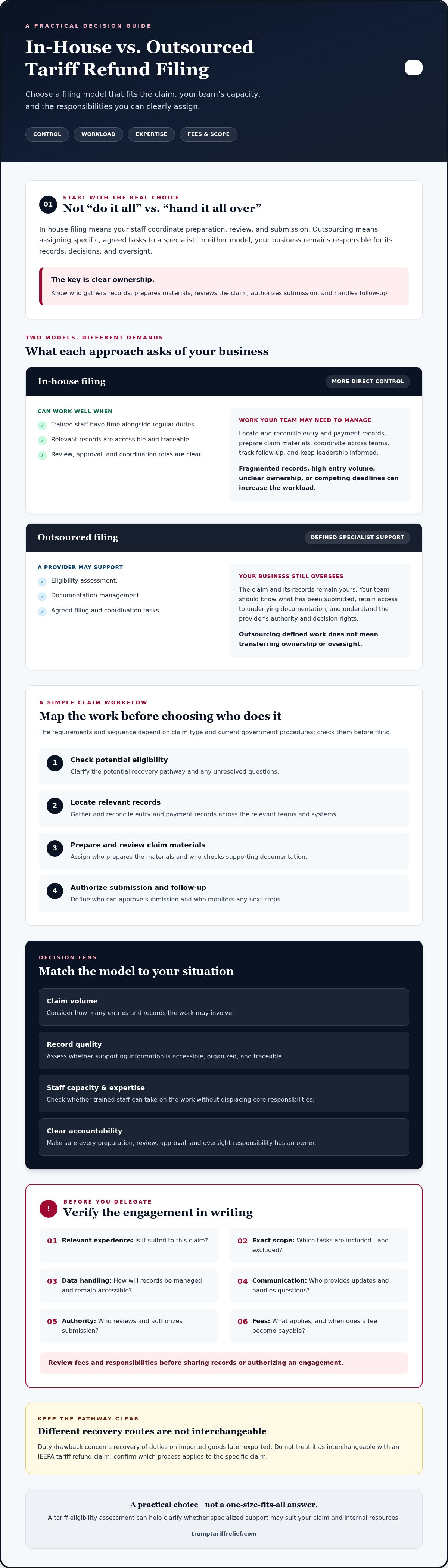
Choose a filing model by testing the claim against your actual resources, rather than assuming one approach is always more efficient. Start with claim volume and record condition. Then assess internal expertise, available staff time, and the level of review required. If records are organized and qualified staff can manage the work without disrupting core responsibilities, internal handling may be workable. If specialized questions or workload exceed that capacity, evaluate outside support.
Use a readiness test before deciding
Can one accountable owner coordinate records, reviews, communications, and follow-up? Can staff validate entry information and resolve documentation gaps without pulling them away from essential finance or trade work? If the answer to either question is unclear, don’t treat the claim as ready for fully internal handling. Refer uncertain procedures or eligibility questions for qualified, claim-specific review.
Internal filing is most practical when your business can demonstrate four things: sufficient capacity, relevant competence, accessible documentation, and clear accountability. A team that can gather records but has no reviewer or escalation path may still need specialist support.
When is a hybrid approach worth considering?
A hybrid workflow can keep business knowledge and approval inside the company while assigning defined tasks to an outside specialist. For example, your staff could supply source records and confirm business details, while a provider supports assessment, documentation management, or filing. The precise division depends on the engagement, so put responsibilities in writing before work begins.
Use a simple decision sequence:
- High volume or scattered records: Check whether your team can reconcile the material and maintain a reliable review process.
- Limited internal time or specialized expertise: Evaluate outside support and confirm the provider’s claim-specific experience and scope.
- Strong internal records, but a need for targeted help: Consider a hybrid arrangement with internal approval and clearly delegated tasks.
Written role assignments help prevent duplicated record requests, overlooked follow-up, and submissions made without the right internal review. Specify who supplies documents, who prepares and checks materials, who communicates with the provider, and who approves decisions. For more context on IEEPA claim handling, consult this IEEPA refund recovery overview.
The practical test in in-house vs outsourced tariff refund filing is whether your chosen model can sustain the work and preserve accountability. A tariff eligibility assessment can help you consider whether specialized support fits your claim and internal capacity.
Before You Outsource a Tariff Refund Claim: Questions and Next Steps
Before you hand over records or authorize filing work, establish what the provider will do, how your business retains control, and what the engagement will cost if a refund is recovered. Reviewing these details first can prevent gaps in scope, unclear authority, and surprises about responsibilities later.
Questions to ask a tariff recovery provider
Ask for specific answers, preferably in writing. Providers differ in the claim categories they handle, their qualifications, and the services included in an engagement. Use these questions to assess whether the proposed support fits your claim:
- Experience and scope: Which tariff refund claim categories does the provider handle? What work is included, and what falls outside the engagement?
- Roles and authority: Who reviews the claim, who prepares and submits materials, and which actions require your approval?
- Communication: Who is your main contact, how will you receive progress updates, and how will questions or missing information be escalated?
- Data handling: How will sensitive customs and financial records be accessed, stored, and shared? Who will be able to view them?
- Fees and responsibilities: How is any success fee calculated, what triggers payment, what exclusions or additional costs apply, and how can either party end the engagement?
Don’t rely on a general description of “refund support.” Confirm the work, access permissions, decision rights, fee terms, and record-handling responsibilities before signing or transmitting sensitive documents.
Prepare for an initial assessment
Gather the information your business already has, such as entry and duty-payment records and supporting import documentation. Document needs can vary, so confirm the current requirements for your claim before treating any checklist as complete. Also prepare a brief summary of import activity, internal contacts, prior filing actions, and unresolved questions. This gives the assessment a clear starting point without assuming every claim follows the same process.
Trump Tariff Relief specializes in IEEPA tariff refund recovery, including eligibility assessment, customs documentation management, and filing support. Its stated fee model is contingency-based, with no upfront costs and payment only if a refund is successfully recovered. Confirm the current service scope and fee terms directly. This model does not guarantee eligibility or recovery. For additional process questions, review the tariff refund frequently asked questions.
Use the same diligence in in-house vs outsourced tariff refund filing that you would apply to any consequential financial engagement: define the work, protect your records, and preserve clear accountability. Learn more about IEEPA refund assessment.
Choose a Filing Path Your Team Can Sustain
The right choice in in-house vs outsourced tariff refund filing comes down to the claim’s demands and your ability to manage them. Internal filing can work when staff have the time, expertise, organized records, and clear accountability. If specialized questions or workload stretch those resources, outside support may help. A hybrid model can keep key decisions and approvals with your business.
Before delegating, confirm the provider’s claim experience, scope, data practices, authority, communication, and fee terms in writing. Trump Tariff Relief specializes in IEEPA tariff refund recovery, including eligibility assessment, documentation management, and filing support. Its stated contingency-fee model has no upfront costs, with payment only if a refund is successfully recovered, subject to current engagement terms. Recovery is not guaranteed.
Get a clearer view of your claim and the support it may require. Request an IEEPA refund assessment to explore whether specialized support may fit your claim.
Frequently Asked Questions
Is it better to file a tariff refund claim in-house or outsource it?
Neither approach is automatically better. Choose the one your business can manage accurately and consistently. In-house filing may suit a team with organized records, relevant expertise, and enough time for preparation and review. Outsourcing may fit when claim work or specialist questions exceed internal capacity. A hybrid approach is also possible: staff provide records and retain approval, while a provider handles agreed tasks. Compare scope, accountability, and fee terms before deciding.
Can a business manage a tariff refund claim internally?
Yes, a business can manage a claim internally if it has capable staff, accessible records, and a clear review and escalation process. Assign an accountable owner to coordinate documentation, communications, and follow-up, and identify who reviews materials and approves decisions. Consider whether the work can be handled without disrupting core finance or trade responsibilities. If eligibility or procedure questions exceed the team’s expertise, seek qualified, claim-specific review.
What does an outsourced tariff refund filing service do?
An outsourced provider may support eligibility assessment, customs documentation management, preparation, government filing, or follow-up, depending on its capabilities and written engagement scope. Don’t assume every provider performs all these tasks. Ask who gathers and reviews records, who submits materials, what authority the provider receives, and what your staff must still do. The business remains responsible for its records and should retain clear oversight of decisions and progress.
How much does outsourced tariff refund filing cost?
Costs depend on the provider’s fee structure and the services included, so review the terms rather than assuming all engagements are priced alike. Trump Tariff Relief states that it uses a contingency model: no upfront costs, with a fee based on a percentage of the refund successfully recovered. Confirm the current calculation, payment trigger, exclusions, and termination terms directly before signing. A contingency arrangement doesn’t guarantee eligibility or recovery.
What records should a business have before choosing a filing approach?
Start by locating available customs entry and duty-payment records, along with supporting import documentation relevant to the claim. Also note where records are stored, which teams control them, and whether the information can be traced to specific entries and payments. Requirements depend on the claim and current procedures, so confirm which documents are needed before filing. A clear record inventory helps reveal whether internal staff can manage the workload or need support.
Does hiring a tariff refund specialist guarantee a refund?
No. A specialist can help assess potential eligibility, organize documentation, and support filing, but hiring a provider doesn’t guarantee that a claim qualifies, is accepted, or results in a refund. Ask the provider to explain the work it will perform, the basis for its assessment, and any limits on its role. Be cautious of promises about outcomes, amounts, or timing, and verify current procedures and claim requirements.
Can our internal team work with an outside tariff recovery provider?
Yes. A hybrid workflow can keep your employees involved while assigning specific claim tasks to a provider. For example, internal staff may supply source records and verify business details, while the provider supports eligibility assessment, documentation management, or filing. Put roles in writing: name who prepares, reviews, submits, approves, and receives updates. Clear assignments help prevent duplicated requests, missed reviews, and uncertainty about who is responsible for each step.
Ready to find out what your business may be owed?
Check My Eligibility