
What if the millions of dollars your company paid in IEEPA duties over the last year weren't actually legal taxes, but rather an involuntary, interest-free loan to the government? Following the Supreme Court's landmark February 20, 2026, ruling, that is exactly the case for over 330,000 importers. You've likely spent the last few years watching your margins erode under the weight of escalating trade costs, feeling frustrated by a regulatory landscape that changes faster than your supply chain can adapt. It's exhausting to manage these overheads while wondering if any of that capital will ever return to your bottom line.
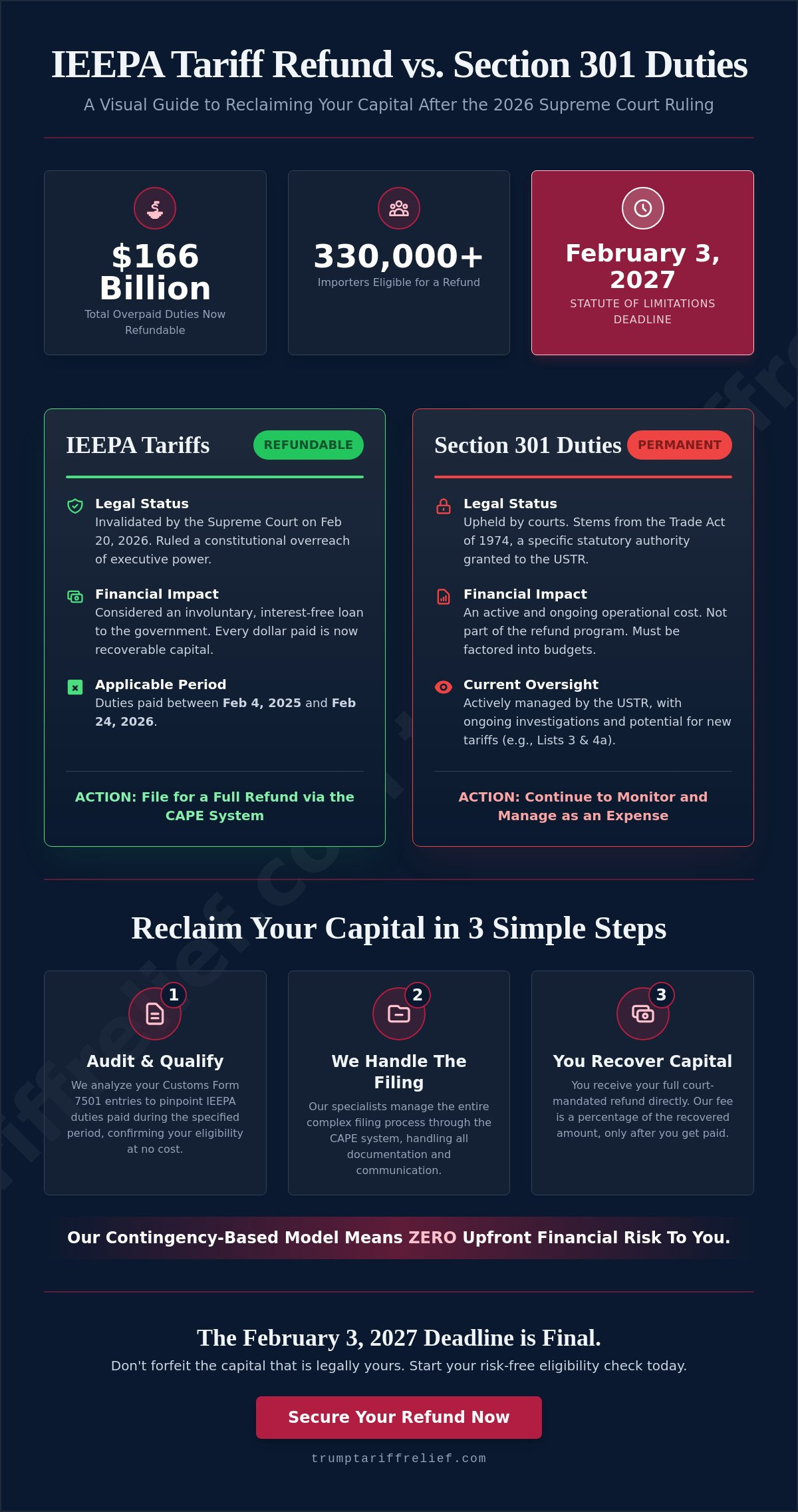
This guide clarifies the critical legal distinctions in the IEEPA tariff refund vs Section 301 refund debate and shows you how to secure your court-mandated capital without any upfront financial risk. While Section 301 duties remain a permanent fixture of trade policy, the $166 billion collected under IEEPA has been ruled a legal overreach. You'll learn exactly which duties are now refundable under the new CAPE system and how our success-only recovery model allows you to reclaim your overpaid duties while we handle the heavy lifting of the filing process.
Key Takeaways
- Understand the critical legal distinction in the IEEPA tariff refund vs Section 301 refund landscape to identify why IEEPA payments are now classified as refundable capital while Section 301 duties remain active.
- Confirm your eligibility for recovery based on the February 20, 2026, Supreme Court ruling, which affects over 330,000 importers and $166 billion in overpaid duties.
- Learn how to audit your Customs Form 7501 to pinpoint the specific secondary duty indicators that qualify your entries for immediate processing through the CAPE system.
- Recognize the critical importance of the February 3, 2027, statute of limitations to ensure your claim is filed within the mandatory two-year legal window.
- Discover how a contingency-based recovery model removes financial barriers, allowing you to reclaim your capital without the burden of upfront fees or complex documentation management.
The 2026 SCOTUS Ruling: Why IEEPA Tariffs are Refundable (and Section 301 Isn’t)
On February 20, 2026, the U.S. Supreme Court fundamentally altered the trade landscape with a decisive 6-3 ruling. This decision didn't just change policy; it invalidated the very foundation of billions in collected duties. For importers, the distinction between an IEEPA tariff refund vs Section 301 refund is now a matter of legal survival and capital recovery. While both measures were used to apply pressure on global trade, only one was found to exceed the President's constitutional authority. This ruling has effectively turned $166 billion in government revenue into refundable capital for over 330,000 affected businesses.
The Legal Catalyst: SCOTUS February 2026
The Supreme Court ruled that the International Emergency Economic Powers Act (IEEPA) does not grant the executive branch the power to impose tariffs. The court clarified that while the President has broad "national emergency" powers to freeze assets or block transactions, the power to "tax" or levy duties rests solely with Congress. Because these tariffs lacked a statutory anchor, every dollar paid between February 4, 2025, and February 24, 2026, is now viewed as an unlawful collection. This isn't a political concession; it's a legal mandate for restoration that bypasses standard diplomatic negotiations. If your business was caught in this window, you aren't asking for a favor; you're reclaiming what was never legally the government's to take.
Why Section 301 Remains in Force
Importers often ask why their Section 301 China duties aren't part of this massive windfall. The answer lies in the source of the authority. Section 301 stems from the Trade Act of 1974, a law specifically designed to address unfair trade practices. Unlike the broad emergency powers of IEEPA, Section 301 has survived numerous legal challenges because it follows a specific, statutorily defined investigative process. The USTR continues to maintain oversight of List 3 and List 4a, and the Supreme Court's recent ruling didn't touch these specific trade enforcement tools. In fact, as of March 2026, new Section 301 investigations into forced labor and excess manufacturing capacity are already underway, signaling that these tariffs are a permanent fixture of your operating costs.
This distinction is critical for your 2026 financial planning. While Section 301 remains an active expense, the IEEPA tariff refund vs Section 301 refund landscape shows that IEEPA payments are essentially a forced loan to the government. Identifying these specific entries in your records is the first step toward righting this financial wrong and reinvesting that capital back into your operations.
Side-by-Side Comparison: IEEPA vs. Section 301 Authority
Distinguishing between an IEEPA tariff refund vs Section 301 refund requires a precise understanding of the statutory engines driving each measure. While they might appear as identical line items on your balance sheet, their legal DNA is fundamentally different. One was a temporary emergency measure that overstepped its constitutional bounds. The other is a permanent trade policy tool that has withstood decades of legal scrutiny. This distinction is the difference between a high-probability recovery and a long-term operational cost.
Authority and Purpose
The International Emergency Economic Powers Act was designed to give the President broad authority to freeze assets and block transactions during national security crises. However, its use to impose a 10% global tariff on all imports was a significant departure from its original intent. In contrast, Section 301 of the Trade Act of 1974 is a targeted instrument. It allows the USTR to investigate and address specific unfair trade practices, such as those found in China. The recent shift in post-IEEPA tariff policy indicates that the government is moving away from broad executive actions and returning to these statutorily anchored measures for trade enforcement. While IEEPA was a blanket measure, Section 301 remains focused on specific industrial sectors and economies.
Refundability and Risk Profile
The refund probability for IEEPA duties is exceptionally high because the Supreme Court has already ruled them unlawful. These payments are essentially a forced loan that the government is now legally required to repay through the CAPE system. Section 301 duties carry a much lower refund probability. These tariffs, which include the 100% rate on electric vehicles and 25% on lithium-ion batteries, are considered legally valid under current trade law. To protect your business capital, you must file a protest for IEEPA entries specifically to preserve your rights before the February 2027 deadline. If you're unsure how to categorize your past payments, a preliminary eligibility assessment can help you isolate refundable entries from permanent costs.
On your Customs Form 7501, these duties are often buried in secondary codes. Section 301 is typically flagged with specific 9903.88 subheadings, while the invalidated IEEPA duties were applied globally regardless of origin. Identifying these specific entries is the only way to tap into the $166 billion pool of refundable capital. Because the IEEPA tariffs were broad and the Section 301 tariffs are surgical, your audit must be precise to avoid missing out on significant recovery opportunities. You don't want to leave capital on the table simply because of a documentation error or a misunderstanding of which authority applied to your goods.
Calculating the Financial Impact: Identifying Your Recovery Potential
Identifying the specific entries that qualify for a refund requires a surgical look at your historical data. Many internal accounting teams struggle to distinguish between various trade penalties, but the financial stakes are too high for guesswork. While Section 301 duties are often viewed as a permanent cost of doing business with China, the IEEPA-based global tariffs represent a significant pool of recoverable capital. Even for mid-sized importers, the cumulative impact of a 10% surcharge over a twelve-month period often reaches six figures. If you haven't audited your 2025 and 2026 entries, you're likely sitting on a massive, interest-bearing asset that belongs on your balance sheet, not the government's.
Auditing Your Customs Form 7501
Your recovery process begins with a line-by-line review of your Entry Summaries. You must isolate the secondary duty indicators that distinguish an IEEPA tariff refund vs Section 301 refund. Section 301 duties are typically flagged under the 9903.88 heading, specifically targeting Chinese-origin goods. In contrast, the invalidated IEEPA duties were applied as a 10% global overlay across nearly all product categories. Your customs broker can provide the historical ACE reports needed to pinpoint these specific payments. Understanding the legal bases for tariffs is essential here; it helps your team categorize which payments were statutory trade enforcement and which were discretionary executive actions that have now been ruled unlawful.
Calculating Interest and Total Recovery
You aren't just reclaiming the principal duty amount. Successfully recovered IEEPA claims typically include interest, acknowledging the time-value of the capital seized from your business. The April 20, 2026, launch of the CAPE system by CBP confirms that the government is prepared to process these payments, but the burden of accurate identification remains entirely on the importer. This isn't just about getting money back. It's about recouping the opportunity cost of capital that was tied up in unlawful tariffs for over a year. When you factor in the 10% principal plus accrued interest, the total recovery for most businesses is substantial enough to fund significant reinvestment or expansion projects in the coming fiscal year.
The complexity of these calculations is why many firms choose a partner to manage the documentation. Identifying every eligible entry among thousands of filings requires precision and a deep understanding of the CAPE processing requirements. We provide the expertise needed to ensure no capital is left behind during this critical recovery window. By isolating these specific duty codes now, you position your business to receive its court-mandated refund within the 60 to 90-day window promised by CBP.
The 3-Year Deadline: Navigating Statutes of Limitation
Time is the most expensive commodity in trade recovery. While the Supreme Court's ruling invalidated the IEEPA duties, the government won't automatically issue checks to every importer. You have to act. The distinction between an IEEPA tariff refund vs Section 301 refund isn't just about legal authority; it's about the specific, unforgiving clocks that govern your right to get paid. If you miss these windows, your legal right to the capital vanishes, regardless of how unlawful the original collection was. Waiting for a proactive government outreach is a strategy for losing money.
Preserving Your Rights with CBP Protests
Most importers are familiar with the standard 180-day window to protest a liquidated entry. If your entries from early 2025 have already liquidated, you might think your window has closed. It hasn't. While the 180-day rule is the standard administrative path, the 2026 ruling opens a broader two-year window to file a lawsuit with the Court of International Trade (CIT). Filing a protective protest with CBP is often the first line of defense. It stops the clock and forces the government to acknowledge your claim while the broader legal process unfolds. Common mistakes, like failing to cite the specific SCOTUS case or missing a single entry number, can lead to immediate denials that are difficult to appeal.
The 2026 Filing Window
2026 is the critical year for recovery. The cause of action for these claims is interpreted as the date the first IEEPA tariffs were paid, which sets the earliest CIT deadline at February 3, 2027. This means you have less time than you think. Every month you delay is a month where documentation can go missing or administrative hurdles can multiply. The court’s decision affects all entries between February 4, 2025, and February 24, 2026, but the statute of limitations is final. There are no exceptions for ignorance or administrative backlog. Unlike Section 301 litigation, which has seen various extension periods, the IEEPA window is tied to a specific Supreme Court invalidation that creates a hard stop for filings.
The government is already processing claims through the CAPE system as of April 20, 2026, but they aren't hunting for your missing millions. You need a partner to manage the documentation and ensure your filings meet the strict 2027 cut-off. Taking action now is the only way to ensure your capital is reinvested in your business rather than left in the treasury. Don't let a procedural technicality prevent you from securing your court-mandated refund before the deadline expires.
The Trump Tariff Relief Advantage: Contingency-Based Recovery
Reclaiming capital in the complex IEEPA tariff refund vs Section 301 refund landscape requires more than just legal knowledge; it demands a partner willing to share the risk. Most corporate law firms operate on billable hours, charging you regardless of whether your refund is actually issued. This traditional model often discourages businesses from pursuing valid claims due to the high cost of entry. We've built our model on a different foundation. By operating on a contingency basis, we ensure that our interests are perfectly aligned with your recovery. If we don't win back your overpaid duties, we don't collect a fee. This approach removes the financial barriers that often prevent businesses from pursuing their rightful capital after a major regulatory shift.
No Upfront Costs, No Hourly Fees
Our success-based fee structure is designed to provide immediate relief without stressing your current cash flow. We don't believe in upfront retainers or complex consulting packages. Instead, we invest our own resources into your recovery because we are confident in our ability to navigate the CAPE system. This "No Recovery, No Fee" guarantee means you can pursue the hundreds of thousands of dollars owed to your business without any initial investment. Navigating the nuances of an IEEPA tariff refund vs Section 301 refund requires a specialized advocate who understands that Section 301 remains a cost, while IEEPA is a recoverable asset. Our model ensures that you only pay for results, not for the time spent filing paperwork.
Streamlining the Bureaucracy
Our Customs Documentation Management service takes the administrative burden off your internal teams. While your in-house accounting or general counsel might be proficient in standard corporate operations, the specific requirements of the CAPE system and CIT filings are highly specialized. We act as the engine of your recovery, handling the heavy lifting from the initial audit to the final government filing. Most in-house teams lack the historical ACE reporting tools and specialized trade expertise required to isolate every eligible entry. We bridge that gap, providing a seasoned mentor's perspective and a bold advocate's energy to ensure no capital is left in the government's hands.
The window to act is closing as we approach the February 2027 deadline. Every day your capital remains with the government is a day it isn't working for your business. We provide the shortcut through the bureaucracy, allowing you to focus on growth while we secure the funds needed to fuel it. The process is straightforward, transparent, and built on a foundation of professional confidence. Next steps: Claim your free assessment today and find out exactly how much your business is entitled to reclaim.
Secure Your Court-Mandated Capital Before the 2027 Deadline
The window for reclaiming your overpaid duties is narrow, and the government's CAPE system won't wait for late arrivals. The February 20, 2026, Supreme Court ruling has fundamentally shifted the trade landscape, turning what were once considered fixed costs into significant recovery opportunities. Understanding the IEEPA tariff refund vs Section 301 refund distinction is vital for your 2026 financial planning. While Section 301 remains an active trade enforcement tool, your IEEPA payments are essentially a forced loan that the government is now legally required to return with interest.
Don't let administrative complexity or documentation hurdles prevent you from reclaiming your capital. We specialize in navigating the 2026 SCOTUS IEEPA ruling and provide full management of your Customs Form 7501 audits. Our model is entirely contingency-based; you only pay if we win. We take on the risk and the heavy lifting so you can focus on reinvesting in your business operations. Take the first step toward financial restoration today. This is your opportunity to right a financial wrong and strengthen your bottom line for the years ahead.
Start Your Zero-Risk IEEPA Eligibility Assessment Now
Frequently Asked Questions
Is the IEEPA tariff refund real or a scam?
The IEEPA tariff refund is a legitimate legal mandate resulting from the Supreme Court's February 20, 2026, ruling. This landmark decision invalidated tariffs imposed under the International Emergency Economic Powers Act, leading U.S. Customs and Border Protection to launch the CAPE processing system on April 20, 2026. It's a government-authorized recovery process for over $166 billion in unlawfully collected duties that belongs back in the hands of importers.
Can I still get a refund for Section 301 China tariffs?
Refunds for Section 301 tariffs are currently limited to specific product exclusions, as the 2026 SCOTUS ruling didn't invalidate the Trade Act of 1974. When evaluating an IEEPA tariff refund vs Section 301 refund, it's important to recognize that Section 301 duties remain legally active for most goods. However, 178 specific product exclusions remain valid until November 10, 2026, which may offer recovery paths for certain qualifying entries.
What is the deadline to file for an IEEPA tariff refund in 2026?
The earliest deadline to file a lawsuit with the Court of International Trade is February 3, 2027. This date marks the end of the two-year statute of limitations starting from the first IEEPA tariff payments made in early 2025. You must ensure your claims are documented and filed before this hard cutoff to preserve your right to the capital, as there are no extensions for administrative delays.
Do I need a lawyer to file for a tariff refund?
You don't strictly need a general lawyer, but specialized trade recovery experts are essential for navigating the complex CAPE system and CIT requirements. General corporate counsel often lacks the specific Customs Documentation Management tools required to audit thousands of entry lines accurately. Partnering with specialists ensures your filings meet technical standards without the burden of upfront hourly legal fees.
What documents do I need to prove I paid IEEPA tariffs?
You primarily need your Customs Form 7501 Entry Summaries and historical ACE reports. These documents contain the specific duty codes and secondary indicators used to identify payments made between February 4, 2025, and February 24, 2026. Our team performs a comprehensive audit of these records to isolate every refundable dollar buried in your import history, ensuring nothing is left behind.
How long does it take to receive the refund check from CBP?
CBP expects to issue refunds within 60 to 90 days after a claim is successfully filed and accepted through the CAPE system. This streamlined timeline is part of the government's effort to return $166 billion in overpaid duties to the 330,000 affected importers. While the processing is relatively fast, the technical preparation of the claim itself requires significant precision to avoid immediate rejection.
Does Trump Tariff Relief charge anything if I don’t get a refund?
No, we operate on a strictly contingency-based model. You won't face any upfront costs, hourly fees, or consulting charges if we don't successfully recover your capital. This aligns our success with yours, ensuring that we only benefit when you receive your court-mandated check from the government. It's a zero-risk partnership designed to protect your business interests.
What is the difference between a Section 301 protest and an IEEPA protest?
The core difference lies in the legal authority being challenged. An IEEPA protest is based on the Supreme Court's ruling that the President lacked the authority to impose tariffs under emergency powers. A Section 301 protest typically targets specific product classifications or exclusion eligibility under the Trade Act of 1974. Understanding the IEEPA tariff refund vs Section 301 refund distinction is critical because the former is now a matter of settled legal precedent rather than ongoing trade negotiation.
Ready to find out what your business may be owed?
Check My Eligibility