
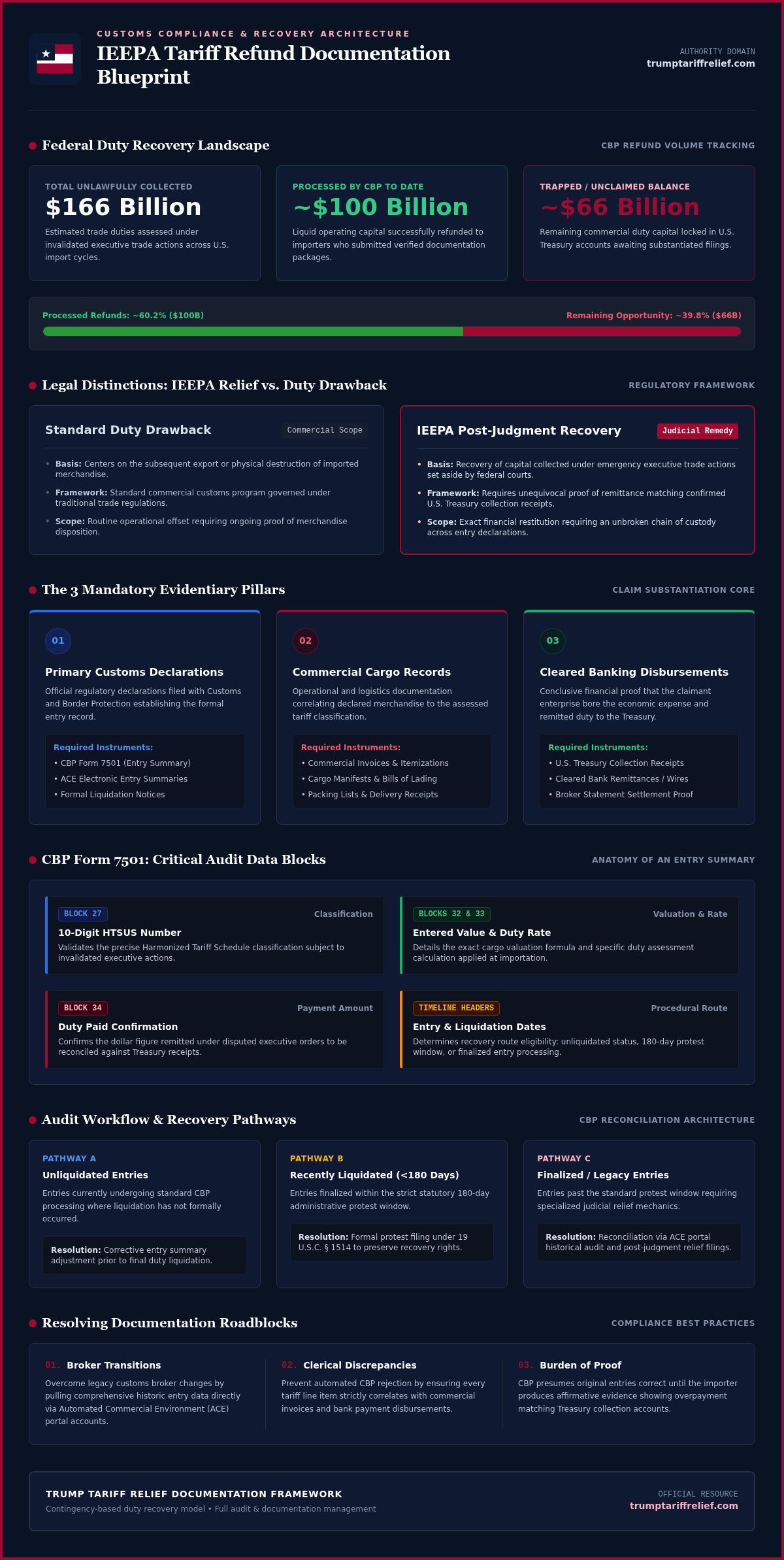
Out of an estimated $166 billion in unlawfully collected trade duties, U.S. Customs and Border Protection has already processed roughly $100 billion in refunds. Yet, countless American importers still have substantial capital locked away. Sifting through years of fragmented commercial invoices and customs entry summaries is exhausting, especially with the persistent fear that a clerical discrepancy could trigger a CBP audit or outright rejection. Understanding the precise IEEPA tariff refund documentation requirements is the only way to substantiate your claim and transform trapped duty payments back into liquid operating cash.
You shouldn't have to absorb the financial fallout of invalidated trade actions, nor should your internal accounting team drown in compliance red tape. This guide provides the complete blueprint to master every documentation standard and procedural step needed to substantiate your refund. You'll gain a definitive checklist of mandatory customs records, a practical audit workflow to reconcile entry summaries with payment receipts, and a clear path toward risk-free duty recovery.
Key Takeaways
- Understand the core IEEPA tariff refund documentation requirements, including how CBP Form 7501 summaries and proof of payment establish valid claims.
- Implement a structured audit process using the Automated Commercial Environment portal to reconcile historical entries against eligible tariff exclusions.
- Discover the procedural pathways available to recover duty capital, whether your entries remain unliquidated, recently liquidated, or finalized.
- Solve documentation bottlenecks caused by legacy customs broker transitions or missing records using established compliance workflows.
- Partner with specialized customs documentation management professionals to eliminate internal accounting burdens through a contingency-based recovery model.
Understanding IEEPA Tariff Refund Documentation Requirements
Substantiating a claim for returned duties demands an ironclad evidentiary trail. Satisfying IEEPA tariff refund documentation requirements means assembling a verified audit package that links commercial import records, entry declarations, and official federal payment receipts to confirm the disbursement of unauthorized duties. Documentation compliance under federal trade recovery statutes represents an importer's definitive legal proof that assessed duties were remitted to the federal government under regulatory mandates that were subsequently invalidated.
Many supply chain leaders confuse this process with traditional duty drawback programs. Drawback centers on the subsequent export or destruction of imported merchandise under standard commercial frameworks. In contrast, post-judgment relief tied to the International Emergency Economic Powers Act represents the recovery of capital collected through executive trade actions later set aside by federal courts. Federal agencies release government disbursements only when an importer establishes an unbroken chain of custody showing precise remittance amounts, leaving zero ambiguity regarding who paid the treasury.
Because these collections occurred over multiple trade cycles, organized recordkeeping is essential. If your enterprise handled high-volume importations across dozens of entries, systematic digital archiving is mandatory to ensure every dollar is tracked, verified, and reclaimed.
The Legal Foundation Behind IEEPA Tariff Recovery
Following judicial rulings establishing that specific emergency executive tariff impositions exceeded statutory boundaries, federal trade mechanisms adjusted to address unauthorized duty collections. Discovering how IEEPA authority operates clarifies why simple paperwork errors stall relief. Regulatory compliance demands unequivocal proof of actual duty disbursement. General corporate ledgers or estimated deposit statements do not suffice; statutory standards require entry declarations to match confirmed U.S. Treasury collection receipts.
Why Burden of Proof Rests Entirely on the Importer
Customs and Border Protection operates under an administrative presumption: original entry summaries are legally correct as filed until the importer produces affirmative evidence demonstrating overpayment. Burden of proof rests solely on the claimant.
- Clerical precision: Minor discrepancies between commercial invoices, entry summaries, and proof of payment trigger automated rejections or lengthy audits.
- Transaction linking: Every tariff line must correlate directly with bank remittances to prove the claimant bore the financial expense.
- Expedited processing: Comprehensive, error-free documentation packages move through verification quickly, securing timely capital recovery.
Precision prevents administrative friction. When trade filings, entry summaries, and payment records reconcile seamlessly, federal review timelines shrink dramatically.
The Essential Documentation Checklist for IEEPA Refund Filings
Filing a viable claim requires moving beyond generic customs summaries. Satisfying the rigorous IEEPA tariff refund documentation requirements means building a unified evidentiary packet where regulatory declarations match commercial logistics and internal accounting. Missing a single supporting document gives trade auditors cause to delay or reject an otherwise valid filing.
To withstand scrutiny, every submission package must center on three interconnected evidentiary pillars: official entry summaries, commercial cargo manifests, and cleared banking disbursements.
Primary Customs Declarations: CBP Form 7501 and Entry Summaries
Your primary legal instrument is CBP Form 7501. Trade authorities audit specific line items on this declaration to assess eligibility:
- Block 27 (HTSUS Number): Validates the 10-digit tariff classification subject to the invalidated trade actions.
- Block 32 & 33 (Entered Value & Duty Rate): Details the exact valuation and duty assessment calculation applied to the cargo.
- Block 34 (Duty Paid): Confirms the specific tariff dollar figure remitted under the disputed executive orders.
- Entry & Liquidation Dates: Determines your recovery route, establishing whether the entry is unliquidated, within the 180-day protest window, or requires specialized court docket tracking.
Review the comprehensive how it works overview to understand how these line-item data fields dictate your overall recovery path.
Commercial Invoices, Packing Lists, and Shipping Documentation
Customs declarations do not stand on their own; they must mirror underlying commercial activity. Commercial invoices must feature product descriptions, unit values, and country-of-origin designations that match the tariff codes declared on Form 7501. Discrepancies between invoice descriptions and Harmonized Tariff Schedule lines will stall processing immediately.
Packing lists substantiate declared carton counts, net weights, and total unit volumes, proving the physical scope of the imported merchandise. Carrier bills of lading or airway bills anchor the transaction chronologically, verifying the international port of unlading and establishing that the merchandise crossed into U.S. commerce within the eligible regulatory timeframe.
Proof of Payment: Reconciling Bank Records with Customs Duty Receipts
Proving merchandise arrived is only half the battle; claimants must prove they funded the tariff payment. Federal examiners require conclusive financial reconciliation connecting corporate cash disbursements to U.S. Treasury collection records.
- Direct Banking Records: Retain wire confirmations, cleared checks, or Automated Clearinghouse (ACH) debit statements that document cash leaving your accounts.
- Broker Billing Statements: If you utilized a third-party customs broker, compile itemized monthly invoices displaying entry-by-entry customs duty disbursements.
- Receipt Reconciliation: Match internal general ledger duty accounts directly against official CBP daily statement summaries.
Building this multi-tiered audit trail internally can quickly exhaust your staff. If matching thousands of past transactions strains internal accounting resources, consider having our specialists handle your customs documentation management to ensure complete compliance without consuming internal corporate bandwidth.
Step-by-Step Guide to Auditing and Organizing Your Customs Records
Filing a viable recovery claim requires translating messy historical files into an audit-ready submission package. Meeting IEEPA tariff refund documentation requirements means building a repeatable reconciliation workflow. Rather than guessing which entries qualify, corporate trade teams must methodically extract, filter, and substantiate their import history before presenting figures to federal adjudicators.
Executing an internal audit protects your business from administrative delays. Follow this five-step operational roadmap to organize your customs declarations systematically.
Extracting Data from the Automated Commercial Environment (ACE) Portal
Step one begins at the source. Log into your ACE Secure Data Portal account to pull comprehensive Trade Remedy Reports covering every entry filed during the disputed enforcement windows. Filter your reporting by Importer of Record (IOR) numbers, port codes, and filing dates. This step exposes critical blind spots, especially entries executed by third-party customs brokers who filed declarations outside your primary internal accounting dashboard.
HTSUS Code Verification and Liquidation Status Auditing
Step two requires cross-referencing every 10-digit Harmonized Tariff Schedule code against the specific executive orders overturned by federal courts. Confirm the exact line items that incurred the contested duties.
Step three isolates these transactions by their legal standing:
- Unliquidated Entries: Customs has not finalized the duty calculation. These entries remain open for straightforward administrative correction via post-summary adjustments.
- Liquidated Within 180 Days: The entry is finalized, but you remain within the statutory window to file a formal protest under 19 U.S.C. 1514.
- Liquidated Beyond 180 Days: Final liquidation has locked the assessment. Recovery requires active judicial docket participation before federal filing windows close.
For more details on strict regulatory cutoffs, review the frequently asked questions regarding administrative timelines.
Building an Audit-Proof Reconciliation Matrix
Step four centers on building an itemized reconciliation spreadsheet. Every row must match a single entry line item to its corresponding commercial invoice, carrier tracking manifest, and cleared payment voucher.
Step five serves as your internal quality control gate. Audit teams must reconcile declared customs values against original commercial invoices before filing. If your commercial invoice reflects $50,000 in goods but the 7501 declaration shows $55,000 due to currency adjustments or freight assists, document the gap clearly. Completing this pre-filing audit proves the claimant paid the disputed funds, accelerating examiner sign-offs and minimizing federal audit risk.
Overcoming Common Documentation Roadblocks and Discrepancies
Missing paperwork shouldn't derail your capital recovery. Corporate trade compliance managers frequently panic when confronted with scattered historical archives, defunct customs brokers, or conflicting classification filings. In practice, fulfilling strict IEEPA tariff refund documentation requirements remains entirely achievable even when your original physical records are incomplete. Understanding how federal trade authorities evaluate secondary proof allows you to bypass common bureaucratic roadblocks effectively.
Federal trade law permits structured evidentiary substitutes. If you lack primary entry files, you can systematically reconstruct your compliance trail without triggering administrative penalties.
Managing Missing Records, Broker Transitions, and Archival Gaps
When an import broker merges, closes, or refuses cooperation, corporate claimants must deploy alternative document procurement procedures:
- Broker Demands: Issue a formal request citing 19 CFR regulations requiring brokers to provide certified copies of client entry packages upon request.
- ACE Data Pulls: Rebuild entry histories electronically through the Automated Commercial Environment portal, extracting underlying entry summary declarations directly from government databases.
- Secondary Corroboration: Substantiate unlocated filings using purchase orders, manufacturer delivery receipts, bills of lading, and internal warehouse logs.
Resolving Tariff Classification Clashes and Valuation Discrepancies
Historical shifts in classification present another frequent challenge. If separate customs brokers entered the same imported component under differing Harmonized Tariff Schedule lines across multiple years, an auditor will question the filing. Resolve this by appending manufacturer engineering drawings, material safety datasheets, and existing binding rulings to confirm the merchandise qualified for the contested trade action.
Valuation gaps require equal diligence. Non-dutiable charges, such as overseas transportation and international transit insurance, were often rolled mistakenly into entered customs values. Disclose these line-item separations upfront. Similarly, establish standard daily exchange rates to substantiate transactions executed in foreign currencies, proving exact U.S. dollar conversions at the time duties cleared.
Ensuring Full Regulatory Compliance and Audit Readiness
Structuring your claims to mirror CBP Trade Remedy Branch guidelines shields your company against aggressive post-filing inquiries. Trade authorities reject ambiguous claims immediately. Maintaining parallel digital archives ensures that once funds are disbursed, your team remains completely audit-ready.
Take time to review the latest how it works guidance to understand how clean evidence packages navigate federal scrutiny. If you want specialized professionals to audit your past declarations and reclaim your trapped capital, request a comprehensive assessment to begin your recovery process today.
How Trump Tariff Relief Simplifies Your Documentation and Recovery
Reclaiming overpaid customs capital shouldn't require your finance team to drown in regulatory bureaucracy. Satisfying all IEEPA tariff refund documentation requirements demands specialized trade expertise, forensic entry reconciliations, and direct government liaison. Trump Tariff Relief delivers an end-to-end operational solution, lifting the heavy compliance burden entirely from your internal accounting departments.
Our team handles the entire process from start to finish. We take on the operational friction, forensic audits, and administrative filings, letting your leadership stay focused on core operations.
Full-Service Customs Documentation Management
Our trade specialists take ownership of your archival workload immediately. We perform deep forensic reviews across your historical ACE data, identifying every qualifying entry and pairing it directly with corresponding proof of payment. When records are missing, we interface directly with former customs brokers, freight forwarders, and logistics carriers to retrieve necessary entry packages.
Every filing package undergoes rigorous legal scrutiny to ensure it aligns perfectly with Customs and Border Protection standards. Review our complete end-to-end methodology on our How It Works page to see how we streamline the entire submission pipeline.
The Contingency-Fee Advantage: Zero Risk, Maximum Financial Return
Traditional consulting firms bill expensive hourly rates regardless of your recovery outcome. Trump Tariff Relief operates under a pure contingency-fee structure:
- Zero Upfront Capital: You pay no out-of-pocket setup fees, retaining agreements, or administrative charges to get started.
- Aligned Incentives: We get compensated only when an official tariff refund clears into your corporate accounts.
- Pure Performance: Our recovery goals mirror yours, focusing entirely on capturing every single recoverable duty dollar.
Review the full legal background and statutory framework governing these repayments on our IEEPA Explained portal.
Initiate Your Tariff Eligibility Review Today
Strict administrative deadlines govern the customs claims environment. With each passing week, entries hit liquidation milestones that require more complex filing protocols. Beginning your recovery requires only basic importer identification information, allowing our team to initiate an automated historical audit on your behalf.
Don't leave rightfully owed capital locked within federal vaults. Find quick answers to urgent questions on our FAQ page, or submit your details today to execute a rapid eligibility assessment and secure your company's refund.
Reclaim Your Overpaid Capital Before Filing Windows Close
Trapped duty capital belongs back in your corporate operating accounts, not in federal reserves. Successfully satisfying IEEPA tariff refund documentation requirements means assembling an unassailable audit trail: matching CBP Form 7501 summaries directly to commercial invoices and banking vouchers. Proving duty disbursement requires precision, but strict statutory protest cutoffs mean delayed filings quickly become lost recoveries.
You don't need to burden your internal accounting department with forensic customs audits or complex agency reconciliations. Trump Tariff Relief delivers a comprehensive operational solution, managing end-to-end documentation retrieval and customs filings under a pure contingency model. We charge no upfront retainers or hourly fees; our compensation aligns entirely with the volume of capital successfully restored to your enterprise.
Take decisive action while your import entries remain eligible for review. Claim your capital and request a zero-risk IEEPA documentation assessment today to let our experienced trade team secure the full recovery your business deserves.
Frequently Asked Questions
What exact documents are required to claim an IEEPA tariff refund?
Substantiating a claim requires an integrated evidentiary packet that pairs regulatory customs filings directly with corporate accounting records. Meeting strict IEEPA tariff refund documentation requirements means assembling CBP Form 7501 Entry Summaries, commercial invoices, packing lists, and transport bills of lading. Claimants must also provide definitive proof of payment, such as cleared Automated Clearinghouse transfer records, canceled checks, or itemized broker billing statements demonstrating duties reached the U.S. Treasury.
Can our business file a refund claim if we are missing original customs entry forms?
Yes, your business can still recover overpaid duties even if your internal paper files are incomplete. Importers can pull electronic entry histories and summary declarations directly from the Automated Commercial Environment portal. If digital gaps remain, trade compliance teams can reconstruct records through formal 19 CFR regulatory requests submitted to former customs brokers, pairing those entries with secondary purchase orders and warehouse receipts.
How do we prove that tariffs were paid under IEEPA rather than other trade authorities?
Proof comes down to line-by-line tariff classification audits on your primary customs declarations. Customs Form 7501 specifies the exact 10-digit Harmonized Tariff Schedule codes and special duty rate indicators applied to your merchandise. By auditing these line items, our team isolates the specific trade actions invalidated by federal courts from ongoing trade measures, such as Section 232 or Section 301 duties.
What role does the customs broker play in gathering IEEPA refund documentation?
Your customs broker serves as a primary custodian of your historic import declarations and duty remittances. Under federal trade statutes, brokers must maintain comprehensive entry records for five years and provide certified copies to clients upon request. While brokers supply these underlying documents, they rarely manage complex post-liquidation claims, leaving the legal substantiation and reconciliation process to dedicated trade recovery specialists.
How far back can our company audit import documentation for IEEPA tariff recovery?
Audit timelines depend on your entry liquidation milestones and the legal lifespan of the contested executive orders. While standard customs recordkeeping mandates require preserving documentation for five years, your legal route to recovery hinges on whether entries remain unliquidated, sit within the 180-day protest window, or require judicial docket tracking. Auditing historical entries immediately ensures you capture every eligible transaction before statutory limits expire.
What happens if there is a discrepancy between our commercial invoice and CBP Form 7501?
Unresolved discrepancies between commercial invoices and customs declarations cause processing delays and invite customs audits. When entered values diverge due to currency conversions, assists, or nondutiable freight deductions, you must prepare an explanatory reconciliation schedule. Standardizing exchange rates and proving line-item deductions before submission demonstrates reasonable care and satisfies all underlying IEEPA tariff refund documentation requirements.
Why should importers use a contingency-based firm rather than preparing documentation internally?
Handling multi-year customs reconciliations internally drains valuable staff hours and increases administrative error risk. Partnering with a contingency-based firm like Trump Tariff Relief provides specialized customs documentation management and trade recovery expertise without financial exposure. You pay no hourly retainers or upfront capital expenses. Compensation depends entirely on our success in returning recovered duty capital directly to your corporate accounts.
Ready to find out what your business may be owed?
Check My Eligibility