
The U.S. Supreme Court's February 2026 ruling didn't just strike down unlawful tariffs; it triggered a massive $166 billion financial restoration event that requires expert IEEPA claim assistance to navigate. While the Treasury has already certified $100 billion in refunds as of July 31, 2026, the window for secure recovery remains narrow and fraught with technical hurdles. You likely understand that reclaiming these funds is a matter of justice for your bottom line, yet the fear of triggering a CBP audit or failing a complex CAPE attestation keeps many executives from taking action.
Submitting thousands of entries through the ACE Secure Data Portal demands a strategic defense of your historical customs data rather than simple clerical work. This guide provides the insights necessary to bypass the confusion of CSV formatting and secure your capital with zero upfront financial risk. We'll explore the critical milestones of the 2026 refund phases and outline a path to successful recovery that prioritizes full regulatory compliance and protects your business from the risk of reliquidation.
Key Takeaways
- Understand how the 2026 Supreme Court ruling and the new CAPE portal have opened a massive window for reclaiming unlawfully collected duties.
- Protect your business from CBP audits by securing professional IEEPA claim assistance to manage high-stakes attestation and data requirements.
- Learn why a 100% contingency-fee model is the most effective way to recover capital without incurring upfront legal or consulting costs.
- Follow a proven roadmap to validate historical customs data and avoid the "CAPE Reliquidation" risks that can trigger secondary duty assessments.
- Discover how an end-to-end management strategy shifts the entire burden of data extraction and filing from your internal team to specialized experts.
Understanding the IEEPA Ruling and the CAPE System
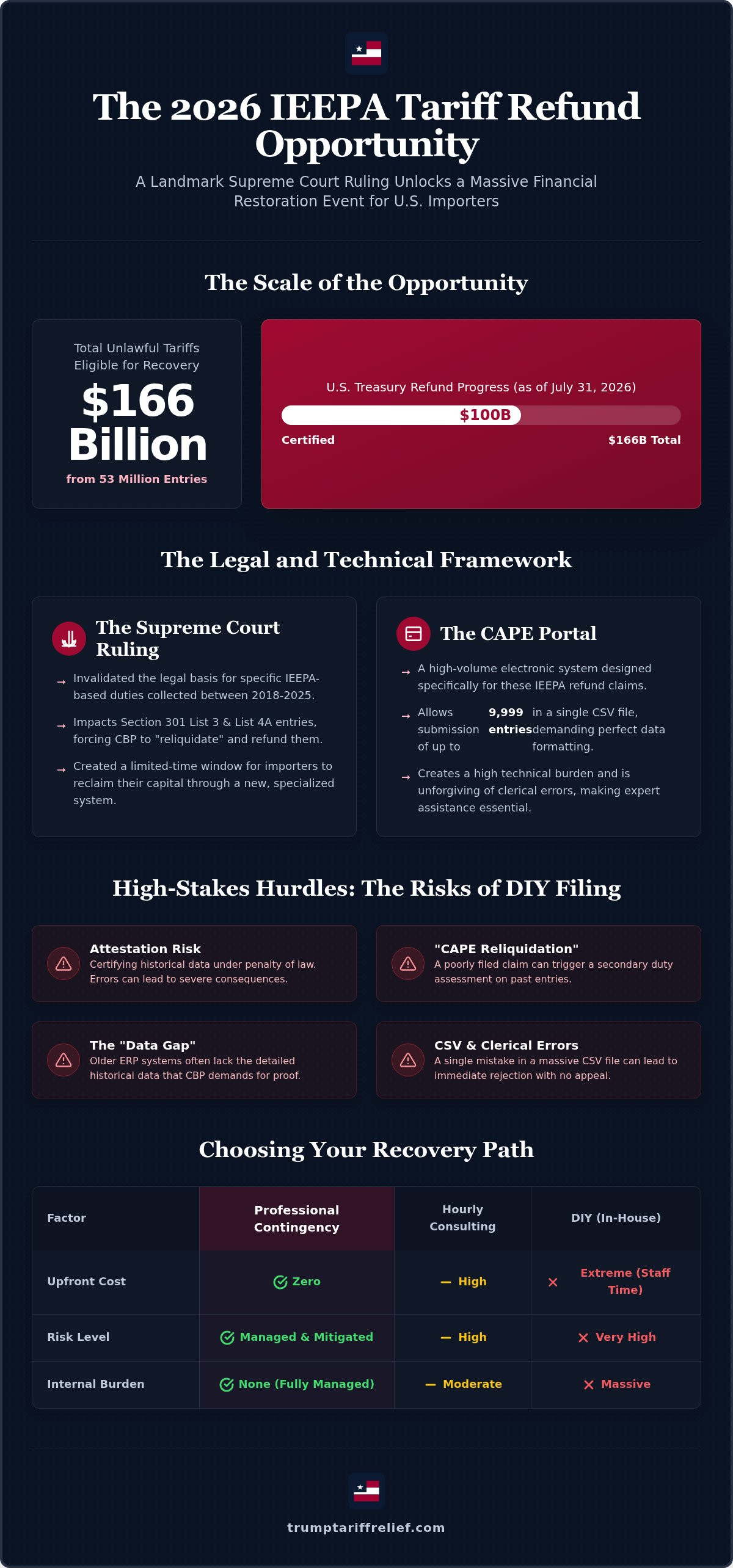
The landscape of international trade shifted overnight following the February 2026 Supreme Court ruling. This landmark decision determined that the International Emergency Economic Powers Act does not grant the executive branch unilateral authority to impose tariffs without specific legislative triggers. For American importers, this means the $166 billion collected across 53 million entries is now eligible for recovery. While traditional protests were once the standard for challenging duties, the sheer scale of these refunds led to the creation of a specialized, electronic filing framework. The 2026 refund window primarily targets duties associated with Section 301 List 3 and List 4A entries that relied on IEEPA authority, creating a massive capital restoration opportunity for those who acted within the current statute of limitations.
The Legal Catalyst: Why Refunds are Available Now
The Supreme Court's decision effectively invalidated the legal basis for specific IEEPA-based duties. This ruling forces a process known as reliquidation, where the Customs and Border Protection (CBP) must treat the original entry as if the unlawful duty was never applied. If you paid these tariffs between 2018 and 2025, you're likely eligible to reclaim your capital. You can find a detailed breakdown of the court's reasoning and the specific timeline of events in our IEEPA explained resource. The current window is governed by strict timelines; once an entry is finally liquidated beyond the standard 180-day protest window, recovery through standard channels becomes impossible without utilizing the CAPE system. This makes the timing of your filing the single most important factor in a successful claim.
The CAPE Portal: Your Gateway to Recovery
On April 20, 2026, CBP launched the Consolidated Administration and Processing of Entries (CAPE) portal to handle the high volume of claims. Unlike a standard entry summary, which focuses on individual transactions, a CAPE declaration allows for the submission of up to 9,999 entries in a single CSV file. This system streamlines the path to a refund check, but it also increases the technical burden on your internal teams. It's vital to note that professional IEEPA claim assistance has become a necessity because CBP has already issued alerts regarding unsolicited, fraudulent offers of help. Legitimate recovery requires access to the ACE Secure Data Portal and a deep understanding of the phased rollout, which began with unliquidated entries and is now expanding to finally liquidated entries in late 2026. Managing these declarations requires precise data validation to ensure every entry meets the strict eligibility criteria defined by the court.
Why Professional IEEPA Claim Assistance is a Strategic Necessity
The recovery of unlawfully collected duties isn't a clerical exercise; it's a legal attestation with high stakes. Under the authority of 50 U.S.C. Chapter 35, the federal government requires importers to certify the absolute accuracy of their historical data under penalty of law. This creates a significant "Attestation Risk" for businesses attempting to manage the process internally. If your data doesn't align perfectly with CBP’s records, you don't just face a rejected claim. You risk "CAPE Reliquidation," a scenario where a poorly filed claim triggers a secondary duty assessment on entries you thought were closed. Expert IEEPA claim assistance ensures that every List 3 and List 4a entry is validated against official records before submission, neutralizing the threat of government overreach.
Many importers struggle with the "Data Gap" of 2018 and 2019. Older ERP systems often lack the granularity to support the specific documentation CBP demands for IEEPA refunds. Validating these records requires a deep forensic dive into customs data that most internal teams aren't equipped to handle. The burden of proof remains on the importer of record to prove that their specific HTS codes fall within the scope of the Supreme Court's ruling. Without specialized management, these data discrepancies become liabilities rather than assets. Professional partners bridge this gap by aggregating historical customs data and validating it against CBP’s official records to ensure your claim is bulletproof.
The Risks of DIY Filing in the ACE Portal
The CAPE portal is designed for efficiency, but it's unforgiving. A single clerical error in a 9,999-line CSV file can lead to an immediate rejection with no clear path for appeal. When you sign a CAPE declaration, you're assuming a specific legal burden. Attestation risk is the legal liability an importer assumes when certifying customs data for a refund. CBP is actively monitoring for misrepresentations, and federal penalties for inaccurate filings are severe. Professional oversight prevents these unforced errors and ensures your filing is audit-ready from day one, protecting your corporate reputation while you reclaim your capital.
Navigating the 3-Year Statute of Limitations
Time is your greatest enemy in the recovery process. The 2026 window is governed by strict deadlines that vary based on when your original entries were filed and liquidated. Waiting to see how other claims process often results in the permanent loss of capital as the statute of limitations expires. You can review the critical deadlines and legal framework in our IEEPA explained guide. Missing a cutoff date means your capital stays in the Treasury's hands forever. You can see how it works to determine if your historical data is eligible for a risk-free assessment before these deadlines pass.
Comparing Recovery Models: Contingency vs. Hourly vs. DIY
Selecting the right vehicle for capital recovery determines your final ROI. While the Supreme Court has cleared the legal path, the method you choose to navigate the CAPE portal can either safeguard your capital or create a new cycle of administrative costs. Most importers evaluate three primary paths: traditional hourly legal counsel, general customs brokerage, or specialized contingency-based recovery. The traditional hourly model often proves prohibitive for high-volume IEEPA claims. When a firm bills by the hour, your company assumes all the financial risk. You pay for forensic data review and filing preparation regardless of whether CBP validates the claim or issues a refund. For a recovery event involving thousands of historical entries, these upfront legal fees can quickly erode the value of the potential check.
The DIY approach or relying solely on a general customs broker presents a different set of challenges. Most brokers are experts in entry filing and daily logistics, but they aren't structured for large-scale legal recovery or forensic data validation. Brokers often charge a "per-entry" fee for historical corrections. On a claim involving 5,000 entries, a seemingly small per-entry fee becomes a massive upfront expense. More importantly, general brokers rarely provide the robust audit support necessary if CBP challenges an attestation. If you don't have a partner who stands by the claim through a potential audit, you're left defending complex legal positions without the necessary trade counsel.
The Contingency Fee Advantage for CFOs
Specialized IEEPA claim assistance operates on a 100% performance-based model, which aligns the consultant's incentives directly with your bottom line. This "No Recovery, No Fee" structure eliminates the financial barrier to entry, allowing businesses to pursue even the most complex claims without budget approval for upfront legal spend. Under this model, the service provider takes on the heavy lifting of data extraction and validation because their success is tied to yours. This incentivizes a deeper forensic dive into your 2018-2025 records to identify every qualifying dollar that an hourly firm might overlook in the interest of billable efficiency. It's a high-reward, zero-risk partnership that protects your operational budget while maximizing capital restoration.
Specialized Expertise vs. General Brokerage
Recovering IEEPA duties requires a fusion of trade law, data science, and bureaucratic navigation that standard brokerage firms simply don't maintain. A successful claim demands more than just filing a CSV; it requires a team of trade attorneys and data analysts who understand the nuances of List 3 and List 4A exclusions. You can see how it works to understand the specialized workflow required to move from raw ERP data to a certified Treasury check. This process involves validating your internal records against CBP’s official ACE data to ensure 100% accuracy before any attestation is signed. By choosing a specialized partner over a general broker, you're investing in a defensive shield that protects your organization from the risks of reliquidation and federal audits.
The 2026 Roadmap for a Successful IEEPA Recovery
The path to a successful refund is a methodical operation that transforms raw customs data into a legally defensible claim. For most organizations, professional IEEPA claim assistance provides the technical infrastructure needed to move through the five essential stages of recovery without disrupting daily operations. This isn't a simple filing process; it's a forensic reconstruction of your trade history from 2018 to 2025. Following a structured roadmap ensures that your submission isn't just accepted by the portal, but actually results in a Treasury check.
- Step 1: Conduct a Comprehensive Tariff Eligibility Assessment. This identifies every entry that falls under the invalidated List 3 and List 4A categories.
- Step 2: Aggregate and Validate. You must cross-reference your internal ERP data with official CBP ACE reports to ensure every entry number and dollar amount matches perfectly.
- Step 3: Prepare the CAPE Declaration. This involves formatting your data into the precise CSV structure required by the portal, including exact HTS codes and entry numbers.
- Step 4: Execute the Attestation. A corporate officer must sign the legal certification before submission via the ACE portal.
- Step 5: Monitor and Manage. Once submitted, you must track the reliquidation and be prepared to manage any CBP Form 28 Requests for Information.
Phase One: The Assessment and Data Audit
Effective recovery begins with a granular audit of your Automated Commercial Environment (ACE) reports. You'll need to pull specific "Entry Summary" reports to isolate payments made under Section 301 List 3 and List 4A. The real challenge lies in cross-referencing these reports with your internal commercial invoices to verify that the goods imported match the HTS codes eligible for the refund. This data audit is the foundation of your claim. If you're unsure about which entries qualify under the 2026 ruling, you can see how it works to start your preliminary assessment and secure your data.
Handling Complex Importer Scenarios
Not every claim is straightforward. Nonresident Importers (NRIs) often find their payments flagged or "stuck" in the CAPE portal due to banking or bond verification issues. These scenarios require a specific administrative protest to release the funds. Similarly, companies that have undergone mergers or acquisitions since 2018 must provide successor-in-interest documentation to prove they're the rightful party to receive the refund. If your claim becomes stalled or flagged, a formal administrative protest is often the only way to move the process forward and ensure your capital isn't lost to bureaucratic friction.
Don't let technical errors or complex corporate structures block your recovery. You can get a free tariff eligibility assessment to identify your qualifying entries and begin the recovery process today.
Maximizing Your Refund with Trump Tariff Relief
Trump Tariff Relief stands as the definitive advocate for businesses impacted by overreaching trade policies. Our specialized focus on IEEPA and Section 301 recovery means we don't just help with filings; we engineer the entire restoration of your capital. This is a mission of justice. For too long, American importers have carried the burden of unlawful duty assessments. We've built our entire infrastructure to right this wrong, ensuring that the $166 billion in unlawfully collected duties returns to the companies that earned it. With approximately $66 billion in IEEPA duties still unrecovered as of August 2026, our IEEPA claim assistance provides the elite legal and technical shield your business needs.
Our end-to-end management covers every technical requirement mentioned in this guide. We manage the process from the initial data extraction out of your ERP system to the moment the Treasury check arrives at your door. Because we operate on a 100% contingency basis, our success is inseparable from yours. We only get paid when you receive your refund. This model ensures our team is motivated to capture every eligible dollar from List 3 and List 4A without adding a single dollar of upfront risk to your balance sheet.
Our Proven Recovery Process
We utilize proprietary data validation tools specifically designed to handle the 2026 CAPE portal requirements and 9,999-entry CSV limits. Our trade experts don't just fill out forms. They draft the precise legal language for your CAPE declaration attestation to minimize audit triggers and protect your corporate officers. If CBP issues a Form 28 or initiates an inquiry after your filing, we provide comprehensive post-filing support. We stand by our data and defend your claim through the final reliquidation process to ensure your capital stays where it belongs.
Get Started with a Preliminary Assessment
The CAPE portal is active right now, and the phases are moving quickly toward the final 2026 deadlines. Waiting another month could mean the permanent loss of your recovery rights as the statute of limitations expires. We invite you to a low-friction preliminary assessment to determine the potential size of your refund. This initial consultation requires no upfront investment and provides immediate clarity on your eligibility. You can find answers to common recovery questions in our FAQ, but the most effective step is to secure your place in the refund queue today. Don't let the government keep capital that the Supreme Court has already ruled belongs to you.
Secure Your Capital Before the 2026 Deadlines Expire
The window for recovering unlawfully collected duties is active, but it won't stay open forever. As the CAPE portal moves through its final phases, the technical burden on importers continues to rise. You've seen that successful recovery requires more than just simple data entry. It demands a forensic audit of historical records and a strategic defense against CBP scrutiny. Relying on specialized IEEPA claim assistance is the most effective way to ensure your attestations are bulletproof while avoiding the pitfalls of reliquidation or federal audits.
Our team of recovery experts handles the entire data validation process on a 100% contingency basis. This means you face no upfront costs or hourly fees; we only get paid when your refund is secured. By partnering with us, you gain a powerful ally dedicated to righting the wrongs of overreaching trade policies and returning capital to your bottom line. We provide the comprehensive data validation necessary to mitigate your audit risk and maximize your financial restoration.
Reclaim your capital with a 100% contingency-based IEEPA assessment today. Your business has already paid the price for these tariffs; it's time to bring that capital home.
Frequently Asked Questions
Is the IEEPA tariff refund real or a scam?
The refund is a legitimate legal restoration resulting from the February 2026 Supreme Court ruling that found certain tariffs unlawful. As of July 31, 2026, the Treasury Department has already certified approximately $100 billion in refunds for disbursement. While the opportunity is real, CBP has issued alerts regarding fraudulent, unsolicited offers; you should only work with verified experts who utilize the official ACE Secure Data Portal for filings.
How much does it cost to hire an IEEPA claim assistant?
Professional IEEPA claim assistance is typically provided on a 100% contingency basis. This structure ensures there are no upfront costs, hourly legal fees, or forensic audit charges for your business. The service provider only receives a performance-based fee after you successfully receive your refund check from the Treasury, which aligns their incentives with your capital recovery goals.
Can my current customs broker file the IEEPA claim for me?
While authorized brokers can technically submit filings, many aren't equipped to handle the forensic data validation or the complex legal attestations required by the CAPE system. General brokers often lack the trade attorneys needed to defend a claim if CBP challenges your historical data. A specialized recovery partner provides a higher level of protection against audit risks and reliquidation events that a standard broker might overlook.
What is the deadline to file for an IEEPA tariff refund in 2026?
Deadlines are governed by a strict statute of limitations that depends on the original entry and liquidation dates of your goods. While the CAPE portal launched on April 20, 2026, the window for unliquidated entries and those liquidated within 180 days is closing rapidly. Waiting to file often results in the permanent loss of capital because these federal cutoffs are non-negotiable and vary by entry phase.
How long does it take for CBP to process a CAPE refund check?
Once your CAPE Declaration passes validation, refunds are typically issued within 60 to 90 days. These payments include daily compounded interest based on quarterly IRS rates, which currently range from 4.5% for large corporate overpayments to 6% for the first $10,000. The speed of your disbursement depends on the accuracy of your CSV submission and whether your entries fall into the current processing phase.
What happens if my IEEPA claim is audited by CBP?
If CBP issues a Form 28 Request for Information, you must provide specific documentation to validate your HTS codes and entry summaries. An audit can be triggered by clerical errors or mismatched data in your CAPE filing. Having expert IEEPA claim assistance means you have a dedicated team to manage these inquiries and defend your attestation, preventing the risk of claim rejection or secondary duty assessments.
Which Section 301 lists are eligible for IEEPA refunds?
The current recovery window primarily focuses on duties paid under Section 301 List 3 and List 4A that were imposed using IEEPA authority. The Supreme Court ruling specifically targeted these lists, distinguishing them from other tariffs that remain in effect. A comprehensive eligibility assessment is the only way to isolate which of your 53 million possible entries qualify for restoration under the 2026 legal framework.
Do I need to have an active ACE portal account to claim a refund?
Yes, all CAPE Declarations must be submitted electronically through the ACE Secure Data Portal using a validated CSV file. If your company doesn't maintain an active account or lacks the internal resources to manage the portal's technical requirements, your recovery partner can act as your authorized representative. This ensures your data is formatted correctly for the system's 9,999-entry limit per declaration.
Ready to find out what your business may be owed?
Check My Eligibility