
Your company’s capital is currently sitting in a government account, and without the right digital keys, it will stay there indefinitely. The February 20, 2026, Supreme Court ruling invalidated IEEPA tariffs, but the burden of proof rests entirely on your shoulders. If you are feeling overwhelmed by the new CAPE portal or disorganized internal records, you are not alone. Most importers are asking the same critical question: what documents are needed for tariff refund success before the 180-day protest window slams shut?
We understand that navigating customs bureaucracy feels like a high-stakes race against time. This article provides the definitive roadmap to mastering your documentation requirements so you can reclaim every dollar of unlawfully paid duties. You will gain a clear checklist of required entry numbers, an understanding of the new CAPE system, and the confidence to file a successful claim. We will break down the specific digital files required for the Automated Commercial Environment and the essential bank details needed for your mandatory ACH direct deposit.
Key Takeaways
- Identify the specific shipment entry numbers and commercial invoices required to prove your eligibility for List 3 and List 4a China tariff recovery.
- Discover exactly what documents are needed for tariff refund claims to satisfy the strict evidentiary standards of the new CAPE portal.
- Distinguish between liquidated and unliquidated entries to determine if you must file a CAPE Declaration or a formal CBP Form 19 protest.
- Update your ACE Portal with accurate ACH direct deposit information to comply with the mandatory electronic payment requirement for all 2026 refunds.
- Mitigate the risk of disqualification by learning how a single data entry typo can jeopardize high-value claims during the customs audit process.
The 2026 IEEPA Tariff Refund Opportunity: Why Documentation is Your First Step
The legal landscape for U.S. importers shifted permanently on February 20, 2026. On that day, the U.S. Supreme Court delivered a landmark ruling that invalidated the executive branch's authority to impose specific tariffs under the International Emergency Economic Powers Act (IEEPA). For years, your business may have been forced to pay "fentanyl" and "reciprocal" duties that the court has now deemed unlawful. This isn't just a minor regulatory change; it's a massive financial restoration for companies that were overcharged. However, the government won't volunteer this capital back to you. The burden of proof lies entirely with the Importer of Record. To reclaim your funds, you must proactively identify and submit a comprehensive claim before the strict 2026 deadlines expire. Understanding exactly what documents are needed for tariff refund success is the only way to move your money from a government ledger back into your bank account. Precision is your only protection against a bureaucratic denial.
The Supreme Court Ruling and Your Right to Recovery
The 6-3 Supreme Court decision clarified that presidential authority has strict constitutional limits. The court ruled that the administration overstepped its bounds by using emergency powers to bypass Congress for long-term trade policy and revenue collection. This decision effectively opens the door for refunds on tariffs applied to goods from China, Canada, and Mexico. It's a moment of accountability for the federal government. Reclaiming these duties is about righting a wrong and recovering capital that was never legally owed to the Treasury. If your business imported goods under these specific executive orders, you have a constitutionally backed right to recovery. You can find more detail on the legal nuances and how they apply to your specific shipments at our IEEPA explained page.
Introducing CAPE: The New CBP Refund Infrastructure
Following the ruling, U.S. Customs and Border Protection (CBP) launched the Consolidated Administration and Processing of Entries (CAPE) portal on April 20, 2026. This isn't a separate entity but an automated extension of the existing ACE system designed specifically to handle the surge of IEEPA claims. Efficiency is the priority here, but so is technical accuracy. CAPE is the mandatory electronic filing gateway for all IEEPA claims. If your data doesn't align perfectly with CBP’s internal records, the system will reject your submission before a human ever sees it. This digital-first approach means your recovery depends on your ability to translate physical records into the precise electronic formats required by the portal. Mastering the digital requirements of this portal is non-negotiable for any business seeking a full refund in 2026.
The window for action is narrow. With the 180-day protest clock ticking for liquidated entries and the 300-day window for post-summary corrections, there's no room for administrative delay. You aren't just filing paperwork; you're launching a targeted recovery mission for your company's bottom line. The distinction between a successful claim and a forfeited refund usually comes down to the quality of your initial audit. By organizing your records now, you position your business at the front of the queue in a system that is already facing a significant backlog of claims.
The Essential Documentation Checklist for Tariff Recovery
Securing a refund for unlawfully paid IEEPA duties is not an automatic process. It is a precise administrative challenge that requires you to prove, entry by entry, that your business is the rightful recipient of these funds. Understanding exactly what documents are needed for tariff refund recovery is the first hurdle in this multi-billion dollar reclamation process. In the wake of the 2026 Supreme Court decision, the government has established a high bar for evidentiary support. You cannot rely on high-level accounting summaries; you need granular, shipment-level data that matches the records held within the Automated Commercial Environment (ACE). Precision is your only protection against a summary denial by the CAPE system.
Your immediate priority is a comprehensive audit of all imports affected by China List 3 and List 4a tariffs. These lists represent the bulk of IEEPA-related duty payments and require the most intensive documentation. You must correlate every Harmonized Tariff Schedule (HTS) code used on your entries with the specific IEEPA duty payments made. If your internal records are disorganized, the task can feel insurmountable. However, the data exists; it's simply a matter of extracting it from the right sources. If you find your internal archives are incomplete, our tariff recovery workflow can help you identify the specific entry numbers required for a valid claim.
Primary Customs Records: Entry Summaries and Form 7501
CBP Form 7501, the Entry Summary, is the "golden record" for your claim. This document provides the definitive proof of what was imported, which HTS codes were applied, and the exact dollar amount of IEEPA duties paid. To build a successful filing, you must locate the specific line items on these forms that reflect the additional 201 or 301 duties. If you don't have these forms on hand, contact your customs broker immediately. They are legally required to maintain these records, and they are the foundational proof required by CBP guidance on IEEPA duty refunds. Without a verified Form 7501 for every entry in your claim, the CAPE portal will reject your declaration during the initial validation phase.
Financial Proof: Verifying IEEPA Duties Paid
Official customs forms are only half of the equation. You must also provide financial proof that the duties were actually paid by your company. This requires matching your internal bank statements, wire transfer records, or cancelled checks to specific entry numbers. CBP is particularly vigilant about ensuring the refund goes to the correct entity. This means your Importer of Record (IOR) number must match the filing entity exactly. In 2026, all refunds are issued exclusively via ACH direct deposit. If your financial records don't align with your ACE portal bank details, your refund will be delayed, or worse, redirected. Ensure your records show a clear path from your corporate accounts to the Treasury for every dollar you intend to reclaim.
- Entry Summary (CBP Form 7501): Must show specific IEEPA duty line items.
- Commercial Invoices: Necessary to verify the country of origin and product HTS codes.
- Proof of Payment: Bank records or ACH confirmations tied to specific entry numbers.
- IOR Verification: Documentation confirming your authority to claim on behalf of the filing entity.
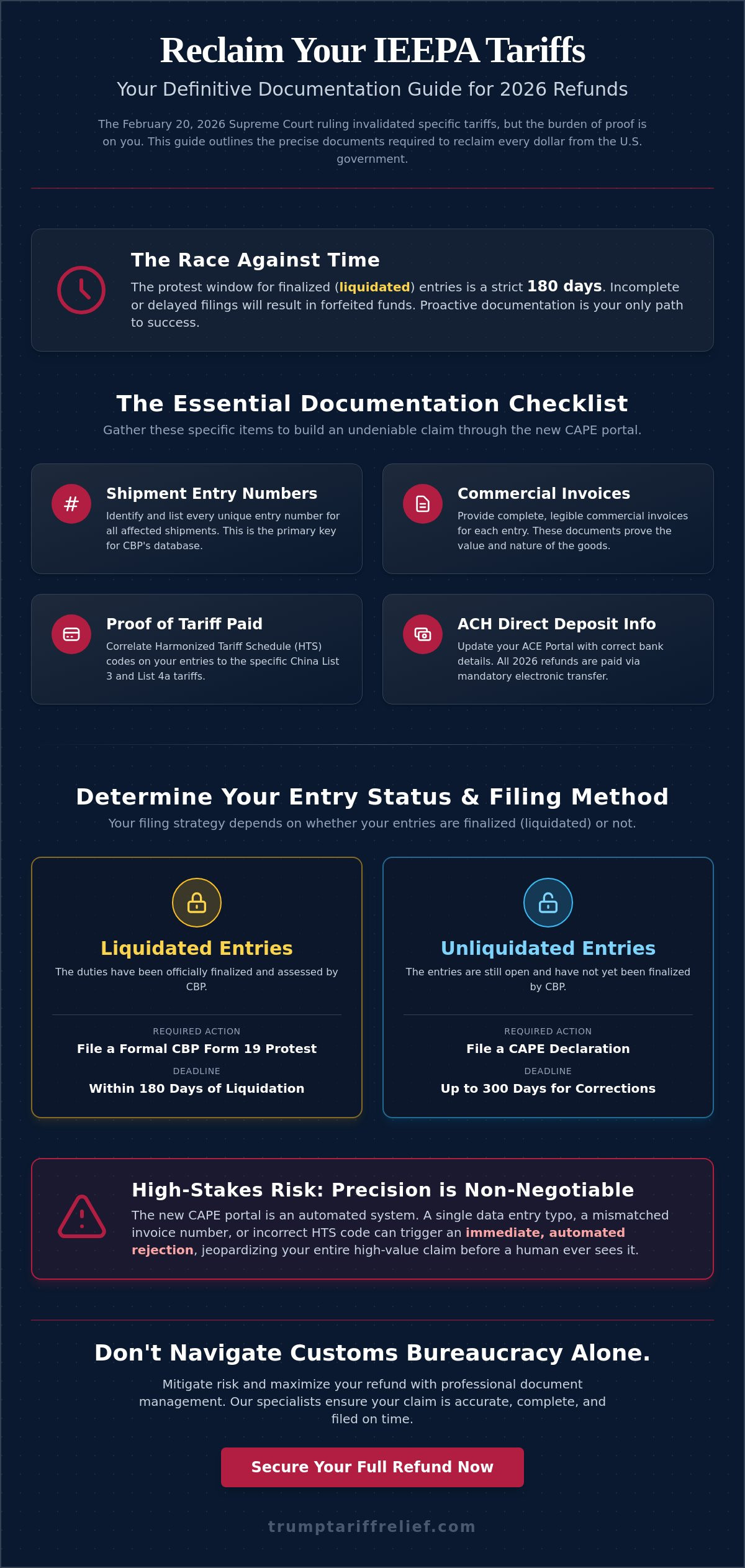
Documenting Entry Status: Liquidated vs. Unliquidated Claims
Liquidation is the final calculation of duties by U.S. Customs and Border Protection (CBP). It typically occurs within 314 days of entry. In the current 2026 recovery climate, this status is the primary factor that dictates your filing strategy. If an entry is unliquidated, your path is relatively streamlined. If it has already liquidated, you're facing a strict 180-day countdown to secure your capital. Missing this distinction is the most common reason claims are rejected. You must use your ACE portal to verify the current status of every shipment before determining what documents are needed for tariff refund processing. Precision at this stage prevents the loss of your right to recovery.
Records for Unliquidated Entries (Phase One)
Unliquidated entries are shipments where CBP hasn't yet finalized the duty assessment. These entries are the primary focus of the initial CAPE portal rollout launched in April 2026. For these "open" entries, you don't need to file a formal protest. Instead, you'll need a specific set of data points to file a Post-Summary Correction (PSC) or a CAPE declaration. You must have the entry number, the exact date of entry, and the specific port code ready for upload. Because these shipments are still active in the system, Phase One claims are often processed faster, allowing for a more rapid restoration of your company's liquidity. This restored capital can be reinvested into facility improvements, and you can learn more about Rescue Roofing Tulsa for expert commercial roofing services in the Oklahoma region.
Identifying Entries Within the 180-Day Protest Window
Once an entry liquidates, the clock starts ticking. You have exactly 180 days from the final liquidation date to file a Formal Protest (CBP Form 19). If you cross into day 181, your right to a refund for that specific shipment is generally lost. For entries liquidated within the preceding 80 days, the CAPE portal allows for a simplified declaration. However, for anything older than 80 days but still under the 180-day limit, a more robust documentation set is required. You'll need to provide a formal legal statement citing the February 2026 Supreme Court ruling as your grounds for the claim. Reviewing IEEPA explained resources can help you distinguish between these two legal paths. When asking what documents are needed for tariff refund success in this category, remember that a formal protest requires a higher level of legal justification than a standard digital declaration.
Managing these timelines requires a high level of organizational discipline. Your customs broker can pull a "Liquidation Report" from the ACE system to help you categorize your shipments. This report is your master roadmap. It tells you which shipments require an immediate CAPE declaration and which ones need a formal protest drafted before the 180-day window slams shut. By categorizing your records by liquidation date, you ensure that no high-value entry is left behind due to a missed administrative deadline.
Digital Readiness: ACE Portal and CAPE Declaration Requirements
The 2026 recovery process has abandoned the traditional paper trail in favor of a high-speed digital infrastructure. U.S. Customs and Border Protection (CBP) now processes all IEEPA claims through the Consolidated Administration and Processing of Entries (CAPE) portal. This shift means that your physical archives are merely the raw material for a mandatory digital submission. If your electronic data doesn't align perfectly with the records in the Automated Commercial Environment (ACE), your claim will stall. Digital inconsistencies are currently the #1 cause of refund delays in Phase One. To avoid these bottlenecks, you must ensure your internal data matches the "Consolidated Declaration" format required by the CAPE system. Understanding what documents are needed for tariff refund success in this digital environment is no longer optional; it is the difference between a prompt ACH deposit and a permanent administrative rejection.
Setting Up Your Importer of Record Account
Your recovery depends on the integrity of your Importer of Record (IOR) data. You must log into the ACE portal to verify that your continuous bond is active and that your IOR status is current. Check your contact information immediately. If CBP cannot reach the designated contact on file, you may miss critical "Request for Information" (CBP Form 28) notifications that could disqualify your claim. Ensure your account has at least one user with "Filer" permissions. Without this specific administrative access level, you cannot upload the bulk entry lists required for a CAPE declaration. This verification step is a foundational requirement that must be completed before any financial data is submitted.
Enrolling in ACH for Direct Refund Deposits
CBP has officially phased out paper checks for IEEPA refunds in 2026. All payments are now issued via Automated Clearing House (ACH) direct deposit. To receive your funds, you must have your bank information verified and on file within your ACE account. The specific documents needed for ACH enrollment include your bank routing and account numbers, which must be submitted on official company letterhead. Any mismatch between the name on the bank account and the name on the IOR record will trigger an immediate fraud flag. If you encounter technical errors during this process, consult our FAQ for solutions to common digital setup hurdles. Ensuring your financial "plumbing" is ready is just as important as the claim itself.
The complexity of these digital requirements often leads to simple data entry errors that jeopardize multi-million dollar recoveries. A single transposed digit in an entry number or an outdated bond record can result in a system-wide rejection. We specialize in the technical side of this mission, taking the administrative burden off your internal teams. If you are ready to move from preparation to execution, our IEEPA Tariff Refund Recovery service provides the expert oversight needed to ensure your digital filings are flawless and your capital is returned without delay.
Securing Your Refund: The Advantage of Professional Document Management
The transition from identifying what documents are needed for tariff refund claims to successfully executing a filing is where most importers encounter their greatest risks. In the high-stakes environment of 2026, the margin for error is non-existent. A single transposed digit in a multi-page CAPE Declaration or an inconsistent IOR number can trigger an immediate system rejection, potentially forfeiting millions in recoverable capital. The federal government has created the pathway for recovery, but they've also built a digital gauntlet that rewards precision and punishes administrative haste. For busy firms, the internal cost of managing this audit can quickly outweigh the benefits if not handled by a specialized partner.
Data integrity is your only defense against a "Request for Information" (CBP Form 28) that could stall your refund for months. When you're managing thousands of historical entries across various ports, the probability of a data entry error increases exponentially. Beyond simple mistakes, the 2026 IEEPA ruling has unfortunately attracted sophisticated bad actors. You must be prepared to identify and avoid refund scams that target ACE portal users with promises of "instant" payouts. These entities often attempt to secure your corporate banking details under the guise of official CBP communications. A professional approach to Customs Documentation Management ensures that your sensitive data is handled with the security and legal gravitas your business deserves.
Avoiding the Scams and Filing Errors That Stall Claims
Vigilance is mandatory when navigating the 2026 recovery window. You should treat any unsolicited email regarding "immediate" tariff refunds as a red flag. CBP utilizes a rigorous, multi-stage verification process for every CAPE Declaration, and they never solicit bank details through unofficial channels. Having a seasoned partner to handle the heavy lifting of documentation provides a necessary buffer between your firm and the bureaucracy. We provide a comprehensive Tariff Eligibility Assessment before any paperwork is filed, ensuring that every entry in your claim meets the exact legal criteria established by the Supreme Court. This proactive audit identifies potential rejections before they happen, keeping your claim at the front of the processing queue.
The Contingency Advantage: No-Risk Recovery with Trump Tariff Relief
Trump Tariff Relief acts as the engine of your recovery, allowing your team to focus on core business operations while we reclaim your overpaid duties. Our model is built on a results-oriented foundation: we operate on a contingency basis, meaning we only win when you successfully recover your capital. There are no upfront packages or hidden administrative fees. We take on the entire burden of document gathering, status verification, and digital filing. This approach removes the financial barrier to entry and ensures that our interests are perfectly aligned with your success. Learn how it works and start your recovery today to ensure your company isn't left behind as the 180-day windows begin to close.
Take Decisive Action on Your IEEPA Duty Recovery
The 2026 Supreme Court ruling has created a historic but fleeting window for importers to reclaim their overpaid capital. Success depends entirely on your mastery of the new CAPE portal and your ability to provide a flawless digital audit. You now know what documents are needed for tariff refund success, from the essential Form 7501 Entry Summaries to the mandatory ACH enrollment data. The complexity of the 180-day protest window means that even a minor administrative delay can result in a permanent loss of your right to recovery. Precision is your only protection against a bureaucratic denial.
You don't have to navigate this bureaucratic gauntlet alone. Our expert team specializes in IEEPA and Section 301 recovery, managing the entire ACE and CAPE filing process on your behalf. We operate on a strictly contingency-based model. There are no upfront costs, and we only win when you recover your funds. Don't let your company's capital sit in a government account while the clock runs out on your eligibility. Get Your Free Tariff Eligibility Assessment Now and take the first step toward restoring your financial bottom line. Your path to professional, risk-free recovery starts today.
Frequently Asked Questions
What is the most important document needed for an IEEPA tariff refund?
CBP Form 7501, the Entry Summary, is the foundational record required for any successful claim. This document contains the specific entry number, the Harmonized Tariff Schedule (HTS) codes used, and the exact dollar amount of IEEPA duties paid. Without this "golden record," you cannot verify the overpayment amount to the standards required by the CAPE portal.
Can I still get a refund if I don’t have my original Form 7501?
Yes, you can still recover your capital even if your internal archives are incomplete. Your licensed customs broker is legally required to maintain these records for five years and can provide copies upon request. Additionally, you can retrieve specific entry data directly through your ACE portal account to reconstruct the necessary filing details for your submission.
Does a customs broker need to file the refund claim for me?
You aren't required to use your original customs broker to file a refund claim. While the Importer of Record (IOR) has the authority to file independently, many firms choose to partner with specialized recovery experts. This ensures that the technical CAPE portal requirements are met with the precision necessary to avoid the high rejection rates seen in Phase One.
How far back do the eligible records go for the 2026 IEEPA refund?
The 2026 refund opportunity focuses on duties paid under the presidential authority invalidated by the February 20, 2026, Supreme Court ruling. While the affected shipments may span several years, your ability to file is strictly governed by the liquidation status of each entry. You generally have 180 days from the date of liquidation to file a protest or 300 days from the date of entry for unliquidated shipments.
What is a CAPE Declaration and is it required for all importers?
A CAPE Declaration is a digital file containing a list of entry numbers that is uploaded to the new Consolidated Administration and Processing of Entries portal. It became the mandatory electronic gateway for all importers seeking the simplified refund path after the portal's launch on April 20, 2026. This digital-first approach replaces traditional paper-based claims for most IEEPA recovery categories.
How do I prove I paid the tariffs if my company has since merged or changed names?
You must provide legal documentation that establishes a clear succession of interest, such as merger agreements or certificates from the Secretary of State. CBP requires these records to verify that your current entity is the legal successor to the original Importer of Record. This ensures the refund is issued to the correct corporate entity via the mandatory ACH direct deposit system.
What happens if some of my entries are liquidated and others are not?
You must split your filing strategy to accommodate both statuses. Unliquidated entries require a Post-Summary Correction (PSC) filed within 300 days of the entry date. Liquidated entries must be handled through a CAPE Declaration or a Formal Protest within the strict 180-day window following the final liquidation date to ensure you don't forfeit your right to recovery.
Are there fees associated with filing for a tariff refund through CBP?
CBP does not charge any official fees for processing your IEEPA refund. However, many businesses find that the internal resource cost of identifying what documents are needed for tariff refund success is significant. Partnering with a contingency-based recovery expert allows you to outsource the complex audit and filing process without any upfront financial risk to your firm.
Ready to find out what your business may be owed?
Check My Eligibility