
What could your business lose by leaving a potentially eligible tariff refund unclaimed? The cost of not claiming a tariff refund may be more than the duties already paid. If an entry-specific filing window closes, the opportunity to pursue recovery may close with it. Not every tariff payment or import entry qualifies, however, and the right path depends on the entry’s status and the current refund procedures.
It’s reasonable to weigh potential recovery against the staff time, documentation, and uncertainty involved. A claim can require careful review, while inaction can leave eligible funds unrecovered. Before deciding that the administrative burden outweighs the potential benefit, establish whether your entries warrant further assessment.
This article explains the financial and operational trade-offs, how to compare an internal review with professional support, and which records and questions can help you decide. Eligibility and deadlines need to be assessed entry by entry. A contingency-based recovery service may reduce upfront costs and internal workload, while charging a percentage of any refund successfully recovered. No refund is guaranteed, so start with a clear assessment of your circumstances.
Key Takeaways
- The cost of not claiming a tariff refund can include foregone recovery and lost procedural options, but eligibility depends on the facts for each entry.
- Assess your potential exposure using customs records, not broad estimates or assumptions about which tariffs may qualify.
- Compare in-house review with specialist support based on staff capacity, record readiness, control, and uncertainty.
- Gather entry summaries, payment records, and liquidation information, then verify the current requirements and deadlines for each entry.
- A contingency-fee recovery service may reduce upfront expense and administrative work. Understand the percentage charged if funds are successfully recovered.
What Is the Real Cost of Not Claiming a Tariff Refund?
The cost of not claiming a tariff refund isn’t necessarily equal to every duty your business paid. It is the potential recovery you may leave unpursued, weighed against the staff time and resources required to investigate and act. Inaction can also narrow your options if a procedural window applies to an entry and passes. The actual trade-off depends on your records and circumstances.
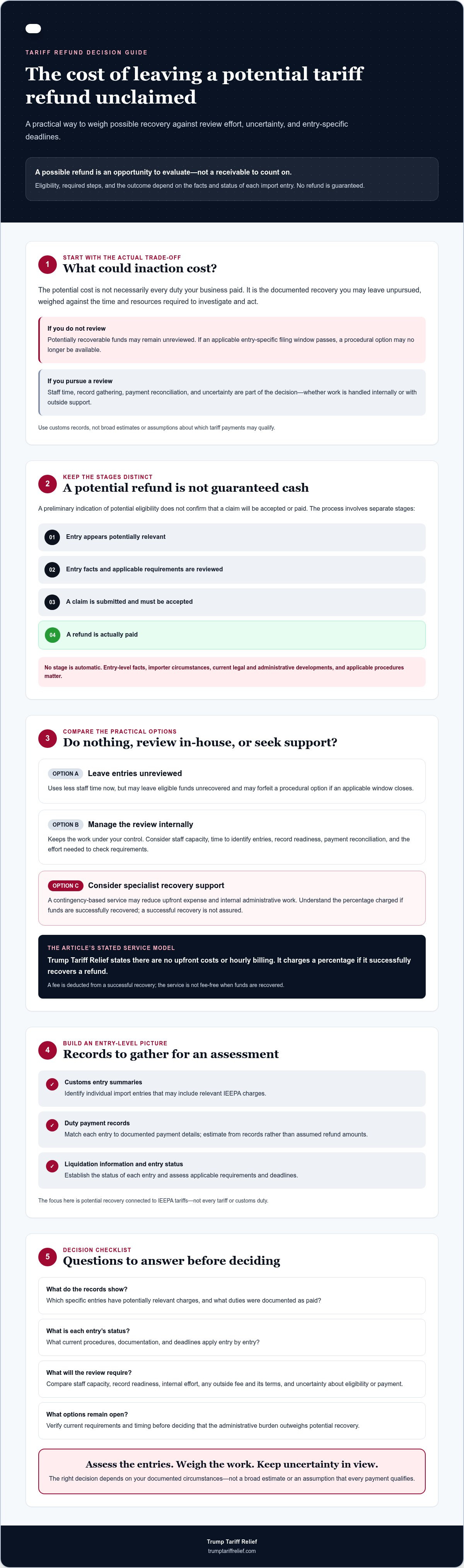
A possible refund is an opportunity to evaluate, not a receivable to count on. Duties already paid are historical cash outflows. They may be recoverable only if an applicable process covers the entry, the facts support the claim, and the required steps are completed. A preliminary review, possible eligibility, an approved claim, and a refund actually paid are separate stages. None is automatic.
Which tariff payments might be relevant to a refund review?
This article focuses on potential recovery connected to IEEPA tariffs, not every tariff or customs duty. A tariff is a tax on imported goods; the Tariff overview provides general background. Whether a payment merits review depends on the specific import entry and the rules and procedures that apply. Entry summaries and records showing duties paid are practical starting points. For context on the relevant trade measure, see this IEEPA tariff ruling explanation.
Start with customs records rather than an estimate based on total duties across your business. Identify entries with potentially relevant IEEPA charges, then match each entry to its payment details and status. This record-by-record review helps distinguish amounts that warrant further evaluation from payments that may fall outside the relevant process.
Why potential recovery is not the same as guaranteed cash
Current legal and administrative developments can affect which entries may qualify, what process applies, and what documentation is needed. An initial indication of potential eligibility does not confirm that a claim will be accepted or paid. Importer circumstances and entry-level facts matter, so no broad assumption can establish that every importer, product, or tariff payment qualifies.
In practical terms, inaction may preserve staff time today while leaving a potentially recoverable amount unreviewed. If an applicable deadline passes, a procedural option may no longer be available. A review also takes effort, whether handled internally or with specialist support. Compare the documented opportunity, the work required, and the options still open for each entry, rather than treating the decision as “refund versus no refund.”
How Inaction Can Affect Cash Flow, Deadlines, and Business Options
Leaving a potentially eligible entry unreviewed can mean forgoing a chance to recover duties and related funds. Pursuing a claim also uses resources: staff time to locate records, effort to reconcile payments, and attention to a process with an uncertain outcome. The practical cost of inaction depends on the entries involved and what it would take to assess them.
The financial trade-off: possible recovery versus the cost of pursuing it
Use your own customs records to make a qualitative comparison. For the entries under review, estimate the potentially relevant duties paid. Then compare that amount with the internal hours needed to assemble and check records, any outside service fee, and the uncertainty that some entries may not qualify or result in a refund.
- Potential recovery: Estimate from documented payments, not an assumed refund amount.
- Internal effort: Staff time to identify entries, confirm payment details, and organize supporting documents.
- Outside assistance: Any fee and its terms, compared with the administrative work the provider may handle.
- Uncertainty: Eligibility, review, and payment depend on the facts and applicable process.
Under Trump Tariff Relief’s stated model, there are no upfront costs or hourly billing. The firm charges a percentage if it successfully recovers a refund. A fee is therefore deducted from a successful recovery, but recovery is not assured and the service is not fee-free if funds are recovered. If you’re considering this route, how tariff refund recovery works can help you understand the process and compare it with internal handling.
Why claim timing deserves a separate review
Deadlines aren’t a single calendar date that applies to every entry. The relevant procedure, entry status, and current government guidance can affect which timing rules matter. A delay may reduce available options if an applicable deadline passes. Check dates against the records for each entry instead of relying on a general rule of thumb.
Check deadline risk against current rules and the facts of each entry, rather than assuming one business-wide timeline applies. The U.S. Customs and Border Protection's guidance is a practical starting point for checking current refund procedures. Track entry status, identify any potentially applicable filing window, and verify the requirement before deciding to wait.
This review doesn’t commit your business to pursuing every entry. It helps distinguish entries that need prompt attention from those that may warrant further analysis, so cash-flow decisions reflect actual records and available options.
Do Nothing, Manage In-House, or Seek Recovery Support?
There isn’t one right path for every importer. The choice depends on the quality of your entry records, staff expertise, administrative capacity, and applicable procedures. Compare the trade-offs before deciding that the cost of not claiming a tariff refund is preferable to the work or expense of pursuing a review.
| Path | Effort and control | Cost and uncertainty |
|---|---|---|
| Do nothing | Little immediate administrative work, but no entry review or claim activity. | No recovery fee, but potentially eligible funds may go unpursued. Available procedural options could change if applicable deadlines pass. |
| Manage in-house | More internal work, with direct control over record review and decision-making. | Staff time is the main internal investment. Eligibility and outcome remain uncertain. |
| Seek specialist support | Can reduce internal administrative work through eligibility assessment and customs documentation management. | Fees and terms vary. Under Trump Tariff Relief’s stated contingency model, there are no upfront costs or hourly billing, and a percentage is charged only when a refund is successfully recovered. Recovery isn’t guaranteed. |
When an internal review may be a reasonable first step
An in-house review may suit your business if your team has trade expertise, time to examine the relevant entries, and organized records that can be matched to payment details. Consider whether staff can identify potentially relevant entries, reconcile duties paid, and track unresolved questions. If records are spread across teams or systems, estimate the work before assigning it. Verify procedural details against current sources before acting.
What professional recovery support can, and cannot, do
Specialist support may help assess entry eligibility, coordinate customs documentation, and support applicable government filings. This can shift some administrative work away from internal teams, but it can’t make an entry eligible or control how the government reviews a claim. Before proceeding, understand the service scope, fee terms, records required, and unresolved eligibility questions. Review the tariff refund claim process to understand how support may fit into your decision.
Use the comparison as a decision tool, not a rule. If your records are complete and experienced staff have capacity, internal handling may be practical. If a review would divert scarce resources, professional assistance may be worth evaluating. Either way, document what remains uncertain and confirm which requirements apply to the entries in question.
How to Decide Whether the Cost of Not Claiming Is Acceptable
Replace assumptions with a review of your actual customs records. A focused screen can show which entries deserve further investigation, what information is missing, and whether the potential opportunity warrants the effort. The cost of not claiming a tariff refund is difficult to judge until you know which payments and procedural options may apply to your specific entries.
- Identify entries. Locate entries with potentially relevant IEEPA tariff payments. Confirm which business was the importer of record.
- Gather records. Match each entry to payment details and supporting documentation. Note gaps instead of filling them with estimates.
- Verify the rules. Check the tariff basis, entry status, applicable deadlines, and documentation requirements against current procedures.
- Compare your paths. Weigh in-house review against specialist assistance, considering staff capacity, record readiness, uncertainty, and any applicable service fee.
Resolve key unknowns before estimating potential exposure: Who was the importer of record? Which tariff basis appears on the entry? What is its current status? What deadline, if any, applies? Can the payment and entry details be supported by available documents? Answers can differ across entries, even within the same company.
What records help clarify your potential exposure?
Start with entry summaries and duty payment records. Then gather related commercial invoices and broker communications where available. These documents can help connect the imported goods, entry, and payment. Document needs depend on the claim and current government procedures, so treat any checklist as a starting point, not a substitute for verifying requirements for your circumstances.
A practical go, pause, or investigate decision
Go to a qualified review if records point to potentially relevant payments and timing or eligibility remains unclear. Pause before estimating value if importer identity, tariff classification, or payment history is incomplete. Investigate the gaps by locating missing records and checking entry status and current procedures before deciding whether to pursue a claim.
A Tariff Eligibility Assessment can help replace broad assumptions with an entry-specific review, but it can’t guarantee eligibility or recovery. If you’re ready to assess your records and possible next steps, request an IEEPA tariff refund assessment.
Reduce the Risk of Leaving a Potential Tariff Refund Unreviewed
A structured eligibility review can replace broad assumptions with entry-specific information. It helps clarify which payments may merit further attention, which records are missing, and which procedures or deadlines need verification. That gives your business a firmer basis for weighing the cost of not claiming a tariff refund against the effort and uncertainty involved.
What to clarify before engaging a recovery provider
Before sharing records or authorizing work, ask direct questions and get the answers in writing:
- Which tariff payments and entries will be assessed, and what records should you provide?
- What work is included, what responsibilities remain with your team, and how is the fee calculated?
- What outcomes are possible, and what happens if entries are found ineligible or no refund is recovered?
- How will deadlines and filing procedures be checked against current authoritative guidance?
Clear answers help you compare professional support with an internal review and understand what a provider can and cannot control. Confirm the scope, fee basis, client responsibilities, and uncertainty before proceeding.
How Trump Tariff Relief supports an importer’s review
Trump Tariff Relief provides IEEPA tariff eligibility assessments, customs documentation management, and support with government filings. Its contingency-fee model has no upfront costs or hourly billing. A percentage is charged only when a refund is successfully recovered. This may help reduce the administrative load on internal teams, including those at businesses in manufacturing, retail, technology, and other sectors.
Support is not a promise of eligibility, claim approval, a particular timeline, or a refund. The outcome depends on the entry facts, applicable procedures, documentation, and government review. An assessment informs your next decision; it does not guarantee a result.
If your records suggest potentially relevant payments, a review can help clarify which questions to resolve before choosing a path. Discuss your potential tariff refund recovery and determine whether an entry-specific assessment fits your situation.
Make an Informed Decision About Potential Recovery
The cost of not claiming a tariff refund depends on more than duties paid. It also reflects the time needed to review records and whether an applicable procedural option remains available. An entry-by-entry assessment helps clarify potential eligibility, documentation gaps, and next steps.
Use your customs records to guide the decision, then compare in-house effort with specialist support. Trump Tariff Relief focuses on IEEPA tariff refund recovery, including eligibility assessment and customs documentation management. Its contingency-fee model has no upfront costs or hourly billing, and charges a percentage only when a refund is successfully recovered. Eligibility, approval, timing, and payment aren’t guaranteed.
If you’re ready to examine your entries, request an IEEPA tariff refund assessment and get a clearer basis for deciding what to do next.
Frequently Asked Questions
What is the cost of not claiming a tariff refund?
The cost may include potential recovery left unpursued, staff time spent assessing entries, and procedural options that could become unavailable if an applicable deadline passes. The amount, if any, depends on entry-level facts and current procedures. A possible refund isn’t guaranteed cash or a confirmed receivable. Compare the potential opportunity shown in your records with the work, uncertainty, and any fee involved in pursuing recovery.
Can a business lose the right to claim a tariff refund by waiting?
Yes, waiting can affect available options when an applicable filing deadline passes. The deadline depends on the procedure and entry facts. As of September 2026, a customs protest generally must be filed within 180 days of liquidation; a Post-Summary Correction is due within 300 days of entry or at least 15 days before scheduled liquidation, whichever comes first. Verify current rules for each entry before acting.
How much money could my business lose by not claiming?
There’s no reliable figure without reviewing your customs records. Start by identifying potentially relevant tariff payments entry by entry, then confirm which entries and amounts may fall within an applicable refund process. Don’t treat total duties paid as a refund estimate. Eligibility, documentation, entry status, and current procedures all affect potential recovery. Consider any service fee when comparing options.
What happens if my company never files a tariff refund claim?
If your company never pursues a claim, duties already paid remain an outflow, and any recovery that might have been available goes unclaimed. If an applicable deadline passes, some procedural options may no longer be available for that entry. Not every payment qualifies, however, so the result depends on entry-specific facts and current rules. Review records and timing before deciding that no action is worthwhile.
Is it worth hiring help to pursue a tariff refund?
It may be worth evaluating if your team lacks time, trade expertise, or capacity to organize and review entry records. In-house handling may work well when records are orderly and staff can manage the process. Specialist support can assist with eligibility assessment, customs documentation management, and government filings, but can’t create eligibility or control the government’s decision. Compare scope, responsibilities, fees, and uncertainty before choosing.
Does a contingency-fee tariff recovery service require upfront payment?
Under Trump Tariff Relief’s stated contingency-fee model, there are no upfront costs or hourly billing. The firm charges a percentage only when it successfully recovers a refund. That percentage is payable from a successful recovery, so the service isn’t fee-free if funds are recovered. A contingency arrangement also doesn’t guarantee eligibility, claim approval, timing, or payment. Confirm the fee basis and scope of work in writing.
What records should I gather before evaluating a possible tariff refund?
Gather entry summaries, records showing duties paid, commercial invoices, and relevant customs broker communications where available. Also note the importer of record, tariff basis, entry status, and any known liquidation information. These records can connect a payment to a specific entry and help identify gaps for follow-up. Exact document requirements depend on the claim and current government procedures, so verify what applies before filing.
Ready to find out what your business may be owed?
Check My Eligibility