
Over $150 billion in unauthorized trade duties is currently sitting in government accounts, and choosing the right IEEPA tariff refund consultant is now the only thing standing between your business and a significant windfall. Following the Supreme Court's landmark ruling on February 20, 2026, the opportunity to right this financial wrong is finally here. You've likely spent years absorbing these costs, and it's natural to feel urgent pressure from the June 6 Department of Justice appeal deadline. The technical hurdles of the CAPE system and the high hourly rates of trade attorneys shouldn't prevent you from recovering what's yours.
This guide shows you how to identify a recovery partner who operates on a pure contingency basis, ensuring you maximize your total refund with zero upfront risk. You'll learn how a specialized advocate can manage the entire CBP filing process while you remain completely hands-off. We'll preview the specific criteria needed to navigate the ACE portal and secure your interest-bearing refunds before the three-year statute of limitations expires.
Key Takeaways
- Understand how a specialized IEEPA tariff refund consultant bridges the gap between complex trade litigation and the technical requirements of the ACE portal.
- Identify the five critical criteria for selecting a recovery partner, focusing on proven experience with the Court of International Trade and proficiency in the CAPE environment.
- Compare the financial benefits of a contingency-based recovery model against the high risks and costs of traditional hourly legal billing.
- Learn to spot industry red flags, such as demands for upfront filing fees or vague claims that fail to reference specific IEEPA regulatory frameworks.
- Discover how a turn-key recovery solution manages the entire documentation lifecycle, from the initial data audit to the final delivery of your refund check.
What is an IEEPA Tariff Refund Consultant?
An IEEPA tariff refund consultant is a specialized recovery architect who manages the identification, filing, and reclamation of unauthorized duties. This role is distinct from traditional logistics support because it requires a deep understanding of the International Emergency Economic Powers Act (IEEPA) and its litigation history. Following the Learning Resources v. Trump ruling, these experts bridge the significant gap between your daily customs brokerage and the complexities of international trade litigation. They act as your primary intermediary with the CBP CAPE portal, translating court precedents into specific financial recoveries for your HTS codes.
The 2026 Landscape: Why Specialized Help is Mandatory
The current environment is high-stakes and heavily regulated. With over $100 billion in collected tariffs now subject to immediate refund requests, the government has implemented strict protocols. The CAPE system operates in distinct phases, and navigating Phase 1 and Phase 2 declarations requires more than just basic entry knowledge. You're dealing with tight 80-day windows for liquidated entries and the looming June 6 deadline for government appeals. A single attestation error during the filing process doesn't just result in a rejection; it can trigger a comprehensive CBP audit of your entire trade history. You can't afford a trial-and-error approach when your capital is on the line.
Consultant vs. Customs Broker: Knowing the Difference
Your daily customs broker is an essential partner for compliance, but their focus is almost entirely on forward-looking logistics. They ensure your current shipments clear the port without delay. An IEEPA tariff refund consultant, however, specializes in retroactive, litigation-based recovery. This requires "reliquidation" expertise, which is the ability to reopen and correct entries that the government has already closed. Most standard brokers simply aren't equipped with the specialized software needed to audit years of ACE data simultaneously. While your broker manages the "now," a consultant secures the "then" by identifying every eligible entry summary across your historical import data.
- Reliquidation Focus: Consultants reopen closed entries; brokers manage active ones.
- Data Auditing: Experts use proprietary tools to scan millions of lines of ACE data for HTS eligibility.
- Litigation Alignment: Consultants ensure every claim follows the specific legal requirements of the Supreme Court's ruling.
5 Critical Criteria for Evaluating an IEEPA Consultant
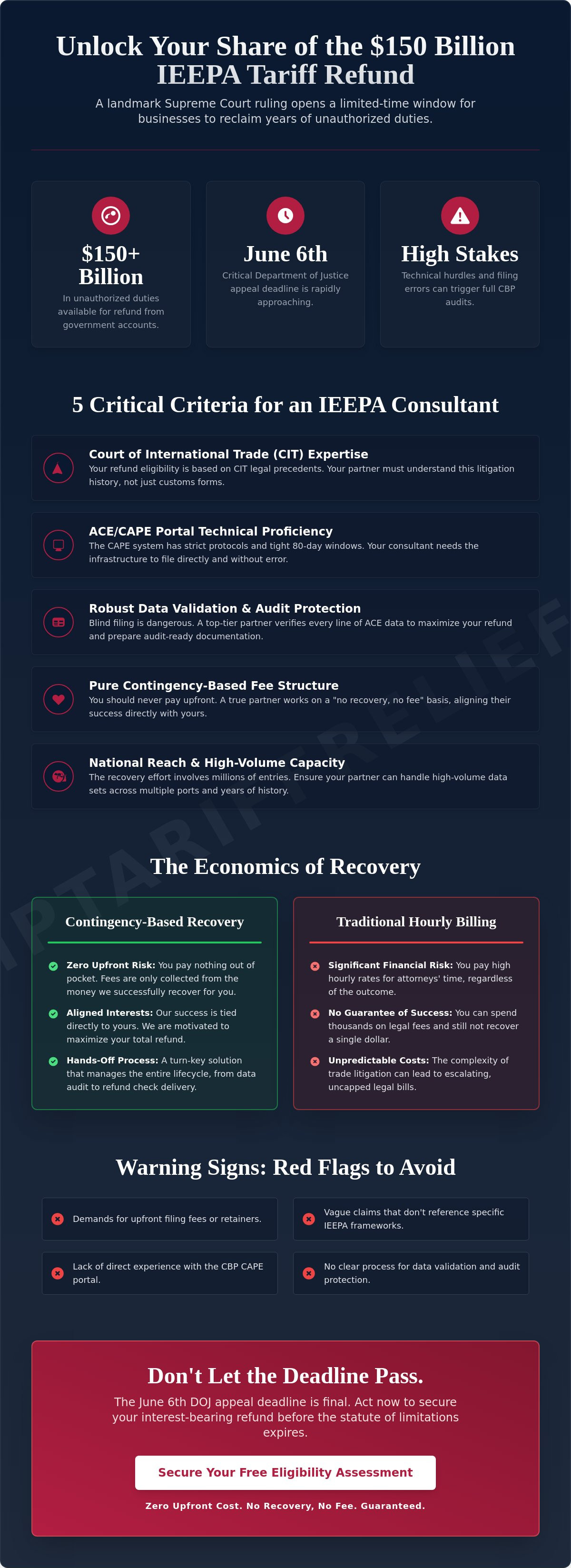
Selecting an IEEPA tariff refund consultant isn't just a procurement decision; it's a strategic move to reclaim capital that was never legally owed. The $150 billion pool of collected duties has attracted many generalists, but the technical nature of the CAPE portal requires a surgical approach. You need a partner who understands that recovery isn't a standard entry correction. It's a specialized litigation-recovery hybrid that demands specific credentials to succeed before the June 6 DOJ appeal deadline.
First, verify their experience with the Court of International Trade (CIT) filing process. While you might not be a named party in the original litigation, your eligibility hinges on those legal precedents. Second, technical proficiency in the ACE/CAPE portal is non-negotiable. Since only the Importer of Record or an authorized broker can submit these declarations, your consultant must have the infrastructure to manage these filings directly within the government's exclusive environment.
Third, look for robust data validation protocols. With over 34 million entries affected, the risk of over-claiming is real. A legitimate partner will perform a thorough tariff eligibility assessment before submitting a single claim. Fourth, insist on a transparent, contingency-based fee structure. You shouldn't pay for the privilege of identifying your own money. Finally, ensure they have the national reach to handle high-volume data sets across multiple ports and years of import history.
Data Integrity and Audit Protection
Customs data validation is the most significant hurdle in Phase 1 recovery. Blind filing without verifying which entries are liquidated versus unliquidated is a recipe for a CBP audit. A top-tier consultant doesn't just pull reports; they clean and verify every line item. They prepare audit-ready documentation for every claim, ensuring that if CBP questions a specific HTS code or entry date, the evidence is already compiled. This proactive stance protects your corporate compliance record while accelerating the 60 to 90-day refund timeline.
The Importance of CIT Litigation Knowledge
Even if your business didn't file an individual protest, your IEEPA tariff refund consultant must understand the ripple effects of the Learning Resources decision. Different tariff lists may be treated differently as the June 6 appeal deadline approaches. A consultant with deep CIT knowledge can anticipate these shifts and adjust your strategy accordingly. They should also be prepared to handle formal protests if a claim is initially denied, providing a layer of advocacy that a standard internal broker simply isn't equipped to offer. This specialized expertise is what separates a successful recovery from a rejected declaration.
Contingency vs. Hourly: The Economics of Tariff Recovery
Securing a refund for unauthorized duties shouldn't require a second financial blow to your balance sheet. For many US importers, the decision between hiring a traditional trade law firm and a specialized IEEPA tariff refund consultant comes down to how risk is distributed. Traditional firms often demand rates exceeding $500 per hour, regardless of whether a single dollar is ever recovered. This creates a misaligned incentive where the professional is paid for the process, while the importer bears the entire financial burden of a potentially unsuccessful claim.
An elite IEEPA tariff refund consultant operates on a success-based model. This contingency framework aligns the consultant’s goals perfectly with your own: they only profit when you receive your refund. By removing the barrier of upfront costs, this model allows businesses to pursue the full scope of their 34 million eligible entries without draining current cash flow. If the consultant doesn't win, you don't pay. This partnership turns a complex legal recovery into a low-risk, high-reward financial maneuver.
Hidden Costs to Avoid in Consultant Agreements
Not all contingency agreements are created equal. You must scrutinize the fine print for "administrative fees" or "data processing charges" that some firms attempt to bake into the early stages of a claim. A legitimate recovery partner handles the heavy lifting of the ACE data audit using their own capital and resources. Ensure your contract includes a strict "No Recovery, No Fee" clause. Additionally, clarify that the success fee applies to the total amount recovered, including the statutory interest. With CBP paying approximately 6% interest on refunded duties, this interest can represent a significant portion of your total recovery and should be managed transparently from day one.
Why Hourly Billing Can Stall Your Claim
Hourly billing naturally rewards duration over results. In the fast-moving 2026 landscape, where the June 6 DOJ appeal deadline creates a narrow window for action, you can't afford a partner who moves at the pace of billable hours. Hourly firms often lack the incentive to invest in the high-speed data auditing software required to process thousands of entries simultaneously. They may get bogged down in the administrative burden of tracking time rather than aggressively pursuing the CAPE portal filing. Specialized consultants, conversely, are motivated to move with professional urgency. They invest their own capital into the audit process because they are confident in the recovery outcome, ensuring your claim is submitted well before the three-year statute of limitations expires.
Red Flags: When to Walk Away from a Recovery Firm
The $166 billion pool of potential refunds has created a modern gold rush. While the Supreme Court's February 20 decision opened the door for legitimate recovery, it also invited predatory actors into the trade space. A legitimate IEEPA tariff refund consultant will never use vague language. If a firm references "general government relief" or "secret tariff programs" without specifically citing the Learning Resources ruling or the IEEPA framework, walk away. Sophisticated recovery requires sophisticated language. You need a partner who understands the legal mechanics of the CAPE system, not someone selling a generic solution.
Professional urgency is one thing; predatory pressure is another. If a firm demands "initial filing fees" or "setup costs" before performing a comprehensive data audit, they're likely a refund mill. You shouldn't pay for the privilege of being told you're eligible. Legitimacy is found in firms that have a physical US presence and verifiable trade law credentials. Avoid any entity that guarantees a 100% recovery rate before seeing your ACE data. Every claim is subject to Phase 1 and Phase 2 eligibility rules. A seasoned expert knows that guarantees are impossible until the audit is complete. To ensure your business isn't left vulnerable to these pitfalls, you should get a professional IEEPA tariff eligibility assessment from a verified recovery partner.
Identifying "Tariff Scams" in a High-Stakes Environment
The difference between an elite consultancy and a refund mill often comes down to data security. You should never share your ACE portal credentials with unverified third parties. Legitimate recovery involves a formal Power of Attorney (POA). This document allows your IEEPA tariff refund consultant to act on your behalf within the legal bounds of CBP regulations. It establishes a professional chain of command and ensures your corporate identity is protected throughout the recovery lifecycle. If a firm asks for direct login access instead of a POA, it's a critical security risk that could compromise your entire trade history.
The Danger of Automated "One-Click" Filing Services
Automation is a tool, not a solution. Some firms promise "one-click" filing through proprietary algorithms, but IEEPA claims are too complex for a purely automated approach. Misclassifying even a single HTS code in a rush to meet the June 6 appeal deadline can lead to rejected claims or a CBP audit. Algorithms often fail when CBP requests supplemental documentation or clarification on unliquidated entries. You need human expert oversight to ensure every declaration is audit-ready. A manual review process is the only way to catch the nuances that an algorithm will inevitably miss.
- Credential Verification: Ensure the firm has a history of CIT-level trade litigation support.
- Fee Transparency: Walk away if they refuse a "No Recovery, No Fee" model.
- Data Sovereignty: Never hand over master ACE passwords; use the POA process instead.
The Trump Tariff Relief Advantage: National Recovery Experts
Choosing a partner to reclaim your capital requires more than just a legal background; it demands a dedicated engine for recovery. Trump Tariff Relief provides a turn-key, contingency-based solution designed specifically for US importers who've been unfairly burdened by unauthorized duties. As your IEEPA tariff refund consultant, we don't just advise from the sidelines. Our team manages the entire lifecycle of your claim, from the initial deep-dive ACE data audit to the moment the final refund check arrives in your account. We provide a level of specialization in IEEPA and Section 301 recovery that general corporate law firms simply can't match.
Our national scope allows us to serve importers across all industrial sectors without geographic restrictions. Whether you're a high-volume electronics importer or a specialized manufacturer, our infrastructure is built to handle the 34 million entries currently eligible for review. We act as your assertive ally, navigating the technical bureaucracy of the CBP CAPE portal so your internal team can stay focused on core operations. We've positioned ourselves as the active engine in this process, taking on the heavy lifting while you remain the sole beneficiary of the restoration.
Our Proven 3-Step Recovery Process
We've streamlined the path to financial restoration into three distinct phases. This ensures every claim meets the strict standards set by CBP while moving as quickly as the 60 to 90-day processing window allows. If you're ready to begin, our process is designed for maximum efficiency.
- Step 1: Free Eligibility Assessment. We perform a comprehensive tariff eligibility assessment to identify your exact recovery potential. This initial audit comes at no cost to your business, providing a clear roadmap of what's reclaimable.
- Step 2: Expert Documentation. Our trade specialists take over the customs documentation management. We prepare every filing to meet the rigorous CBP standards, ensuring your claim is audit-ready and protected against attestation errors.
- Step 3: Recovery. We manage the CAPE portal process from start to finish. Our team tracks the filing until the refund, including statutory interest, is successfully secured.
Why National Importers Trust Our Contingency Model
Trust is built on shared risk. We take 100% of the financial burden by investing our time, proprietary software, and trade expertise into your claim. Our contingency model means we don't get paid unless you win. This "Righting the Wrong" philosophy drives our advocacy; we believe businesses shouldn't have to pay upfront to recover money that was taken without authorization. With the June 6 DOJ appeal deadline approaching, there's no time for the slow pace of hourly billing. It's time to partner with a high-performing recovery expert that values your bottom line as much as you do. Secure Your Free IEEPA Tariff Refund Assessment Today.
Secure Your Rightful Recovery Today
The $150 billion recovery pool represents more than just a refund. It's a critical opportunity to restore your company's financial health. You now understand that a specialized IEEPA tariff refund consultant is the essential bridge between complex trade litigation and a successful credit in your account. By prioritizing a contingency-based model, you eliminate the risk of high hourly fees while ensuring your ACE and CAPE portal filings are managed with professional precision. Our specialized focus on IEEPA and Section 301 litigation ensures that your recovery is maximized without draining your current cash flow.
The June 6 Department of Justice appeal deadline is approaching quickly. Don't let the complexities of the CAPE system or the fear of a CBP audit prevent you from reclaiming what's yours. We take on 100% of the financial risk and the administrative burden, managing the entire lifecycle of your claim from data audit to final payment. Your business deserves the restoration of these unauthorized duties. Take the first step toward reclaiming your capital with an expert advocate by your side.
Get Your Free IEEPA Eligibility Assessment Now
It's time to right this financial wrong and secure the capital your business deserves. We're ready to help you win.
Frequently Asked Questions
Is the IEEPA tariff refund actually real?
Yes, the refund is legitimate and supported by the February 20, 2026, Supreme Court ruling in Learning Resources, Inc. v. Trump. U.S. Customs and Border Protection officially launched the Consolidated Administration and Processing of Entries (CAPE) system on April 20, 2026, specifically to facilitate these payments. With over $150 billion collected in unauthorized duties, the mechanism for recovery is now active and exclusive to the CAPE portal.
What is the deadline to file for an IEEPA tariff refund in 2026?
Importers should prioritize the June 6, 2026, deadline, which is the final date for the Department of Justice to file an appeal. Additionally, Phase 1 eligibility is restricted to entries liquidated within 80 days of the refund claim submission. Because the system is phased, waiting too long could move your entries into more complex, later stages of recovery or cause you to miss the three-year statute of limitations.
How much does an IEEPA tariff refund consultant cost?
Most specialized firms operate on a contingency fee basis rather than charging upfront. This means the IEEPA tariff refund consultant only receives a success fee once the refund is actually paid into your account. This model aligns the consultant's interests with yours, as they're motivated to maximize the total recovery, including the 6% statutory interest, without imposing financial risk on your business.
Can my internal customs broker handle the IEEPA refund claim?
While your broker can technically access the ACE portal, they may lack the specialized litigation software and reliquidation experience required for these specific claims. A standard broker focuses on current compliance and port logistics. An IEEPA tariff refund consultant is built for retroactive recovery, using advanced data auditing to identify errors across 34 million potentially eligible entries that a traditional broker might overlook.
What documents do I need to provide for a tariff refund audit?
You typically need to provide your HTS codes, entry summaries, and authorized access to your ACE data reports. A formal Power of Attorney (POA) is also required so your consultant can legally submit declarations through the CAPE system. Having these documents ready allows for a rapid data audit, which is the first step in verifying your total refund potential before the 80-day Phase 1 window closes.
How long does it take for CBP to process an IEEPA refund through the CAPE portal?
CBP estimates a processing time of 60 to 90 days from the moment a claim is accepted to the final electronic payment. Payments are made via ACH, so importers must have valid banking information on file within the ACE portal. This timeline is relatively fast compared to traditional protests, provided the initial filing is free of attestation errors that could trigger a manual audit.
What is the difference between Section 301 and IEEPA tariff refunds?
Section 301 tariffs are specific duties often associated with the China trade war, while IEEPA tariffs were imposed under the International Emergency Economic Powers Act. While both involve significant duty amounts, the current refund opportunity stems specifically from the Learning Resources decision regarding IEEPA authority. A qualified consultant will perform a tariff eligibility assessment to distinguish between these categories and identify every reclaimable dollar.
Are there any upfront costs to starting a claim with Trump Tariff Relief?
There are zero upfront costs to initiate a claim with our team. We operate on a pure contingency model, meaning we invest our own capital and expertise into the data audit and filing process. You don't pay a fee unless we successfully recover your unauthorized duties. This approach removes all financial barriers, allowing you to pursue a full recovery with total confidence.
Ready to find out what your business may be owed?
Check My Eligibility