
What if the duties your company paid aren’t covered by the refund process you’ve heard about? For businesses searching “cbp tarrif refunds,” the key is to identify which tariff authority applies. CBP’s current process addresses qualifying duties imposed under IEEPA, not every tariff on an import. Section 301 duties, for example, don’t become refundable through CAPE simply because they were paid on the same entry.
After the Supreme Court’s February 20, 2026 ruling, CBP began administering IEEPA refunds through CAPE, a system in the ACE Portal. Potential recovery depends on the duty paid, the entry’s status, and the applicable CAPE phase. Refunds are issued electronically by ACH, so ACE access and banking details matter as well. Because filing instructions can change and unsolicited refund pitches circulate, verify requirements through official CBP channels and organize records before acting.
This guide explains which duties the IEEPA process covers, how CAPE’s phases affect entries, and what the process doesn’t establish about other duties. It also outlines the entry, payment, and account details to gather when assessing a potential recovery claim. First, we’ll distinguish IEEPA duties from other tariffs, then walk through the process and practical preparation steps.
Key Takeaways
- For cbp tarrif refunds, first identify whether the duties were imposed under IEEPA. Other customs duties aren’t automatically covered.
- Compare each entry’s status with the current CAPE phase before assessing whether it may be included in the refund process.
- Gather entry summaries, duty-payment records, Importer of Record details, and broker information for an eligibility review.
- Verify ACE access and refund banking instructions through official CBP channels, and retain records of filing activity.
- Specialist support can help assess potential eligibility, manage customs documentation, and handle government filings. CBP determines validation and payment.
What Are CBP Tariff Refunds, and Which Duties Are They About?
For businesses asking whether cbp tarrif refunds could apply to them, start by identifying the legal authority behind the duty, not just the amount paid. The current CBP refund program concerns qualifying duties imposed under the International Emergency Economic Powers Act (IEEPA), subject to applicable authority and CBP validation. It does not create a general refund for every customs duty listed on an entry.
What does “CBP tariff refund” mean in this context?
CBP’s IEEPA refund program processes qualifying IEEPA duties under applicable legal authority, with refunds subject to CBP validation. This describes the program’s scope in CBP’s current IEEPA tariff refund fact sheet. On February 20, 2026, the Supreme Court ruled that IEEPA did not authorize the president to impose tariffs. CBP administers the resulting refund process, but the duty type and entry details still determine whether a potential refund fits the program.
This program is distinct from other customs refund mechanisms. For example, duty drawback generally concerns refunds of duties on imported goods that are later exported. It provides useful background on duty refunds, but it is not the IEEPA refund pathway described here.
CBP’s fact sheet and operational updates are the key references for current program details. Check the issue date on each update because procedures can change. The program information described here reflects the research status as of October 2026.
Are IEEPA refunds the same as Section 301 tariff refunds?
No. IEEPA and Section 301 are separate legal authorities, so duties imposed under one aren’t interchangeable with duties imposed under the other. The IEEPA refund process does not automatically establish that Section 301 duties qualify for repayment. If an entry includes multiple duty types, review the tariff and payment records separately rather than treating the total duty paid as a single refund claim.
A business may have paid IEEPA duties on an entry that also carried separate duties. The IEEPA process addresses only its qualifying scope; other duty programs have their own applicable authority and procedures. For background on the ruling behind this refund pathway, read the IEEPA tariff ruling explained. Correctly identifying the duty category is the first step in assessing potential recovery. It doesn’t guarantee that CBP will validate or pay a claim.
How CBP’s CAPE Refund Pathway Connects to the ACE Portal
For eligible entries, CBP processes IEEPA refund requests through CAPE, the Consolidated Administration and Processing of Entries system within the ACE Portal. CAPE is designed to consolidate refund processing across entries instead of requiring a separate refund request for each one. The Federal Register’s rule on consolidated administration and process of entries provides the formal background for this approach.
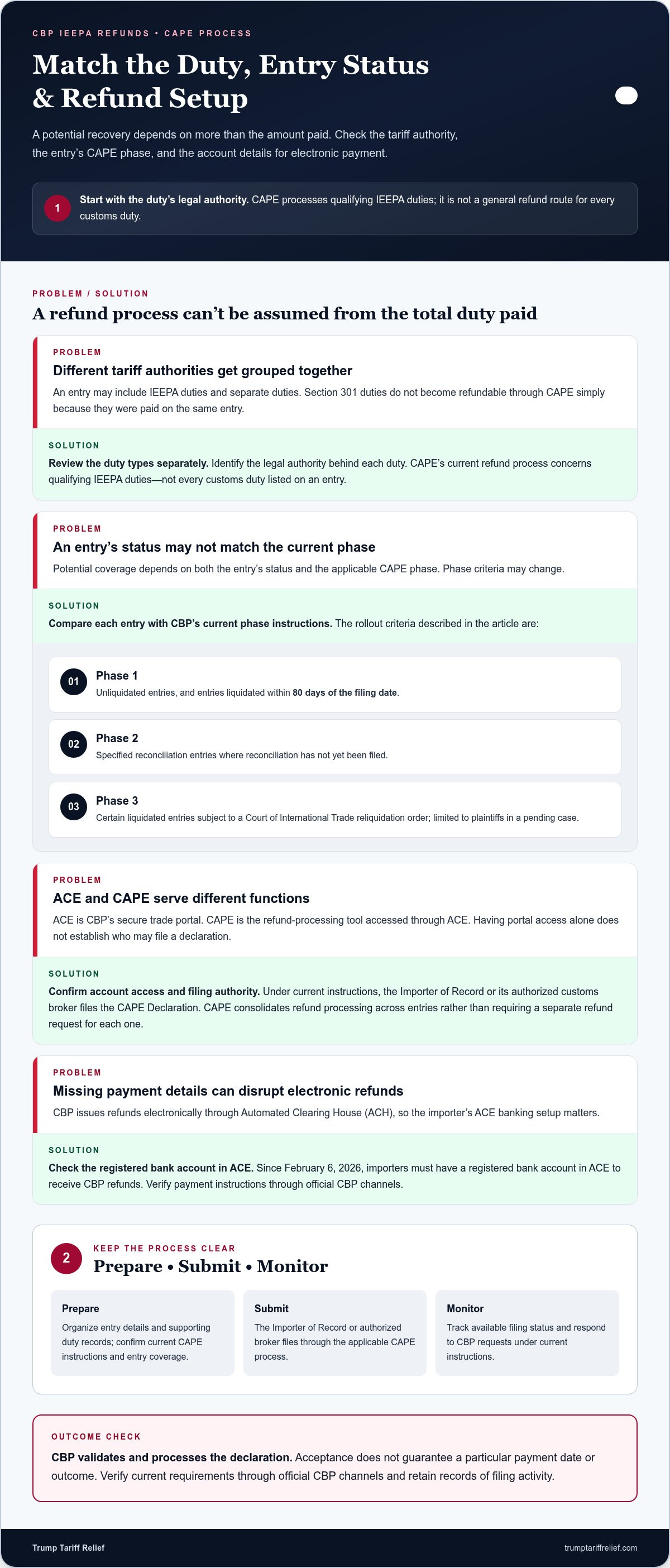
ACE is CBP’s secure trade portal, while CAPE is the refund-processing tool accessed through it. They’re connected, but they serve different functions. A business needs appropriate ACE access and account roles to manage its information and handle a declaration. Under current instructions, the Importer of Record or its authorized customs broker files the CAPE Declaration. Specialist support can help organize records and manage documentation or filing work, but it doesn’t replace CBP’s portal or review.
Prepare, submit, and monitor the declaration
Before filing, assemble the relevant entry information and confirm current CAPE instructions and entry coverage through CBP’s official channels. Preparing the underlying records takes care, but the main steps are clear:
- Secure ACE access. Confirm the account access and user authority needed for the work.
- Prepare entry information. Organize entry details and supporting duty records for the declaration.
- Submit as instructed. The Importer of Record or authorized broker files through the applicable CAPE process.
- Monitor the filing. Track available status information and respond to CBP requests under current instructions.
CBP’s rollout has been phased. As of October 2026, Phase 1 covers unliquidated entries and entries liquidated within 80 days of the filing date. Phase 2 covers specified reconciliation entries where reconciliation hasn’t yet been filed. Phase 3 covers certain liquidated entries subject to a Court of International Trade reliquidation order and is limited to plaintiffs in a pending case. These criteria may change, so consult CBP’s latest CAPE updates before relying on a phase description.
How refunds are issued
CBP issues refunds electronically through Automated Clearing House (ACH). Since February 6, 2026, importers must have a registered bank account in ACE to receive CBP refunds. Verify account details and payment instructions through official CBP channels, not through an unsolicited message. After submission, CBP validates and processes the declaration. Acceptance does not guarantee a particular payment date or outcome.
For help organizing the administrative work around a potential recovery, review how the recovery process works. This support is separate from CAPE itself: CBP retains control of validation and refund issuance.
Which Entries May Fall Within CBP’s Refund Scope?
Potential coverage depends on more than whether a company paid import duties. For cbp tarrif refunds through CAPE, the duty must fall within the IEEPA program’s scope, and the entry must meet the requirements of the phase in effect. The table summarizes CBP’s phase information as of October 6, 2026. Check current CBP instructions before acting because program details can change.
| Duty type | Entry status | Current CAPE coverage |
|---|---|---|
| Qualifying IEEPA duties | Unliquidated | Covered in Phase 1. |
| Qualifying IEEPA duties | Liquidated within 80 days of CAPE filing | Covered in Phase 1, subject to current CBP instructions. |
| Qualifying IEEPA duties | Entry types 01, 02, or 06 flagged for reconciliation, with no reconciliation entry filed | Included in Phase 2. |
| Qualifying IEEPA duties | Liquidated entry with a Court of International Trade order for reliquidation | Phase 3 is limited to importers who are plaintiffs in a pending CIT case. |
| Section 301 or other non-IEEPA duties | Any status | Not covered through the IEEPA CAPE pathway merely because duties were paid. |
How can entry status affect a potential refund?
An unliquidated entry is one for which CBP hasn’t completed liquidation, the process that finalizes the duty calculation. A liquidated entry has been finalized. This distinction can affect which CAPE route applies and whether a time-sensitive step or separate court-related condition matters. The 80-day threshold above is a current Phase 1 rule, not a universal deadline for every entry or claim.
Match each entry number to its liquidation status and any reconciliation or court-related history before drawing conclusions. Don’t rely on an older analysis or apply a threshold outside its CAPE phase. Use CBP’s latest notices to confirm the relevant coverage and instructions.
Does every importer or tariff payment qualify?
No. Paying a tariff doesn’t establish eligibility for this IEEPA refund process, and a company’s industry alone doesn’t determine whether an entry is covered. The Importer of Record (IOR), entry details, duty type, and status all matter. The IOR or its authorized customs broker handles the CAPE Declaration, so confirm who is identified on the entry and who has filing authority.
Reviewing records entry by entry helps distinguish potentially relevant IEEPA duties from other charges and identify missing documentation. For a broader explanation of the factors involved, see the tariff refund eligibility assessment guide. An assessment can clarify potential fit, but CBP controls validation and any refund decision.
What Should a Business Prepare Before Pursuing a CBP Refund?
Start with records that clearly connect the importer, the duties assessed and paid, and the entry associated with each payment. For businesses evaluating cbp tarrif refunds, organizing this information can make an eligibility review more efficient and reveal gaps before a CAPE filing is prepared. The specific documents and steps depend on the entry and current CBP instructions.
Which records help organize a potential claim?
Create a working file for each potentially relevant entry. Group documents by entry number, then compare importer, duty, and payment details across records. A practical checklist includes:
- Entry summaries and available entry-level records identifying the goods, duties, and Importer of Record.
- Duty-payment evidence, such as payment records that can be matched to the corresponding entry.
- Broker records, including relevant correspondence and filing details that clarify who handled the entry.
- Importer identifiers and authorization records that help establish the responsible Importer of Record and any authorized filing role.
These records support a review; they aren’t a universal list of mandatory attachments. Requirements depend on the entry and the latest CAPE instructions. Resolve mismatches, such as a payment that can’t be clearly connected to an entry or inconsistent importer details, rather than assuming the records will align automatically. For more preparation guidance, see the answers to common IEEPA refund questions.
How can importers avoid refund scams and preventable delays?
CBP warns importers about fraudulent messages seeking sensitive company or personal information. Treat unexpected refund emails, texts, and links with caution. Don’t follow a link in an unsolicited message. Instead, access ACE and CBP resources directly through official channels. Never share account credentials or banking details in response to an unexpected request.
CBP refunds are issued electronically through ACH, and importers need a registered bank account in ACE to receive payment under current requirements. Verify account access, user roles, and refund banking instructions through CBP’s official systems. Keep internal records of who can access the account and who is authorized to act for the Importer of Record.
Trump Tariff Relief brings eligibility review, customs documentation, and government filings together in a managed recovery process. Explore IEEPA tariff refund recovery support to understand how the process can help your business prepare. CBP retains control of validation and payment decisions.
How Specialist Support Can Help Navigate CBP Tariff Refunds
Understanding CAPE is one part of the work. Coordinating entry reviews, records, and filing tasks across a business is another. Specialist support can bring these tasks together, giving your internal team a clearer view of potential recovery and the work involved in pursuing it. The aim is organized, well-supported administration, not a promise of a refund.
What work can a tariff recovery specialist handle?
For businesses assessing cbp tarrif refunds, a specialist can review entry information for potential IEEPA eligibility, organize customs documentation, and manage government filing work. This includes connecting entry records with duty information, identifying documentation gaps, and coordinating the administrative steps needed to prepare a submission under current instructions.
This focused support can reduce the claim administration handled by import, finance, and compliance teams, particularly when records span multiple entries or departments. It also keeps eligibility assessment, documentation, and filing preparation aligned instead of treating them as separate tasks.
CBP retains the decision-making authority. A specialist can prepare and manage the work, but CBP determines whether a filing meets its requirements, validates the information, and issues any refund. Engaging a specialist doesn’t guarantee eligibility, approval, a particular recovery amount, or timing.
How does contingency-based recovery reduce upfront commitment?
The recovery service operates on a contingency basis, with no upfront costs. If funds are successfully recovered, the fee is a percentage of the amount recovered. The service arrangement sets out the specific fee terms. This structure doesn’t prevent CBP from declining or limiting a claim, and it doesn’t assure a recovery.
Because the service fee is tied to successful recovery, the business doesn’t pay an upfront consulting fee or hourly billing during the filing process. Specialist support can manage eligibility assessment, customs documentation, and government filings. The fee arrangement concerns how the service is paid, not how CBP decides the claim.
If your business paid IEEPA duties and wants a structured review of potential eligibility, begin an IEEPA tariff refund assessment. The assessment can clarify practical next steps while keeping administrative support distinct from CBP’s independent decision.
Turn Your Refund Review Into a Clear Next Step
Potential cbp tarrif refunds depend on the duty type and the entry’s status under the current CAPE phase. IEEPA duties aren’t interchangeable with Section 301 or other customs duties, and payment alone doesn’t establish eligibility. Organized entry, duty-payment, Importer of Record, and ACE account records help prepare your business for an informed review.
Trump Tariff Relief manages potential eligibility assessment, customs documentation, and government filings, while CBP retains authority over validation and payment. The service has no upfront costs; its fee is a percentage of refunds successfully recovered. This arrangement doesn’t guarantee that a claim will be approved or funds recovered.
If your business wants to assess its potential IEEPA recovery and identify a practical path forward, request an IEEPA tariff refund assessment. With organized records and focused support, you can approach the process with greater clarity.
Frequently Asked Questions
Is CBP currently issuing refunds for IEEPA tariffs?
Yes. CBP is processing potential refunds for qualifying IEEPA duties through CAPE, subject to applicable authority, entry coverage, and CBP validation. Paying IEEPA duties alone doesn’t establish eligibility or guarantee payment. The available route can depend on an entry’s status and the current CAPE phase, so review CBP’s latest instructions before preparing or submitting a declaration.
Can a business get a CBP refund for Section 301 tariffs?
Section 301 duties aren’t automatically refundable through the IEEPA CAPE process. They arise under a separate tariff authority, so a ruling or refund procedure concerning IEEPA duties doesn’t by itself determine whether Section 301 duties can be recovered. If an entry includes multiple duty types, review them separately. Don’t treat the total amount paid as a single IEEPA refund claim.
What is CAPE, and how does it relate to the ACE Portal?
CAPE, or Consolidated Administration and Processing of Entries, is CBP’s tool for processing IEEPA refund declarations. It operates within ACE, the Automated Commercial Environment secure trade portal. ACE provides the portal and account access; CAPE provides the refund-processing pathway. Importers should confirm they have appropriate account access and follow CBP’s current instructions for preparing and monitoring a declaration.
Who can submit a CAPE Declaration for an IEEPA duty refund?
The Importer of Record or its authorized customs broker can submit a CAPE Declaration under current CBP instructions. The Importer of Record is the party identified as responsible for the imported goods on the entry. Confirm those details in the entry records and establish filing authority before proceeding. A specialist may assist with eligibility assessment, documentation, and filing work, but CBP retains control of validation and payment decisions.
What documents should an importer gather for a CBP tariff refund?
Start with entry summaries, duty-payment records, Importer of Record identifiers, and relevant customs broker records or correspondence. Match each document to the applicable entry so discrepancies are easier to spot. These records are useful for review, but they aren’t a universal list of required CAPE attachments. The information needed depends on the entries involved and CBP’s current filing instructions.
How long does CBP take to process an IEEPA refund?
CBP’s current guidance, as summarized in the October 2026 research for this article, states that valid IEEPA refunds are generally issued within 60 to 90 days after a CAPE Declaration is accepted. This range isn’t a guaranteed payment date. Processing depends on CBP’s review and the declaration. Check current CBP updates for the latest information, and distinguish acceptance for processing from final validation and payment.
How can a business tell whether a CBP tariff refund message is a scam?
Be cautious of unexpected messages that request sensitive company or personal information, account credentials, or banking details, or urge you to follow an unfamiliar link. CBP warns importers about fraudulent messages seeking sensitive information. Don’t use links in unsolicited messages to access ACE. Go directly to official CBP systems to verify instructions or account notices, and don’t share credentials in response to an unexpected request.
Ready to find out what your business may be owed?
Check My Eligibility