
What if a customs form in your files shows how an import entry was reported, but doesn’t prove that a tariff was paid or that a refund is due? That distinction is central to understanding what is CBP Form 7501 Entry Summary. Importers can find its identifiers, values, and duty fields difficult to interpret, especially when checking past entries for accuracy or possible recovery.
Form 7501 is a structured entry record, not a payment receipt or refund decision. It summarizes information used in customs processing and duty accounting, but it does not by itself confirm that an amount was paid or that CBP approved a refund. This guide explains the form’s role, how to locate key details such as importer and entry identifiers, and how to compare its figures with related records. If you’re reviewing IEEPA-related entries, Form 7501 can help identify transactions for a broader document review, but it cannot establish eligibility on its own.
Key Takeaways
- Understand what is CBP Form 7501 Entry Summary and how it fits into import processing and duty accounting.
- Learn where to find key identifiers, dates, importer details, and duty-related information on the form.
- See how entry summaries differ from release records, payment evidence, and liquidation information.
- Use a practical sequence to match Form 7501 details with shipment records and flag discrepancies.
- Learn how entry-level data can support an IEEPA tariff review, while recognizing that the form alone cannot establish refund eligibility or outcome.
What Is CBP Form 7501 Entry Summary and What Is It For?
If you’re asking what is CBP Form 7501 Entry Summary, it’s the entry summary for a U.S. import entry. It records key information about imported goods for customs processing and duty accounting, connecting the reported details of an entry with the duties and fees calculated for it.
CBP Form 7501 is a customs record summarizing an import entry and its reported details for customs processing and duty accounting. It is associated with U.S. Customs and Border Protection (CBP), the federal agency responsible for administering customs and border processes. Importers use the form as a structured record to review and compare with shipment documents.
Form 7501 is not, by itself, a complete receipt showing that every reported amount was paid, nor is it a refund approval. A duty figure on the form is an entry detail, not proof of payment or a decision about recovery. Those questions may require other records and a review of the entry’s circumstances.
Who prepares or files an entry summary?
The importer of record is responsible for the import and the accuracy of the entry information. When authorized, a customs broker may prepare and transmit entry data on the importer’s behalf. The broker’s role in submitting information does not make the broker the importer of record. Keep that distinction clear when organizing records or identifying the party associated with an entry.
When does Form 7501 appear in the import process?
Form 7501 generally appears after the initial entry process has begun and the goods have been presented for customs processing. Release documentation, such as CBP Form 3461 where applicable, serves a different purpose: it relates to release of the goods. The entry summary provides more detailed information for customs processing and duty accounting.
Further CBP processing may follow, including liquidation, the final computation of duties. The sequence and timing can depend on the entry and current requirements, so don’t assume the same timeline applies to every shipment. Match the form to the correct entry, then review it alongside the commercial and shipping documents for that transaction.
How to Read the Main Sections of a CBP Form 7501
Begin with the importer of record, entry identifiers, and dates. These details help you connect the summary to the correct shipment before reviewing its classification, value, or duty information. Form labels and layout can vary by revision, so use the current official form and instructions rather than relying on remembered box numbers.
Which identifiers help you find a specific entry?
The importer number identifies the importing party in customs records. The entry number identifies a particular entry, while dates and port information help distinguish it from other transactions. Use these details together to cross-reference the form with company shipment files, accounting records, and supporting documents.
Entry identifiers connect a Form 7501 summary to a specific import transaction, making it possible to match the customs record with the shipment and its supporting paperwork. Before relying on the document, check that the importer and entry details are consistent across records. If your company has multiple entries for the same supplier or shipment period, use the entry number to avoid mixing them up.
Where do classification, value, and duty details appear?
Line-level details typically include the goods’ tariff classification under the Harmonized Tariff Schedule of the United States (HTSUS), entered value, and duty-related amounts. Read these fields together. Classification depends on the product and applicable rules, while value and duty calculations depend on the entry’s facts and the requirements that apply. The governing customs framework is set out in Title 19 of the Code of Federal Regulations.
Compare the form’s details with commercial invoices, packing information, and other source records. A figure on the form is a reported entry detail. On its own, it is not proof of payment, a legal classification determination, or a final refund calculation.
Illustrative example: Suppose you’re reviewing an entry for a product category your company imports regularly. First, use the importer and entry identifiers to locate the matching shipment file. Then compare the product description and entered value with the source documents, and review the tariff classification and duty lines in that context. This example includes no actual shipment or duty figures and does not determine a classification or refund amount.
If a field doesn’t match the underlying documents, flag the discrepancy rather than assuming which record is correct. For a broader review, customs documentation can be assessed alongside the other records relevant to eligibility and recovery.
Form 7501 vs. Entry, Payment, and Liquidation Records
Import records can look similar because they refer to the same transaction, but each answers a different question. If you’re asking what is CBP Form 7501 Entry Summary in relation to those records, think of it as the entry-summary record. It reports details of an import entry, but does not by itself confirm every payment or later change to the duty calculation.
| Record | What it generally shows | What not to assume |
|---|---|---|
| Form 7501 | Entry-summary information, including reported goods, value, classification, and duty-related details. | That every amount shown was paid, or that a refund or adjustment has been approved. |
| Entry or release record | Information associated with an entry or the release process. A release record, such as Form 3461 where applicable, serves a different function from the entry summary. | That release documentation contains the full entry-summary details or proves payment. |
| Payment evidence | Records that help show a duty payment was made or processed, such as relevant accounting or transaction records. | That a Form 7501 duty line alone confirms a payment cleared. |
| Liquidation information | CBP’s later determination of the final duty calculation for an entry. | That the original summary and the later liquidation status are identical or interchangeable. |
Does Form 7501 prove that customs duties were paid?
No. The form may report duty amounts associated with an entry, but a reported amount is not evidence that funds were paid and processed. To verify payment, compare the entry summary with relevant accounting records or other official transaction information available to your business. Match records using the same entry identifiers so a payment isn’t mistakenly linked to another shipment.
What is liquidation, and how does it relate to the summary?
Liquidation is CBP’s final computation of duties for an entry. It is a later stage of processing, distinct from the entry summary, which records information reported for the import entry. Liquidation information can therefore provide a separate part of the entry’s history. Check the applicable CBP status and documentation rather than treating Form 7501 as proof of a particular liquidation outcome.
For a complete picture, connect the records by entry number and review them together: the summary shows reported entry details, payment records help establish whether funds were processed, and liquidation information reflects CBP’s later duty determination. None substitutes for the others. In a tariff-focused review, Form 7501 is one useful document in the broader file, but it does not establish refund eligibility, amount, or outcome by itself.
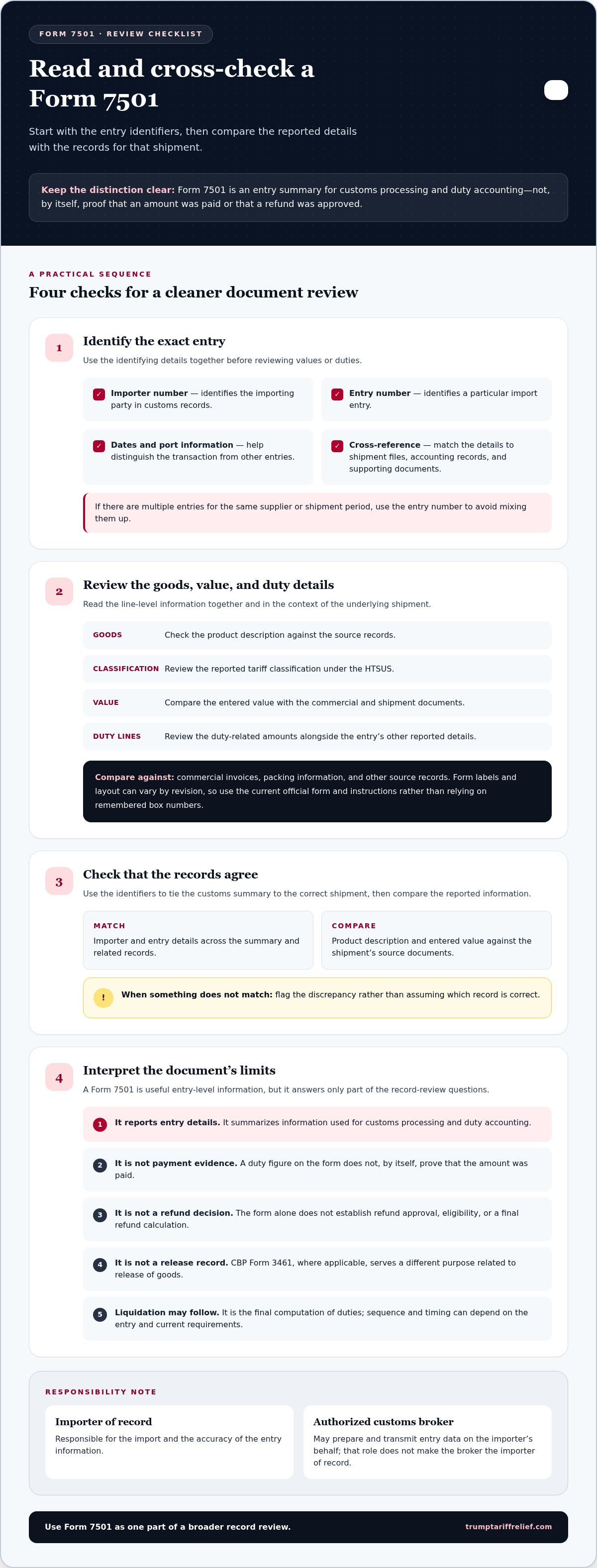
How to Find, Check, and Organize Form 7501 Records
A consistent review process makes it easier to spot missing documents and mismatched entry details before they complicate an accounting or tariff review. Start with the records your business holds, then reconcile each summary against the shipment paperwork for that entry.
- Locate the summary. Check company customs files, records provided by your customs broker, and applicable official systems. Access steps can vary, so follow the current procedures for the system or account you use.
- Confirm the identifiers. Match the importer identity, entry number, dates, and port information to your internal shipment records.
- Compare the shipment details. Review the merchandise description, value, classification, and duty details alongside invoices, transport documents, and payment evidence where available.
- Flag differences. Note missing pages, inconsistent identifiers, or details that don’t align with source documents. Record what differs and which supporting document you used for comparison.
What should you check when reviewing a summary?
Check for consistency across the importer identity, entry identifiers, merchandise description, entered value, classification, and duty lines. For example, if the commercial invoice describes goods differently from the summary, keep both records and flag the mismatch for review. A discrepancy is a reason to investigate the file, not proof by itself of an error, overpayment, or refund eligibility.
Group records by entry rather than by supplier alone. This makes it easier to trace each Form 7501 to its related invoice, transport paperwork, and payment record without confusing separate shipments from the same supplier.
What if a Form 7501 is missing or contains an error?
If you can’t locate a summary, check your company’s customs files, records provided by the customs broker, and applicable CBP channels using their current access procedures. If you find a potential error, preserve the original document and note the specific field, the conflicting source record, and why it needs review. Don’t alter the original or assume that one correction process or deadline applies to every entry. The appropriate next step depends on the entry’s facts and current requirements.
For broader file preparation, see this IEEPA tariff refund document checklist. If you’re organizing entries for a tariff-focused review, review how the documentation review process works so each record can be considered in context.
Why Form 7501 Can Matter in an IEEPA Tariff Review
For an IEEPA tariff review, Form 7501 helps organize the inquiry at the entry level. Its identifiers and reported details can help reviewers locate a specific import transaction and identify duty lines for closer examination. It is a supporting record, not a decision about whether a tariff applied or money is recoverable.
The key question isn’t simply whether a Form 7501 exists. It’s whether the entry’s facts and supporting records align with the tariff rules and procedures relevant to that transaction. For background on the policy context, read IEEPA tariff rules explained.
Which details may help identify entries for review?
Entry dates, classification, merchandise descriptions, and duty information can help narrow down which records to examine. A reviewer can use these details to connect an entry summary to invoices and other customs documentation, then assess whether the relevant tariff treatment could apply to that entry. They are starting points for analysis, not a standalone eligibility test.
Tariff applicability depends on the entry-specific facts and current legal analysis. A line item or duty amount on Form 7501 alone doesn’t establish IEEPA coverage, eligibility, a refund amount, or an outcome. Consider each entry in context, including the records supporting its reported description, value, and duty treatment.
What happens after an importer gathers its entry summaries?
Once summaries are assembled, organize and assess them alongside the supporting customs and commercial documents. This review can identify records that need clarification, missing information, or entries that merit further eligibility assessment. It is a documentation and assessment step, not a claim-filing recipe; filing requirements and procedures depend on the circumstances and current instructions.
A useful review keeps the distinction clear: Form 7501 helps identify and understand an entry, while a broader assessment determines whether the record set supports further action. Trump Tariff Relief manages IEEPA tariff refund recovery, including eligibility assessment, documentation, and government filings. Explore how the review process works to see how those steps fit together.
Put Your Entry Records to Work
Knowing what is CBP Form 7501 Entry Summary helps you use the document for what it can do: connect reported entry details with the records behind an import. Its identifiers, classification, value, and duty lines can support a focused review, but the form alone doesn’t prove payment, IEEPA coverage, refund eligibility, or a recovery amount.
Keep each summary organized with its related shipment and payment records, and flag differences for review rather than drawing conclusions from a single field. If you’re assessing past entries, a specialist documentation and eligibility review can bring the records together and determine whether further action may be appropriate.
Trump Tariff Relief focuses on IEEPA tariff refund recovery. The service includes an eligibility assessment and management of customs documentation and government filings. It is contingency-based, with no upfront costs and fees tied to refunds successfully recovered. Explore IEEPA tariff refund recovery and take the next step with your entry records.
Frequently Asked Questions
What is CBP Form 7501 used for?
CBP Form 7501 records the entry summary for a U.S. import entry, including information used in customs processing and duty accounting. If you’re asking what is CBP Form 7501 Entry Summary, it’s best understood as a structured record of reported entry details, not a refund decision. Importers can use it to identify and review an entry alongside supporting shipment documents and other customs records.
Who files CBP Form 7501?
The importer of record is responsible for the accuracy of the import entry information. A customs broker may prepare or transmit entry data on the importer’s behalf when authorized, but transmitting the data doesn’t make the broker the importer of record. Keep this distinction clear when checking who is identified on the summary and organizing records tied to a particular import transaction.
What information is included on an Entry Summary?
An Entry Summary generally includes importer and entry identifiers, dates, port information, merchandise descriptions, tariff classifications, entered values, and duty-related details. The precise labels and layout can depend on the form revision, so use the current CBP form and instructions when checking specific fields. Read the figures in context and compare them with source documents such as invoices and shipping records.
Does CBP Form 7501 prove that duties were paid?
No. Form 7501 may show duty amounts reported for an entry, but those figures alone don’t prove that payment was made or cleared. To verify payment, compare the summary with relevant company accounting records or other official transaction information available to you. Match records using the entry identifiers to reduce the risk of connecting a payment to the wrong shipment.
How can I get a copy of CBP Form 7501?
Start with your company’s customs and shipment files, then check records provided by the customs broker that handled the entry. If the summary isn’t available there, review the applicable CBP channels and their current access procedures. Keep the entry number and importer details nearby to help locate the correct record. Save the summary with its related invoices, transport documents, and payment records where available.
What is the difference between Form 7501 and liquidation?
Form 7501 is an entry-summary record that reports information for an import entry. Liquidation is CBP’s later final computation of duties for that entry. They serve different roles, so the summary shouldn’t be treated as the liquidation record or assumed to show a later final determination. Review the relevant entry history and status information when you need to understand what happened after the summary was filed.
Can Form 7501 show whether an import may qualify for an IEEPA tariff refund?
Form 7501 may help identify an entry and its reported dates, merchandise classification, description, and duty information for a tariff-focused review. But it can’t establish IEEPA coverage, refund eligibility, the amount potentially recoverable, or the outcome by itself. Those questions require review of entry-specific facts, supporting customs documents, and the rules and procedures applicable to the entry.
Ready to find out what your business may be owed?
Check My Eligibility