
What if your company paid the IEEPA tariff, but another business appears as the Importer of Record? If you’re asking, “can I get a refund if I wasn't the IOR,” the answer depends on two separate issues: who may claim a refund from the government and who ultimately bore the tariff cost. That distinction can determine whether your company looks to U.S. Customs and Border Protection (CBP), a supplier, or another business under your agreement.
The February 20, 2026, Supreme Court ruling in Learning Resources, Inc. v. United States established the legal basis for refunds of IEEPA tariffs. But a business that wasn’t the IOR generally can’t file a direct refund claim with CBP. The IOR, or the licensed customs broker that filed the entry, may submit the claim. An IOR may be able to designate another party to receive a refund, but that is different from having the right to file the claim.
This article explains how to use customs entry records, payment trails, and contract terms to clarify your position. You’ll learn what to check, how recovery from another business differs from a CBP claim, and why an individualized review matters before you decide what to do next.
Key Takeaways
- If you’re asking “can I get a refund if I wasn't the IOR,” separate the right to pursue a customs refund from the question of who ultimately paid the tariff cost.
- Check entry and payment records to identify the Importer of Record and trace how tariff charges moved through your supply chain.
- Review purchase orders, supply contracts, and reimbursement terms to see whether they address refunds or tariff costs between businesses.
- Gather relevant documents from your importer, broker, supplier, or finance team before assessing possible recovery routes.
- A case-specific eligibility assessment can help distinguish customs-record issues from contractual recovery questions. No outcome is assured without an individualized review.
Can a business get an IEEPA tariff refund if it was not the Importer of Record?
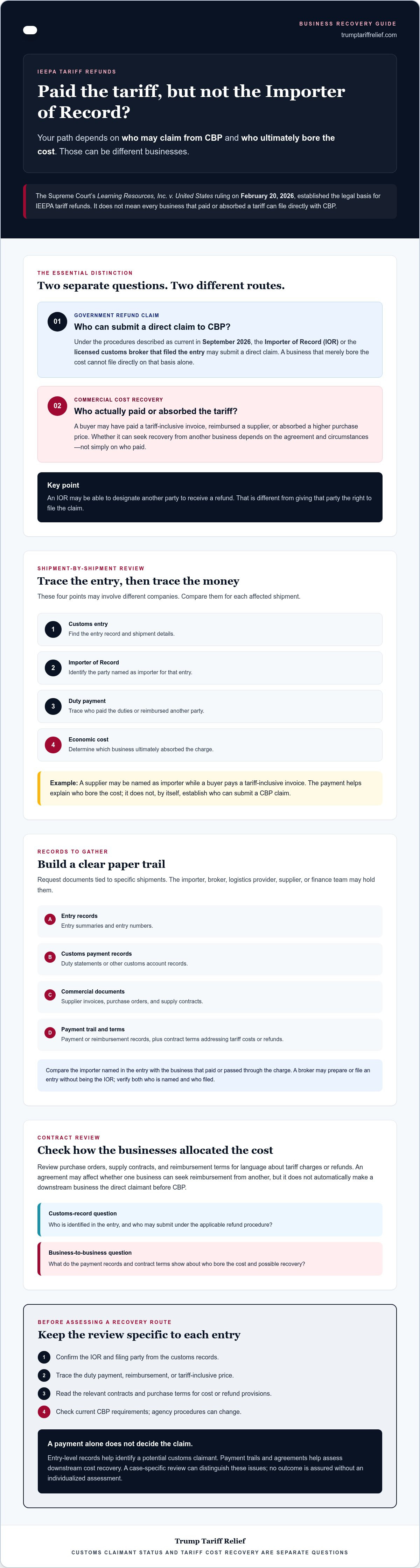
Not being the Importer of Record (IOR) doesn’t, by itself, resolve every recovery question. It does matter when determining who may seek a refund directly from U.S. Customs and Border Protection (CBP). A purchaser or downstream business may have absorbed tariff costs through a tariff-inclusive price or a reimbursement to its supplier, even if a different company is named in the customs entry. Those facts have separate implications.
For IEEPA duties, direct claim eligibility depends on the applicable refund procedure and current CBP guidance. Under the procedures described as current in September 2026, the IOR or the licensed customs broker that filed the entry may submit a direct claim. A business that merely bore the cost cannot file directly on that basis alone. Agency procedures can change, so confirm the current requirements before acting. The duties at issue were imposed under the International Emergency Economic Powers Act (IEEPA).
Customs claimant status follows the applicable entry and refund procedure. Downstream responsibility for the tariff cost depends on the commercial relationship. A separate agreement may affect whether one business can seek reimbursement from another, but it doesn’t automatically make the downstream business the direct claimant before CBP.
What does Importer of Record mean in a tariff refund claim?
The IOR is the party identified as the importer in the relevant customs entry, subject to the rules that apply to that entry. Check the entry documents rather than relying on informal descriptions such as “we handled the import.” A broker may prepare or file an entry without becoming the IOR. Because the filing role and the importer’s identity aren’t necessarily the same, verify both who is named and who filed.
Does paying the tariff automatically give your business refund rights?
No. Paying a supplier’s tariff-inclusive invoice, reimbursing an importer, or absorbing a higher purchase price may show that your business bore an economic cost. That alone doesn’t establish a direct right to claim a refund from the government. Whether you can seek reimbursement from another business is a separate question shaped by the relevant contract and circumstances.
For each affected transaction, ask two questions: who appears in the customs record, and what do the business records show about who paid or absorbed the charge? Review entries individually because the IOR, filing party, payment trail, and contract terms can differ across suppliers or shipments. If you’re asking, “can I get a refund if I wasn't the IOR,” the answer requires an entry-level review and a separate look at any potential recovery between the companies involved.
How customs records and IEEPA procedures affect a non-Importer’s claim
Trace each shipment through four points: the customs entry, the Importer of Record named for that entry, the duty payment record, and the business that ultimately absorbed the cost. These may involve different companies. For example, a supplier may appear as the importer while a buyer pays a tariff-inclusive invoice. That payment trail helps explain the commercial relationship, but it doesn’t by itself identify who can submit a claim to CBP.
The customs entry record is the starting point for identifying a potential claimant, not a complete answer to who may recover the tariff cost downstream. Compare it with payment evidence and business agreements to understand the full picture. For background on the underlying authority, see IEEPA tariff authority explained.
Which records identify the importer and tariff payment?
Start by gathering records that connect an entry to the parties and payments involved:
- Entry summaries and entry numbers
- Duty statements or other customs account records
- Supplier invoices and purchase orders
- Payment records showing who paid duties or reimbursed another party
The importer, customs broker, logistics provider, or your finance team may hold these documents. Request records tied to specific shipments, then compare the named importer with the business that paid or passed through the charge. Don’t assume a particular form or data field is required without checking current CBP instructions.
Why the IEEPA refund process needs current verification
The U.S. Supreme Court’s February 20, 2026, ruling in Learning Resources, Inc. v. United States established a legal basis for refunds of tariffs imposed under IEEPA. CBP’s refund process and guidance determine how eligible claims are handled, and those details can change. Review the U.S. Code on International Emergency Economic Powers for the law’s text, and confirm current agency guidance for the refund process.
For a non-IOR, the key issue is whether the current procedure allows your business to file directly, receive a designated refund, or pursue recovery separately from the importer. Entry status, liquidation, protest history, and refund mechanics may affect the options for an entry. Don’t assume one route applies to every shipment. Before acting on “can I get a refund if I wasn't the IOR,” verify the rules for the specific entries and circumstances. A focused review can help organize the records and identify questions for an eligibility assessment.
Who may recover the tariff cost: importer, buyer, or another business?
The company named in a customs entry and the company that ultimately paid the tariff may not be the same. Under the applicable procedure, the importer may be positioned to pursue a customs refund, while a buyer or distributor may need to look to its commercial agreement for repayment. If you’re asking, “can I get a refund if I wasn't the IOR,” non-IOR status may complicate a direct claim, but it doesn’t settle every contractual question.
The federal regulation on legal standing to file a customs protest refers to a person paying a charge or exaction. That provision concerns customs protests. It shouldn’t be treated as automatic eligibility to file an IEEPA refund request under a separate process. Confirm the current procedure and requirements for the specific entries before drawing conclusions.
| Business role | Questions to investigate |
|---|---|
| Importer of Record | Is the business identified on the relevant entry, and what refund procedure applies? |
| Purchaser | Did it pay a tariff-inclusive price or reimburse the importer, and do the terms address refunds? |
| Distributor | Did it absorb or pass through the charge, and what do its customer and supplier agreements say? |
| Related entity | Which affiliate controlled the entry, paid the duty, holds the records, and may act under the current process? |
These are questions to investigate, not findings of eligibility. A broader tariff refund eligibility assessment guide can help you consider entry-level and commercial issues together.
What purchase agreements and invoices can reveal
Review purchase orders, supplier invoices, customs or duty clauses, pass-through charges, and credit arrangements. A contract might address who bears import costs, whether a refund must be shared, or whether one party must cooperate with the other. The wording may shape a buyer’s ability to seek repayment from its counterparty, but don’t assume there is a standard clause or a guaranteed result. The agreement and transaction facts matter.
What if an affiliate or supplier was the Importer of Record?
A related-company structure may involve shared finance or logistics functions, while an independent supplier relationship may be governed by separate purchase terms. In either case, identify who controlled the entry, who paid the duties, and who holds the supporting records. Before an importer, affiliate, or buyer takes action, confirm authority and coordinate requests. This can help reduce the risk of inconsistent submissions or competing expectations about who should receive any recovery.
Trump Tariff Relief’s IEEPA refund recovery process includes eligibility assessment and customs documentation management. A case-specific review can help distinguish a potential customs claim from a separate contractual recovery issue, but it can’t guarantee an outcome.
What if your company wasn't the Importer of Record?
Start with the transactions, not assumptions. If you’re asking, “can I get a refund if I wasn't the IOR,” organize the facts entry by entry. Your company may not be the direct claimant, but identifying who imported, who paid, and what your agreements say can clarify whether there may be a route to recover costs.
- Identify affected entries. Match shipments and invoices to the tariff charges you’re reviewing.
- Confirm the Importer of Record. Check the entry records and ask the importer or broker to clarify any uncertainty.
- Trace the cost. Record who paid the duty, who reimbursed whom, and whether the cost was included in a purchase price.
- Review the agreements. Look for terms addressing duties, refunds, credits, or cooperation between the parties.
- Seek a case-specific assessment. Current procedures and the facts for each entry matter. Don’t treat a general explanation as a determination of eligibility.
Request relevant entry and payment records from the importer, broker, supplier, logistics provider, or your internal finance team. Keep a working schedule with entry identifiers, shipment dates, counterparties, tariff amounts shown in your records, and a brief explanation of why your company believes it bore the cost.
Documents to assemble before assessing recovery
Gather purchase agreements and orders, supplier invoices, entry records, proof of payment or reimbursement, and communications about duty charges or possible credits. Note which entity imported, which entity paid, and how the charge moved through the transaction. An organized file can help a specialist assess the customs documentation and identify questions for further review.
Questions to resolve with the Importer of Record
Ask whether the importer has reviewed the affected entries and whether any refund-related action is underway. Clarify who will communicate with CBP and how the parties will discuss allocating any funds recovered. Put coordination and agreed next steps in writing to help prevent duplicate requests, inconsistent statements, or later payment disputes.
Don’t assume that an assignment, authorization, or promise to share proceeds automatically transfers the right to seek a refund. The effect of those arrangements depends on the applicable procedure and documents, so obtain appropriate legal confirmation before relying on them.
For a structured review of your records and potential recovery path, see how the refund review process works. An assessment can help identify the issues, but it can’t guarantee that your company qualifies or that funds will be recovered.
Get a case-specific review before pursuing an IEEPA tariff refund
A useful review should separate two questions: which entries may qualify for a customs refund under current procedures, and whether your company may have a separate contractual basis to recover costs from an importer, supplier, or affiliate. Those questions can involve different records, parties, and routes. If you’re asking, “can I get a refund if I wasn't the IOR,” an individualized assessment can help clarify what the documents show without assuming your business qualifies or that a particular recovery path is available.
What a specialist assessment should clarify
The review should identify the Importer of Record for entries connected to your company’s tariff costs, match available entry and payment records to the transactions, and flag missing documents or unresolved questions for counterparties. It should also distinguish a potential customs claim from a request for payment under a commercial agreement. Any recommended next step depends on current law and agency procedures, as well as the facts and records reviewed.
Trump Tariff Relief assists businesses with IEEPA tariff refund recovery, tariff eligibility assessments, customs documentation management, and government filings. The firm assesses available information and supports the relevant recovery process, but does not guarantee eligibility, a filing route, processing time, or a refund. An assessment may identify a need for more information or coordination with the Importer of Record.
How to move forward without assuming the outcome
Prepare a concise summary before requesting a review. Include the entities involved, relevant shipments or entry identifiers, known tariff payments, and how the charges reached your company. Note which records you have and what remains outstanding. Ask specifically how the assessment handles businesses that weren’t the Importer of Record and whether cooperation or authority from the importer may be needed.
The service operates on a contingency-fee basis with no upfront costs. A fee applies to refunds successfully recovered. Confirm the engagement terms, including how the arrangement applies to your circumstances, before proceeding. No review can promise that a refund will be available.
Take the next step with your records in hand. Request an initial review of your IEEPA tariff circumstances to help determine what the entry documents and business records support.
Turn your records into a clear next step
If you’re asking, “can I get a refund if I wasn't the IOR,” the answer depends on more than who absorbed the tariff cost. Customs records help identify who may pursue a direct claim under the current procedure, while contracts and payment records may clarify whether your company has a separate basis to seek recovery from another business.
Start by connecting affected entries to the Importer of Record, tracing how duties were paid or passed through, and reviewing the agreements between the parties. Then assess the specific facts and current agency procedures before deciding how to proceed. No general explanation can establish that your company qualifies or guarantee a refund.
Trump Tariff Relief manages eligibility assessment, customs documentation, and government filings for IEEPA tariff refund recovery. Its service has no upfront costs and uses a contingency-fee model, with fees based on refunds successfully recovered. Confirm the engagement terms for your circumstances.
Request a case-specific IEEPA refund assessment to understand what your records may support. A careful review can help you decide on a next step.
Frequently Asked Questions
Can I get an IEEPA tariff refund if I was not the Importer of Record?
Possibly, but not by filing a direct CBP claim solely because your business paid or absorbed the tariff cost. Under the IEEPA refund process described in current guidance, the Importer of Record or the licensed customs broker that filed the entry may submit a direct claim. If you’re asking, “can I get a refund if I wasn't the IOR,” review the entry records, current procedures, and any contract that may support separate recovery from another business.
Does the Importer of Record have to receive the tariff refund?
Not necessarily, but the current CBP procedure determines who may claim and how payment can be directed. An Importer of Record may designate another party to receive a refund by filing CBP Form 4811 before submitting the refund claim through CAPE. That designation is distinct from the right to file the claim. Check that the entry, designation, and timing meet current CBP requirements, and review any separate agreement about sharing recovered funds.
Can a buyer recover tariffs passed on by its supplier?
A buyer may have a potential claim against its supplier under the purchase agreement or other commercial terms, but that’s different from filing directly with the government. Review how the invoice described the duty charge, whether the buyer reimbursed the importer, and whether the agreement addresses refunds or credits. Identify the Importer of Record and coordinate before anyone acts on the same entries. Contract language and transaction facts determine what recovery may be available between the businesses.
What documents should I request if another company imported the goods?
Request entry records and identifiers, duty statements or payment evidence, purchase orders, supplier invoices, and communications explaining how tariff costs were charged or passed through. The importer or its broker may hold customs records; finance and procurement teams may have invoices, payment records, and agreements. Match documents to specific shipments where possible. The records needed depend on the entries, current refund procedure, and questions the review needs to resolve.
Can a company assign its tariff refund claim to another business?
Don’t assume an assignment or authorization transfers the right to file a claim or receive refund funds. The effect may depend on the applicable CBP procedure, current rules, the status of the entry or claim, and the document’s wording. Before relying on an assignment, power of attorney, or other authorization, verify the arrangement with qualified counsel or a specialist familiar with the current process. Confirm who is authorized to act and receive payment.
What if my supplier or importer has already filed for a refund?
First, ask which entries the filing covers, who submitted it, and whether your purchases relate to those entries. Then review your agreement and discuss in writing how any recovered funds may be allocated. Don’t submit a duplicate or inconsistent request before clarifying who is handling the claim and what the procedure permits. If the entries, filing status, or allocation remain unclear, organize the related records and seek an individualized review.
Can a tariff recovery specialist assess my business if it was not the Importer of Record?
Yes. A specialist can review available customs and business records to identify the Importer of Record, trace tariff costs, and flag questions that need resolution. That assessment doesn’t guarantee direct refund eligibility or recovery under a contract. Trump Tariff Relief manages eligibility assessment, customs documentation, and government filings. Its recovery service has no upfront costs and uses a contingency-fee model, with fees based on refunds successfully recovered. Confirm engagement terms before proceeding.
Ready to find out what your business may be owed?
Check My Eligibility