
Over 330,000 importers currently have their capital held hostage by invalidated IEEPA duties, yet many remain paralyzed by the complexity of the recovery process. With the CAPE portal now active as of April 20, 2026, the opportunity to calculate potential tariff refund amounts is no longer a theoretical exercise but a financial necessity. You've likely spent months watching your margins shrink while waiting for a resolution to these illegal tariffs. It's frustrating to see your liquid capital tied up in government accounts; especially when the distinction between Section 301 and IEEPA duties remains confusing to even seasoned trade professionals.
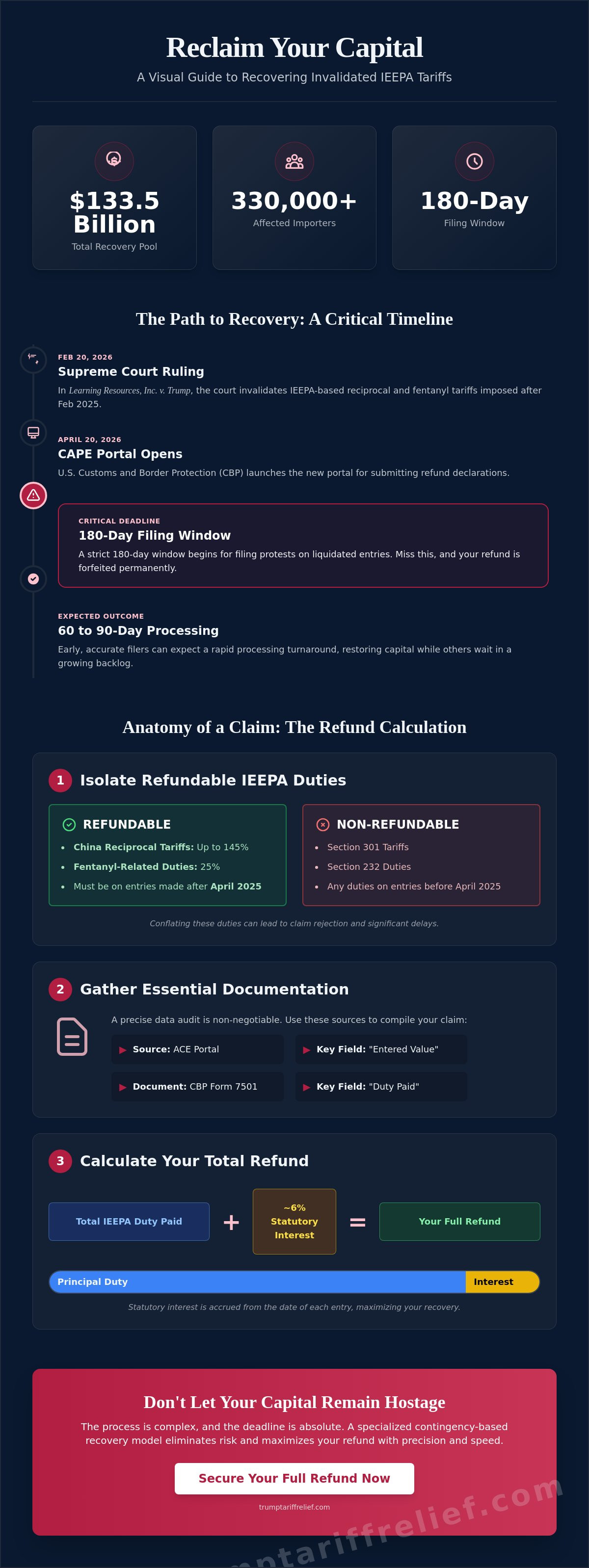
You can finally reclaim what's yours and restore your company's financial health. This guide provides the technical framework you need to accurately estimate your share of the $133.5 billion recovery pool and secure the 6% statutory interest you're legally owed. We'll break down the Phase One eligibility requirements, the critical 180-day filing window for liquidated entries, and the exact steps to leverage the CAPE system for a 60 to 90 day processing turnaround. By the end of this article, you'll have a clear, low-risk path to identifying every dollar your business is entitled to recover.
Key Takeaways
- Identify the invalidated IEEPA reciprocal and fentanyl tariffs that form the basis of the $133.5 billion recovery pool.
- Execute a precise data audit to calculate potential tariff refund amounts using your historical "Entered Value" and "Duty Paid" records.
- Separate refundable IEEPA duties from non-refundable Section 301 payments to ensure your claim is accurate and compliant.
- Utilize the ACE portal and CBP Form 7501 to gather the essential documentation required for a successful refund verification.
- Understand why a specialized contingency-based recovery model provides a low-risk alternative to traditional customs brokerage for these complex claims.
The $133.5 Billion Recovery Opportunity: Why Calculation is Your First Priority
The federal government is currently holding $133.5 billion in tariff payments that the U.S. Supreme Court has declared invalid. This isn't a theoretical surplus or a future budget allocation. It's capital stripped from the balance sheets of American importers. For businesses in the retail, manufacturing, and technology sectors, the ability to accurately calculate potential tariff refund amounts is now the single most important step in their 2026 fiscal strategy. The window to act is narrow. The complexity of the filing process means that those who delay will likely find themselves at the back of a very long administrative line.
The Legal Catalyst: Learning Resources, Inc. v. Trump
On February 20, 2026, the Supreme Court issued a landmark ruling in Learning Resources, Inc. v. Trump. The court determined that the executive branch overstepped its constitutional limits by using the International Emergency Economic Powers Act (IEEPA) to impose reciprocal and fentanyl-related duties without specific congressional approval. While the government argued these tariffs were necessary for national security, the ruling clarified a vital distinction. Emergency powers are not a blank check for indefinite trade wars. This decision specifically targets duties imposed after February 2025, creating a clear legal mandate for the return of these funds to the companies that paid them.
Why Your Business Cannot Afford to Wait
Restoring your company's working capital depends entirely on speed and precision. U.S. Customs and Border Protection (CBP) has established a strict 180-day window for filing protests on liquidated entries. If you miss this deadline, your right to a refund expires permanently. Beyond the legal cutoff, there's a practical reality to consider. CBP is processing these claims through the new CAPE portal on a first-come, first-served basis. With over 330,000 potentially eligible importers, the administrative backlog will grow rapidly.
Importers who prioritize their recovery now can expect a 60 to 90 day processing turnaround once their declaration is accepted. Those who wait risk being caught in a multi-year bottleneck. When you calculate potential tariff refund totals today, you aren't just filling out a form. You're securing the liquidity needed to fund 2026 operations and righting a significant financial wrong. The money belongs on your balance sheet, not in the government's accounts.
The Anatomy of a Claim: How to Calculate Your Potential IEEPA Refund
Quantifying the financial damage of illegal tariffs requires a surgical approach to your import data. You can't simply apply a flat percentage to your total annual customs spend. To accurately calculate potential tariff refund totals, you must isolate specific entry lines that fall under the IEEPA reciprocal or fentanyl duty mandates. Start by filtering your records for entries made after the April 2025 implementation date. You'll need to aggregate the "Entered Value" and the specific "Duty Paid" amounts found on your CBP Form 7501 summaries. This isn't just a clerical task; it's a forensic audit of your capital.
Precision is the difference between a rejected claim and a successful recovery. Once you've identified the qualifying entries, apply the specific IEEPA rates: 25% for fentanyl-related duties and up to 145% for China reciprocal tariffs. Don't forget the statutory interest. According to current CBP guidelines, approved refunds include a statutory interest rate of approximately 6% accrued from the date of entry. However, you must carefully deduct any non-refundable Section 301 or Section 232 duties. If you conflate these separate trade regimes, your entire CAPE declaration could be flagged for non-compliance, delaying your capital restoration for months.
Identifying Qualifying HTS Codes
Focus your audit on high-impact categories like consumer electronics, industrial steel components, and high-volume consumer goods. Verification is key. You must confirm that your specific Harmonized Tariff Schedule (HTS) codes were subject to the April 2025 reciprocal tariffs. The "Entry Date" is your most critical filter. Entries made before this window or those under different trade authorities won't qualify. For more technical details on eligibility, reviewing a comprehensive IEEPA Tariff Refund FAQ can help clarify which specific HTS lines are currently prioritized by CBP.
Handling Variable-Rate Tariff Lines
Imports from the EU, Japan, and South Korea present a unique challenge due to fluctuating reciprocal rates. These entries don't follow a uniform percentage. A line-by-line audit is the only way to ensure accuracy. If you rely on broad estimates, you risk under-calculating your claim by ignoring secondary IEEPA modifiers that can significantly increase your total recovery. This level of detail is exactly why many firms choose to request a professional eligibility assessment before submitting their final documentation. Relying on your standard broker for this granular data often leads to missed opportunities, as their systems aren't typically optimized for retroactive IEEPA recovery.
Disentangling the Chaos: IEEPA vs. Section 301 and Interest Math
The most dangerous pitfall in the recovery process is the "Stacking Effect." During the peak of trade tensions, a single shipment of Chinese made electronics might have been hit with a 25% Section 301 duty, a 10% Section 232 steel duty, and a 15% IEEPA reciprocal duty. If you attempt to calculate potential tariff refund totals by simply looking at the total "Duty Paid" column on your CBP Form 7501, your claim will be rejected for overvaluation. You must isolate the specific IEEPA layer from the broader Section 301 and Section 232 trade remedies, which remain legally in effect and non-refundable.
To successfully calculate potential tariff refund amounts, your audit must follow a strict subtraction model. You start with the total duty paid on a specific entry line and then deduct any amounts attributed to the Trade Act of 1974 (Section 301). What remains is your refundable IEEPA base. This distinction is critical because Section 301 tariffs, which primarily target Chinese trade practices, were not part of the Learning Resources, Inc. v. Trump ruling and are not eligible for recovery through the CAPE portal. Failing to pull these layers apart doesn't just result in an incorrect estimate; it can lead to a compliance flag that freezes your entire recovery effort.
Refundable vs. Non-Refundable Duties
Clarity on eligibility is your best defense against administrative delays. While IEEPA reciprocal and fentanyl duties are now fully refundable, other trade enforcement actions remain "sticky." For instance, Section 232 duties on steel and aluminum are still active and non-refundable. Some importers are also monitoring "Section 122" duties, which are currently under separate judicial review but are not yet part of the $133.5 billion CAPE pool. If your China imports were subject to both Section 301 and IEEPA, you can only claim the portion specifically tied to the emergency powers overreach that occurred after February 2025.
The Power of Accrued Interest
The federal government doesn't just owe you the principal; it owes you for the time your capital was out of your hands. Statutory interest begins accruing from the moment the duty was paid. For corporate importers, the statutory interest rate is approximately 6%, while non-corporate entities may see rates closer to 7% depending on the specific quarterly adjustments made by the Treasury. The impact of this interest is substantial. For example, if your business paid $1 million in qualifying IEEPA duties 12 months ago, the interest alone adds roughly $60,000 to $70,000 to your final recovery. This interest is not a bonus; it's a legal requirement designed to restore your business to its original financial position. When you view these figures as restored working capital rather than just "found money," the urgency of filing becomes undeniable.
Data Preparation: Gathering Documentation for a Precise Audit
The success of your recovery hinges on the integrity of your documentation. You cannot accurately calculate potential tariff refund amounts based on high-level accounting summaries or bank statements alone. U.S. Customs and Border Protection (CBP) requires specific, line-level proof of every dollar paid under the invalidated IEEPA mandates. The central pillar of your evidentiary package is CBP Form 7501, the Entry Summary. This document provides the definitive record of the HTS codes used, the port of entry, and the exact duty amounts remitted. Without a complete set of 7501s, your claim lacks the legal standing required for CAPE portal acceptance.
Beyond the 7501, you must secure your commercial invoices. These are vital for substantiating country-of-origin claims, especially for reciprocal tariffs where the rate depended on the specific trading partner. Organizing this data by entry port and entry number creates a clean audit trail that CBP administrative officers can verify quickly. The government isn't looking for excuses to pay you; they're looking for reasons to deny your claim. Providing a meticulous data set removes those excuses and positions your business as a high-priority claimant.
The ACE Portal: Your Primary Data Source
To build a comprehensive audit, you must pull historical data directly from the Automated Commercial Environment (ACE) portal. Running a "Trade Interface" report is the most efficient way to capture all 2025 and 2026 entry data. This report must include mandatory fields such as the Port Code, Entry Number, and the 10-digit HTS code. If you find missing or corrupted entry records, you'll need to reconcile your internal records with the ACE Secure Data Portal. This forensic approach ensures that when you calculate potential tariff refund totals, your figures are backed by the government's own digital evidence.
Verifying Liquidation Status
Your recovery mechanism is dictated by the "Liquidation" status of your entries. Liquidation is the final determination of duties by CBP, and it triggers a high-stakes countdown. If an entry is already liquidated, you have exactly 180 days from that date to file a formal customs protest (CBP Form 19). If you miss this window, your right to a refund is permanently forfeited. Unliquidated entries are generally easier to handle through Post-Summary Corrections (PSCs) and often see faster turnaround times. Categorizing your entries by status allows you to prioritize the most urgent filings first.
If the prospect of auditing thousands of entries feels overwhelming, you can delegate your customs documentation management to our specialized team to ensure no refundable dollar is left behind.
Beyond the Spreadsheet: Why Professional Recovery Outperforms DIY Calculation
While an internal audit is a necessary starting point, the transition from a spreadsheet estimate to a physical check requires more than just clerical data entry. Many importers attempt to calculate potential tariff refund totals internally, only to realize that the administrative hurdles within the CAPE portal are designed for specialized trade legalities. The government’s $133.5 billion recovery pool is protected by complex regulatory gates. Navigating these requires a partner who understands the nuance of the Learning Resources, Inc. v. Trump ruling and the specific technical requirements of a successful IEEPA protest.
Professional recovery is about more than just numbers; it’s about overcoming the "Broker Gap." Most standard customs brokers are optimized for moving freight and ensuring entry compliance, not for pursuing complex, retroactive litigation. They are often ill-equipped to handle the forensic documentation needed to challenge liquidated entries. By choosing a specialized recovery partner, you gain access to trade specialists who focus exclusively on administrative hurdles. This full-service approach manages everything from the initial audit to the final government filing, ensuring your capital is restored without draining your internal resources.
The Problem with "Standard" Customs Brokers
Your current broker is likely a vital part of your supply chain, but they aren't equipped for this specific mission. Brokers focus on the point of entry. Their systems are built for transactional speed, not the deep historical analysis required for IEEPA claims. There's also a potential conflict of interest to consider. If a broker originally misclassified your entries, they may be hesitant to flag those errors in a recovery audit. Specialized trade consultancies don't have this baggage. We operate with a singular focus: maximizing your recovery through precise tariff eligibility assessments and documentation management.
The Trump Tariff Relief Contingency Advantage
The most significant barrier to trade recovery is often the fear of mounting legal fees or upfront costs. We eliminate this barrier through a performance-based success fee model. We only get paid when you receive your refund check from the government. This structure ensures our goals are perfectly aligned with yours. We take on the heavy lifting and the administrative risk, allowing you to focus on your 2026 fiscal planning. There are no upfront costs and no risk to your current budget. You can calculate your potential refund with our experts today to begin the process of reclaiming your capital before the 180-day filing window closes for good.
Secure Your Share of the $133.5 Billion Recovery Pool
The 180-day window for filing protests on liquidated entries is non-negotiable. If you miss this deadline, your company's capital remains in the government's hands forever. You now have the framework to identify qualifying entries and the interest you're owed, but you must accurately calculate potential tariff refund amounts to ensure your claim is accepted by the CAPE portal. Identifying the opportunity is only the beginning; the real challenge lies in managing the administrative hurdles that often paralyze standard customs brokers.
You don't have to shoulder the risk of complex federal filings alone. Our team provides the specialized expertise needed to disentangle overlapping trade regimes and manage every aspect of your CBP documentation. We operate on a strict contingency basis, meaning there are no upfront costs and our success is directly tied to your recovery. It's time to restore your balance sheet and reclaim the capital your business is legally owed. Get Your Free Tariff Eligibility Assessment today and let us handle the heavy lifting while you focus on growth.
Frequently Asked Questions
Is the China tariff refund real or a scam?
The IEEPA tariff refund is a legitimate recovery opportunity resulting from the February 20, 2026, Supreme Court ruling in Learning Resources, Inc. v. Trump. U.S. Customs and Border Protection officially opened the CAPE portal for claim submissions on April 20, 2026. While the opportunity is real, you must distinguish between refundable IEEPA duties and non-refundable Section 301 tariffs to avoid filing errors or falling for predatory service providers making unsupported claims.
How long does it take to receive an IEEPA tariff refund check?
CBP estimates a processing time of 60 to 90 days for valid IEEPA refunds once your CAPE Declaration has been accepted. You won't receive a physical paper check; all payments are issued electronically via the Automated Clearing House (ACH). To receive your funds, you must have a valid ACH account linked to your ACE Secure Data Portal account. Delays often occur if documentation is incomplete or entry data is mismatched.
What is the deadline for filing an IEEPA tariff refund claim in 2026?
There isn't a single calendar deadline for all importers; instead, the window depends on your specific entry status. For entries that have already been liquidated, you must file a formal customs protest within 180 days of the liquidation date. If you miss this 180 day window, you permanently lose the right to recover those duties. Unliquidated entries are currently being processed in Phase One, which began in April 2026.
Can I calculate my refund without HTS codes?
You cannot accurately calculate potential tariff refund amounts without specific 10-digit Harmonized Tariff Schedule (HTS) codes. These codes determine whether an entry fell under the invalidated reciprocal or fentanyl duty regimes. Because the CAPE portal requires HTS-level data for validation, any attempt to estimate recovery based on broad "China trade" spending will result in an unreliable figure. Your CBP Form 7501 remains the primary source for this mandatory data.
Do I need a lawyer to file for a tariff refund?
You don't legally require a lawyer to submit a claim, but only the Importer of Record or their licensed customs broker can file a CAPE Declaration. While the process is administrative, the complexity of disentangling multiple tariff layers makes specialized trade expertise highly valuable. Many importers use a recovery partner to manage the documentation and ensure compliance, as standard brokers often lack the specific tools to calculate potential tariff refund totals for complex historical entries.
What is the difference between a Post Summary Correction (PSC) and a Protest?
The primary difference lies in the "Liquidation" status of your import entry. A Post Summary Correction (PSC) is used to amend data for entries that haven't yet liquidated, which is often a faster route to recovery. A Protest, specifically CBP Form 19, is the required legal mechanism for entries that have already liquidated. You have a strict 180 day limit from the date of liquidation to file this protest and secure your refund.
Does the IEEPA ruling affect Section 301 tariffs on China?
No, the IEEPA ruling doesn't apply to Section 301 tariffs, which remain in full effect and are non-refundable. Section 301 duties are based on the Trade Act of 1974, while the current refund pool specifically targets duties imposed under the International Emergency Economic Powers Act. It's vital to audit your entries line-by-line to ensure you aren't claiming Section 301 payments, as this will lead to an immediate rejection by CBP.
How much interest does the government pay on tariff refunds?
Approved IEEPA refunds include statutory interest at a rate of approximately 6%. This interest accrues from the date the original duty was paid until the date the refund is issued via ACH. For many importers, this interest represents a significant portion of the total recovery. For example, on a $1 million claim held for over a year, the interest alone can add more than $60,000 to the final payment amount.
Ready to find out what your business may be owed?
Check My Eligibility