
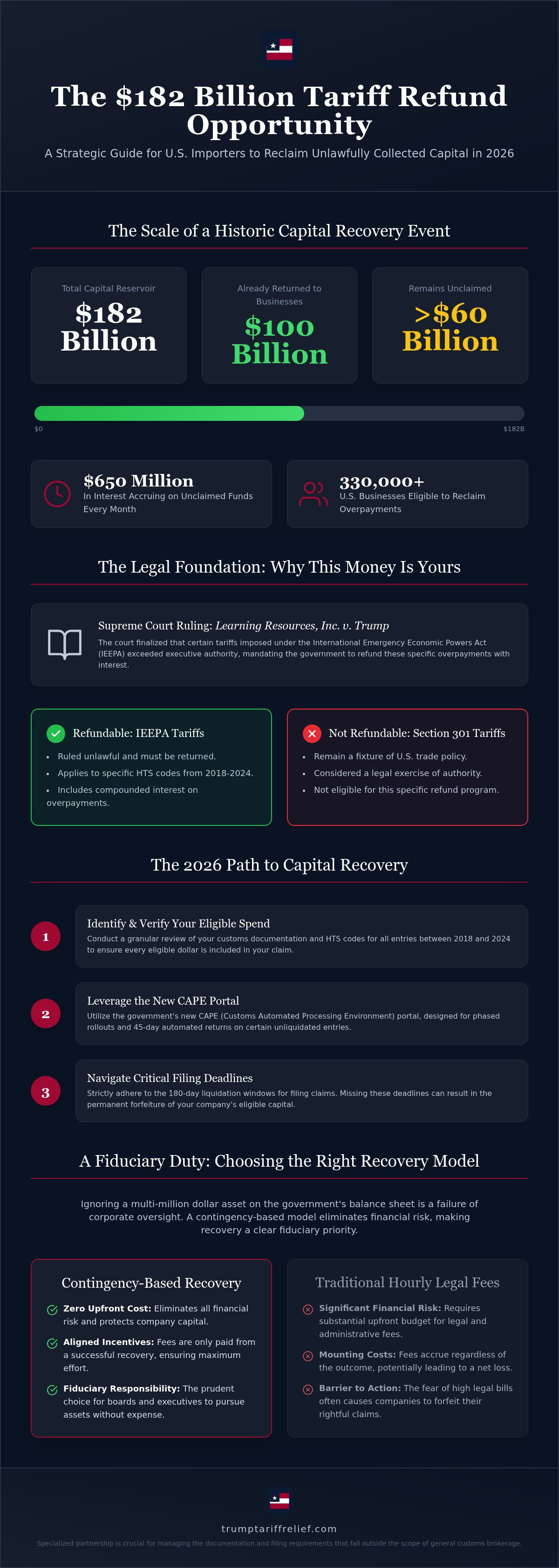
As of July 31, 2026, the U.S. government has already returned $100 billion in IEEPA tariff refunds, yet over $60 billion remains unclaimed while accruing interest at a staggering $650 million every single month. You've likely spent years watching your company's capital sit dormant on the government's balance sheet, perhaps hesitating because the legal fallout from the Supreme Court's ruling in Learning Resources, Inc. v. Trump felt like a moving target. It's frustrating to know your liquidity is restricted while the fear of mounting legal fees makes recovery feel like a gamble.
This guide establishes the definitive business case for pursuing tariff refunds in 2026. It's designed to show you how to reclaim this capital as a fiduciary priority through a low-friction, contingency-based model that eliminates upfront financial risk. We'll preview the new CAPE portal's phased rollout, provide clear ROI justifications for your board, and outline a strategic path to navigate the complex 180-day liquidation windows before your window of opportunity closes forever. Reclaiming what's yours isn't just about the bottom line; it's about correcting a historical overreach with a strategy that protects your firm's future.
Key Takeaways
- Capitalize on the $182 billion recovery opportunity created by the Supreme Court's ruling, which has opened the door for over 330,000 U.S. businesses to reclaim unlawful IEEPA payments.
- Develop a robust business case for pursuing tariff refunds by adopting a contingency-based recovery model that eliminates upfront costs and aligns with fiduciary responsibilities.
- Mitigate corporate risk by implementing specific documentation strategies to defend against "double recovery" objections and ensure a clean, compliant filing process.
- Master the 2026 roadmap, including the phased rollout of the CAPE portal and critical 180-day liquidation deadlines, to prevent the permanent forfeiture of eligible capital.
- Utilize specialized partnership to manage the high-stakes documentation and filing requirements that typically fall outside the scope of general customs brokerage or in-house legal teams.
The $182 Billion Capital Opportunity: Defining the IEEPA Refund
The financial landscape for U.S. importers shifted fundamentally in early 2026. The Supreme Court's decision in Learning Resources, Inc. v. Trump finalized the illegality of certain tariffs, unlocking a capital reservoir estimated at $182 billion. This isn't a theoretical legal win. It's a massive injection of liquidity for over 330,000 businesses that paid these duties between 2018 and 2024. For many firms, this represents the single largest capital recovery event in their history.
It's vital to distinguish between standard Section 301 duties and those imposed under the International Emergency Economic Powers Act (IEEPA). While Section 301 remains a fixture of trade policy, the IEEPA-specific levies were found to exceed executive authority. This distinction forms the core business case for pursuing tariff refunds, as the government is now mandated to return these specific funds with interest. Unlike discretionary trade programs, these refunds are a matter of established law.
To manage the volume, the government is implementing a system designed for 45-day automated returns for specific unliquidated entries. This reflects the urgency and the scale of the correction. If you've been waiting for a reason to audit your trade spend, this automated pipeline is the catalyst. The window to act is defined by liquidation dates, making speed a critical component of your recovery strategy.
Understanding the IEEPA Ruling for Importers
The Learning Resources case confirmed that the administration lacked the statutory power to use IEEPA for indefinite tariff extensions without specific emergency declarations. Consequently, the Court of International Trade (CIT) is now overseeing a massive payout process. U.S. Customs and Border Protection (CBP) has been tasked with the logistical heavy lifting, utilizing the new CAPE portal to process claims. These aren't just base refunds. They include interest, which is currently accruing at a rate of $650 million per month across the industry. This makes the wait even more costly for businesses that delay their filings.
Identifying Your Eligible Tariff Spend
Your recovery potential depends on your historical entry data from 2018 through 2024. Not every shipment qualifies. You must verify if your specific Harmonized Tariff Schedule (HTS) codes were subject to the struck-down IEEPA lists rather than valid Section 301 actions. Identifying these entries requires a granular review of your customs documentation to ensure every eligible dollar is accounted for in your claim. You can learn more about IEEPA eligibility to see if your product categories align with the court's mandate. Accuracy at this stage prevents delays and maximizes the eventual payout.
Quantifying the ROI: Why Contingency Recovery is a Fiduciary Duty
The decision to reclaim capital is no longer a legal "option"; it's a fiduciary mandate for any corporation with a significant import history. The Supreme Court ruling has effectively moved billions of dollars from a sunk cost column to a potential liquidity asset. According to the Penn Wharton Budget Model, the ruling is projected to generate up to $175 billion in refunds. For a CFO or Controller, ignoring a six, seven, or eight-figure balance sheet asset isn't just a missed opportunity. It's a failure of oversight that directly affects shareholder value. This realization forms the primary business case for pursuing tariff refunds in 2026.
Time is working against companies that delay. Per IRS Revenue Ruling 2026-10, the interest rate for corporate overpayments for the third quarter of 2026 is 6%. For the portion of a corporate overpayment exceeding $10,000, the rate is 4.5%. These are not negligible percentages. With total industry interest accruing at an estimated $650 million every month, the cost of inaction is a measurable financial leak. Every month your claim sits unfiled, you're essentially giving the government an interest-free loan on funds that the courts have already declared belong to you.
Contingency vs. Hourly Legal Fees
Mid-market importers often shy away from recovery because traditional legal engagements require massive upfront retainers and complex protective lawsuits. This creates a friction point that stops recovery before it starts. A contingency-based recovery model removes this barrier entirely. It eliminates the "billable hour" anxiety that plagues finance departments and ensures that the service provider’s incentives are perfectly aligned with the speed and volume of the recovery. Since there are no upfront costs, the ROI is technically infinite. You can see how our recovery process works to understand how we manage the end-to-end documentation without taxing your internal resources.
Impact on 2026 Cash Flow and Balance Sheets
A successful refund provides a unique opportunity to strengthen the 2026 balance sheet. These funds shouldn't be viewed as a mere rebate; they're a capital injection that can fund critical R&D, fuel market expansion, or be used for aggressive debt reduction. In an era of tight credit, reclaiming historical tariff spend is the most efficient way to generate non-dilutive capital. If you haven't yet quantified your potential recovery, now is the time to request a preliminary assessment to see what’s sitting in your "dormant asset" column.
Mitigating Corporate Risk: Double Recovery and Litigation Defense
A primary roadblock in the business case for pursuing tariff refunds is the fear of "double recovery" litigation. Boards often worry that if they passed tariff costs to their customers, reclaiming those funds from the government might trigger class-action lawsuits or regulatory scrutiny. This concern is valid but shouldn't be a deal-breaker. In fact, ignoring the refund opportunity doesn't shield you from consumer or shareholder scrutiny. It simply leaves you without the capital necessary to address potential claims. The most effective defense isn't avoidance; it's professional documentation management.
Rigorous documentation serves as your primary shield against fraud or "unjust enrichment" allegations. By meticulously tracking how tariff costs were absorbed, companies can demonstrate that price increases were driven by broader market volatility, labor costs, or logistics rather than a direct pass-through of the unlawful IEEPA levies. This granular level of detail is exactly what class-action plaintiffs lack, making it your strongest asset in a litigation defense. Proving that your firm suffered an economic burden despite your pricing strategy is the key to a low-risk recovery.
Strategic Documentation as a Defense
Auditing your pricing history is the first step in refuting material injury claims. You need to prove that your company suffered an economic burden regardless of your end-user pricing. Professional recovery teams help you aggregate internal data to show that your margins were compressed or that other operational cuts were made to offset the tariffs. This level of preparation turns a potential liability into a manageable administrative process. To get started on your internal audit, review the Required Documents for IEEPA Tariff Refund to ensure your records meet the high standards required for a successful defense.
Protecting the Importer of Record
Legal standing is another critical risk area. Generally, the Importer of Record (IOR) holds the primary right to the refund. However, complex supply chains often involve secondary businesses that may have contractually agreed to bear the tariff burden. If you aren't the IOR but paid the duties as part of a landed cost agreement, you may still have a path to recovery through contractual claims. Clarifying these relationships early prevents internal disputes and ensures that the refund reaches the entity that actually suffered the financial loss. This proactive approach to supply chain transparency is a core component of a sound business case for pursuing tariff refunds, as it protects your partnerships while restoring your capital.
The 2026 Roadmap: Deadlines and Filing Requirements
The roadmap to capital restoration is defined by technical precision and strict adherence to a rolling calendar. Unlike a standard tax credit, IEEPA refunds operate on a per-entry basis. This means your business case for pursuing tariff refunds is only as strong as your tracking of liquidation dates. If an entry liquidates and the protest window expires, that capital is legally forfeited to the Treasury. To avoid this, your recovery strategy must follow a disciplined, four-step execution plan.
- Step 1: Conduct a comprehensive tariff eligibility assessment. Not all duties paid between 2018 and 2024 are recoverable. You must isolate IEEPA-specific HTS codes from valid Section 301 entries to ensure your claim is legally sound.
- Step 2: Aggregate and verify all Customs and Border Protection (CBP) documentation. This involves pulling years of ACE reports to identify every eligible entry number, duty amount, and liquidation status.
- Step 3: Decide between the CAPE electronic portal or a protective CIT lawsuit. Unliquidated entries often flow through the automated portal, but liquidated entries may require a formal protest or litigation in the Court of International Trade to preserve your rights.
- Step 4: Execute the filing before the statute of limitations expires. Timing is the most common point of failure. A coordinated filing ensures that no entry is left behind as the windows close.
Critical Deadlines for 2026 Filings
There's no single "deadline day" for all claims. Instead, the clock starts ticking the moment an entry liquidates. For entries within 80 days of liquidation, the CAPE portal offers an expedited path. However, for entries that have been liquidated for more than 80 days but less than 180 days, you must file a formal protest. Once you cross the 180-day threshold, the entry is "finally liquidated," and recovery becomes significantly more complex. You can review the Tariff Refund Statute of Limitations to map your specific entry history against these high-stakes windows. A wait-and-see approach is a dangerous gamble with your company's liquidity.
The Role of the CBP Electronic Portal
CBP launched the Consolidated Administration and Processing of Entries (CAPE) portal on April 20, 2026, to handle the massive volume of IEEPA claims. The system is currently in Phase 1, prioritizing unliquidated entries and those within the 80-day window. While the portal promises 60 to 90-day processing times, bottlenecks are inevitable as more of the 330,000 eligible importers log on. If the automated system denies a claim due to a technicality, you must be prepared to escalate to a manual protest immediately. To ensure your documentation is portal-ready and compliant, you should request a documentation audit before attempting a bulk filing.
Executing the Recovery: Why Professional Partnership Matters
While the legal basis for recovery is now clear, the execution remains a specialized administrative hurdle. Most in-house legal departments and general corporate law firms excel at broad compliance but lack the granular trade data expertise required for IEEPA recovery. Navigating thousands of entries through the CAPE portal while managing strict liquidation protests isn't just a legal task; it's a massive data management project. Relying on generalists often leads to missed deadlines or incomplete documentation, which effectively invalidates your business case for pursuing tariff refunds.
Trump Tariff Relief operates as a specialized engine for this specific recovery lifecycle. We don't just offer advice; we manage the entire process from initial eligibility assessment to the final issuance of the refund check. By partnering with a national consultancy focused exclusively on tariff restoration, you gain access to a dedicated infrastructure designed to handle the bureaucratic friction of CBP filings. This allows your finance team to focus on 2026 growth while we handle the heavy lifting of historical capital reclamation.
The Trump Tariff Relief Advantage
Our methodology is built on the distinction between general customs brokerage and specialized recovery. Unlike brokers who focus on ongoing entries, we specialize in the forensic audit of historical IEEPA and Section 301 spend. We've developed a results-oriented, success-fee model that ensures our interests are perfectly aligned with your liquidity goals. If we don't recover your capital, you don't pay a fee. This contingency framework removes the financial risk from your balance sheet and places the burden of performance squarely on our shoulders. We handle the documentation management, filing logistics, and any necessary escalations, providing a turnkey solution that preserves your internal bandwidth.
Next Steps for Your Business
The window for 2026 recovery is active but closing with every liquidated entry. Initiating your recovery begins with a streamlined, 15-minute eligibility assessment. During this initial consultation, we'll review your historical import volume and HTS categories to determine the scale of your potential refund. You'll receive a clear roadmap of the recovery timeline and a preliminary estimate of the interest-bearing assets you're eligible to reclaim. If you have specific technical questions about the process, you can explore our Frequently Asked Questions about Tariff Refunds to understand the nuances of the 2026 landscape. Don't let your capital sit in government accounts while the interest rates are in your favor; start your assessment today.
Secure Your 2026 Capital Recovery
The Supreme Court has cleared the legal path, but the administrative window is closing fast. Reclaiming your historical tariff spend is no longer a matter of legal debate; it's a critical fiduciary priority that directly impacts your 2026 liquidity. By addressing the business case for pursuing tariff refunds now, you protect your firm from permanent capital loss while mitigating litigation risks through professional documentation. With $100 billion already returned to U.S. importers, the precedent for success is firmly established.
Our expert team focuses exclusively on IEEPA and Section 301 recovery, providing comprehensive documentation and filing management that removes the burden from your internal staff. We operate on a contingency-based model, which means you only pay if we win. This ensures our incentives are perfectly aligned with your financial restoration. Don't let your interest-bearing assets sit dormant while the government's 180-day clocks continue to tick. It's time to bring that capital back where it belongs.
Request your free tariff eligibility assessment and start your recovery today. We're ready to help you win back the capital your business deserves.
Frequently Asked Questions
Is the IEEPA tariff refund program legitimate or a scam?
The IEEPA tariff refund program is a legitimate federal correction following the February 2026 Supreme Court ruling in Learning Resources, Inc. v. Trump. This landmark decision declared specific tariffs unlawful, leading U.S. Customs and Border Protection to launch the CAPE portal on April 20, 2026. With over $100 billion already paid out to U.S. businesses as of July 31, 2026, the recovery process is a standard administrative function for eligible importers.
How much does it cost to hire a tariff refund consultant?
Hiring a specialized consultant for IEEPA recovery typically operates on a contingency-fee basis, meaning there are no upfront costs or hourly legal retainers. You only pay a percentage of the actual capital recovered from the government. This model eliminates financial risk and ensures your partner is motivated to maximize the refund amount. It remains the most efficient way to build a business case for pursuing tariff refunds without taxing your 2026 budget.
What is the deadline for filing an IEEPA tariff refund claim in 2026?
There's no single universal deadline; instead, every customs entry has its own timeline based on its liquidation date. You generally have a 180-day window from the date of liquidation to file a formal protest for entries that aren't handled automatically through the CAPE portal. Because these windows are rolling, waiting too long on any specific shipment can result in the permanent forfeiture of those funds. Proactive identification of your entry dates is essential.
Can we still get a refund if we passed the tariff costs to our customers?
Yes, you can still claim a refund even if you adjusted your end-user pricing to account for the tariffs. Legal standing for these claims rests with the Importer of Record who paid the duties to the government. While "double recovery" is a common corporate concern, professional documentation can prove that your business still suffered compressed margins or other economic burdens during the 2018-2024 period. Reclaiming these funds is a matter of statutory right.
How long does it take for the government to process a tariff refund?
U.S. Customs and Border Protection anticipates that valid refunds will be issued within 60 to 90 days after a CAPE Declaration is accepted. However, this timeline depends on the accuracy of your documentation and the current phase of the portal rollout. Phase 1 began in April 2026, and while the system is designed for speed, manual protests for older, finally liquidated entries may take longer to resolve through the standard administrative channels.
Do we need to file a lawsuit in the Court of International Trade to get our money back?
A formal lawsuit in the Court of International Trade isn't always required, as many unliquidated entries can be processed through the CAPE portal. However, for entries that have been liquidated for more than 180 days, litigation may be the only remaining path to preserve your rights. A specialized assessment helps determine whether the automated portal or a protective legal filing is the more effective route for your specific portfolio of entries.
What documents do we need to prove our eligibility for a refund?
You need comprehensive entry data, specifically Entry Summaries (CBP Form 7501) and commercial invoices that identify the HTS codes used. Most businesses start by pulling historical ACE reports for the 2018-2024 period to isolate IEEPA-specific duty payments. Verifying these records against your internal financial statements is essential for building a robust business case for pursuing tariff refunds that survives federal audit and ensures maximum capital restoration.
Can we claim refunds for tariffs paid on Section 301 China lists?
You can only claim refunds for duties specifically linked to the struck-down IEEPA authority, which overlaps with some, but not all, Section 301 China lists. The Supreme Court ruling didn't invalidate all China tariffs, only those where the administration exceeded its statutory power under the International Emergency Economic Powers Act. Identifying which of your specific entries fall into this category requires a granular HTS code eligibility assessment to ensure your claim is legally valid.
Ready to find out what your business may be owed?
Check My Eligibility