
A small tariff refund can be worth pursuing, but the gross amount alone won’t tell you whether it makes sense. If you’re asking, “is it worth it to file for a small tariff refund,” start by identifying the duties paid, the records you can assemble, and the effort or service fees that could reduce your net recovery. The answer depends on the claim, not just its headline value.
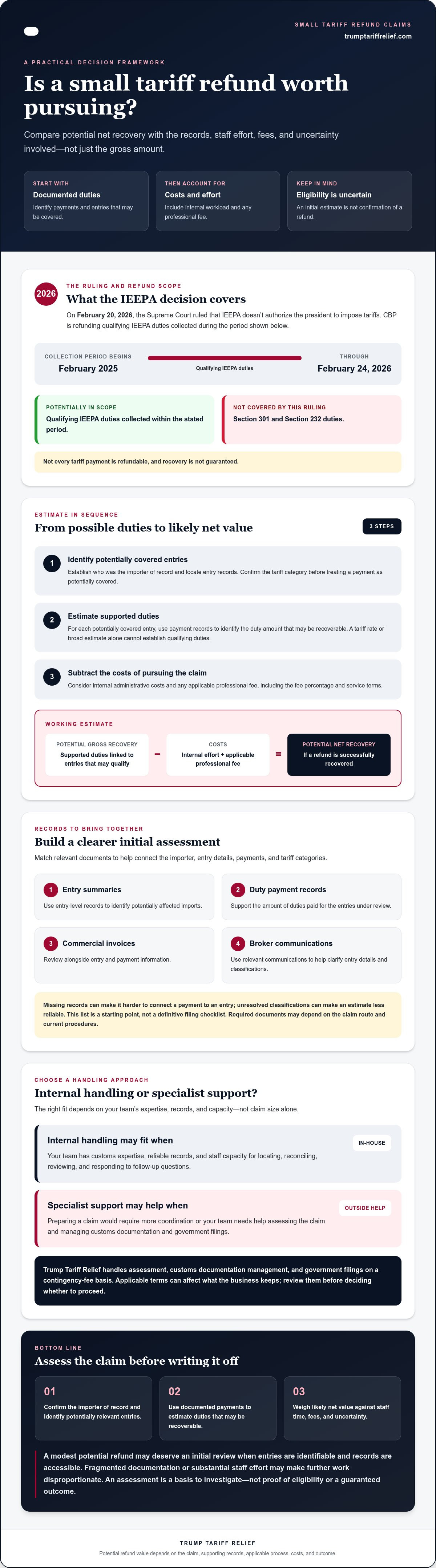
On February 20, 2026, the Supreme Court ruled that IEEPA doesn’t authorize the president to impose tariffs. CBP is refunding qualifying IEEPA duties collected from February 2025 through February 24, 2026. That doesn’t make every tariff payment refundable: Section 301 and Section 232 duties aren’t covered by the ruling, and recovery isn’t guaranteed.
This guide explains how to identify potentially covered payments, which entry and payment records can support an initial assessment, and how to compare self-filing with outside help. It also explains how contingency-based support can reduce upfront expense while still affecting the amount you keep. Use these steps to decide whether to investigate further, without assuming you’re eligible.
Key Takeaways
- To answer “is it worth it to file for a small tariff refund,” compare likely net recovery with the time, internal workload, fees, and uncertainty involved.
- Estimate potential value in sequence: identify potentially covered entries, calculate duties that may be recoverable, then account for professional fees and internal administrative costs.
- Internal handling may fit a team with customs expertise, reliable records, and staff capacity. Specialist support may help when claim preparation would require more coordination.
- Before assessing a claim, establish who was the importer of record and locate records for potentially affected entries.
- Trump Tariff Relief handles assessment, customs documentation management, and government filings on a contingency-fee basis. Review the applicable terms before deciding whether to proceed.
Is filing for a small tariff refund worth it? Start with net value
It can be, but assess the likely net recovery, effort, fees, and uncertainty together. A small claim isn’t automatically unworthy; its practical value depends on the payments and entries involved, the applicable refund process, and the resources needed to pursue it. Treat an initial estimate as a reason to investigate, not as confirmation that a refund is owed.
What “worth it” means for a business tariff claim
Separate the gross amount that might be recoverable from the amount the business would ultimately retain. Net recovery means any successful refund, less applicable professional fees and internal administrative costs. Internal costs can include time spent by finance, operations, and customs staff locating entry records, reconciling duty payments, answering questions, and reviewing claim documents.
A possible refund is not the same as the amount your business ultimately keeps. If staff time is diverted from other work or a provider charges a fee on successful recovery, account for those effects before deciding. Consider both the applicable service terms and the work your team would otherwise need to do. Don’t treat a preliminary estimate as a confirmed entitlement or guaranteed outcome.
Confirm what kind of duty is at issue before calculating value. The 2026 Supreme Court ruling concerns IEEPA tariffs, not every tariff paid on imported goods. Other recovery concepts have different rules: for example, Duty drawback generally concerns duties on imported goods that are later exported, rather than the IEEPA refund process. The payment category matters before you assess potential recovery.
Why a small claim can still deserve a closer look
Claim size alone doesn’t establish eligibility or predict whether recovery is likely. A modest potential amount may warrant an initial assessment if the relevant entries are identifiable and records are accessible. Fragmented documentation or substantial staff effort, on the other hand, may make further work disproportionate. Clarify the facts before committing to a full claim process.
A focused assessment can help identify potentially relevant payments, missing information, and whether the next steps justify the likely net value. That’s more useful than dismissing the possibility based on a rough gross estimate. For background on the IEEPA-specific recovery process, see the IEEPA refund recovery guide.
How to estimate whether a small tariff refund could produce net value
Build a working estimate in three steps: identify potentially covered entries, estimate the duties that may be recoverable, then subtract the costs of assessing and pursuing the claim. Base the calculation on documented payments. A tariff rate or broad estimate alone can’t establish which duties qualify. For an overview of how import charges are structured, consult the International Trade Administration’s understanding import tariffs and fees.
Which records help size a potential recovery?
Start with entry summaries and duty payment records, then match them against commercial invoices and relevant broker communications. Together, these records may help identify the importer, entry details, payments, and tariff categories. Missing records can make it harder to connect a payment to an entry. Unresolved classifications can also make an estimate less reliable.
Use this document list as a starting point, not a definitive filing checklist. Required documents can depend on the claim route and current procedures, so verify what applies before submitting anything. Trump Tariff Relief’s claim assessment and documentation process can help businesses determine what information is needed for an initial review.
Which costs and uncertainties belong in the calculation?
Use a simple worksheet. For each potentially covered entry, record the duty amount supported by payment records. Add the entries to form a preliminary gross estimate, then subtract expected internal costs and any applicable professional fee:
- Potential gross recovery: supported duties associated with entries that may qualify.
- Internal effort: staff time spent locating, reconciling, and reviewing records, plus follow-up work.
- Professional fee: if using a service provider, apply the percentage and terms stated in the applicable agreement.
- Working net estimate: potential gross recovery minus internal costs and applicable professional fees.
Enter your supported duty total, estimated staff hours and internal cost, and any fee calculated under the agreement. Flag uncertain items rather than counting them as confirmed recovery. Follow-up requests, incomplete documents, or a finding that some entries don’t fit the relevant claim process may change the estimate. A contingency arrangement may reduce upfront cash-flow demands, but its fee still affects what the business retains.
A preliminary estimate is a planning tool, not a CBP determination or a promise that a refund will be paid. If the records support further review, a tariff eligibility assessment can help clarify the next step before the business commits more resources.
Small tariff refund claim: compare handling it internally with expert support
Choose between internal handling and specialist support based on your team’s capacity, customs knowledge, record quality, and the net amount the business may retain. If you’re asking, “is it worth it to file for a small tariff refund,” compare the full workload and cost structure, not just whether an outside provider charges upfront.
| Factor | Internal handling | Specialist assistance |
|---|---|---|
| Effort | Staff locate and reconcile records, prepare information, and monitor the process. | Support with assessment and document coordination can reduce the workload on your team. |
| Expertise | Best suited to teams familiar with customs records and able to check current requirements. | Useful when the business needs help reviewing potential eligibility and organizing documentation. |
| Cost structure | No outside service fee, but staff time and competing priorities still have a cost. | Trump Tariff Relief works on a contingency basis, with no upfront costs or hourly billing; a fee applies only if a refund is successfully recovered. The applicable agreement controls the fee. |
When an internal review may be proportionate
Internal handling may fit if entry data is organized, staff understand the relevant customs records, and someone has time to track the claim and respond to follow-up. Before acting, confirm current CBP requirements for the specific claim route rather than assuming a familiar process applies. No outside invoice doesn’t mean there’s no cost: staff time spent gathering and checking records still uses business capacity.
When professional support may make sense
If customs expertise is limited or records are spread across finance, operations, and broker files, coordinating a review can pull a lean team away from core work. Specialist assistance may help assess potential eligibility, manage customs documentation, and handle government filings. It doesn’t remove uncertainty: recovery depends on the claim’s facts and applicable procedures, and a refund isn’t guaranteed.
Trump Tariff Relief’s contingency model can reduce the upfront cash-flow burden, but the fee still reduces the amount retained if a refund is recovered. Review the fee terms and expected responsibilities before deciding. See how the recovery process works for an overview of assessment, documentation management, and filing support.
What to check before pursuing a small IEEPA tariff refund
Before deciding whether a claim merits more work, confirm the basic facts linking your business to potentially affected duty payments. This is a pre-assessment, not a filing tutorial. Rules, procedures, and deadlines can change, so verify them against authoritative guidance before acting.
Confirm the payment and importer records
- Identify the importer of record. Check entry-level records to establish which business entity imported the goods and who paid or was responsible for the duties. Don’t assume the entity that ultimately bore the business cost is the party entitled to receive a refund.
- Locate potentially affected entries. Match entry summaries and duty payment records to the transactions under review. A product’s country of origin alone doesn’t establish that its duties qualify.
- Separate duty categories. Distinguish IEEPA-related duties from other tariffs and charges unless current guidance confirms they’re covered. The Supreme Court’s February 20, 2026 ruling addressed IEEPA tariffs; it didn’t make every import duty refundable.
If the importer of record, payment trail, or tariff category is unclear, treat the potential recovery as unconfirmed until those details are reviewed.
Verify current rules before making a decision
Check the ruling’s current scope, subsequent government guidance, the claim route available for the entries, and any applicable deadlines. CBP’s CAPE refund process is being rolled out in phases, so confirm the procedures for the specific entry status rather than relying on a general summary or an older filing guide. The IEEPA ruling explanation offers background, but current official instructions should guide procedural decisions.
Keep a short verification record: note the source and date checked, the relevant entry status, and any deadline that may apply. If a deadline is unclear, seek qualified guidance promptly rather than assuming an estimate or informal interpretation is sufficient.
Once you’ve gathered the importer and payment information, Trump Tariff Relief can assess potential eligibility and help manage customs documentation and government filings. Learn more about an IEEPA tariff eligibility assessment before deciding whether the likely recovery justifies the next steps.
Decide on your next step: assess the claim before writing it off
A small potential refund doesn’t require an automatic yes or no. Use a measured process: gather the records you have, request an assessment, review the service terms, then decide whether to proceed. That sequence helps finance and trade teams evaluate the opportunity before committing more time or authorizing further work.
A practical decision checklist for finance and trade teams
- Gather available records. Assemble entry and duty payment information, and identify the business entity associated with the imports.
- Request an assessment. If the records suggest potentially covered duties, have the claim reviewed before treating an estimate as a recoverable amount.
- Review the scope and terms. Clarify what documentation is needed, what work is included, how the fee is calculated under the applicable agreement, and which current procedures may apply.
- Compare effort with cautious net value. Record the staff time needed to locate, reconcile, and review documents. Weigh that effort and any applicable fee against a conservative estimate, while allowing for uncertainty.
If key records are missing or the relevant duty category is unclear, resolve those questions before authorizing more work. A careful assessment can show whether the opportunity merits further attention, but it can’t guarantee eligibility, a particular refund amount, or when payment might occur.
Request a preliminary tariff refund assessment
Trump Tariff Relief handles tariff eligibility assessment, customs documentation management, and government filings for businesses pursuing IEEPA tariff refund recovery. Its model has no upfront costs or hourly billing, and a fee applies only if a refund is successfully recovered. That can reduce the initial cash-flow barrier, but the fee still affects the amount retained. Review the applicable agreement so you understand the terms before deciding whether to proceed.
If you’re still weighing whether it’s worth filing for a small tariff refund, an initial eligibility review can help clarify the claim-specific facts and what further work may involve. Share the entry and duty records available to your business for assessment, then decide based on likely value, documentation needs, and internal capacity. Review the tariff refund assessment process.
Make the Next Step a Measured One
A small potential refund shouldn’t be dismissed on size alone. Whether it’s worth filing depends on whether the duties and entries may qualify, how reliable your records are, and what effort and fees could reduce the net recovery. A preliminary estimate can guide the decision, but it isn’t a guarantee of eligibility or payment.
Gather the entry and duty records you have, then compare the likely value with staff time and any applicable professional fee. Trump Tariff Relief supports businesses with assessment, customs documentation management, and government filings. Under its contingency-based model, there are no upfront costs or hourly billing, and a fee applies only if a refund is successfully recovered. Review the applicable agreement and account for the fee when estimating what your business would retain.
If you’re ready to evaluate the claim before writing it off, request a preliminary tariff refund assessment. A careful review can help you choose a proportionate next step, with the facts and uncertainty in view. Your business can make an informed decision without assuming recovery is guaranteed.
Frequently Asked Questions
Is there a minimum amount required to file for a tariff refund?
The available guidance doesn’t establish a minimum refund amount, and CBP doesn’t charge a fee to process tariff refunds. However, that doesn’t mean every small payment qualifies for recovery. The duty type, entry details, importer of record, claim route, and current procedures all matter. Before preparing a claim, confirm that the payments are potentially covered and weigh likely net recovery against staff effort and any professional fee.
Is it worth filing for a small IEEPA tariff refund?
It may be, if the likely net recovery justifies the work and any applicable professional fee. To decide whether it’s worth filing for a small tariff refund, first identify potentially covered IEEPA duties and the entries tied to those payments. Then account for record gathering, staff time, uncertainty, and fees. A preliminary assessment can help clarify whether further work is proportionate, but it can’t confirm eligibility or guarantee recovery.
Can a small business claim an IEEPA tariff refund?
A small business may be able to pursue a refund if its claim meets the applicable requirements; business size alone doesn’t establish eligibility. Under the current CAPE process, the importer of record or the customs broker that filed the original entries can submit a CAPE Declaration. Start by confirming which business entity was importer of record and locating the potentially affected entry and duty records. Verify current CBP rules and procedures before acting.
How do I estimate whether a tariff refund will be worth the effort?
First identify potentially covered entries, then total the duties supported by payment records to form a preliminary gross estimate. Subtract expected internal administrative costs, including staff time spent finding and checking records, and any professional fee under the applicable agreement. Treat missing documents, unresolved duty categories, and possible follow-up requests as sources of uncertainty. The result is a planning estimate, not a CBP determination or a guaranteed refund amount.
Do I have to pay a tariff refund recovery firm upfront?
Not necessarily. Trump Tariff Relief states that it works on a contingency-fee basis, with no upfront costs or hourly billing, and a fee applies only if a refund is successfully recovered. The fee still affects the amount the business retains, so review the applicable agreement before proceeding. This is separate from CBP’s refund processing, for which CBP doesn’t charge a fee.
What documents should I gather before assessing a small tariff refund?
Gather available entry summaries, duty payment records, commercial invoices, and relevant customs broker communications. These records can help connect the importer of record, specific entries, and duties paid. Also note which business entity imported the goods and which tariff categories appear on the entry documents. Requirements may vary by claim route, so use this as a starting set and verify which documents current CBP procedures require.
Does filing for a tariff refund guarantee that my business will get money back?
No. Filing doesn’t guarantee eligibility, approval, a particular refund amount, or payment by a specific date. The outcome depends on claim-specific facts, supporting records, and applicable CBP procedures. CBP estimates that processing an accepted CAPE Declaration may take 60 to 90 days, but that estimate isn’t a promise of payment timing. Confirm current guidance for the relevant entries, and treat any preliminary recovery estimate as uncertain until the claim is resolved.
Ready to find out what your business may be owed?
Check My Eligibility