
Did you know that an estimated $66 billion in tariff overpayments is currently sitting unclaimed following the Supreme Court's February 2026 decision? For many businesses, these funds represent the difference between stagnant growth and a massive inventory reinvestment. You've likely felt the weight of squeezed margins for years, yet the prospect of securing a tariff refund for retail companies often feels buried under layers of government bureaucracy and the fear of a potential audit. It's frustrating to watch your capital sit on a federal balance sheet while you manage rising operational costs and complex supply chain shifts.
We understand that the distinction between Section 301 duties and the recently invalidated IEEPA tariffs is often confusing. This guide provides the clarity you need to stop the financial bleeding and start the recovery process. You'll discover how retail leaders are successfully reclaiming billions through professional recovery services that manage the entire documentation and filing process. We will preview the specific eligibility windows for duties paid since February 2025 and explain a risk-free method to assess your claim, ensuring you reclaim your capital to reinvest in your business without the typical administrative headache.
Key Takeaways
- Understand the landmark Supreme Court ruling that invalidated IEEPA duties, unlocking over $100 billion in potential capital for the retail sector.
- Identify if your specific product categories, such as electronics or furniture, qualify for recovery under the Section 301 List 3 and List 4a classifications.
- Follow a precise five-step roadmap to secure a tariff refund for retail companies by aggregating historical customs data and Form 7501 records.
- Learn why a contingency-based model is the most effective way to manage complex documentation while eliminating upfront financial risk for your business.
The $100 Billion Retail Opportunity: Why Tariff Refunds Matter in 2026
The Supreme Court's February 20, 2026, ruling has fundamentally shifted the financial landscape for U.S. importers. Over $100 billion in refunds have already been processed, yet current data suggests that approximately $66 billion remains outstanding. This isn't just a regulatory update; it's a massive reclamation of capital that was erroneously collected under the International Emergency Economic Powers Act (IEEPA). Securing a tariff refund for retail companies is now a critical priority for leadership teams looking to bolster balance sheets against a mixed economic outlook. By reclaiming these funds, businesses can effectively reverse the damage done to their margins over the past year.
What is an IEEPA Tariff Refund?
An IEEPA refund represents the return of duties paid on specific goods between February 4, 2025, and February 24, 2026. The Supreme Court struck down these charges, ruling that the executive branch exceeded its authority by applying these specific emergency powers to standard trade lists. Retailers were hit hardest because these lists included high-volume consumer goods like electronics, furniture, and home appliances. To understand the broader context, it helps to look at how U.S. customs duties are structured and why this specific overreach was so legally significant. Ultimately, an IEEPA refund is a legal reclamation of capital, not a government subsidy.
The Financial Incentive for Retailers
Reclaiming these funds allows businesses to recover capital that was previously written off as a cost of goods sold (COGS). When you recover $4.8 million or $7.2 million, as some major retailers already have, you gain an immediate cash infusion to reinvest in inventory or price reductions. This creates a distinct competitive advantage while slower competitors remain inactive. You can learn more about IEEPA explained to see how these specific rulings apply to your historical imports. This recovered capital serves as a powerful hedge against inflation and supply chain volatility.
The window for action is narrow. While 125,000 claims have already been accepted through the CBP ACE portal, the 180-day post-liquidation protest deadline is a rolling window. If you miss the filing date for a specific entry, that capital is lost forever. A professional tariff refund for retail companies ensures that every eligible entry is identified and filed before these legal deadlines expire. We take on the heavy lifting so you can focus on leveraging this recovered capital for your 2026 growth strategy.
Legal Precedents and Retail Impact: Why These Duties Were Ruled Invalid
The legal battle surrounding IEEPA duties wasn't about the validity of trade policy, but rather the limits of executive power. The administration attempted to use the International Emergency Economic Powers Act as a bypass for the procedural requirements of Section 301. While Section 301 provides a framework for trade investigations, it carries strict statutory timelines. By adding List 3 and List 4a long after the original investigation concluded, the government exceeded its legal mandate. The Supreme Court's February 2026 ruling confirmed that these specific duties were collected without proper authority, creating a massive opportunity for a tariff refund for retail companies that bore the brunt of these costs.
The Supreme Court Ruling Explained
The Court's decision focused on the timing and scope of the tariff lists. Under Section 301, the President has a specific window to implement duties. When the administration exhausted that window and turned to IEEPA to implement List 3 and List 4a, it broke the legal chain of command. This ruling invalidated billions in duties specifically tied to retail heavy categories like apparel, footwear, and consumer electronics. Following the high court's lead, the Court of International Trade (CIT) issued a March 4, 2026, order directing CBP to begin processing refunds. Learning How to Process Tariff Refunds via the ACE portal is now the standard operational procedure for any importer looking to correct these historical overpayments.
Fiduciary Responsibility of Retail Executives
Securing a tariff refund for retail companies is a matter of fiduciary duty, not political stance. Leaving millions of dollars on a government balance sheet when a legal right to recovery exists can be viewed as a failure of financial oversight. Major industry leaders like Walmart and Home Depot have already normalized this process, treating it as a standard capital reclamation exercise. These firms recognize that recovered capital is essential for maintaining competitive pricing and healthy inventory levels. If your business has yet to conduct a preliminary assessment, you're essentially allowing your capital to sit idle while your competitors use theirs to gain market share. It's helpful to review IEEPA explained to understand exactly how your past imports fit into this new legal reality.
Seeking these refunds isn't about challenging the government; it's about ensuring your business isn't unfairly penalized by an invalid regulatory action. The process is professional, transparent, and increasingly automated through the CBP's specialized portals. If you're concerned about the complexity of the filing, you can see how our recovery process works to minimize your internal administrative burden.
Identifying Refundable Duties: Section 301 List 3, List 4a, and IEEPA
To successfully secure a tariff refund for retail companies, you must first isolate which entries were subject to the invalidated IEEPA authority. The legal conflict centers on what the industry calls the "Gap Period," which spans from February 4, 2025, to February 24, 2026. During this window, billions of dollars in duties were collected under List 3 and List 4a. While Section 301 duties are often permanent fixtures of trade policy, the Supreme Court determined that the specific escalation of these lists via emergency powers was procedurally flawed. This technical differentiation is where most internal audits fail, making expert Importer Advice on Section 301 Duties essential for distinguishing between valid trade enforcement and invalid executive overreach.
List 3 vs. List 4a Eligibility
Eligibility depends largely on the Harmonized Tariff Schedule (HTS) codes of your imports and the rates applied during the Gap Period. List 3 primarily targeted industrial and consumer goods at a 25% rate, including furniture (HTS 9403) and large appliances (HTS 8418). List 4a focused on a broader range of consumer products at a 7.5% rate, such as smartwatches, Bluetooth headphones (HTS 8517), and certain apparel categories. Identifying these specific entries is the first step in righting the financial wrong done to your bottom line.
| Feature | List 3 | List 4a |
|---|---|---|
| Invalidated Duty Rate | 25% | 7.5% |
| Primary Retail Categories | Furniture, Home Decor, Appliances | Electronics, Apparel, Footwear |
| Refund Eligibility Window | Feb 4, 2025 - Feb 24, 2026 | Feb 4, 2025 - Feb 24, 2026 |
The Role of Customs Documentation
Your Entry Summaries, specifically CBP Form 7501, are the foundational evidence for any recovery claim. These documents contain the HTS codes, duty rates, and liquidation dates necessary to prove your eligibility. Auditing your historical data to find hidden IEEPA payments requires a methodical approach, as these duties are often bundled with standard customs fees. If your documentation is disorganized, the recovery window may close before you can substantiate your claim. For a comprehensive list of what you need to gather, refer to our Required Documents for IEEPA Tariff Refund guide. We specialize in managing this documentation burden, ensuring that a tariff refund for retail companies is processed with clinical precision and zero upfront cost.
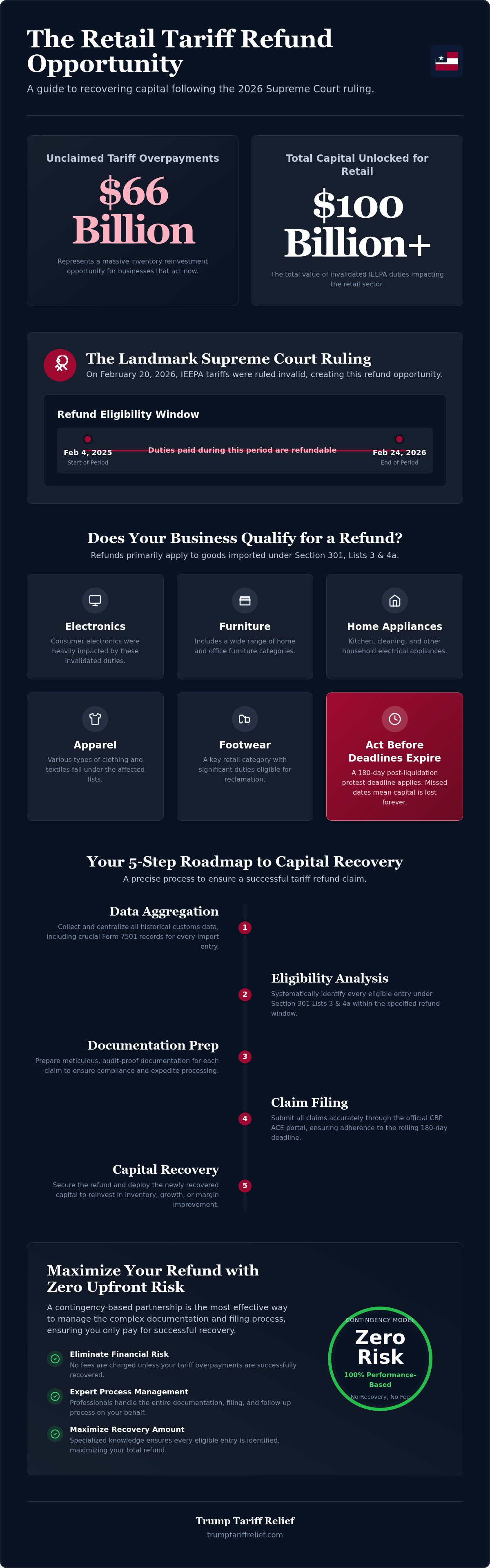
The Retailer’s Roadmap: 5 Steps to Filing a Successful Recovery Claim
Securing a tariff refund for retail companies requires more than just awareness; it demands a disciplined execution strategy. The window to reclaim these funds is governed by strict administrative timelines that favor the prepared. By following this five-step roadmap, your organization can move from awareness to capital recovery with minimal internal friction.
- Conduct a Comprehensive Eligibility Assessment: Audit all China-origin imports during the 2025-2026 gap period. Focus specifically on List 3 and List 4a HTS codes to identify potential overpayments.
- Aggregate Historical Customs Data: Collect all Form 7501 Entry Summaries. These documents serve as the legal proof of payment and are the foundation of your recovery claim.
- Identify the Correct Claim Mechanism: Determine if your entries are liquidated or unliquidated. Liquidated entries require a formal protest within the 180-day window to remain eligible.
- Prepare and Submit the Formal IEEPA Filing: Compile the technical documentation for U.S. Customs. Precision during this stage prevents immediate rejection or administrative delays.
- Monitor via the CAPE Processing System: Track the claim through the Customs Automated Processing Environment until the treasury check is issued and the capital is returned to your balance sheet.
Navigating the Statute of Limitations
The most significant threat to your recovery is the clock. While general claims may have a three-year window, the 180-day protest deadline for liquidated entries operates on a rolling basis. If you miss this window for a specific shipment, that entry's refund potential is permanently extinguished. You can review the Tariff Refund Statute of Limitations to map out your specific deadlines and avoid leaving millions on the table.
Avoiding Common Filing Mistakes
Retailers often fall victim to HTS code mismatches or incomplete documentation packages while pursuing a tariff refund for retail companies. Generic customs brokers typically focus on future clearances rather than historical recovery, leading to missed opportunities. A single error in the CAPE portal can delay your refund by months or trigger unnecessary scrutiny. To avoid these pitfalls, see our FAQ for common filing questions and ensure your submission is audit-ready from day one.
If you want to ensure your claim is handled with clinical precision, see how our recovery process works and let our experts manage the heavy lifting.
Maximizing Recovery with a Contingency-Based Partnership
The erroneous collection of IEEPA duties was a financial injustice that squeezed retail margins across the country. Traditional legal models often penalize companies with high hourly rates regardless of the outcome, which creates a friction point when pursuing a tariff refund for retail companies. This approach is counterproductive when the goal is capital reclamation. A contingency-based partnership flips the script by aligning our success directly with your refund. We ensure that every action taken is focused on one specific goal: returning your capital to your balance sheet.
Specialized trade expertise is the critical differentiator in these filings. While general corporate legal counsel handles broad compliance, they often lack the granular experience required to navigate the ACE portal or the specific CAPE processing system. We manage the entire documentation and filing process, allowing your operations team to stay focused on selling products rather than auditing historical Form 7501 records. This "Success Only" model ensures that our incentives are perfectly mirrored with yours, driving us to identify every possible dollar of eligibility.
The No-Upfront-Cost Advantage
For mid-sized retail firms, the financial barrier to entry for complex trade audits is often too high. The contingency model removes this obstacle entirely, creating a "nothing to lose" scenario for your initial eligibility check. Our firm only earns a fee if the retailer receives a refund check from the government. This structure demonstrates our confidence in the legal precedents established by the Supreme Court and our ability to successfully navigate the federal bureaucracy. It transforms a complex legal challenge into a risk-free business opportunity.
Getting Started with Trump Tariff Relief
Momentum is your greatest asset in the recovery process. Our 15-minute preliminary assessment is designed to be low-friction and high-impact. We use this time to review your high-level import data and identify missed opportunities that your current customs broker likely overlooked. Because the protest deadlines for a tariff refund for retail companies operate on a rolling 180-day basis, every day of inaction is a day of potential capital loss. We identify the gaps, aggregate the data, and file the claims on your behalf.
You don't need to be an expert in trade law to reclaim what is yours. You simply need a partner who is. Our team handles the technical heavy lifting, from the initial eligibility assessment to the final submission of the formal IEEPA claim. Start your free tariff eligibility assessment today and secure the capital your business needs to thrive in 2026.
Take Command of Your Financial Restoration
The window to reclaim what was erroneously collected is narrowing every day as entries liquidate. By identifying your eligible List 3 and List 4a imports, your business can effectively reverse years of margin pressure. You've seen how a tariff refund for retail companies isn't just a legal possibility; it's a strategic necessity for any firm looking to reinvest in growth during 2026. We provide the specialized IEEPA expertise required to navigate the CAPE system without distracting your internal teams from their core operations. Our contingency-based model ensures there are zero upfront costs for retail eligibility audits, meaning we only succeed when you receive your refund check. Don't let your capital remain on a federal balance sheet when the law has already ruled in your favor.
Secure Your Retail Tariff Refund Assessment Now
It's time to right this financial wrong and put your capital back to work. Our team is ready to help you win back the funds your business deserves.
Frequently Asked Questions
Is the retail tariff refund program really legitimate?
Yes, the program is a direct result of the Supreme Court's February 20, 2026, ruling that invalidated specific duties. The Court of International Trade followed this by issuing an order on March 4, 2026, directing U.S. Customs and Border Protection to process refunds. With over $100 billion already returned to importers, this is a standard legal reclamation of capital. It corrects a regulatory overreach where the executive branch exceeded its statutory authority.
Which retail product categories are eligible for IEEPA refunds?
Eligibility covers a vast array of consumer goods found on List 3 and List 4a. Common retail items include furniture under HTS 9403, household appliances in HTS 8418, and electronics like smartwatches or headphones under HTS 8517. Apparel and footwear also feature heavily in these lists. If your business imported China-origin products within these classifications between February 2025 and February 2026, you likely qualify for a tariff refund for retail companies.
What is the deadline for retail companies to file for a tariff refund in 2026?
There is no single expiration date; instead, you face a rolling 180-day protest window after each entry liquidates. This makes immediate action critical for 2026 filings. Once an entry passes this 180-day post-liquidation mark, the opportunity to reclaim those specific duties is generally lost. Because the refund process for IEEPA tariffs is complex, retail leaders must audit their historical data now to ensure no deadlines are missed for early 2025 imports.
How much does it cost to hire a tariff recovery specialist?
Most recovery firms operate on a contingency-based model, meaning there are zero upfront costs for your business. You don't pay for the initial eligibility assessment or the documentation management required to file a claim. Fees are only earned if a refund is secured, typically as a percentage of the actual check issued by the government. This structure aligns the specialist's incentives with your recovery and eliminates the financial risk associated with complex trade litigation.
How long does it take for U.S. Customs to process a refund check?
While U.S. Customs has already accepted more than 125,000 claims through the ACE portal, the actual time to receive a check varies. The process involves coordination between the Court of International Trade and CBP to verify entry data. Once a claim is accepted and processed through the CAPE system, the government typically issues refunds in waves. Professional management of your filing ensures that documentation errors don't cause unnecessary administrative delays in the queue.
Can I still claim a refund if I passed the tariff costs on to my customers?
Yes, your legal right to a refund is based on your status as the Importer of Record who paid the duties to U.S. Customs. The government does not audit whether those costs were absorbed or passed to consumers through price increases. If your company’s name is on the Form 7501 as the party responsible for the duty payment, you are the entity entitled to the reclamation of those invalid funds regardless of your retail pricing strategy.
What documents does my retail company need to provide to start a claim?
Your primary requirement is the Entry Summary, officially known as CBP Form 7501, for every eligible shipment. These documents provide the HTS codes, duty rates, and liquidation dates necessary to substantiate your claim. You should also have your commercial invoices and packing lists available to verify product descriptions if Customs requests additional detail. Specialized recovery services often help aggregate this data directly from your historical customs records to streamline the process.
What is the difference between Section 301 and IEEPA refunds?
Standard Section 301 duties are trade enforcement tools that remain active for many imports. In contrast, the IEEPA refunds specifically target duties applied to List 3 and List 4a during the period of February 2025 to February 2026. The Supreme Court ruled that using the International Emergency Economic Powers Act to escalate these specific tariffs was illegal. A tariff refund for retail companies focuses on reclaiming these specific invalid duties while maintaining compliance with standard trade regulations.
Ready to find out what your business may be owed?
Check My Eligibility