
A large refund portfolio isn’t managed by treating every entry alike. It’s managed in cohorts, then validated entry by entry. With 53 million total entries subject to IEEPA tariffs, managing a large volume of import entries for refund can quickly become an administrative challenge. Records may sit across broker files, invoices, payment systems, and customs data, while liquidation status and filing timelines vary. Reviewing every entry manually can overwhelm a team, but moving too quickly can blur important eligibility distinctions or put deadlines at risk.
A controlled process can bring the work into focus without assuming every entry will qualify. This guide explains how to organize records, group entries for efficient review, separate potential candidates from exceptions, and track the right next steps. It also covers why the 180-day deadline typically applies to formal protests of liquidated entries, and how specialist support can help with eligibility filtering, documentation assembly, filing, and claim tracking. The goal is a repeatable, well-documented view of potential recovery, with each entry assessed on its own facts.
Key Takeaways
- Make managing a large volume of import entries for refund more controlled with one inventory, clear ownership, and traceable source records.
- Group entries by liquidation status and documentation, then assess potential eligibility entry by entry rather than assuming an entire cohort qualifies.
- Use the site-reported figure of 20.1 million entries still unliquidated as of Dec 2025 as context, not as a substitute for reviewing your own portfolio.
- Build a repeatable workflow from record intake through eligibility review, documentation assembly, filing, and claim tracking. The 180-day deadline typically applies to formal protests of liquidated entries.
- A potential assessment starts with basic company and import-history information, a scheduled call, and an eligibility review. The eligibility check and consultation have no upfront cost; payment is only a percentage of recovered funds.
Why managing a large volume of import entries for refund requires a controlled review
High-volume refund management calls for a coordinated portfolio review with eligibility controls at the entry level. Teams need a reliable way to assemble records, assign review ownership, track each entry’s status, and identify which entries warrant further assessment. A portfolio view makes the work manageable; individual review keeps decisions grounded in the facts.
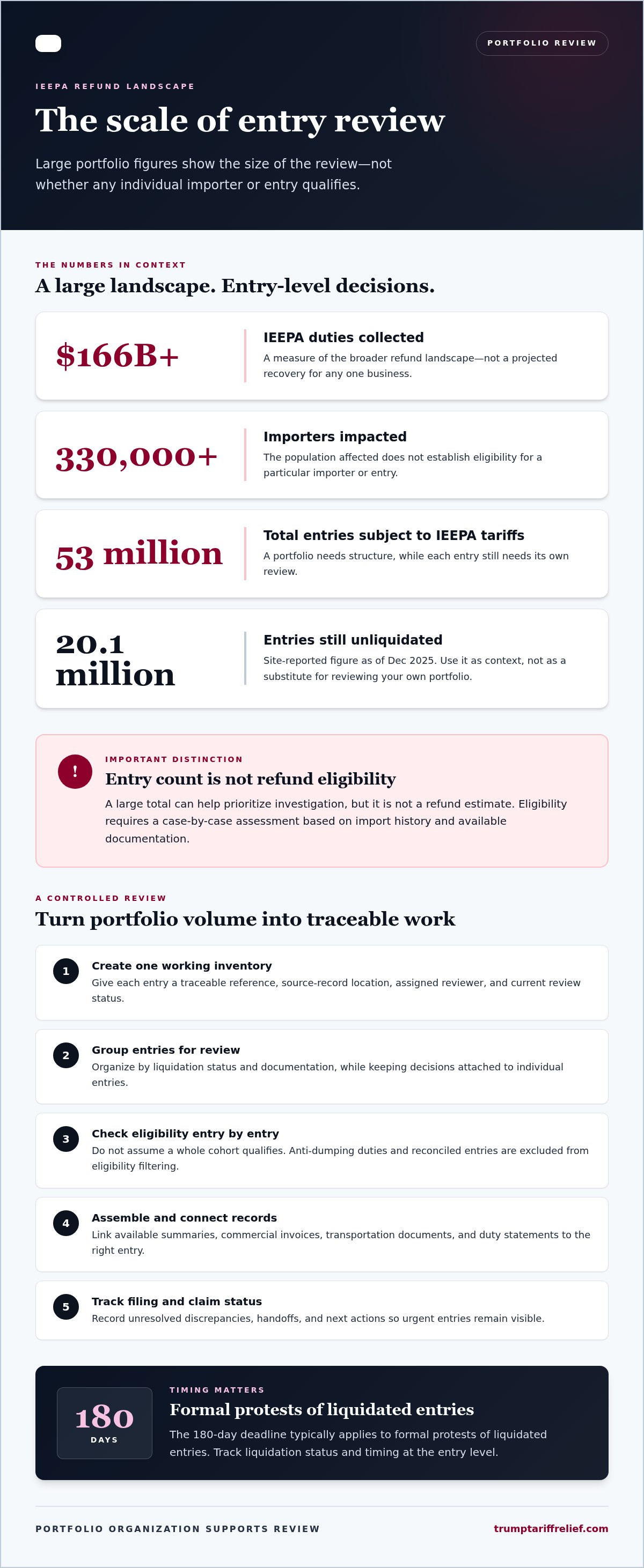
The scale explains the challenge. $166 B+ in IEEPA duties was collected, with 330,000+ importers impacted and 53 million total entries subject to IEEPA tariffs. These figures describe the size of the potential refund landscape, not the outcome for any one company. Managing a large volume of import entries for refund means creating structure without mistaking a large population for confirmed eligibility.
Portfolio organization helps teams control the work; only entry-level review can assess potential eligibility.
What makes a large import-entry portfolio difficult to review?
Records rarely arrive as one clean dataset. Entry details may sit in company systems, broker records, accounting files, invoices, and payment documentation. A spreadsheet can provide a useful starting point, but it may not contain the supporting records needed to understand an entry or determine its status. Connect source documents to the right entry and keep the original data distinguishable from later review notes.
Entries can also differ in tariff treatment, documentation completeness, and liquidation status. One group may have supporting records readily available, while another needs follow-up. Liquidation status matters because filing options and timelines can differ. The 180-day deadline typically applies to formal protests of liquidated entries. Tracking status and timing at entry level helps prevent urgent cases from disappearing inside a portfolio total.
A spreadsheet sum is not a refund estimate. It may combine entries that need more documentation, follow a different review path, or fall outside eligibility filtering. Treat totals as a way to prioritize investigation, not as an amount the business can count on recovering.
Why entry count is not the same as refund eligibility
Each entry requires a case-by-case assessment based on the company’s import history and available documentation. The Supreme Court ruling enabled the possibility of IEEPA refunds, but it doesn’t guarantee a refund for every importer or entry. Anti-dumping duties and reconciled entries are excluded from eligibility filtering.
Keep distinct refund concepts distinct, too. Duty drawback generally concerns recovering duties on imported goods that are later exported or destroyed; it isn’t interchangeable with assessing potential recovery of IEEPA duties. Classifying entries accurately helps teams avoid combining unlike claims and gives leadership a more useful picture of what may warrant further review.
Start with control, not a projected recovery figure: connect source records, note exceptions, and preserve each entry’s status for the next stage of assessment. That foundation makes a large portfolio reviewable without treating every line as a promise.
Build a scalable IEEPA entry inventory without losing entry-level control
A controlled inventory gives every entry a traceable place in the review, even when records come from different systems or teams. Use one authoritative working register with a unique entry identifier, the importer or business unit, relevant import period, broker, source-record location, assigned reviewer, and current review status. Keep the register focused: it should point to source documents and record decisions, not replace the underlying records.
A portfolio inventory organizes the review; it doesn’t determine eligibility. Its job is to make work visible, route exceptions to the right owner, and show what remains unresolved. Eligibility decisions stay attached to individual entries.
What fields belong in a working entry inventory?
Capture fields that help reviewers locate evidence and move each entry forward. Where available, link each entry to its summary, commercial invoice, transportation documents, and duty statement. Mark whether records are complete, under review, or awaiting follow-up, and record the reviewer and next action. The IEEPA refund FAQ also outlines supporting-record categories.
- Entry reference: the identifier used to connect the inventory row with source records.
- Record references: document names, storage locations, or links to available summaries, invoices, transportation records, and duty statements.
- Review controls: tariff review status, documentation completeness, reviewer, and next follow-up action.
- Change history: dated notes explaining updates, unresolved discrepancies, or review handoffs.
Protect the inventory and linked files by limiting access to people involved in the review. Keep original source data separate from working notes: preserve received records unchanged, then document corrections or interpretations in the review layer. This makes it easier to trace how a status changed and what evidence informed a decision.
How should teams separate entries into review cohorts?
Group records to make assignments practical, not to make decisions on behalf of the group. Useful cohort dimensions include business unit, import period, broker, or current status. For example, a reviewer could work through one business unit’s entries associated with a broker, while a separate queue tracks entries with incomplete records. Every row should still retain its own status and evidence references.
Flag missing, inconsistent, or duplicate records for resolution instead of silently removing them. A missing invoice may require follow-up with the records team; a duplicate may need comparison against its source record before either row is closed. Use clear exception labels and assign an owner so unresolved entries don’t vanish from the review because they don’t fit a clean cohort.
As the portfolio grows, keep cohort labels consistent and avoid overlapping categories that obscure ownership. A structured inventory can support IEEPA eligibility filtering and documentation management while keeping the underlying entry decisions distinct.
Compare entry cohorts by status, documentation, and filing path
Once entries are organized, sort them into review queues that reflect what is known and what still needs attention. Liquidation status affects the next questions to ask; documentation gaps and excluded categories need their own controls. The aim isn’t to assign one filing route to an entire cohort. It’s to focus review effort while preserving a separate record and decision for every entry.
20.1 million entries were still unliquidated as of Dec 2025. That figure provides context for the scale of the review, not a count of entries that qualify for a refund or a prediction for any individual importer.
Liquidation status can affect the appropriate review path and deadline analysis, so assess it entry by entry.
| Review category | What to check | Portfolio action |
|---|---|---|
| Unliquidated | Confirm the recorded status and connect the entry to its supporting records. | Keep in a separate queue for review of the applicable next steps under current instructions. |
| Liquidated | Record liquidation status and date, then prioritize deadline analysis. | Flag for prompt review. The 180-day deadline typically applies to formal protests of liquidated entries, not every entry or filing. |
| Incomplete records | Identify missing or inconsistent summaries, invoices, duty statements, or other supporting documents. | Route to an exception queue with a named follow-up owner; don’t treat a documentation gap as an eligibility decision. |
| Excluded entries | Identify anti-dumping duties and reconciled entries. | Keep outside IEEPA eligibility filtering rather than including them in potential recovery estimates. |
How liquidation status changes the review queue
Separate unliquidated and liquidated entries before assigning the next review step. For liquidated entries, capture the liquidation date and make deadline review visible to the responsible owner. The 180-day deadline typically applies to formal protests of liquidated entries; don’t apply it universally to every entry or filing path. For background on the ruling behind potential IEEPA refunds, see this IEEPA ruling overview.
How to handle incomplete or excluded records
Keep incomplete entries active in a distinct exception queue until the gap is resolved or documented for further assessment. For example, if a duty statement is missing, record what’s needed and assign follow-up instead of removing the entry from the working inventory. Keep anti-dumping duties and reconciled entries outside eligibility filtering. Don’t calculate potential recovery from a mixed set before eligibility and documentation have been assessed.
This status-based method makes managing a large volume of import entries for refund more disciplined: teams can prioritize deadline-sensitive reviews, resolve record gaps, and keep excluded entries from distorting the assessment. If specialist support would help organize eligibility review and documentation, see how the review process works.
Run a repeatable high-volume refund workflow across teams
A repeatable workflow turns a large entry inventory into assigned work, documented decisions, and visible follow-up. Set an internal coordinator to maintain the master inventory, but give each function a clear role: import operations validates entry details, finance helps trace duty records, records teams retrieve supporting documents, and customs brokers can contribute relevant entry information. Clear ownership prevents requests and exceptions from circulating without resolution.
- Intake and reconcile records. Import operations gathers available CBP/ACE data and broker files, then connects each entry to its source records. Log missing, duplicate, or conflicting information instead of silently dropping it.
- Review potential eligibility. Assign an owner to assess entries individually against import history and available records. Keep excluded categories and unresolved entries distinct from those ready for further review.
- Assemble supporting documentation. The records team gathers the documents needed for each entry and links them to its inventory record. Track what is complete and what remains outstanding.
- Determine and coordinate the appropriate filing. Route reviewed entries for the applicable next step based on their circumstances and status. Don’t treat one filing instrument as the default for every entry.
- Track progress and exceptions. Record filing status, relevant updates, and outstanding actions. Review deadline-sensitive entries and unresolved exceptions regularly, assigning an owner and next action to each.
How to assign review ownership and resolve exceptions
Name one internal coordinator who is accountable for inventory integrity, ownership assignments, and status updates. That person doesn’t need to perform every review; they make sure each entry has a clear next step. Route missing documents and conflicting details to a defined resolution queue. Keep decisions, dates, and source references attached to the relevant entry so a handoff doesn’t break the record trail.
Set a recurring exception review that gives deadline-sensitive entries timely attention. Use the entry’s status and relevant dates to prioritize the queue, and escalate records that need prompt review. This keeps unresolved items visible without confusing “waiting for documentation” with “ineligible.”
How to coordinate with customs brokers and specialist support
Customs brokers can partner in the work by sharing relevant entry records and helping resolve data questions. They don’t replace internal ownership: your company still needs a coordinator who can bring together import operations, finance, and records teams. Trump Tariff Relief can add capacity by reviewing CBP/ACE data, filtering entries for potential eligibility, assembling supporting documentation, filing the appropriate instrument, and tracking claims.
Trump Tariff Relief provides a 24-hour initial review and an initial eligibility response within one business day. The full assessment timeline varies by case complexity. Specialist support can help clarify how eligibility review, filing, and tracking fit into a managed portfolio. For businesses managing a large volume of import entries for refund, this division of work can ease administrative pressure while keeping entry-level review intact.
Organize your portfolio and have Trump Tariff Relief assess potential IEEPA refund eligibility. The eligibility check and consultation have no upfront cost; payment is only a percentage of funds successfully recovered.
Move from an organized entry portfolio to a potential refund assessment
A well-organized portfolio gives a specialist a clearer starting point, but it doesn’t replace an entry-by-entry assessment. For businesses managing a large volume of import entries for refund, intake moves from broad import-history information to a focused review of records, potential eligibility, and appropriate next steps.
The initial intake follows three straightforward steps:
- Submit basic company and import-history information. Share an overview of the business and its IEEPA-related import activity so the review can begin with relevant context.
- Schedule a call. Use the discussion to clarify the portfolio, available records, and questions about the review.
- Review potential eligibility. The team assesses the available information and identifies which entries may warrant further review. Eligibility is determined case by case, and no refund outcome is guaranteed.
What happens after a business requests an eligibility check?
The team reviews company and import-history information alongside available supporting records, including CBP/ACE data where relevant. Entries are filtered for potential eligibility, while anti-dumping duties and reconciled entries are excluded from eligibility filtering. If a record is incomplete or details conflict, that issue can be separated for follow-up rather than treated as an automatic eligibility decision.
The appropriate filing instrument depends on the entry and the facts of the case. A Post-Summary Correction, protest, or drawback claim may be appropriate in different circumstances, but no single route should be assumed for every entry. The assessment helps organize the facts and identify the appropriate next step without presenting a potential recovery as certain.
Trump Tariff Relief provides a 24-hour initial review and an initial eligibility response within one business day. The full assessment timeline varies by case complexity. Company and import information is kept strictly confidential and is never shared without explicit consent.
How does contingency-based support reduce upfront commitment?
The eligibility check and consultation have no upfront cost, and there is no hourly billing. Payment is only a percentage of funds successfully recovered. That structure lets a business pursue an assessment without an upfront service charge, while keeping payment tied to funds actually recovered. It doesn’t remove uncertainty: eligibility remains case by case, and refunds aren’t guaranteed.
Advanced funding may be available for qualifying claims, but it’s optional, not a required step. Whether it is relevant depends on the claim and the business’s circumstances.
If your portfolio is assembled and you’re ready to understand what may qualify, request an eligibility check. Share basic company and import-history information, then let the review determine whether any entries warrant further action. The first step is an assessment, not a promise of a refund.
Turn your review into a clear next step
A well-managed refund portfolio should do more than organize records. It should help your business decide what deserves attention, what needs further documentation, and where a potential claim warrants specialist review. Keep the focus on informed decisions, not assumed recovery. Eligibility is assessed case by case, and no refund outcome is guaranteed.
Specialist support can help turn complex entry data into an organized assessment. Trump Tariff Relief’s founder brings 20+ years of experience in government receivables and structured financial claims, supporting a careful approach to potential recovery.
You don’t need to resolve every record before taking a first step. Share your import history for an initial eligibility review, then use the assessment to understand whether further action may be appropriate. The result is a more grounded basis for deciding how to proceed.
Begin your IEEPA eligibility assessment and take a practical next step toward understanding your potential claim. The eligibility check and consultation have no upfront cost, and payment is only a percentage of funds successfully recovered.
Frequently Asked Questions
Can a business manage a large volume of import entries for a refund in one claim?
A business can organize entries together for review, but that doesn’t mean every entry qualifies or can be treated as one eligibility decision. Cohorts can help teams manage records and assign work, while each entry remains subject to individual review of its documentation and applicable deadlines. Grouping entries is an organizational method, not a filing method. An eligibility check based on your import history can help identify which entries may warrant further assessment.
Does having more import entries make a business more likely to qualify for an IEEPA refund?
No. Entry volume alone doesn’t establish eligibility or guarantee recovery. A review considers the business’s import history, supporting records, each entry’s status, and applicable deadlines. A large portfolio or substantial duties paid may provide more records to examine, but it doesn’t prove that any particular entry qualifies. Avoid projecting a recovery amount from entry counts or totals before an assessment; refund outcomes can’t be guaranteed.
What documents should importers gather when reviewing many entries for a refund?
Gather available entry summaries, commercial invoices, transportation documents, and duty statements. These records help reviewers connect import activity and duty information to individual entries, but having them doesn’t guarantee eligibility or a successful refund. Documentation availability is part of the eligibility check, and completeness can differ across a portfolio. Organize files so each document can be matched to the relevant entry, and mark gaps rather than assuming a missing record applies to every entry in a group.
What is the 180-day deadline for liquidated import entries?
The 180-day deadline typically applies to formal protests of liquidated entries. It isn’t a universal deadline for every entry or every filing path. As a practical first step, identify which entries are liquidated, record the relevant liquidation information, and flag them for prompt review. Don’t apply the same timing across a mixed portfolio without reviewing the status and circumstances of each entry, since the appropriate review path depends on case details.
Are anti-dumping duties or reconciled entries included in this refund review?
No. Anti-dumping duties and reconciled entries are excluded from Trump Tariff Relief’s eligibility filtering for potential IEEPA tariff refunds. Keep these categories separate in your working inventory so they aren’t mixed into the group being assessed. For example, use a clear excluded status rather than combining those records with entries awaiting review. This helps keep portfolio tracking and any preliminary assessment focused on the relevant entries.
How quickly does Trump Tariff Relief respond to a high-volume eligibility request?
Trump Tariff Relief provides an initial eligibility response within one business day and a 24-hour initial review. That timing refers to the initial response, not completion of a full portfolio assessment or a refund filing. The full assessment timeline varies by case complexity, including the scope of import history and records to review. An initial response is not a determination that every entry qualifies or that a refund will be recovered.
Is there an upfront fee for managing a large-volume tariff refund claim?
No. The eligibility check and consultation have no upfront cost. Under the contingency-based model, payment is only a percentage of funds successfully recovered. This doesn’t mean a refund is assured. Eligibility is assessed case by case, and payment depends on successful recovery. Businesses can use the initial assessment to understand potential eligibility without treating a portfolio total as guaranteed funds.
Will a business’s import records be shared with third parties during an eligibility review?
Business information is kept strictly confidential and is never shared without explicit consent. To begin an eligibility check, a business can provide basic company data, estimated tariff fees paid, import regions, and documentation availability. Keeping information organized by entry can help connect import history to relevant supporting documents. No business records are shared with third parties without the business’s explicit consent.
Ready to find out what your business may be owed?
Check My Eligibility