
A tariff refund doesn’t determine its own tax treatment. The way your business accounted for the original duty often does. So, are tariff refunds considered taxable income? Generally, a recovery may be taxable to the extent the original deduction reduced your tax, but it isn’t automatically taxable in full or automatically tax-free.
It’s understandable to focus on when the refund arrives. The key questions are what happened to the goods and where the tariff cost was recorded. If the goods remain in inventory, the refund may reduce inventory basis. If they’ve been sold and the duty was included in cost of goods sold, the recovery may affect income in the year it’s recognized. Duties capitalized into an asset can call for a different adjustment.
This guide explains how the tax benefit rule, accounting method, and timing can shape the result, and which import, inventory, asset, and tax records to organize for review. Tariff refund assistance is separate from income-tax analysis: eligibility support can help assess a potential claim and manage customs documentation, while a qualified tax professional evaluates how any recovery should be reported.
Key Takeaways
- Whether tariff refunds are considered taxable income depends on how the original tariff cost was treated and whether its deduction reduced the business’s tax.
- Trace each refund to the goods it relates to: unsold inventory, goods already sold, and duties capitalized into assets can lead to different accounting questions.
- Separate the timing of refund recognition from the date cash arrives, and review any refund interest as a distinct item.
- Gather import-entry records, invoices, duty statements, inventory details, accounting entries, and refund correspondence to support a clear tax review.
- Keep claim recovery and tax reporting distinct: tariff refund assistance can address IEEPA eligibility, documentation, and government filings, while tax treatment requires a separate review.
Are tariff refunds taxable income? Start with the tax benefit rule
Are tariff refunds considered taxable income? Sometimes. The answer depends on how the tariff payment was treated originally and whether deducting it reduced the business’s tax. A refund doesn’t automatically become taxable simply because cash arrives, and it isn’t automatically tax-free because it returns money the business previously paid.
The guiding concept is the federal tax benefit rule, reflected in Internal Revenue Code Section 111 and explained in IRS Publication 525. In plain English, if a business claimed a deduction that lowered its tax and later recovered that amount, the recovery may need to be included in income, but only to the extent the earlier deduction provided a tax benefit. The refund isn’t necessarily treated as entirely new income; it may reverse the tax effect of a prior deduction.
Quotable takeaway: The prior tax benefit is central to a tariff refund’s treatment, but the result requires a case-specific tax review.
What the tax benefit rule means for a tariff refund
Start with the prior tax return, not just the refund notice. A deduction’s tax effect depends on the taxpayer’s circumstances and how the deduction affected the amount of tax owed. For example, if a tariff expense reduced taxable income and lowered the tax due, recovering that cost may trigger income recognition to the extent of that benefit. If the deduction didn’t reduce tax, the recovery may be treated differently.
This isn’t a shortcut formula. The deduction may have interacted with other items on the return, so the amount originally claimed alone doesn’t establish the taxable amount. A reviewer needs to trace the recovery to the original reporting and determine the actual tax effect. The rule helps frame the analysis; it doesn’t replace review of the company’s returns and accounting records.
Why the original tariff accounting matters
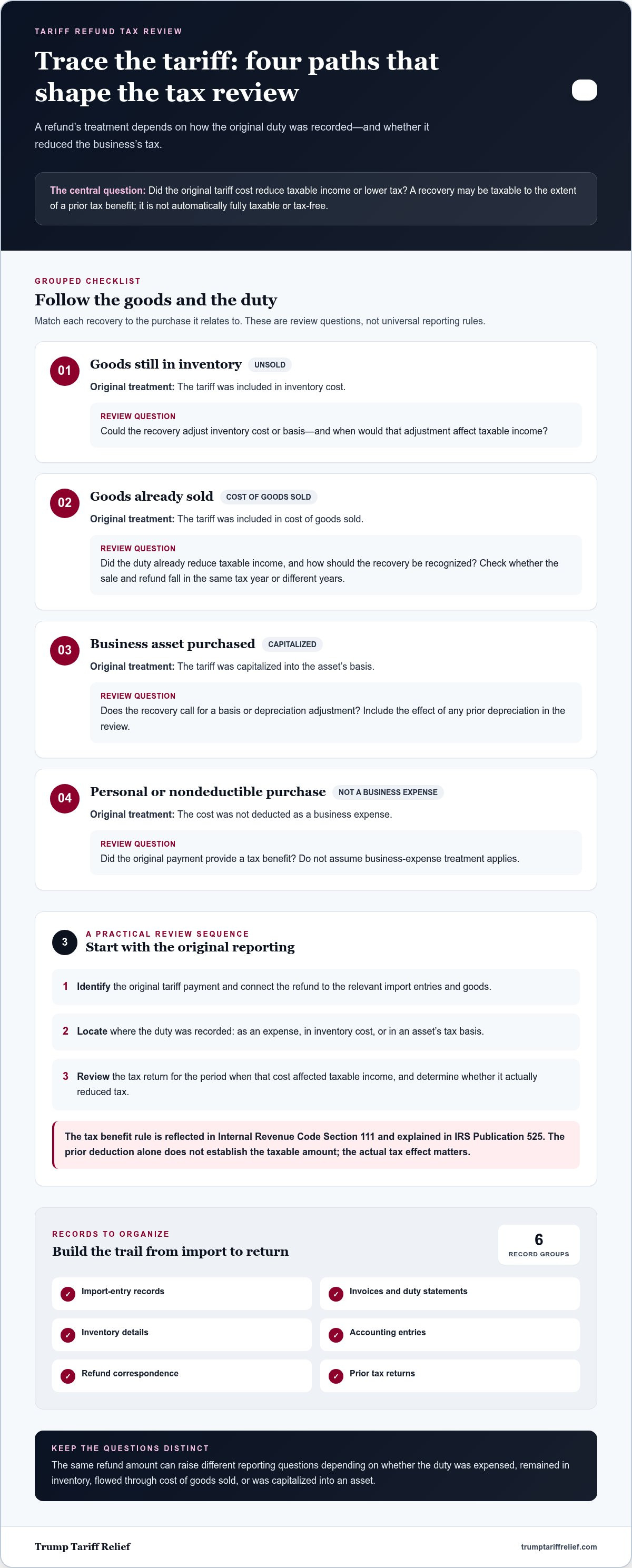
A tariff payment may have been recorded as an expense, included in the cost of inventory, or added to an asset’s tax basis. Those classifications affect when the cost may have influenced taxable income. An expense may have been deducted in one period; an inventory cost may affect income when goods are sold; a capitalized cost may affect taxable income over time through depreciation.
That means the same refund amount can raise different reporting questions depending on the underlying transaction. Before reaching a conclusion, connect the refund to the relevant import entries and identify how the duty moved through the books and tax returns. For background on the trade claim itself, the IEEPA tariff refund recovery guide explains the separate recovery process.
A practical starting sequence is to identify the original tariff payment, locate where it was recorded, and review the return for the period in which that cost affected taxable income. This establishes the key facts for a qualified tax reviewer without assuming every refund has the same outcome.
How inventory, cost of goods sold, and asset purchases change the analysis
Once you’ve identified how a tariff was recorded, trace what happened to the goods it applied to. Unsold inventory, merchandise already sold, and equipment placed in service can carry the duty through the books differently. That history helps a qualified tax reviewer determine whether a refund adjusts a cost or basis, affects income, or requires another treatment.
The same tariff refund may receive different treatment across purchase categories because the duty may have affected taxable income at different times, or not at all. Use this comparison to organize the questions, not as a universal reporting rule:
| Purchase status | Original accounting treatment | Issue to review |
|---|---|---|
| Goods remain unsold | Tariff included in inventory cost | Whether the recovery adjusts inventory cost or basis, and when that adjustment affects taxable income. |
| Goods have been sold | Tariff included in cost of goods sold | Whether the duty already reduced taxable income and how the recovery is recognized. |
| Business asset purchased | Tariff capitalized into asset basis | Whether basis or depreciation requires adjustment, including the effect of prior depreciation. |
| Personal or otherwise nondeductible purchase | Cost not deducted as a business expense | Whether the original payment provided a tax benefit; don’t assume the business-expense treatment applies. |
Goods still in inventory versus goods already sold
If goods are still on hand, the tariff may remain embedded in inventory records. A refund could raise an inventory-cost or basis adjustment question rather than immediate income recognition. The timing and reporting depend on the taxpayer’s accounting and tax facts, so don’t automatically record every recovery as income.
For goods already sold, the duty may have flowed into cost of goods sold and affected taxable income in the period the sale was reported. If so, the refund may be analyzed as a recovery of that cost. Check whether the goods sold in the same tax year as the refund or an earlier year, then reconcile the entries with the accounting records. CBIZ discusses these distinctions in its overview of Tax Implications of Tariff Refunds.
Fixed assets and nondeductible purchases
Equipment and other fixed assets need a separate review. If duties were included in an asset’s basis, a refund may affect basis and depreciation rather than follow inventory treatment. The reviewer may need to consider depreciation already claimed and the asset’s remaining recovery period. Don’t treat the full refund as an immediate expense reversal without examining how the asset was reported.
Also distinguish deductible business costs from personal or otherwise nondeductible purchases. A tariff tied to a cost that didn’t reduce taxable income may not have the same recovery consequence as a previously deducted expense. The purchase’s use and tax treatment matter.
For the tax review, match each refund to the import entry, product, sale or asset record, and original accounting treatment. Separately, an IEEPA refund claim process addresses claim eligibility and supporting customs documentation, not the tax reporting conclusion.
When to recognize a tariff refund, interest, and customer repayments
The amount recovered is only part of the reporting question. A business also needs to identify the relevant tax year, separate any interest from refunded duties, and determine whether it owes any portion to a customer. These are related facts, but they raise distinct tax and accounting questions. The date Customs and Border Protection issues or pays a refund does not, by itself, settle every part of the analysis.
Does tax recognition always happen when cash arrives?
For a cash-method taxpayer, income is generally recognized when received. For an accrual-method taxpayer, recognition may arise earlier if the right to the recovery becomes fixed and determinable, even if payment comes later. That concept can matter when a claim is pending, but it doesn’t establish a universal recognition date for every tariff refund.
Ask a qualified tax reviewer to assess the company’s accounting method, claim status, and the facts that establish whether a right to payment exists. Keep three timelines separate: whether an import entry may qualify for a refund, when the government processes or pays a claim, and when tax rules require the business to recognize a recovery. Those milestones may not line up.
To prepare for that review, document the claim’s status at each reporting date, including submitted filings, government notices, decisions, and payment records. If the claim remains unresolved at year-end, preserve the relevant correspondence rather than assuming either that recognition must wait for cash or that filing a claim fixes the tax year.
How interest and customer obligations complicate reporting
Separate the refunded duty principal from any interest paid on the refund. Under the federal treatment described in IRS guidance, refund interest is generally treated as taxable ordinary income in the year received. It is distinct from the duty recovery, which may be analyzed based on its original accounting and tax effect. Record the two components separately, and have a qualified tax reviewer confirm the treatment for the business and tax year.
Quotable takeaway: Refund principal, interest, and amounts owed to customers are separate reporting questions, even when they arrive in one payment.
Customer arrangements add another layer. A contract may assign responsibility for duties or provide for sharing a later recovery. If the business collects a refund and then repays a customer, the agreement, the payment’s timing, and the amount actually remitted can all affect the analysis. A contractual obligation or planned repayment doesn’t automatically mean the business excludes the refund from income; the tax result depends on the facts and applicable accounting treatment.
Build a reconciliation that shows the gross duty refund, any interest, the customer or transaction connected to each amount, and any repayment actually made. Retain contracts, credit notes, payment evidence, and correspondence explaining the calculation. This creates a clear trail from government recovery to the company’s books without conflating claim processing with income-tax recognition.
What records should your business gather before its tax review?
A tax review is more efficient when each refund can be traced from the government notice back to the import, the goods, and the original accounting period. Organized records help a qualified tax reviewer assess whether tariff refunds are considered taxable income based on the business’s facts. Use this checklist to assemble the record trail; it’s preparation for a review, not tax advice.
Build a record of the duties and affected goods
Start with customs and purchasing records. Keep documents together by entry number or another consistent reference so the duty paid, imported products, and any later recovery can be connected. Trump Tariff Relief’s required documents for an IEEPA tariff refund can help organize the claim-support file.
- Entry summaries: Gather the entry summaries and related import records for each entry tied to the refund.
- Invoices and shipping records: Collect commercial invoices and transportation documents that identify the goods and transaction.
- Duty statements: Preserve statements or other records showing duties paid, along with records that reconcile those amounts to the entries.
- Refund correspondence: Keep claim submissions, government notices, payment records, and correspondence. Record the refunded duty principal separately from any interest.
- Goods status: Map the affected products to inventory still held, goods already sold, or purchases tied to an asset. Retain inventory movement or asset records that support the classification.
Then reconcile the amount received, or claimed, to the relevant entries. Note differences between the duty originally paid and any amount refunded, and preserve records that explain adjustments. This makes it easier to identify the goods and periods involved instead of relying on a single payment total.
Prepare the accounting and customer-impact trail
Import records show what happened at the border. Accounting records show how the duty affected the business’s books and tax filings. Gather documents that connect those two sides:
- Accounting entries: Collect general-ledger detail and workpapers showing whether duties were treated as an expense, inventory cost, cost of goods sold, or part of an asset’s basis.
- Tax records: Provide prior returns and supporting workpapers for the periods when the tariff costs were recorded or affected income.
- Inventory and asset detail: Include inventory reports and sales records, plus asset schedules or depreciation records where relevant.
- Customer obligations: Gather contracts, credit notes, and evidence of amounts actually credited or repaid to customers. Keep planned payments distinct from completed payments.
Prepare a simple reconciliation showing the import entry, duty amount, original accounting period, goods status, refund principal, interest, and any customer repayment. Flag missing or inconsistent records for the tax reviewer rather than filling gaps with estimates. For businesses managing ongoing bookkeeping and year-end compliance, professional firms such as Mazuma provide accountancy services that keep financial records clean and audit-ready.
For support with assessing potential IEEPA claim eligibility and organizing customs documentation, review the IEEPA refund claim process. Claim support and tax treatment are separate reviews.
Keep tax reporting separate from your IEEPA tariff refund claim
A potential customs refund and its income-tax treatment are separate matters. Claim support focuses on whether particular imports may qualify for recovery, assembling documentation, and making appropriate government filings. Tax reporting focuses on how the business originally accounted for the duties, when a recovery must be recognized, and what effect it has on the company’s return. Keeping those workstreams distinct helps prevent a claim review from being mistaken for a tax conclusion.
So, are tariff refunds considered taxable income? The answer still turns on the original accounting, the tax benefit, and the timing of recognition. A tariff refund specialist can help organize and advance a potential claim, but that work doesn’t determine how the business reports a recovery for tax purposes. Bring the import and payment records together for the claim process, and give your tax reviewer the accounting and return information needed for a separate analysis.
What tariff refund claim assistance covers
Trump Tariff Relief assists U.S. importers with IEEPA refund eligibility review, customs documentation preparation, and appropriate government filings. Eligibility depends on the specific import history, supporting documents, and applicable deadlines. Not every entry qualifies, and no refund outcome is guaranteed. The work is focused on the tariff refund process, not income-tax analysis, general tax advice, or general legal advice.
Business information is kept strictly confidential and not shared without explicit consent. Claim support can help create a clearer record of the imports and documentation involved, while a qualified tax reviewer evaluates the business’s reporting position. These roles are complementary, but they are not interchangeable.
There’s no upfront cost for claim assistance, and payment is only a percentage of funds successfully recovered. This contingency-based arrangement means payment is due only on successful recovery. It doesn’t guarantee eligibility, a filing result, or a particular recovery amount.
A practical next step for importers
To begin an eligibility review, submit basic company and import-history information, including estimated tariff fees paid, import regions, and available documentation. The eligibility check and consultation are free. Trump Tariff Relief provides an initial response within one business day; the full assessment timeline varies with case complexity. This review assesses potential IEEPA eligibility, not the taxability of a future refund. Keep relevant entry records and duty documentation organized so the import history can be considered alongside the supporting materials.
Understanding how the tariff refund process works can help you distinguish claim preparation and government filings from your separate tax review. After any recovery, provide your tax reviewer with the claim outcome, payment details, and records showing how the original tariff costs were treated. That handoff gives each review a clear purpose and helps the business address recovery and reporting without confusing one for the other.
Put your next decision on solid ground
A potential recovery creates two separate decisions: whether to pursue an eligible claim and how to report any recovery for tax purposes. Keep those workstreams connected through clear records, but don’t let progress on one stand in for review of the other. A well-organized file can help your tax reviewer evaluate the facts and help your claim team assess the import history.
If your business paid IEEPA tariffs, the next step is to establish whether its specific entries may qualify. An eligibility check assesses potential claim eligibility, not whether a future refund will be taxable. For that tax question, bring the original accounting and relevant return records to a qualified tax reviewer.
Still asking, are tariff refunds considered taxable income? The answer turns on your company’s circumstances, so move forward with both reviews clearly defined. Request a no-cost IEEPA refund eligibility check to begin assessing your potential claim. A careful review can help your business pursue available recovery opportunities while keeping tax reporting decisions grounded in the right facts.
Frequently Asked Questions
Are IEEPA tariff refunds considered taxable income?
There’s no universal yes-or-no answer to whether tariff refunds are considered taxable income. Under the federal tax benefit rule, a recovery may be included in income to the extent a prior deduction reduced tax, but inventory treatment, other original accounting, and recognition timing can change the analysis. For example, two importers receiving similar refunds may have reported the duties differently. This is general information, not company-specific tax advice. Have your tax professional review the relevant returns and records.
Is a tariff refund taxable if the imported goods are still in inventory?
Not necessarily as immediate income. If the tariff remains embedded in the cost of goods still on hand, it may not yet have affected taxable income in the same way as a cost included in cost of goods sold. That distinction matters, but it doesn’t make the refund automatically tax-free. Inventory valuation, accounting methods, and the particular goods all matter. Have your tax professional review the company’s records before deciding how to report it.
Do businesses pay tax on tariff refunds for goods already sold?
Not in every case. Whether tariff refunds are considered taxable income for goods already sold depends on how the duties were treated and whether that treatment reduced tax. If the duty was previously deducted or included in cost of goods sold, the tax benefit rule may apply to a later recovery. Recognition timing also matters, so review the original tax workpapers and recovery details with your tax professional.
When should a business report a tariff refund for tax purposes?
The recognition year depends partly on the business’s tax accounting method and the facts establishing its right to the refund. Cash receipt may be relevant for a cash-method taxpayer, while an accrual-method taxpayer may need to assess whether a right became fixed earlier. A pending claim doesn’t automatically settle the answer. Keep claim filing and payment dates distinct from tax recognition, then ask your tax professional to assess the company’s year-end facts.
Is interest paid with a tariff refund treated the same as the refunded duties?
Interest should be tracked separately from the refunded duty principal because it can have a different reporting treatment. Federal guidance generally treats interest paid on a refund as taxable ordinary income when received, but the business should have its tax professional confirm the treatment for its circumstances and accounting method. Check the payment statement for a separate interest amount and retain it with the refund records. Don’t combine both components into one unexplained ledger entry.
What records should I keep for the tax treatment of a tariff refund?
Keep entry summaries, commercial invoices, transportation documents, duty statements, refund notices, and prior tax workpapers showing how the duties were recorded. Inventory records can help connect the imported goods to later sales or remaining stock; customer credits and repayment evidence may also matter. Use a reconciliation to link the refund to its import entries and original accounting period. This tax-review file is distinct from the documents used to assess and file a refund claim.
Does a tariff refund become nontaxable if a business must repay customers?
No automatic exclusion follows just because a customer may be owed money. The contract, the nature of the obligation, and whether the business actually issued a credit or payment can all be relevant to the tax analysis. Preserve the governing agreement, customer correspondence, credit notes, and proof of any repayment. A tax professional can evaluate how those facts affect the company’s reporting; don’t assume a planned remittance has the same effect as an amount already paid.
Does Trump Tariff Relief determine whether my tariff refund is taxable?
No. Trump Tariff Relief assists with IEEPA refund eligibility, customs documentation, and appropriate government filings, while the business’s tax treatment requires a separate review of its accounting and circumstances. Eligibility checks and consultations are free, with no upfront cost; payment is only a percentage of funds successfully recovered. No refund outcome is guaranteed, and eligibility depends on the specific import history, documentation, and deadlines. Keep tax-reporting questions with your tax professional.
Ready to find out what your business may be owed?
Check My Eligibility