
Can your business recover tariffs on Chinese imports simply because the goods came from China? No. The legal authority behind each duty matters more than the country of origin. That distinction is crucial: the Supreme Court ruled IEEPA tariffs unlawful on February 20, 2026, and collection stopped on February 24, while Section 301 tariffs on Chinese goods remain in effect.
If you paid duties on China-origin shipments, it’s reasonable to ask whether a refund is possible. U.S. Customs and Border Protection is processing certain IEEPA refund claims through its CAPE system, but refunds aren’t automatic. Eligibility depends on the tariff involved, entry status, and applicable procedures. A China-related duty isn’t necessarily an IEEPA duty.
This guide explains how to distinguish potentially recoverable IEEPA duties from Section 301 and other tariffs, which entry and payment records can help identify what you paid, and why timing and entry status matter. You’ll also learn how an IEEPA tariff eligibility assessment and customs documentation management can help organize a case-specific review without assuming that any entry qualifies for a refund.
Key Takeaways
- For recovering tariffs on Chinese imports, trace each duty to its legal authority rather than relying on country of origin alone.
- Compare the tariff authority and entry status before treating a duty as potentially refundable. A remedy tied to one authority doesn’t automatically apply to another.
- Start your review with entry summaries, tariff classifications, origin details, payment records, and broker communications.
- A refund system doesn’t establish that every duty or entry qualifies. The entry details and applicable process matter.
- If your records point to potentially applicable IEEPA duties, an IEEPA-focused assessment can help organize documentation and manage the filing work.
Recovering Tariffs on Chinese Imports Starts With Identifying the Duty
A shipment’s Chinese origin tells you where the goods came from, but not which legal authority imposed each duty collected at the border. Identifying the charge is the first step in recovering tariffs on Chinese imports. Before considering a refund or another remedy, determine what was assessed.
IEEPA and Section 301 are separate authorities, so a development affecting one doesn’t automatically change the treatment of the other. The Supreme Court ruled IEEPA tariffs unlawful on February 20, 2026, and collection ceased on February 24. Section 301 tariffs remain a distinct category. When reviewing a China-origin entry, separate the duty lines instead of treating the total paid as one recoverable tariff.
What does recovering tariffs on Chinese imports mean?
Tariff recovery means seeking a potential refund or other remedy, not expecting automatic repayment. A refund claim seeks repayment of duties through an applicable process. Other routes address different issues: an exclusion may remove or reduce a tariff’s application to qualifying goods, drawback may concern duties on imported goods later exported, and a protest may challenge a customs decision. These options aren’t interchangeable. Each has its own legal basis, requirements, and limits, and none should be assumed to apply to every importer or entry.
Recovery depends on the duty’s legal authority and the facts of the specific entry, not simply on the goods’ country of origin.
Why the tariff line matters more than the country label
Two shipments from China can carry different duty components, even if they arrive in the same period. One entry might show a base duty and a Section 301 charge; another may also include a separately identified duty imposed under a different authority. The tariff classification and additional tariff provisions on the entry summary can help show what was assessed. Treat these details as clues to investigate, not as a final eligibility decision.
Start with the entry summary and compare its tariff details with the duty payment records. Check the product classification, origin information, and any additional tariff codes shown. If the paperwork is incomplete or the charges are unclear, broker communications may help connect the assessed amounts to the entry. Keep each shipment’s documents together. A general ledger total alone may not show which authority applied to which goods.
The IEEPA tariff framework helps explain why identifying the authority matters. IEEPA refers to the International Emergency Economic Powers Act (IEEPA), a legal authority distinct from Section 301. A ruling concerning IEEPA shouldn’t be read as automatically invalidating or refunding a separate Section 301 duty.
That’s the practical dividing line: if records point to potentially applicable IEEPA duties, an IEEPA-focused assessment can help determine the next step. If they show only Section 301 or other duties, that fact alone doesn’t establish an IEEPA refund claim. Classify the charge first, then assess the entry-specific facts and applicable route.
How IEEPA and Section 301 Duties Lead to Different Recovery Questions
A single import entry can carry several duty lines, each tied to a different legal authority. This is tariff stacking: the total paid may combine an ordinary duty with one or more additional tariffs. For recovery purposes, separate those charges first. The authority behind each line determines which legal questions to ask and whether an IEEPA refund process is relevant.
Country of origin identifies where goods come from; the tariff authority identifies the legal basis for a particular duty. Use the entry summary and related payment records to make that distinction, then assess each duty on its own terms.
| Duty category | Authority and typical record clues | Recovery question and caveat |
|---|---|---|
| IEEPA duties | Imposed under the International Emergency Economic Powers Act; look for a separately identified IEEPA-related tariff charge in entry records. | The Supreme Court ruled IEEPA tariffs unlawful on February 20, 2026, and collection ceased February 24. CBP’s CAPE refund process has phased eligibility; the existence of the system doesn’t establish that a particular entry qualifies. |
| Section 301 duties | Trade Act of 1974 authority; records may show a Section 301 additional tariff line. Original China tariffs range from 7.5% to 25%, and a separate 12.5% tariff took effect July 24, 2026. | These duties are distinct from IEEPA tariffs. An IEEPA ruling or refund process doesn’t automatically make Section 301 duties refundable. |
| Other duties | Ordinary classification-based duties, Section 232 measures, or other program-specific charges may appear as separate lines. | Identify the applicable authority and any program-specific rules. Don’t group every charge on a Chinese-origin shipment under one tariff label. |
IEEPA duties and the ruling-related refund question
CBP is processing IEEPA refunds through CAPE in the ACE Portal. Phase 1 covers certain unliquidated entries; Phase 3, launched October 6, 2026, is limited to qualifying plaintiffs with pending Court of International Trade cases who provided their importer of record number to CBP by July 30, 2026. Entry status and the applicable phase matter. Trump Tariff Relief assesses potentially relevant IEEPA duties, organizes documentation, and manages government filings. An assessment doesn’t guarantee eligibility or repayment. The IEEPA ruling explanation provides further context.
Section 301 duties and other China-related charges
Section 301 duties remain separate from IEEPA. Product exclusions, litigation, protests, or other possible routes require their own current, entry-specific review; none should be assumed to provide a general refund path. Section 232 and ordinary duties also have distinct legal bases. If an entry contains multiple lines, review each rather than treating the full duty total as covered by one ruling.
For importers whose records show potentially applicable IEEPA duties, an IEEPA tariff eligibility assessment can help organize the next step. Match each charge to its authority before deciding what recovery question to pursue.
Compare Potential Recovery Routes Before Treating Duties as Refundable
Before pursuing a remedy, match the duty to its authority, the entry’s status, and the applicable process. A refund system administers eligible claims; it doesn’t prove that every duty or entry qualifies. For example, CBP is processing IEEPA refunds through CAPE, with eligibility depending on the entry and applicable phase. That process doesn’t establish a refund route for separate Section 301 charges.
| Potential route | What it addresses | Key question |
|---|---|---|
| IEEPA refund review | Potentially applicable IEEPA duties, subject to the relevant process. | Does the entry include IEEPA duties, and does its status fit the applicable CAPE phase? |
| Product exclusion | Whether a particular product may receive an exception from a tariff under applicable terms. | Did an exclusion apply to the goods and entry at issue? An exclusion is not the same as refunding duties already paid. |
| Duty drawback | Potential recovery related to imported goods that are later exported, subject to applicable rules. | Do the goods and transaction meet the requirements for drawback? This is separate from an IEEPA refund claim. |
| Section 301 review | Section 301 duties and any distinct procedures that may apply. | What review route, if any, applies to the specific charge and entry? An IEEPA-related process doesn’t answer this. |
What a refund process can and cannot establish
CBP’s CAPE module is processing IEEPA refunds, but the system’s availability doesn’t determine whether an importer, duty, or entry qualifies. Phase 1, launched April 20, 2026, covers certain unliquidated entries. Phase 3, launched October 6, 2026, is limited to importers who are plaintiffs with a pending Court of International Trade case and provided their importer of record number to CBP by July 30, 2026. These criteria show why entry status and procedural requirements matter. Administrative processing handles claims; it doesn’t extend a claim’s legal basis to other tariff authorities.
For broader context on the IEEPA refund process, see this IEEPA tariff recovery overview. Use it to frame the issue, then evaluate the actual duty lines and entry details rather than assuming the same route fits every shipment.
When Section 301 questions require separate analysis
Section 301 duties aren’t automatically covered by an IEEPA-related remedy. A product exclusion, protest, or litigation may raise a separate question, but each depends on its own legal and entry-specific requirements. Submitting or pursuing one IEEPA refund claim doesn’t resolve every tariff charge shown on an entry summary.
For recovering tariffs on Chinese imports, keep each potential route distinct: identify the duty, confirm the entry status, and determine what review applies before treating any amount as refundable. If records indicate potentially relevant IEEPA duties, an IEEPA tariff eligibility assessment can help organize the recovery review without presuming a refund outcome.
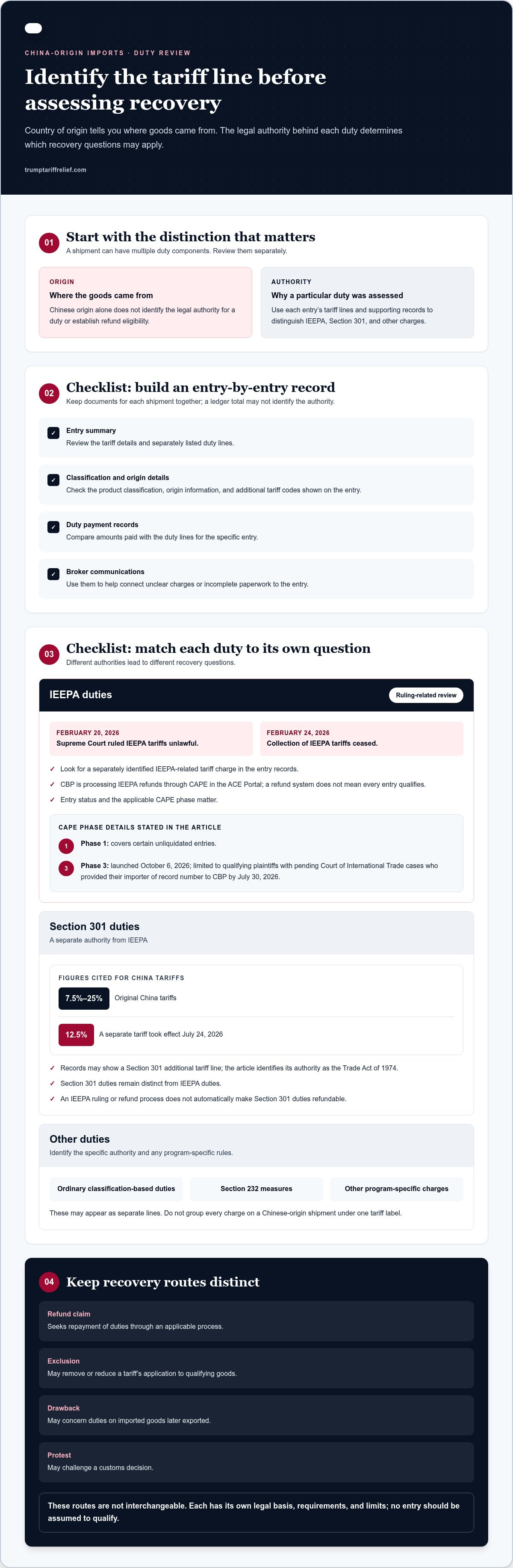
Use Import Records to Triage Tariffs Paid on Chinese Goods
A focused records review can show which entries merit closer attention before you begin filing work. Start with a representative group of China-origin entries, then connect each duty amount to the entry, classification, and importer of record. This helps separate potential IEEPA charges from Section 301 and ordinary customs duties before deciding what to review next.
A first-pass review of entries and duty payments
Gather entry summaries and payment records. For each shipment, record the entry date, tariff classification, duty lines, and amount paid. Compare similar entries to spot differences. Similar goods may have different duty components because of their classification, entry date, or applicable tariff measures. Preserve the entry-level detail rather than relying only on a total from your accounting system.
Use a short triage sequence:
- Identify the importer of record shown for each entry and confirm which entity paid or accounted for the duties.
- Match entry summaries to payment records and note the date, classification, declared origin, and each listed duty.
- Separate any IEEPA-related line items from Section 301 charges and ordinary customs duties.
- Collect broker communications or entry corrections that explain changes, adjustments, or unclear tariff details.
- Flag missing documents, inconsistent classifications, or uncertain duty descriptions for specialist review instead of guessing.
The importer of record and entry history matter because records, claims, and entry status are tied to specific import transactions. If a parent company, affiliate, or purchasing entity holds some documents while another entity appears as importer of record, note that relationship. When sorting through complex intercompany supply contracts or multi-jurisdictional business arrangements, corporate and disputes counsel like Fervent Chambers LLC can assist in clarifying commercial agreements. Preserve the original records and organize copies by entry number so a reviewer can trace each charge to its supporting documentation.
When records point to potentially relevant IEEPA duties, a customs documentation review can make the assessment and filing work more manageable. A document checklist can help identify useful records, but it can’t establish by itself that an entry qualifies.
Preserve deadlines without relying on a generic date
Don’t apply one deadline to every entry or remedy. Timing may depend on entry status, the route being considered, and current procedures. CBP’s CAPE phases, for example, distinguish among categories of entries, and the announced Phase 3 criteria include specific conditions for certain plaintiffs. Preserve entry-specific dates and review current authoritative guidance promptly.
For each entry, record its relevant status and the dates shown in customs documents. Then review the applicable time limits against the route under consideration. A deadline discussed for one process may not apply to another. Careful recordkeeping supports a more reliable assessment of recovering tariffs on Chinese imports, while an IEEPA-focused review can determine whether the facts warrant further action.
If your records indicate potentially applicable IEEPA duties, request an IEEPA tariff eligibility assessment to organize the documentation and evaluate a practical next step.
Turn a Potential IEEPA Refund Into a Managed Recovery Review
When records suggest an entry may include IEEPA duties, the next step is a focused review, not an assumption that repayment is due. Trump Tariff Relief assesses potential IEEPA exposure, organizes customs documentation, and manages the government filing work. The review connects each duty to its entry and supporting records while keeping unrelated tariff charges separate.
What happens during an IEEPA-focused assessment
The assessment starts with import and payment records, including entry summaries, duty details, and relevant communications. These documents help identify potentially applicable IEEPA charges and distinguish them from Section 301 duties or other amounts paid. The team then organizes the customs documentation and manages the filing process. The review can identify a potential recovery path, but it can’t promise that a claim will be accepted or a refund paid.
The service focuses specifically on IEEPA tariff refund recovery. A Chinese country-of-origin designation alone doesn’t establish that a duty falls within this review. The legal basis shown in the records and the entry-specific facts guide the assessment. The tariff recovery process includes eligibility assessment, documentation management, and government filings, with the work shaped by the records and applicable requirements.
The fee model is contingency-based: there are no upfront costs or hourly billing, and the fee is a percentage of refunds successfully recovered. That structure doesn’t change the eligibility analysis or guarantee a particular result. A potential claim still requires review, and no recovery amount or outcome should be assumed before the relevant facts and process have been assessed.
When to request a case-specific review
Consider an IEEPA-focused review if your entry or payment records indicate duties potentially imposed under IEEPA. A case-specific assessment can help separate those charges from Section 301 duties and other China-related tariffs, then organize the documentation for the relevant filing work. If the records don’t clearly identify the authority, review the entry details carefully rather than classifying the charge by origin alone.
For businesses recovering tariffs on Chinese imports, a defined scope matters: the assessment concerns potential IEEPA exposure, not automatic recovery of every tariff paid on China-origin goods. Trump Tariff Relief manages the assessment, customs documentation, and government filings. Eligibility, acceptance, and payment aren’t guaranteed.
If your records point to potentially applicable IEEPA duties, request an IEEPA tariff refund assessment to determine whether a case-specific recovery review is relevant.
Make Your Next Step Evidence-Led
Reviewing past imports can do more than identify a potential refund. An organized, entry-specific picture helps your business make clearer decisions about tariff exposure and avoid treating every China-related charge as the same issue. For recovering tariffs on Chinese imports, base your next step on the evidence in your records, not assumptions about origin or a broad headline.
If your documentation points to duties potentially imposed under IEEPA, a focused assessment can help determine whether a recovery review is relevant. Trump Tariff Relief specializes in IEEPA tariff refund recovery and uses a contingency-based fee model, with no upfront costs or hourly billing. Eligibility and payment aren’t guaranteed, but a case-specific review can clarify what your records support and which steps may make sense.
Request an IEEPA tariff refund assessment to take a practical next step toward understanding your options. A careful review can replace uncertainty with a clearer path forward.
Frequently Asked Questions
Is every tariff paid on Chinese imports refundable?
No. Chinese origin alone doesn’t establish refund eligibility. The duty’s legal authority, entry details, payment history, current rules, and applicable procedure all affect whether a remedy may be available. A payment record might show both an IEEPA-related charge and a Section 301 duty. Those charges raise different questions, and a ruling or refund process concerning one authority doesn’t automatically cover ordinary customs duties or other China-related tariffs.
Can importers recover Section 301 tariffs on Chinese goods?
Not automatically through an IEEPA-related remedy. Section 301 duties have a separate legal basis, so a ruling concerning IEEPA doesn’t by itself make Section 301 payments refundable. Depending on the product, entry, and circumstances, an exclusion, protest, litigation, or another route may warrant review. Each has distinct requirements and may be time-sensitive. Don’t assume a general Section 301 refund is available without a current review of the specific facts.
How can I tell which tariffs my company paid on Chinese imports?
Start with the customs entry summary and supporting broker records. Look for tariff classifications and separate duty line items, then compare them with payment records for the same entry. Country of origin identifies where goods came from, but not every authority behind the charges. For recovering tariffs on Chinese imports, sort entries into IEEPA, Section 301, ordinary duties, and other charges before estimating any potential recovery.
Can a company that was not the importer of record claim a tariff refund?
It depends on the transaction and the procedure involved. The importer of record named on the entry and the supporting customs documents are important clues, but payment arrangements, purchasing relationships, and other transaction details may also need review. Gather contracts, invoices, entry records, and payment evidence to show how the import was structured. Review those documents and the current rules before determining who may pursue a remedy.
How much can a business recover from tariffs on Chinese imports?
There’s no reliable amount to estimate from country of origin alone. Potential recovery depends on the duties actually paid, the entries involved, supporting payment records, legal eligibility, and the remedy that may apply. An entry with multiple tariff charges shouldn’t be valued as though every line were covered by the same claim. A record-based assessment is needed before estimating a possible amount, and no refund or specific result is guaranteed.
What documents should importers gather to review China tariff payments?
Useful starting materials include customs entry summaries, duty payment records, tariff classifications, origin information, commercial invoices, and relevant broker communications. Organize documents so each invoice and payment can be connected to its entry number; mismatched records can make review harder. The precise materials needed depend on the authority and entry circumstances. Keep potentially IEEPA-related charges separate from Section 301 and other duties so each can be assessed on its own basis.
Is there a deadline to recover tariffs paid on Chinese imports?
Deadlines can vary by tariff authority, entry status, and recovery procedure, so one universal date would be misleading. A filing window for one type of claim may not apply to another. Review the relevant entries promptly and verify current requirements against authoritative guidance before relying on a date from a general article or past notice. Keep entry and payment dates accessible, as they may help determine which procedures could apply.
Does Trump Tariff Relief charge upfront to assess and pursue an IEEPA refund?
No. Trump Tariff Relief operates on a contingency-fee basis, with no upfront costs or hourly billing. Its fee is calculated as a percentage of a refund successfully recovered. The firm’s IEEPA-focused assessment and filing support don’t guarantee that a business or entry qualifies, that a filing will be accepted, or that a refund will be paid. This fee structure doesn’t establish a recovery path for separate Section 301 duties.
Ready to find out what your business may be owed?
Check My Eligibility