
A promised tariff refund isn’t proof that an offer is legitimate. With tariff refund scams targeting businesses seeking IEEPA duty recovery, urgent deadlines, official-looking messages, and requests for sensitive information can make it difficult to distinguish a real recovery opportunity from fraud. In May 2026, U.S. Customs and Border Protection warned about these scams: CBP doesn’t charge a fee to issue refunds or send unsolicited messages asking for banking details or passwords.
It’s reasonable to move quickly when a potential refund is at stake, but pressure shouldn’t replace verification. A paid recovery service isn’t automatically a scam. Look at whether its role, process, and fee terms are clear, and whether its claims can be checked independently. This article explains how refund scams operate, how to verify an offer before sharing customs records or account credentials, and what to do if a message or payment raises concern. It also explains how a defined scope and transparent contingency fee can help you assess a recovery engagement without treating any refund as guaranteed.
Key Takeaways
- Check promises, pressure tactics, sender identity, payment requests, and demands for sensitive information to spot tariff refund scams.
- Verify an organization using independently sourced contact details, then review its role, scope, and written terms before sharing records.
- If something feels wrong, pause communication, secure any exposed credentials, and preserve messages, agreements, invoices, and payment records.
- Use a documented process to distinguish legitimacy checks from guarantees of eligibility or recovery.
- Understand how eligibility assessment, customs documentation, and government filings fit into a recovery engagement, and review contingency fee terms carefully.
Tariff Refund Scams: Why Importers Should Verify Before They Act
A potential refund can represent a meaningful recovery for a business that paid import duties. That possibility naturally draws attention, especially when a message suggests there’s a straightforward way to reclaim money. But a genuine refund opportunity doesn’t validate every person or company claiming to help pursue it. Verify the offer before sharing customs records, account access, or payment details.
A tariff refund scam is deceptive conduct that exploits expectations of recovering import duties to obtain money, information, or access. An unexpected message or aggressive sales pitch is a warning sign to investigate, not proof on its own that a person or service is fraudulent.
Why refund claims attract impersonators and misleading offers
High-stakes opportunities can make certainty and urgency persuasive. If a business is told that a refund is waiting, action must happen immediately, or an unusually large recovery is assured, decision-makers may feel pressure to skip routine checks. Such tactics resemble the psychological manipulation described in the Confidence Trick: gaining trust can make a target less likely to question an appealing claim.
Imagine an importer receiving a message that appears to come from an organization involved in customs matters. It refers to a possible refund and asks the recipient to follow a link or provide records. Those details warrant caution and independent verification. They don’t establish who sent the message, whether the offer is authorized, or whether the business is eligible for a refund.
Separate the underlying opportunity from the pitch. A real recovery process can exist while a particular solicitation is misleading, unauthorized, or unclear. Assess the claim using evidence and verifiable details, not how official the message looks or how confidently the sender describes a potential outcome.
What a scam allegation does, and does not, prove
Use precise categories before deciding what to do. An unverified solicitation is a message or offer whose sender or claims haven’t yet been checked. A scam allegation is a concern that someone acted deceptively, but an allegation alone isn’t a finding. A legitimate service with unclear terms may need to explain its role, work, or fees more clearly. Ambiguity deserves attention, but it doesn’t by itself prove fraud.
Fees alone aren’t proof either. A paid service may have a defined scope and written terms, while a no-fee offer could still seek sensitive information or account access. Look at the full picture:
- Identity: Can you verify the organization and reach it using independently sourced contact details?
- Scope: Does the offer clearly explain what work will be performed and what the service is authorized to do?
- Terms and conduct: Are fees, responsibilities, and information requests explained clearly, without pressure to bypass verification?
If key details remain unclear, pause before proceeding. That’s a prudent safeguard, not a verdict. This distinction helps protect your business while leaving room to assess recovery services based on their identity, documentation, and conduct.
How Tariff Refund Scams May Work: Promises, Pressure, and Data Requests
Potential tariff refund scams can follow a familiar sequence: make recovery sound certain, create pressure to act, then ask for money or information before the business has verified who is making the offer. No single behavior proves fraud. Treat a combination of questionable claims and demands as a reason to pause, preserve the communication, and check the sender independently.
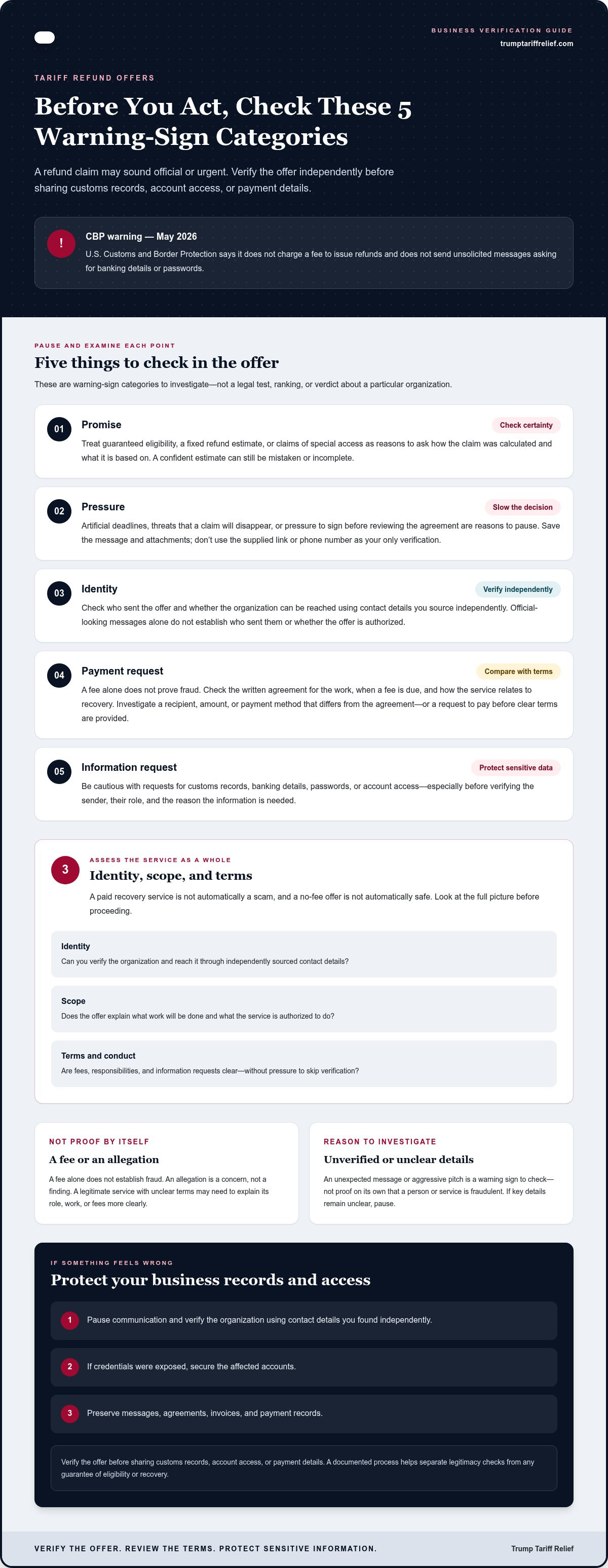
Quick checklist: Check the promise, pressure, identity, payment request, and information request. These are practical warning sign categories, not a legal test or a verdict about any particular organization.
Promises and pressure that should trigger a pause
A guarantee of eligibility, a fixed refund estimate, or a claim of special access should be checked against the facts of your business and the applicable process. Even a confident estimate may be mistaken or based on incomplete information. Certainty is a reason to ask how the figure was calculated, not automatic proof that the offer is fraudulent.
Pay attention to the sender’s behavior, too. Artificial deadlines, threats that a claim will disappear, or demands to sign before you can review the agreement are reasons to slow down. Save the message and attachments, then contact the organization using details you find independently. Don’t rely on a phone number or link supplied in the unsolicited communication.
Assess payment requests against the written terms
A fee by itself doesn’t establish fraud. Compare any payment request with the written agreement. Does it identify the work, explain when a fee is due, and state how the service relates to the recovery process? Be cautious if the payment method, recipient, or amount differs from the agreement, or if you’re asked to pay before seeing clear terms. Verify the organization and the request through a separate, trusted channel before sending funds.
Trade fraud is a serious enforcement concern. The Department of Justice has described the work of its Trade Fraud Task Force in its Trade Fraud Task Force achievements. That broader enforcement work doesn’t establish that a particular refund offer is fraudulent. Assess each offer on its own evidence.
Limit credentials and customs records
Don’t give an unverified contact passwords, one-time verification codes, payment credentials, or broad account access. Any request for sensitive information should have a clear purpose tied to defined work. Before sending customs records, identify which documents are needed, why they’re needed, who will receive them, and how they’ll be shared. Provide only proportionate records through a secure, agreed channel, and keep a copy of what you disclose.
If you’re assessing a recovery engagement, a clearly defined scope and documented workflow can help explain what information is needed and why. Review how the recovery process works before deciding what records to share.
How to Verify a Tariff Refund Offer Without Assuming Every Fee Is a Scam
Use a consistent review before authorizing work or sharing customs documents. The goal isn’t to treat every paid service as suspicious. It’s to establish who you’re dealing with, what they’ll do, and what you’re agreeing to pay. This sequence can help your business assess an offer calmly, even when the sender presents it as urgent.
Verify identity and the claimed government connection
Start with the organization’s legal identity, domain, and independently sourced contact information. If a representative claims to work for a government body, verify that claim through official channels you locate yourself. A logo, caller ID, forwarded document, or prominent search result may look persuasive, but none should be your only evidence.
Review the work and terms in order
Before sharing records or authorizing a filing, go through these checks one by one. If an answer is missing or inconsistent, pause and resolve it before proceeding.
- Identify the organization. Record the full legal name and compare it across the website, proposal, agreement, and payment instructions. Check whether the domain and contact details are consistent. A mismatch is a reason to investigate, not proof of fraud.
- Validate the contact. Find contact information independently, then use it to reach the organization. Don’t rely on links, phone numbers, or reply instructions in an unsolicited message. For a claimed government connection, use the relevant official channel you locate separately to verify the claim.
- Review the scope. Confirm in writing who will assess eligibility, manage customs documentation, and prepare or submit any filing. Check what the organization is authorized to do on your behalf, what work is excluded, and what decisions remain yours. Broad authorization without a clear explanation deserves clarification.
- Inspect the agreement and fees. Compare sales claims with the written terms. If someone promises a guaranteed refund or fixed outcome, ask how that statement fits the agreement, which should explain the actual scope and limitations. Resolve vague fee calculations, payment triggers, and other unclear terms before signing. Contingency pricing describes how compensation is structured; it doesn’t prove legitimacy or guarantee a recovery. Trump Tariff Relief’s documented process includes eligibility assessment, customs documentation management, and government filings, with a contingency fee due only if a refund is successfully recovered. The How It Works process describes these steps.
- Share proportionate records. Once identity, scope, and terms are clear, provide only documents needed for the defined assessment or filing. Agree on a secure way to transfer them, keep a record of what you shared, and don’t provide passwords or verification codes.
These checks can reduce exposure to tariff refund scams, but they can’t guarantee that an organization is legitimate or that your business will receive a refund. Treat verification and eligibility as separate questions, and confirm the claim-specific process before relying on an offer.
Already Responded to a Tariff Refund Solicitation? Protect Your Business Now
Act promptly, but don’t panic. If a refund solicitation now seems suspicious, focus first on limiting further access or loss, then preserve the facts and verify what happened. The right response depends on what you shared: an email address, customs records, account credentials, or payment details each creates a different risk.
If you shared credentials, documents, or payment information
Use this sequence to contain potential exposure. If a step could interfere with securing an account, prioritize the account first and preserve available evidence as soon as practical.
- Secure affected accounts. If you shared a password or verification code, contact the account administrator through an independently verified channel and follow its guidance to restore control. Change exposed passwords and review access or activity where available. Never use contact details supplied in the suspicious message.
- Contact the relevant financial institution. If you sent payment information or money, reach your bank, card issuer, or payment provider using the number on its official website or your account statement. Explain what happened and ask what protective steps are available. A prompt report may help limit further unauthorized activity, but it can’t guarantee that funds will be recovered.
- Stop further disclosure. Pause communication with the sender while you assess the situation. List the information and documents already shared, who received them, and when. Alert appropriate colleagues so they don’t send additional records or act on follow-up instructions without verification.
- Preserve the record. Save messages, attachments, agreements, invoices, payment confirmations, and relevant account notices. Write a dated timeline of contact, requests, information shared, and actions taken. Keep copies in a secure location. Where practical, preserve evidence before deleting messages or resetting access.
If a filing or government contact is in question
A message claiming that a filing was submitted, rejected, or needs immediate correction doesn’t confirm what happened. Verify filing status through an official channel you locate independently, not through a link, number, or reply address in the message. If the sender claimed to represent a government body, contact that body through its independently sourced official contact route before providing more information or following instructions.
You can also consult the Federal Trade Commission’s official fraud-reporting guidance and use the reporting route currently provided there. If the suspected conduct involves a payment or compromised financial account, contact the affected institution as well. Keep copies of any report or reference information. Reporting helps create a record, but it doesn’t guarantee a refund, account recovery, or investigation outcome.
Once immediate risks are contained, review any recovery engagement based on its documented scope, handling of customs records, and written fee terms. A clear process can help you distinguish verifiable work from unsupported promises, without guaranteeing eligibility or a refund. Review the documented tariff recovery process to understand how eligibility assessment, customs documentation, and government filings fit together.
Pursue a Tariff Refund Through a Documented, Transparent Process
After checking an offer, look for a process you can understand and document. Clear responsibilities and written terms make it easier to assess what work is proposed, what information may be needed, and how fees are handled. These are useful checks, not guarantees of legitimacy, eligibility, or a refund.
Useful process indicators: The organization identifies who assesses eligibility, manages customs documentation, and handles government filings. Its written scope explains the work, the agreement describes fees and payment conditions, and requests for records relate to defined tasks.
Reasons to pause and clarify: Responsibilities remain vague, verbal promises conflict with the agreement, fee calculations or payment triggers are unclear, or the requested documents don’t appear connected to the stated work.
Understand the recovery engagement before authorizing work
A clearly explained engagement should show how the work is organized without suggesting that every business qualifies or that recovery is assured. An eligibility assessment considers whether a business may have a relevant claim. Customs documentation management organizes the records needed for the engagement, while government filings are handled as part of the recovery work. The agreement should make responsibilities and fee terms understandable before you authorize work.
IEEPA tariff refunds involve a specific legal and trade context, so distinguish background information from an assessment of your company’s circumstances. The IEEPA tariff background can help explain the subject, but it can’t establish your eligibility or predict an outcome.
Trump Tariff Relief handles eligibility assessment, customs documentation management, and government filings for businesses pursuing IEEPA tariff refunds. Its recovery service uses a contingency fee, with no upfront costs or hourly billing. Payment is due only if a refund is successfully recovered. These terms explain the fee structure; they don’t promise that a refund will be obtained. Review the written agreement for the applicable scope and terms.
Take a measured next step
If your business is considering a claim, an eligibility assessment can help clarify whether it may have a relevant recovery opportunity. Specialists manage the documentation and filing work, while the outcome depends on the circumstances of the claim and the applicable process. Keep your own records of the engagement and make sure you understand what you’re authorizing before sharing documents.
Questions about how the work is organized are reasonable. Review the tariff refund process FAQs for answers, then consider whether a documented assessment is the right next step for your business. If you’re ready to understand the process, review how tariff refund recovery works. An assessment can inform your next decision, but it can’t guarantee eligibility or recovery.
Make Your Next Move With Confidence
A potential refund deserves careful attention, not a rushed decision. Let verification guide your next step: keep your records organized, understand what you’re authorizing, and assess the opportunity based on your company’s circumstances. That approach helps protect your business from tariff refund scams while keeping a legitimate recovery possibility in view.
Trump Tariff Relief helps businesses assess potential IEEPA refund claims, manage customs documentation, and handle government filings. The recovery service is contingency-based, with no upfront costs or hourly billing; a fee applies only if a refund is successfully recovered. No assessment can promise eligibility or a particular result, but a documented review can help clarify whether pursuing a claim may make sense for your business.
Request a tariff refund eligibility assessment to take a measured next step toward understanding your recovery options. Protect your information, ask for clarity, and move forward with confidence.
Frequently Asked Questions
Can a tariff refund consultant guarantee that my business will get money back?
No. A consultant can assess information and handle agreed work, but shouldn’t present a refund as certain before the claim is reviewed and its outcome is known. Ask what supports any estimate, whether it depends on entry-level records or other assumptions, and what happens if the assessment finds no viable claim. For tariff refund scams, promises of guaranteed money are a reason to verify the offer carefully, not proof of fraud by themselves.
Is an upfront fee proof that a tariff refund service is a scam?
No. A fee paid in advance doesn’t, by itself, establish fraud. Consider what the agreement says the fee covers, when it’s due, whether the organization is identifiable, and whether the charge matches the work described. For example, a written fee for a defined assessment is different from a demand for immediate payment with no agreement or clear recipient. Resolve unclear or conflicting terms before authorizing work.
What should I do if someone claiming to be from CBP contacts my business?
Don’t reply with sensitive information or use the contact details in the message. Locate CBP’s official website independently and verify the communication through an official channel. CBP says it doesn’t charge fees for refunds or send unsolicited messages requesting banking information or passwords. If the message includes a payment link or attachment, preserve it for review rather than opening it. Treat any claimed filing or account issue as unverified until independently checked.
Can a search ad or professional-looking website prove a refund offer is legitimate?
No. An ad’s placement and a polished website show neither that the organization is authorized nor that its claims are accurate. Check the domain spelling, the legal name in the agreement, and whether the organization’s independently sourced contact details match its communications. A lookalike site can copy logos and language. Don’t rely on search position or appearance alone; verify identity and written terms through channels you locate separately.
What if my company already paid someone for a tariff refund claim?
Contact your bank, card issuer, or payment service promptly using independently verified contact details. Ask what steps may be available to challenge or secure the transaction, while recognizing that recovery isn’t guaranteed. Save the agreement, invoice, receipt, messages, and payment confirmation. Then compare the work promised with any work performed, and write down dates and conversations while they’re fresh. If account access was also shared, alert the relevant administrator and secure it.
Should I share my customs account password to let someone check a refund claim?
No. Don’t disclose passwords or one-time verification codes to a person offering to review a claim. If someone needs records, ask them to specify which documents are necessary, why they’re needed, and how to send them securely. Use access methods you control and avoid granting broad account permissions without a clearly documented reason. If you’ve already shared credentials, contact the account administrator through a verified channel and follow its security instructions.
Ready to find out what your business may be owed?
Check My Eligibility