
What good is a customs record if your team can’t connect it to the entry, duty payment, or shipment it supports? For many importers, evidence is scattered across departments, brokers, email, and storage systems. Effective customs documentation management turns those disconnected files into a controlled record system, making it easier to find, reconcile, and review the right information when accuracy matters.
Import records may exist, yet missing links or inconsistent details can create rework and uncertainty, especially when preparing tariff refund claims. The answer isn’t simply to store more files. It’s to establish a repeatable process for organizing records, assigning ownership, checking consistency, and preserving clear connections between entries and duty payments.
This guide explains how to build that practical framework, which records to bring together, and how to make them easier to retrieve and reconcile. You’ll also learn how Trump Tariff Relief manages documentation as part of IEEPA tariff refund recovery, helping coordinate the records and review needed for a recovery assessment.
Key Takeaways
- Build customs documentation management around clear ownership, consistent classification, and controlled access so records are easier to retrieve across teams.
- Use a shared naming and indexing convention to connect customs records and reduce time spent searching across systems.
- Reconcile internal records with transaction documents, and route discrepancies for review instead of treating incomplete files as complete.
- Make intake, validation, reconciliation, and access control repeatable steps in your documentation workflow.
- Trump Tariff Relief coordinates documentation review as part of tariff refund recovery. Organized records support an assessment but don’t guarantee a refund.
Customs documentation management: why organized records matter
Import information often starts in one place and ends up in several others: trade teams coordinate shipment details, finance tracks duty payments, operations manages transaction data, and compliance oversees records and review. If each group uses its own naming conventions or stores separate versions, staff can lose time searching, resolving conflicting details, or deciding which record is current.
Customs documentation management is the controlled organization of customs records so they remain traceable, consistent, and usable for operational review. It covers how records are collected, classified, maintained, and accessed. A folder of files isn’t enough if no one can connect a record to the shipment or transaction it concerns. Customs processes sit within a broader system of border controls and trade administration; Customs provides foundational context for that role.
Document management supports the handling and review of trade records. It isn’t ongoing customs brokerage or general legal advice. For a tariff refund claim, records need to be organized and reviewed alongside an eligibility assessment and the relevant filing work. A well-managed file set makes information easier to evaluate, but doesn’t by itself determine whether an entry qualifies for a refund or establish that a claim will succeed.
Which business functions rely on dependable customs records?
Trade may use import details to understand shipment activity, finance may need to reconcile duties with accounting records, compliance may review consistency, and operations may rely on transaction information to resolve questions about a shipment. These teams use overlapping information for different purposes. Assign one owner to coordinate the record set, even when several departments contribute to or rely on it. Ownership clarifies who resolves duplicates, tracks missing context, and maintains a usable version. Records can inform a review, but their presence alone doesn’t establish refund eligibility.
How customs records connect to tariff refund work
Refund review depends on connecting import activity with the related duty information and the tariff treatment under consideration. If those details are held in disconnected systems, reviewers may need to trace each relationship before they can assess the matter. A clear record structure makes that review more efficient and helps surface gaps or inconsistencies for follow-up.
The IEEPA tariff framework provides context for understanding the tariff issues behind a potential recovery review. Organized records support the assessment by helping reviewers identify relevant information, trace its connection to import activity and duty payments, and direct questions to the right people. They are one part of a broader review, not proof of eligibility or a guarantee of recovery.
Build a customs documentation framework with clear ownership and controls
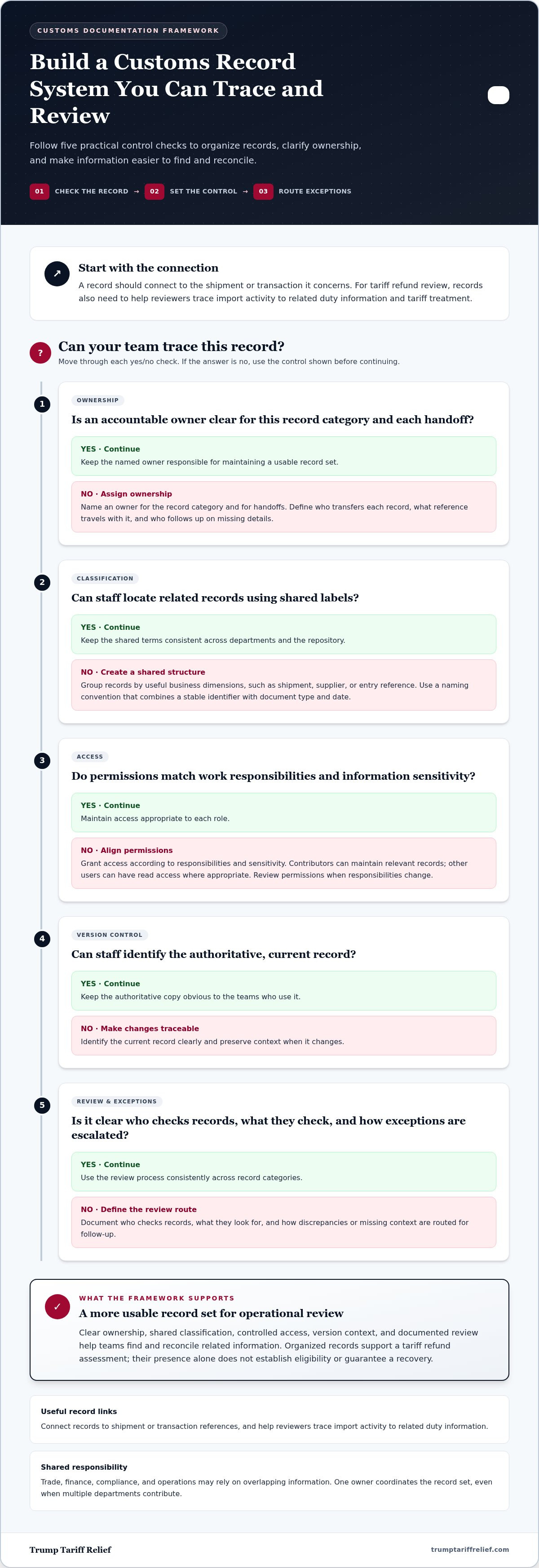
A workable framework makes records easier to find, interpret, and review without turning document storage into a maze. Start with the business purpose of each record category, then define who maintains it, how it’s classified, who can access it, and how changes are reviewed. The goal is consistent governance across teams, not a separate process for every file.
Set five controls as a baseline:
- Ownership: Assign an accountable owner for each category and each handoff between teams.
- Classification: Group records using useful business dimensions, such as shipment, supplier, or entry reference.
- Access: Grant permissions according to work responsibilities and the sensitivity of the information.
- Version control: Make the current record identifiable and preserve context when it changes.
- Review: Document who checks records, what they look for, and how exceptions are escalated.
Keep this governance framework separate from a document-by-document claim checklist. Governance explains how records are controlled; a claim checklist identifies materials that may be relevant to a particular review. A commercial invoice, for example, can serve important trade and assessment functions. The U.S. Department of Commerce explains Commercial Invoice requirements from trade.gov. A framework helps your team manage records consistently, while a checklist can guide a specific recovery assessment.
Assign owners and define the record structure
Name a business owner for each record category, plus an owner for handoffs. For example, one team may receive shipment records while another reconciles payment information. Define who transfers each record, what reference accompanies it, and who follows up if details are missing. Use a shared repository structure that reflects how staff search, with clear categories and consistent labels rather than personal folder systems.
Apply a naming convention that combines stable identifiers, such as a shipment or transaction reference, with a document type and date. Index records using the same terms across departments. Finance and operations can then locate related material without guessing how another team named a file. Restrict access based on each role: contributors can maintain relevant records, while other users can have read access where appropriate. Review permissions when responsibilities change.
Protect accuracy with version and change controls
Make the authoritative copy obvious. Use a status or version field to distinguish current records from drafts and corrected copies, and avoid overwriting earlier versions when the change history matters. Capture the source, date received, and a brief note describing a material correction when that information is available. These details help reviewers understand where a record came from and whether they’re looking at the version intended for use.
Write down a practical review procedure: who checks new or changed records, how discrepancies are flagged, and who approves updates. Apply the same approach across the repository. Strong customs documentation management doesn’t depend on one employee remembering the rules; it gives teams a repeatable way to maintain reliable records. Set retention practices in line with applicable requirements and current policy.
Make customs records reliable through reconciliation and quality checks
Records can look complete in isolation and still conflict when compared. Reconciliation brings information from internal systems, such as purchasing or finance records, alongside external transaction sources, such as documents received from suppliers or service providers. The aim is to identify what matches, what differs, and what still needs explanation before a reviewer relies on the record set.
Identify mismatches before they become claim obstacles
Compare records using shared references wherever possible, then check key fields such as identifiers, dates, product descriptions, quantities, and duty data. A difference isn’t automatically an error: it may reflect a correction, a timing gap, or incomplete information. Record what is confirmed separately from what remains unexplained, and assign each open item an owner, status, and next action.
| Discrepancy | Possible cause | Follow-up action |
|---|---|---|
| Different shipment or entry references | One system uses an internal code while another uses a transaction reference | Trace the identifiers to their source and document the confirmed link |
| Dates don’t align | Records reflect different transaction or processing events | Identify what each date represents; leave unresolved differences open for review |
| Descriptions or quantities vary | Data was entered differently, or a record may be incomplete or corrected | Compare source records and request clarification from the responsible team |
| Duty information doesn’t reconcile | Payment data and import records are recorded in separate systems or at different levels of detail | Trace the figures to their sources and record the explanation or remaining question |
Use an exception log to keep unresolved issues visible. Capture the record reference, discrepancy, owner, current status, follow-up action, and resolution when available. Don’t silently edit a source record to make it match another system. If a correction is appropriate, preserve the original context and record the reason for the change.
Create an audit trail that preserves context
A useful review trail explains how a record changed without erasing what came before. Keep the original source, retain corrected or supplementary material with a clear relationship to it, and note who made a change and why when that information is available. This helps later reviewers distinguish a verified correction from an unexplained difference.
Traceable corrections strengthen a documentation system because they show what changed, why it changed, and which source supports the update. Set a consistent review cadence suited to your workflow, and close an exception only when its status and supporting explanation are recorded. Customs documentation management becomes more dependable when reconciliation produces a visible decision trail, not just a cleaned-up spreadsheet. That discipline lets a team move unresolved questions forward without confusing assumptions with confirmed facts.
Put customs documentation management into a repeatable workflow
A repeatable workflow gives every record a defined route from arrival to controlled use. It also prevents a common process failure: treating a file as complete simply because it has been saved. Build customs documentation management around five stages, with a clear handoff between each one:
- Intake: Receive records through a consistent channel, whether they come from internal teams or transaction partners.
- Classification: Apply the agreed record category and link it to the relevant business reference.
- Validation: Check that basic indexing details are present and the record can be understood.
- Reconciliation: Compare related information and flag differences for resolution.
- Controlled access: Make approved records available to authorized users while keeping working files distinct from reviewed records.
Move records from intake to a controlled repository
Set one intake route, such as a designated mailbox, shared workspace, or system queue, and direct contributors to use it. At receipt, capture practical indexing details: the record type, source, date received, and relevant shipment or transaction reference. An assigned owner checks that the record is classified and indexed before it moves into the repository. If key context is missing, route it for follow-up rather than filing it as ready for use.
Review exceptions and improve the process
Maintain an exception queue for missing, inconsistent, or unclear information. Give each item an owner, status, next action, and resolution note; keep it open until the question is answered or clearly documented as unresolved. This creates a visible path for follow-up instead of allowing gaps to disappear inside a folder or spreadsheet.
Use periodic reviews to look for patterns, not to add another approval layer to every record. Group exceptions by process stage and responsible team. If the same reference is repeatedly missing at intake, refine the intake instructions or required indexing fields. If classification errors cluster around one category, clarify the guidance and share it with the teams that submit records. Review whether closed exceptions have usable explanations, then adjust the workflow where recurring friction appears.
Keep the workflow focused on record readiness and internal control. It isn’t a claim-filing procedure or a way to calculate legal deadlines. Instead, it helps teams identify what is complete, what needs attention, and who owns the next step. Trump Tariff Relief manages documentation review as part of tariff refund recovery, coordinating records for assessment and government filings. An organized process supports that assessment, but no workflow by itself determines eligibility or guarantees a refund. Explore managed tariff refund recovery.
How managed documentation support helps prepare a tariff refund claim
Preparing records for a tariff refund review can draw time from trade, finance, and compliance teams, especially when information sits in different systems or has unclear ownership. Trump Tariff Relief manages customs documentation as part of IEEPA tariff refund recovery. The team organizes and reviews relevant records, identifies gaps, and helps connect import information with duty details so the assessment can proceed on a clearer evidentiary footing.
What a managed documentation engagement can address
As part of IEEPA tariff refund recovery, Trump Tariff Relief coordinates document review, organizes information for assessment, and flags questions that need attention. This is recovery-focused support, not ongoing customs brokerage. The work centers on preparing and reviewing records for a potential recovery, rather than managing routine customs activity across all of a company’s imports.
A managed process can reduce the internal burden of tracking down records across teams and clarifying which information is current. The tariff refund recovery process brings eligibility assessment, documentation, and government filings into a broader engagement. Organized records help the team review the available information, but neither record organization nor an assessment guarantees that a refund will be recovered.
Prepare your organization for a preliminary assessment
You don’t need to solve every documentation issue before seeking an assessment. Start by identifying the import activity you want reviewed, the internal teams or individuals who own related records, and any known challenges, such as missing links between payment details and import records. This gives the review a practical starting point and helps surface where coordination may be needed.
Trump Tariff Relief manages the assessment and documentation work as part of the recovery engagement. Your team can share its known record sources and open questions; specialists coordinate the review and organize the information for next steps. The assessment considers whether the matter may support a recovery effort. It isn’t a promise of eligibility or a particular result.
The fee structure avoids upfront costs: Trump Tariff Relief charges a percentage of the refund successfully recovered. That contingency arrangement ties the fee to a successful recovery without guaranteeing one. If your records are spread across teams or internal coordination is slowing review, the recovery team can manage the documentation work while your organization provides the information and context it holds.
Start with a tariff refund assessment to put your import activity and documentation questions before the recovery team.
Turn organized records into a clear next step
Reliable customs documentation management does more than keep files in order. It gives your business a clearer starting point for deciding whether import activity merits a closer review, and helps prevent unresolved record questions from holding that review back. You don’t need to resolve every gap alone before exploring your options.
Customs documentation management is part of Trump Tariff Relief’s IEEPA tariff refund recovery service, where specialists coordinate eligibility assessment, documentation, and government filings. There are no upfront costs, and a fee applies only if a refund is successfully recovered. An assessment can help clarify potential next steps, but it can’t guarantee a refund.
If your team is ready to move from scattered records to a focused review, take the next step with a tariff refund assessment. Bring forward the import activity and documentation questions you already know about, and the recovery team can assess the information and coordinate the next steps.
Frequently Asked Questions
What is customs documentation management?
Customs documentation management is the organized handling of import-related records so staff can identify their purpose, source, and relationship to a transaction. In practice, that could mean tracing a commercial invoice from its supplier reference to the corresponding internal purchase record, without relying on one employee’s memory. The term describes a business process, not a particular software product or customs filing service.
Why is customs documentation management important for importers?
It helps importers answer operational and financial questions with less uncertainty. For example, if finance questions a duty charge during a close, staff can investigate the transaction using connected records rather than relying on an isolated spreadsheet entry. A dependable process also preserves business knowledge when employees change roles, since context and record ownership aren’t held only in individual inboxes.
Can customs documentation management help with tariff refund claims?
Yes. Organized import and payment information gives a claim reviewer a clearer basis for examining the transactions involved and identifying questions that need further attention. It supports review, but doesn’t establish eligibility by itself or guarantee a refund. Trump Tariff Relief’s specialist assessment considers the relevant tariff framework and circumstances; documentation management makes the available information easier to evaluate.
What causes errors in customs documentation?
Errors can arise when staff re-enter data from one system into another, supplier records arrive after internal processing, or teams use different descriptions for the same product. A unit mismatch, an outdated template, or an uncommunicated correction can also create conflicting information. Reduce these risks by checking data when it enters a workflow and making corrections traceable instead of silently replacing earlier records.
Should a business use customs documentation software?
Software may help if import records arrive at a volume or pace that makes manual tracking difficult. Look for practical capabilities such as searchable indexing, role-based permissions, version history, and exportable records that staff can use outside the platform. Before adopting a tool, map the work it must support. Software can streamline a defined process, but it can’t decide who owns records or resolve unclear information on its own.
How long should importers retain customs records?
Retain each record for the period required by the current rules that apply to its category and circumstances. Don’t assume one blanket schedule covers every record or transaction. Assign someone to check current requirements against your retention policy, document the schedule’s basis, and make sure records aren’t removed before the applicable period ends. If a record’s status is unclear, resolve that question before routine disposal.
Ready to find out what your business may be owed?
Check My Eligibility