
What if tariff recovery could move forward without pulling your team away from the work that keeps goods moving? For tariff refunds for supply chain managers, the challenge is more than finding a possible refund. It means matching tariff charges to the right entries, payment records, and recovery path while procurement, logistics, finance, and compliance keep operating.
A defined catalyst is now in place: on February 20, 2026, the Supreme Court ruled IEEPA tariffs unconstitutional, and CBP established the CAPE system to process eligible refunds. But not every duty or entry qualifies. The tariff authority, entry status, and identity of the party that paid can all affect the next steps.
If your records are spread across broker files, customs systems, and finance reports, a structured recovery workstream can help bring them together without turning the process into a daily operational distraction. This guide explains how to identify potentially affected entries, coordinate internal and external stakeholders, and assess recovery options. It also covers how to distinguish IEEPA duties from other tariffs, understand process limitations, and plan practical next steps before committing resources.
Key Takeaways
- Build a defensible exposure view by matching entry summaries, broker records, invoices, and duty payment records.
- For tariff refunds for supply chain managers, distinguish potentially refundable IEEPA duties from other tariff charges before scoping recovery work.
- Set a review period using current legal guidance and import history, then assess entry details and payment records together.
- Keep operations moving by assigning clear responsibilities to finance, trade compliance, procurement, logistics, and broker contacts.
- Specialized recovery support can manage eligibility assessment, customs documentation, and government filings. Fees are based on successfully recovered refunds, with no upfront costs.
Tariff refunds for supply chain managers: what changed and why it matters
Potential recovery work rarely arrives when operations are quiet. Supply chain teams still need to secure materials, manage delivery risks, and keep production moving while finance and compliance review past tariff payments. Tariff refunds for supply chain managers require more than a quick search for duty charges: teams need to identify which payments relate to the relevant authority and determine which process applies to each entry.
An IEEPA tariff refund is a potential recovery of duties assessed under relevant measures imposed pursuant to the International Emergency Economic Powers Act. On February 20, 2026, the Supreme Court ruled that IEEPA tariffs were unconstitutional, creating a basis for refund processing. The ruling creates an opportunity to assess, not an automatic entitlement. Eligibility, entry treatment, payment details, and applicable procedures still matter. For the legal catalyst and its scope, see the IEEPA tariff ruling.
Which tariff payments are relevant to this recovery discussion?
Start with the tariff authority, not just the country or product on an import record. A shipment may have incurred IEEPA duties alongside Section 301 duties or another tariff charge. The IEEPA portion is the focus of this recovery discussion; other charges follow their own rules. Product origin alone doesn’t establish whether a claim qualifies. Trace the assessed duty to the applicable measure, then connect it to the entry and payment record.
The broader idea of recovering duties is sometimes described as drawback, but that term can refer to separate statutory processes. Understanding Duty Drawback can help explain the general concept. It shouldn’t be taken to mean an IEEPA refund uses the same eligibility rules or filing route.
Why should operations teams pay attention now?
Entry status and payment history can shape the available path. An unliquidated entry, a recently liquidated entry, and a finally liquidated entry may be treated differently under current procedures. The identity of the Importer of Record or the party that directly paid the duties may also matter. Start by preserving entry summaries, broker records, and payment evidence together. Match them to tariff line or assessment information rather than relying on country-of-origin reports alone.
As of October 6, 2026, CBP’s CAPE Phase 3 allowed qualifying importers who are plaintiffs in pending Court of International Trade cases to submit declarations for finally liquidated duties, with rolling biweekly submissions for those who provided IOR numbers after July 30.
Deadlines depend on the entry and procedure, so a date that applies to one recovery route may not apply to another. For certain IEEPA entries outside CAPE coverage, a protest may be needed within 180 days after liquidation. Confirm the applicable rule and entry status before setting an internal deadline. Treat the review as a controlled workstream: establish ownership, preserve records, and flag entries requiring prompt assessment without interrupting routine purchasing or logistics decisions.
Build a reliable tariff-refund exposure view from supply chain records
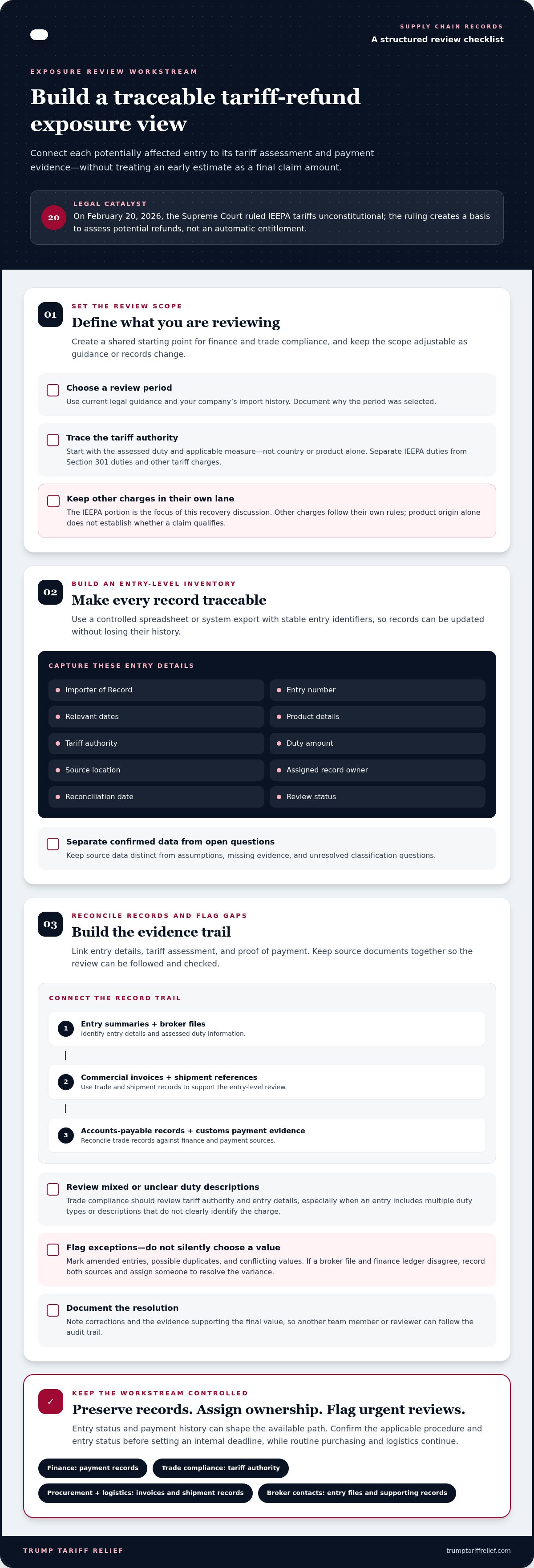
A credible exposure view starts with a defined review scope, not a rough total from a duty report. Set the period using current legal guidance and your company’s import history, then document why you selected it. Keep the scope adjustable: new guidance or a record discrepancy may mean additional entries need review. This gives finance and trade compliance a shared starting point without treating an early estimate as a final claim amount.
For tariff refunds for supply chain managers, the core task is to create a traceable link between each entry, its tariff assessment, and evidence of payment. Start with entry summaries and broker files, then reconcile them against commercial invoices and customs payment records. A document inventory helps teams identify which source supports each field. Use the IEEPA refund document checklist to structure collection.
Create an entry-level inventory the team can maintain
Use a controlled spreadsheet or system export with stable entry identifiers, so records can be updated without losing their history. Capture the Importer of Record, entry number, relevant dates, product details, tariff authority, and duty amount. Add fields for source location, assigned record owner, reconciliation date, and review status. Keep confirmed source data separate from assumptions, missing evidence, and unresolved classification questions.
Flag amended entries, possible duplicates, and conflicting values rather than silently choosing one version. For example, if a broker file and finance ledger show different duty amounts, record both sources and assign someone to resolve the variance. Note any correction and the evidence supporting the final value. That audit trail makes the inventory easier for another team member or reviewer to follow.
Reconcile trade, finance, and broker data
Match broker entry data to accounts-payable records and customs payment evidence. Trade compliance should review the tariff authority and entry details, especially when an entry includes multiple duty types or descriptions that don’t clearly identify the charge. Finance can confirm payment records. Procurement and logistics can help locate invoices, shipment references, and broker contacts when source documents are incomplete.
- Missing records: Assign an owner and record what evidence is still needed.
- Duplicate entries: Compare stable identifiers and source files before excluding a record.
- Inconsistent amounts or dates: Trace the variance to its source and retain the resolution note.
- Amended information: Preserve both the original and updated record, with the amendment clearly identified.
An entry inventory supports review, not eligibility. It organizes the evidence for a focused assessment of relevant facts; it does not establish that a refund will be approved or paid. If assembling and reconciling the records is straining internal capacity, specialized customs documentation management can help organize the file while your team retains oversight.
Compare internal handling and specialized tariff refund support
Choosing a recovery model is a capacity decision as much as a technical one. Your team may have the trade knowledge to lead the work but lack time to collect and validate records. Or the records may be organized while procedures and filing requirements call for specialist attention. For tariff refunds for supply chain managers, the right model depends on workload, expertise, documentation quality, and the level of review the business needs.
Compare the options against the work itself, not just the potential recovery amount. Internal ownership preserves direct control. Specialist support can handle assessment and documentation tasks. A coordinated model combines company oversight with dedicated execution support.
| Approach | Best-fit conditions | Workload | Oversight needs | Key trade-offs |
|---|---|---|---|---|
| Internal-led | Records are centralized and experienced trade staff have available capacity. | Internal teams gather, reconcile, assess, and coordinate filing work. | Assign accountable owners and review points; keep procedural guidance current. | Strong direct control, but recovery tasks compete with daily responsibilities. |
| Specialist-supported | Entries are numerous, records fragmented, or dedicated internal capacity is limited. | Specialists manage eligibility assessment, customs documentation, and government filings. | Company stakeholders retain oversight and provide source records and decisions. | Reduces internal administrative burden; requires clear coordination and an agreed fee model. |
| Coordinated | Internal teams can provide business context but need added execution capacity. | Work is divided between company owners and recovery specialists. | Define decision rights, handoffs, and review controls before work begins. | Balances internal knowledge and external support, but responsibilities must be explicit. |
When can an internal-led review make sense?
An internal-led approach may fit when entry and payment records are centralized, trade staff have relevant experience, and the review can be resourced without compromising core work. Name a lead, set review checkpoints, and assign someone to track current procedures. Keep preliminary exposure mapping distinct from formal eligibility decisions and government filing steps. An organized list helps scope the work, but doesn’t itself establish a valid claim.
When might specialized recovery support help?
Specialist support can help a business facing fragmented broker files, a high volume of entries, or limited staff availability. Trump Tariff Relief provides eligibility assessment, customs documentation management, and government filing support, while company stakeholders provide records, operational context, and oversight. Learn how the recovery process works to see how those responsibilities can be coordinated.
The contingency model avoids upfront costs: the fee is calculated as a share of successfully recovered refunds. That structure doesn’t guarantee eligibility, approval, or payment, so compare the fee terms with the scope of work and internal review responsibilities. IEEPA tariff refund recovery support can help move assessment and documentation forward while your company maintains oversight.
Coordinate a tariff refund workstream without disrupting operations
Keep recovery work visible and owned, separate from decisions that move goods. A defined sequence helps finance, trade compliance, procurement, logistics, and broker contacts contribute without making refund research a bottleneck for purchasing or shipment execution. Assign an executive sponsor to resolve resource or priority conflicts, then give a day-to-day owner responsibility for maintaining the work plan and raising exceptions.
Set ownership, controls, and decision checkpoints
Use a decision log to record unresolved entries, missing source documents, assumptions, approvals, and procedural updates. For each open item, capture an owner, next action, and review date. This prevents an uncertain entry from being treated as settled simply because it appears in a working estimate. Schedule checkpoints around verified procedural changes rather than assuming a processing date or timeline.
Move through the work in order:
- Name a sponsor and workstream owner. The sponsor sets priorities and resolves resourcing issues; the owner coordinates tasks and maintains the decision log.
- Define scope. Trade compliance and the sponsor document the review boundaries and flag questions requiring specialist assessment.
- Collect records. Finance locates payment evidence; procurement and logistics connect invoices and shipment records; broker contacts supply relevant entry files.
- Review exceptions. Trade compliance checks entry details and tariff information, while finance resolves payment discrepancies. Record the basis for each decision.
- Oversee filing information. Assign an approver to review supporting information and confirm that unresolved questions are escalated before submission.
- Track status. The workstream owner records evidence gaps, approvals, submissions, responses, and follow-up actions in a dedicated tracker.
Keep refund work separate from routine supply chain execution
A refund tracker should sit alongside, not replace, the company’s import controls. Purchasing approvals, shipment release, supplier planning, and broker instructions should continue through their existing workflows. This separation reduces the risk that a recovery question delays a shipment or that routine operating decisions are mistaken for claim approvals.
Timing still requires attention. Deadlines and available steps can depend on the entry and procedure, so validate the relevant date against current guidance and the specific entry rather than applying one blanket calendar rule. The tariff refund FAQs can help surface process questions for review. Record the source and date of any procedural guidance the workstream relies on.
With owners, checkpoints, and a separate status trail in place, your team can maintain operational continuity while moving recovery tasks forward. Explore IEEPA tariff refund recovery support for help coordinating eligibility assessment, customs documentation, and government filings.
Move from an exposure review to a managed recovery plan
An organized entry inventory gives the next stage a stronger foundation. A focused assessment can examine which records and duties may relate to IEEPA measures, what evidence supports them, and which questions need further review. It doesn’t turn every listed entry into an eligible claim. The handoff should distinguish plausible review candidates from entries requiring further legal or procedural analysis, so your team can make resourcing decisions on a defensible basis.
What a focused initial assessment should establish
A useful assessment starts by identifying the company’s importer records, potentially relevant duty payments, and available supporting documents. It then clarifies which entries warrant closer review, which records are incomplete, and what assumptions remain unresolved. That distinction matters: an entry with a potential IEEPA charge but missing payment evidence presents a different next step from one with a complete document trail and an unresolved procedural question.
The outcome should be clear enough to guide operations. For each open issue, establish what evidence is needed, who owns the follow-up, and whether the next action is document collection, eligibility analysis, or filing preparation. This helps finance, trade compliance, procurement, and logistics understand their roles without treating an initial screen as approval or assurance of payment.
How specialist support can reduce internal burden
Trump Tariff Relief supports businesses by assessing eligibility, managing customs documentation, and handling government filings. The team coordinates recovery tasks while company stakeholders retain oversight and provide business context. This creates a defined handoff instead of requiring internal teams to build and administer every part of the process around ongoing supply chain responsibilities. The IEEPA refund recovery process connects assessment, documentation, and filing in a managed workflow.
The fee model is contingency-based: there are no upfront costs, and the fee is a percentage of successfully recovered refunds. That aligns the fee with recovered funds, but it doesn’t mean every entry will qualify or that a refund is guaranteed. An assessment can separate potential recovery candidates from unresolved issues before the business commits resources to further work.
For tariff refunds for supply chain managers, the practical next step is to move from an exposure list to an evidence-led assessment. Bring together available importer and entry records, payment details, and supporting documents. Identify and assign gaps rather than guessing. To request an eligibility assessment and review IEEPA refund recovery, start with the records your team has organized. A focused review can clarify the path forward while leaving operational decisions on their established control track.
Turn your review into a clear next step
The next move is not to assume a refund, but to decide whether the evidence and potential value justify a focused assessment. For tariff refunds for supply chain managers, a disciplined handoff lets your company pursue possible recovery while keeping operational decisions on their established track. Bring forward the records you’ve gathered and the questions your team couldn’t resolve. Identifying gaps is useful, even when an entry needs further review.
Specialized support can coordinate eligibility assessment, customs documentation, and government filings, reducing the administrative load on internal teams. The contingency model has no upfront costs or hourly billing, with fees calculated as a percentage of successfully recovered refunds. Recovery is not assured, but your team can assess the path with a clearer understanding of the work involved.
Take the next step with a focused review of your company’s potential exposure. Request an initial tariff refund assessment and put your records in motion. A measured assessment can help your team move forward while keeping attention on resilient supply chain operations.
Frequently Asked Questions
Can supply chain managers claim tariff refunds on behalf of their company?
Supply chain managers can coordinate the review, but their job title alone doesn’t establish who may submit or receive a refund. Start by confirming which legal entity appears as the Importer of Record on the affected entry and who paid the IEEPA duties. Then assign an authorized internal owner for records, decisions, and filing oversight. The applicable CBP process may set additional requirements, so verify them for the entries under review.
Which tariff payments should a supply chain team review for a potential IEEPA refund?
Review duty payments identified as assessed under the relevant IEEPA measures, rather than treating all tariff charges on an import as part of the same recovery. A shipment may show both IEEPA and Section 301 duties, for example; separate the amounts by tariff authority where records allow. Country of origin or product category alone doesn’t determine whether a payment is relevant. Keep unclear charges as exceptions for further review, not confirmed exposure.
What records should a supply chain manager gather for a tariff refund review?
Gather entry summaries, broker statements, commercial invoices, shipment references, and records showing customs duty payments. Include amendments or corrected versions when available, since an updated entry may explain a mismatch between broker and finance files. Useful details include the Importer of Record, entry identifier, entry dates, tariff authority, and amounts paid. Keep the source and version of each document visible so reviewers can trace reported figures back to evidence.
How can a company estimate its potential tariff refund exposure?
Build an entry-level estimate from duties supported by records and identified as IEEPA-related, rather than multiplying total imports by a general tariff rate. For each entry, record the documented duty amount, source, and confidence level. Separate confirmed figures from estimates, missing payment evidence, and charges whose authority is unclear. The result is a planning range for assessment, not a promised recovery; eligibility and refund outcomes depend on applicable rules and entry facts.
Does a tariff refund automatically go to the supply chain manager or importer?
No. A refund isn’t automatically payable to the employee coordinating the review. Confirm which company entity is connected to the entry and payment records, then coordinate with finance to verify the appropriate payee and payment details under the applicable CBP procedure. If a broker or another party made the payment, document that fact for review. Don’t treat an internal exposure spreadsheet as proof of who will receive funds.
Can a business pursue a refund if its customs broker handled the original entries?
Yes, a broker’s role in preparing or transmitting entries doesn’t by itself settle whether a business can pursue a refund. Identify the Importer of Record and establish who directly paid the IEEPA duties. For CBP CAPE Phase 1, the stated condition is that the eligible party was the Importer of Record or the licensed customs broker that directly paid those duties. Other phases may have different conditions, so assess the specific entry and current process.
Are IEEPA tariff refunds guaranteed after the ruling?
No. The Supreme Court ruling created a basis for refund processing, but it doesn’t guarantee that every entry qualifies or that every payment will be recovered. Entry status, applicable procedures, payment evidence, and the party involved can affect the review. Treat a potential refund as an opportunity to assess, not booked income. An entry-by-entry review can identify stronger candidates, reveal missing evidence, and clarify which questions need further procedural analysis.
Ready to find out what your business may be owed?
Check My Eligibility