
What if a court ruling could turn tariffs your business already paid into a recovery claim, but not automatically into a refund? Understanding how court rulings enable tariff recovery starts with that distinction. The Supreme Court’s February 20, 2026 decision invalidated IEEPA tariffs, opening a legal path while leaving entry-specific facts and administrative steps to determine what recovery may be available.
If you’re unsure whether the ruling applies to your company’s imports, start by separating two questions: what the court decided and how the affected entries are handled. The current Customs and Border Protection process, CAPE, handles IEEPA refund claims, but the route depends in part on each entry’s liquidation status. Some finally liquidated entries require a Court of International Trade order. Tariffs imposed under other authorities, including Section 301 duties, aren’t automatically covered by an IEEPA ruling.
This article explains how a court decision can lead to an administrative refund process, what it doesn’t guarantee, and which entry details can affect eligibility. You’ll also learn how to identify the tariff authority and entry status, then organize customs documentation for review. A focused eligibility assessment can connect the legal development to your import records without assuming every entry qualifies.
Key Takeaways
- Learn how court rulings enable tariff recovery, from assessing a decision’s scope to reviewing entries for possible claims.
- Compare the tariff authority named in a ruling with the duty basis recorded for your imports. Different tariff programs may follow different paths.
- Gather entry summaries, duty-payment records, broker statements, and internal import ledgers for an initial readiness review.
- A favorable decision alone doesn’t guarantee that every importer or entry qualifies for recovery.
- Trump Tariff Relief assesses IEEPA recovery potential, manages customs documentation and government filings, and works on a contingency basis with no upfront costs.
How court rulings can create a path to tariff recovery
Can a court decision affect tariffs your business has already paid? It can if the ruling addresses the legal authority behind those duties and the relevant entries fall within its scope. A tariff is a government charge on imported goods; the What is a Tariff? overview provides useful background. But a decision about the law is only the starting point for assessing whether an importer may recover duties.
Tariff recovery means a possible return of qualifying duties through the applicable legal and administrative process. For IEEPA-related duties, the statute’s role and the specific measures at issue matter. A ruling may establish or clarify whether the government had authority to impose specified tariffs, but it doesn’t necessarily direct Customs and Border Protection to refund every payment or resolve each importer’s claim.
What a tariff ruling changes, and what it does not
A court ruling can change the legal basis for collecting particular duties or clarify how that authority applies. Its effect depends on the opinion’s language, the measures it addresses, the parties or entries within its reach, and any later orders. Before drawing conclusions about your entries, review the case name, exact holding, procedural status, and subsequent orders against current court records.
After a court speaks, government agencies may still need to implement the decision and administer claims under applicable procedures. That step can involve instructions, records, and entry-level review. A court ruling defines a legal path; it does not, by itself, determine an importer’s refund. The legal result and the administrative handling are connected, but they are not the same decision.
Why a ruling matters to businesses that already paid
Importers may have paid duties while a tariff measure was in effect, before a later court decision changed or clarified the legal landscape. Recovery may be worth examining when the business can identify the tariff measure and the entries where it was assessed. Evidence of payment alone, however, doesn’t establish that a particular entry qualifies or that a refund will follow.
Start by identifying the legal authority behind the duty. A business reviewing IEEPA-related duties should distinguish them from duties imposed under other authorities. An IEEPA ruling doesn’t automatically reach Section 301 duties or every charge on an import entry. Comparing the underlying authority with the ruling’s scope is essential to understanding how IEEPA tariffs work and whether a recovery assessment may be relevant.
In practical terms, the ruling creates an opportunity to ask more precise questions: Does the decision cover this tariff measure? Which entries may be within its reach? What procedures apply now? Answering those questions connects the court’s decision to a possible importer-specific claim without treating the decision itself as a guaranteed refund.
From court decision to potential refund: the legal and administrative chain
A court decision doesn’t move a duty payment directly back into an importer’s account. The practical route has several stages, each shaped by the decision’s language, its current procedural status, and government instructions for handling affected entries. For IEEPA tariffs, U.S. Customs and Border Protection’s current refund process is CAPE, the Consolidated Administration and Processing of Entries.
A ruling’s practical effect depends on its scope and implementation, not the headline alone. For an importer, the path generally looks like this:
- Decision: Identify what the court decided and the relief stated in its order.
- Scope assessment: Determine which tariff measures, importers, or entries the decision reaches.
- Procedural check: Review whether an appeal, stay, or later order affects the decision’s present effect.
- Agency implementation: Apply current government instructions and administrative procedures.
- Entry review: Match the relevant duties and entry records to the applicable process, then determine whether recovery may be available.
This sequence is conditional. A later order may change the situation, and two entries involving the same importer may follow different routes because their status differs. An importer-specific assessment therefore needs to connect the court record to entry data and current CBP guidance.
Read the holding, remedy, and procedural status separately
Start with the actual opinion and order, not just a summary or broad news headline. The holding explains the court’s decision; the remedy states what the court ordered. Then review the docket for appeals, stays, or later orders that may affect implementation. Don’t assume that a decision addressing a tariff measure automatically directs refunds for every importer or entry connected to it.
Understand the role of U.S. Customs and Border Protection
CBP administers the current CAPE process for IEEPA refund claims. Its phased approach matters: Phase 1, effective April 20, 2026, covers certain unliquidated entries and entries liquidated within the prior 80 days. Phase 2, effective June 29, covers entries flagged for reconciliation. Phase 3, effective October 6, covers finally liquidated entries when the importer has filed a Court of International Trade lawsuit and received a court order. These categories make entry status central to the administrative route.
For CAPE claims, CBP identifies an ACE Portal account and enrollment for ACH electronic payments as requirements. Use current agency instructions to understand how your entries fit the process. Trump Tariff Relief brings eligibility assessment, customs documentation management, and government filings into a focused IEEPA tariff recovery workflow. A claim is not a guaranteed refund.
Does a favorable ruling cover every tariff or every importer?
No. A favorable ruling isn’t a universal refund order. Its reach depends on the legal authority and tariff measures addressed, the language of the court’s order, the importer and entries involved, and the decision’s procedural status. An importer may have paid duties during a period discussed in a ruling and still need to establish that its specific entries fall within the decision and applicable recovery process.
Use this comparison to focus the review. Each factor answers a different question, and no single factor establishes eligibility by itself.
| Review factor | What to compare | Why it matters |
|---|---|---|
| Ruling scope | The court’s holding, remedy, and measures addressed | A ruling may reach a defined issue or set of measures, not every tariff program. |
| Tariff authority | The authority identified in the ruling and the basis shown for the duty | Different legal authorities aren’t interchangeable. |
| Entry facts | Importer of record, entry date, classification, and payment records | Entry-level details help determine whether a claim may fit the ruling’s scope. |
| Procedural status | Current court orders and applicable agency instructions | Appeals, stays, or later instructions may affect the route forward. |
IEEPA duties and Section 301 duties are distinct legal categories
IEEPA is the International Emergency Economic Powers Act, a federal law invoked as the authority for certain tariff measures. Section 301 refers to trade measures under Section 301 of the Trade Act of 1974. The legal basis matters: a ruling concerning IEEPA measures does not, by itself, decide whether Section 301 duties qualify for recovery. Any separate challenge or remedy must be assessed on its own terms.
This distinction is central to how court rulings enable tariff recovery. A company’s records may show multiple duty types on the same import activity. The question isn’t simply whether tariffs were paid, but which measure generated each charge and whether that measure is covered by the decision being considered.
Why the importer and entry details matter
Even where a tariff authority appears relevant, importer and entry records shape the analysis. The importer of record, entry dates, tariff classification, and proof of payment can help connect a company’s transactions to the measures and procedures at issue. A business sector alone can’t establish that a particular entry is covered. Businesses in the same industry may have different entry details, duty bases, or procedural histories.
Match entry records to the tariff basis and period identified in the ruling, then consider whether the importer and procedural circumstances fit its scope. Trump Tariff Relief’s IEEPA recovery guidance provides broader context for assessing potential IEEPA claims. The aim is a precise, documented assessment, not an assumption that one favorable decision applies across every tariff paid by the business.
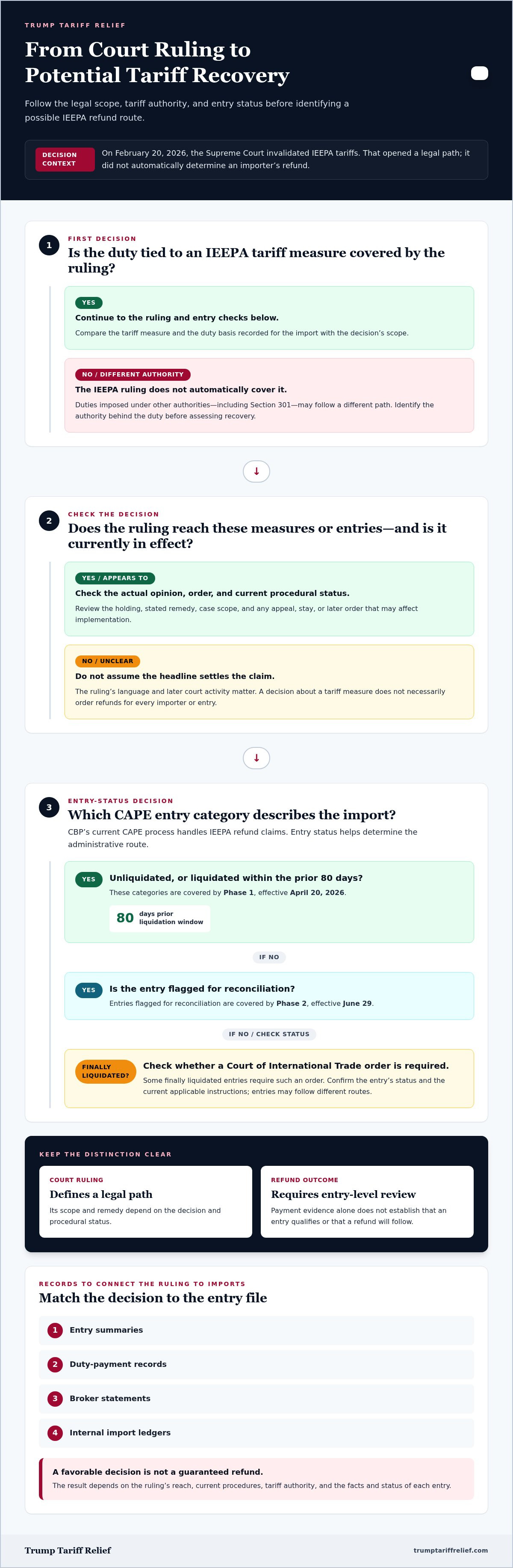
What businesses can review before pursuing tariff recovery
A focused readiness review helps your team organize the facts behind a potential claim. It’s an initial assessment, not a substitute for filing requirements or legal advice, and it can’t determine on its own whether a refund will be approved. The goal is practical: assemble a clear entry-level record, identify gaps, and compare your imports with the relevant tariff authority and ruling.
Start with a working file that connects each entry to the importer of record and the duties paid. Useful records include:
- Customs entry summaries or other available entry records
- Duty-payment records and broker statements
- Internal import ledgers or import-management reports
- Documents showing the importer of record, entry date, tariff classification, and duty basis
A complete file supports a more useful assessment. It helps show where records align, where amounts or entry details differ, and which questions need follow-up. Keep source documents alongside any internal summary so discrepancies can be traced rather than hidden in a spreadsheet.
Build an entry-level picture of duties paid
Organize records by entry, not only by supplier, product line, or accounting period. Capture the entry identifier, date, classification, importer of record, and duty amounts shown in the available records. Then reconcile the customs information with finance and import-management systems where possible. If a broker statement and internal ledger differ, flag the variance and preserve both records for review.
Missing documents don’t automatically answer the eligibility question, but they can limit what an initial review establishes. Note which entries lack a summary, payment record, or clear tariff basis, and record where the available information came from. That turns an incomplete file into a defined follow-up list.
Separate an initial assessment from a recovery decision
An eligibility review identifies whether the ruling, tariff authority, and entry facts appear aligned. It isn’t an agency decision and doesn’t guarantee approval or payment. Legal scope and customs documentation may need to be assessed together, with counsel addressing legal questions and trade specialists organizing entry records and recovery documentation. Keep those roles clear when planning the review.
Timing also needs a current review. Potential filing or protest periods can depend on the entry’s status and the applicable procedure, so don’t infer a deadline from a general summary or assume that compiling documents preserves a claim. Verify the rules and dates relevant to the specific entries before deciding next steps.
Because how court rulings enable tariff recovery depends on connecting legal scope to entry evidence, a structured review can show what’s documented and what still needs attention. Start with organized entry records so the recovery process can be evaluated against the facts without presuming an outcome.
Turn a court ruling into a focused recovery assessment
A court decision can create a reason to examine past tariff payments, but an importer-specific assessment takes more than reading a headline. Trump Tariff Relief focuses on IEEPA tariff refund recovery, helping businesses evaluate whether their entries may fit the relevant scope and organize the documentation needed to pursue a potential claim. The assessment considers the decision, the applicable process, and your customs records. It doesn’t presume a refund is due.
What specialist recovery support can take off your team’s plate
Tariff recovery work involves connecting legal scope to detailed entry data. Trump Tariff Relief coordinates an eligibility assessment with customs documentation management and manages the recovery process and government filings. This helps your team move from scattered records to a more organized claim file, with the analysis tied to the specific tariff authority and entries under review.
This is specialized recovery support, not general corporate legal representation. The firm manages the assessment, documentation, and filing work involved in pursuing IEEPA tariff refunds. Where a matter raises legal questions requiring counsel, legal advice remains distinct from the firm’s recovery and documentation role.
Choose a clear next step based on your records
Before beginning an assessment, gather the records you have: entry summaries, duty-payment records, broker statements, and internal import ledgers. Include the importer of record and entry identifiers where available. You don’t need to resolve every discrepancy first. A clear note of missing or inconsistent items helps focus the review on what the records establish and what may need follow-up.
An initial assessment can identify whether the tariff authority, relevant entries, and available documentation appear aligned with a potential recovery path. It cannot guarantee that an agency will approve a claim or issue a payment. The outcome depends on the applicable legal scope, procedures, and entry-specific facts.
Trump Tariff Relief works on a contingency-fee basis: fees are contingent on successful recovery, with no upfront costs. That structure does not guarantee recovery or a particular result. It means the engagement is tied to recovery, while eligibility and payment remain subject to the relevant process.
If your records show IEEPA duties, submit your situation for an initial assessment. Start an IEEPA tariff recovery assessment to put the ruling and your supporting records into a focused review, without assuming in advance that every entry qualifies.
Put Your Import Records to Work
A court ruling can shift the recovery landscape, but your next decision should rest on evidence tied to your own entries. Use what you’ve gathered to move from a general question to a documented assessment: identify which records are complete, which need follow-up, and what remains uncertain about the duties your business paid. That clarity can help your team make a more informed decision about pursuing recovery.
Understanding how court rulings enable tariff recovery is only the first step. Trump Tariff Relief specializes in IEEPA tariff refund recovery, with eligibility assessment and customs documentation management to support the process. Fees are contingent on successful recovery, with no upfront costs, but eligibility and payment aren’t guaranteed.
Take a practical next step. Request an IEEPA tariff recovery assessment and put your records in front of a focused review. A clearer picture of your options starts with the facts in your file.
Frequently Asked Questions
Can a court ruling make tariff refunds automatic?
No. A ruling doesn’t make refunds automatic. Understanding how court rulings enable tariff recovery means connecting the decision to specific entries and the process that applies. For example, an invoice showing a tariff charge isn’t enough by itself; compare it with customs entry records and the court order. This helps distinguish general news about relief from evidence that a particular payment may qualify.
Does an IEEPA tariff ruling also apply to Section 301 tariffs?
Not automatically. IEEPA and Section 301 are separate legal authorities, so a decision about one doesn’t settle whether duties under the other can be recovered. If an entry record shows charges under multiple tariff provisions, review each charge against the authority and measures addressed by the relevant order. Treating all tariff charges as one category can lead to an inaccurate view of which payments may be affected.
Can a company claim a refund if it reimbursed its supplier for the tariffs?
Possibly, but reimbursing a supplier doesn’t by itself establish who may pursue recovery. For example, a purchase invoice may show a tariff-related surcharge while customs records identify a different importer of record. Preserve the purchase agreement, supplier invoices, entry documentation, and proof of payment so the transaction structure can be assessed. The specific records and governing terms matter; don’t assume the invoice payer and customs claimant are necessarily the same party.
Does a court ruling apply to tariff payments made before the decision?
It may, depending on the order’s wording, later court developments, and the procedures that apply to the relevant entries. When reviewing older payments, map each entry date and duty charge to the measures addressed by the decision rather than assuming all prior payments are included. Keep original entry and payment records together. The decision’s date alone doesn’t establish whether an earlier transaction falls within its reach.
Can downstream customers recover tariffs passed on by an importer?
Not necessarily. A customer who paid a higher price may have borne a commercial cost, while the importer may be the party identified in customs records as having paid duties. For example, a supplier’s price adjustment could reflect several costs, not only a customs duty. Review invoices and contract terms alongside entry documents to understand how the charge moved through the transaction. A price increase alone doesn’t establish a customs recovery claim.
Should a business wait until every appeal is finished before reviewing its tariff records?
No. A business can organize its records and identify potentially relevant entries while court or agency developments continue. That preparation doesn’t require assuming a claim will succeed or taking a particular filing step. Keep entry and payment records accessible, note unresolved questions, and have applicable deadlines and procedural status checked against current information before acting. Early organization can make a later assessment more informed without treating an unsettled issue as resolved.
Is tariff recovery the same as duty drawback?
No. Duty drawback is a separate customs mechanism, while recovery based on a court ruling depends on the ruling’s legal scope and the process available for affected duties. The two terms shouldn’t be treated as interchangeable just because both may involve duties paid on imported goods. For example, a business considering a ruling-based claim should first identify the legal route relevant to its entries, rather than assuming drawback rules control that claim.
Ready to find out what your business may be owed?
Check My Eligibility