
An approved tariff refund isn’t cash in the bank. So, how are tariff refunds paid out, and who receives the money? For current IEEPA refunds, U.S. Customs and Border Protection (CBP) issues payment electronically by ACH to the Importer of Record listed on the entry. Approval is an important milestone, but businesses still need to track the payment and match it to the right entries.
It’s reasonable to want a clear answer before planning cash flow, especially when a refund covers multiple entries or a representative helped manage the claim. CBP pays the Importer of Record; any separate arrangement about passing funds along is a private matter. Valid IEEPA refunds are generally issued within 60 to 90 days after CBP accepts a CAPE Declaration, although that is not a guaranteed payment date.
This article explains the stages from declaration acceptance to disbursement, the bank and entry details finance teams should reconcile, and how to record payment notices or adjustments. It also explains how recovery support and a contingency fee relate to the government’s payout: the fee is separate from CBP’s payment process and is tied to refunds successfully recovered.
Key Takeaways
- Understand how are tariff refunds paid out under the current IEEPA process, including the payment route and the Importer of Record’s role.
- Keep filing, review, decision, disbursement, and receipt distinct so your team knows which stage has been reached.
- Reconcile payment details and notices against the relevant customs entries before closing the books.
- If the amount or timing differs from expectations, verify the refund status, bank details, and entry records before drawing conclusions.
- Specialist recovery support can manage eligibility assessment, documentation, and filings. Its contingency fee is separate from the government’s payment process.
How Are Tariff Refunds Paid Out After Approval?
Tariff refunds are paid after the relevant government process reaches disbursement. Submitting a claim alone doesn’t trigger payment. For current IEEPA tariff refunds, CBP processes eligible declarations through the Consolidated Administration and Processing of Entries (CAPE) system and issues payment electronically by Automated Clearinghouse (ACH). The Importer of Record (IOR) needs bank information on file in its ACE Secure Data Portal account.
A tariff refund payout is the government’s disbursement of an approved refund to the eligible Importer of Record, followed by the importer’s receipt and reconciliation of those funds. This separates the refund decision from the money reaching a bank account. Exact steps can vary by program and entry status, so businesses should follow current CBP instructions for the specific claim.
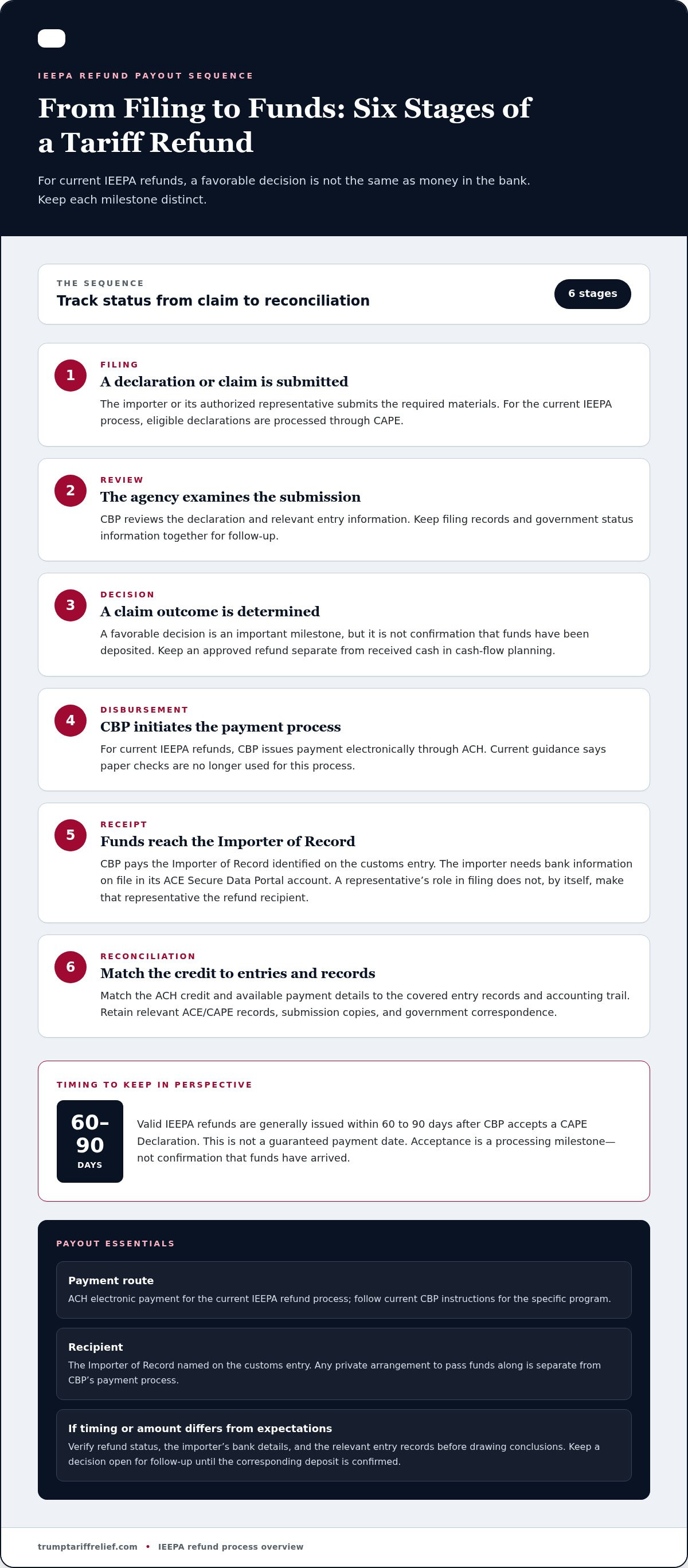
Keep these milestones distinct:
- Filing: The importer or its authorized representative submits the required declaration or claim.
- Review: The agency examines the submission and relevant entry information.
- Decision: The agency determines the claim’s outcome. A favorable decision is not a bank deposit.
- Disbursement: The government initiates payment using the applicable process.
- Receipt: The funds appear in the recipient’s account.
- Reconciliation: Finance matches the receipt and available payment details to the entries and accounting records.
For example, acceptance of a CAPE Declaration is a processing milestone, not confirmation that funds have arrived. Finance teams can track the declaration status separately from the bank transaction, then record the amount received against the appropriate entry records. Keep submission copies and government correspondence with the accounting trail. Duty drawback is another form of duty recovery with its own rules and process. Don’t assume its procedures apply to IEEPA refunds.
Does approval mean the refund has already been paid?
No. Approval is a decision about the claim; disbursement and receipt come later. Processing steps may remain before the government initiates payment, and a payment instruction is not the same as funds appearing in the business’s account. Track each status separately, and don’t treat an approval notice as cash available for operating plans.
This distinction matters for cash-flow forecasting and closeout. If a refund decision is recorded but no corresponding deposit has appeared, keep the item open for follow-up rather than booking it as received cash. Don’t assume a standard interval applies to every claim. Use current program guidance and the status information available for that filing.
Who is the refund intended to reach?
For the current IEEPA refund process, CBP issues payment to the IOR identified on the customs entry. A customs broker, consultant, or authorized filing representative may help prepare or submit materials, but that role alone doesn’t make the representative the refund recipient. Private agreements about sharing or passing through tariff costs are separate from CBP’s payment process.
This section addresses IEEPA tariff refunds, not every form of duty recovery. Eligibility and procedures depend on the program and entry circumstances. The IEEPA tariff explanation provides context on the program. Businesses pursuing recovery should keep the IOR, entry records, filing status, and eventual deposit connected throughout the process.
Which Payment Route Does the Government Use for Tariff Refunds?
For IEEPA tariff refunds under the current process, CBP issues payments electronically through Automated Clearinghouse (ACH). The importer must have bank information on file in its ACE Secure Data Portal account. Follow CBP’s current instructions for the specific refund program rather than assuming another program or an older payment practice uses the same method.
The official payment instructions control the disbursement route, so importers should follow the guidance for their specific refund program. For IEEPA refunds, current guidance identifies ACH as the payment channel and says paper checks are no longer used.
| Method | Recipient details required | Confirmation evidence to retain | Source to verify |
|---|---|---|---|
| ACH electronic payment | The Importer of Record’s bank information must be on file in its ACE Secure Data Portal account. CBP identifies the IOR on the customs entry as the refund recipient. | Keep the relevant ACE/CAPE records and match the ACH credit on the IOR’s bank statement to the refund and covered entry records. | Current CBP CAPE and ACE Secure Data Portal instructions for IEEPA refunds. |
This table applies to the IEEPA refund process described by CBP, not every kind of customs refund. For example, the Code of Federal Regulations on Drawback sets out rules for drawback claims, a distinct recovery program. Use the regulations and agency instructions that apply to the program and entry at issue.
What information can affect payment routing?
Start with the IOR named on the customs entry and the bank information in that importer’s ACE account. Check that the relevant entry and filing records are consistent, and keep declaration details and government status information with the accounting records. Accurate records help your team connect an incoming ACH credit to the right refund and entries, but they don’t guarantee a particular payment date or outcome.
If an ACH deposit isn’t readily identifiable, compare the available payment and filing records before assigning it in the ledger. A consultant’s or broker’s involvement in preparing a claim doesn’t mean the government will send the money to that representative. Confirm recipient identity and payment instructions in CBP’s current program guidance.
Can a representative receive or redirect the payment?
Helping prepare or file a claim is not the same as being the refund recipient. Under the current IEEPA process, CBP pays the IOR listed on the entry. A representative’s role in handling documentation does not by itself transfer entitlement to the refund or establish control over the importer’s bank details. Follow CBP’s current ACE instructions for account access and authorized actions. Don’t infer payment authority from a service agreement alone.
Finance teams should document any private agreement about funds separately from CBP’s disbursement records. Trump Tariff Relief manages eligibility assessment, documentation, and government filings, while your business tracks its payment and reconciliation. The IEEPA tariff refund recovery process brings these parts of the work together.
What Happens Between a Tariff Refund Decision and Cash Receipt?
A refund decision is one milestone, not the finish line. For IEEPA refunds, the path from CBP processing to money in the importer’s account includes separate status, payment, and bookkeeping steps. Use the sequence below as a practical tracking framework, not as a guarantee that every entry follows the same path or receives identical communications.
- Government processing: CBP processes the CAPE Declaration and relevant entry information. Record the declaration reference and the entries included.
- Decision or status update: Save the official decision or status information available for the filing. An accepted declaration is a processing milestone, not proof that funds have been sent.
- Payment initiation: If CBP authorizes a refund, track the government’s payment action separately from the decision. The current IEEPA process uses ACH.
- Bank receipt: Confirm the credit in the Importer of Record’s account and retain the bank transaction record.
- Reconciliation: Compare the received amount with relevant government records and entry-level accounting details, then document any unresolved difference.
These stages can overlap or appear differently in the records available to an importer. Use current CBP guidance and the status information for the specific filing instead of assuming a uniform sequence. A recovery consultant can organize documentation and manage filings, but CBP controls its review and disbursement. The refund recovery process explains how specialist support fits alongside the importer’s payment tracking.
Which notices and records should finance teams watch?
Build the audit trail around records tied to the IEEPA filing: the CAPE Declaration reference, covered entry numbers, relevant ACE status information, any official decision communication received, and the bank record showing the deposit. Use the terminology shown in CBP’s current system. Don’t label a status as an approval or payment confirmation unless the agency record says that’s what it represents.
A simple reconciliation worksheet can connect each entry to its declaration, decision status, expected accounting treatment, and amount actually received. If a payment covers multiple entries, preserve your team’s allocation method and the source records supporting it. This lets another reviewer trace a bank credit back to the filing without relying on memory or an unexplained spreadsheet total.
Why can the amount received need reconciliation?
The amount requested, the amount reflected in a government decision, and the amount credited to the bank are separate records. Compare them before marking the recovery complete. If figures differ, document the variance and check the underlying entry and filing records against the relevant CBP information. Don’t assume an adjustment, offset, or interest explains a difference unless current official guidance or the records for that refund support it.
Keep the issue open until your team can explain the posted amount and its treatment in the ledger. Specialist support can manage eligibility assessment, documentation, and government filings. Finance still plays a critical role in confirming receipt and maintaining the final audit trail.
Why Can a Tariff Refund Payment Be Delayed or Differ from Expectations?
Approval is a decision, not a guaranteed payment date. The time between a favorable refund decision and funds appearing in a business account depends on the applicable government process and the status of the specific filing. A delay or unexpected amount is a reason to verify the records, not proof that the government made an error or that a particular adjustment occurred.
For IEEPA refunds, CBP’s current process uses CAPE and ACH payment. If expected funds haven’t appeared or the deposit differs from internal estimates, review the evidence before changing forecasts or closing the accounting item. Verify:
- The CAPE Declaration reference and the entries covered by the filing.
- The latest official status or decision information available for that declaration.
- The Importer of Record’s bank records and the account used for the expected deposit.
- Whether the amount under review is a requested amount, a decided amount, or a received amount.
These are checks, not a list of confirmed causes. Each case has its own filing and record trail. Keep official notices, declaration details, entry records, and bank evidence together, and use current CBP instructions to determine the appropriate status channel. This section focuses on troubleshooting discrepancies, not estimating how long a refund should take.
What should a business do if expected funds have not arrived?
First, match the declaration or claim reference to the relevant entry records and check whether a corresponding bank credit is present. Confirm which milestone the official status reflects. A decision or processing update is not the same as payment confirmation. Then follow the status channel in current CBP instructions for the applicable filing. Preserve the records reviewed and compare the references with bank activity before concluding that a payment is missing.
What if the payment amount does not match internal expectations?
Compare the official decision or payment information, the entry-level records, and the bank receipt. Make a short variance record showing the amount expected internally, the amount documented by the government, and the amount credited. If the difference remains unexplained, keep the issue open and follow the applicable official procedures to review it. Don’t assume an error, entitlement, offset, or interest adjustment without supporting records or guidance.
Clear documentation helps finance teams explain what is known, what remains unresolved, and why a refund hasn’t yet been marked complete. Recovery support can manage eligibility assessment, documentation, and government filings, while the importer tracks payment status and maintains its accounting records. CBP controls the decision and disbursement.
If your team needs help organizing IEEPA recovery documentation and filings, explore tariff refund recovery support while keeping payment monitoring and reconciliation tied to your company’s records.
How Does Refund Recovery Support Fit Into the Payout?
Recovery support and government payment are separate parts of the process. Trump Tariff Relief manages IEEPA tariff eligibility assessment, documentation, and government filings, helping businesses pursue recovery with organized claim support. CBP, not the consultancy, determines whether a refund is approved and controls its disbursement. Support can advance the claim work, but it can’t guarantee eligibility, approval, an amount, or a payment date.
That distinction answers a practical question: how are tariff refunds paid out when a consultant helps with the claim? The government makes payment under its own process to the Importer of Record. The consultancy’s fee is separate, calculated as a percentage of refunds successfully recovered, with no upfront costs or hourly billing. The government’s payment route does not determine the consultancy’s fee or how a private agreement is handled.
How does a contingency fee relate to funds received?
A contingency fee ties the consultancy’s compensation to refunds successfully recovered, rather than billing upfront or by the hour. It isn’t a government processing charge, and CBP doesn’t collect it as part of the refund disbursement. The engagement terms set out the agreed percentage and payment arrangements. This keeps the public payment decision separate from the private service relationship.
Understanding that distinction helps finance teams track two separate items: the refund issued by the government and the fee arrangement with the recovery consultancy. Trump Tariff Relief’s recovery support covers assessment, documentation, and filing. Keep the service agreement with your company’s financial records, but don’t treat it as evidence of CBP’s decision or payment status.
What should an importer prepare before seeking recovery support?
Import and payment records are useful starting points for reviewing the company’s tariff history and potentially relevant entries. Trump Tariff Relief manages documentation and government filings as part of its recovery work, helping organize available materials into a structured claim process. Keep copies of the records you have and note which entries or periods your team wants assessed.
For example, a finance team may keep import records in one system and payment details in another. Identifying those sources early can help connect the relevant information without confusing internal accounting with the government’s determination. An eligibility assessment evaluates whether a potential recovery path applies; it doesn’t promise that a refund will be obtained.
If your business is considering IEEPA tariff recovery, an eligibility assessment can help determine whether pursuing a claim may be appropriate. Specialist support can manage the documentation and filing work while your team tracks any eventual government decision and payment.
Turn Refund Uncertainty Into a Clear Next Step
Knowing how are tariff refunds paid out is only part of planning for recovery. First determine whether your company’s import history may support an IEEPA refund claim, then keep recovery work and cash planning on separate tracks. An eligibility assessment can clarify whether pursuing a claim may be appropriate, without treating a possible refund as money already secured.
Trump Tariff Relief manages eligibility assessment, documentation, and government filings. Its fee is a percentage of refunds successfully recovered, with no upfront costs or hourly billing. The consultancy supports the claim process, while government authorities retain control over approval and disbursement.
Request a tariff refund eligibility assessment to take a practical first step toward understanding your recovery options. With a clearer view of potential eligibility and organized claim support, your team can move forward with greater confidence.
Frequently Asked Questions
How are tariff refunds paid out?
How are tariff refunds paid out? Payment follows the government’s review and disbursement process for the specific refund program. Filing a claim or receiving a favorable decision doesn’t confirm that funds have reached your account. For current IEEPA refunds, CBP’s instructions specify the payment process; other programs may differ. Keep the government’s disbursement separate in your records from any fee owed under a private recovery-services agreement.
Who receives a tariff refund, the importer or the customs broker?
For current IEEPA refunds, CBP directs payment to the Importer of Record identified on the customs entry. A broker or consultant who helps prepare or submit a claim doesn’t automatically become the recipient. For a different refund program, follow its current official payment instructions. If a representative is involved, review the authorization records and confirm what actions they’re permitted to take rather than assuming filing authority includes control of funds.
Can a tariff refund be paid by direct deposit?
It depends on the refund program. For current IEEPA refunds, CBP issues payment electronically by ACH, which deposits funds into a bank account. The Importer of Record must have bank information in its ACE account. Don’t assume the same channel applies to every customs refund. Identify the program, then verify current CBP or Treasury instructions for the permitted payment method and required payee or account details.
How long does it take to receive a tariff refund after approval?
There isn’t one timeframe that applies to every tariff refund. A decision and a deposit are separate events, and processing depends on the applicable program and filing status. Check the latest official notice or status instructions associated with your claim rather than relying on another importer’s experience. For cash planning, record the decision separately from funds received, and don’t treat an estimated receipt date as confirmed cash.
Can a business receive only part of its requested tariff refund?
Compare the payment amount with the official information for the claim and the underlying import records before deciding what it represents. Don’t assume the full request was approved, that a partial payment indicates an error, or that a particular adjustment applies. If the decision and bank receipt don’t align, document the difference and follow the current official review or inquiry instructions for that program.
Does a tariff refund recovery firm take its fee out of the government payment?
The government’s refund and a recovery firm’s fee are separate matters, and the service agreement sets out the fee arrangement. Trump Tariff Relief charges a percentage of refunds successfully recovered, with no upfront costs or hourly billing. The fee arrangement is separate from CBP’s disbursement, so review the agreement for the terms that apply to your business.
What records should a business keep after receiving a tariff refund?
Keep records that let finance trace the bank credit to its source: government notices, claim references, relevant import records, payment evidence, and reconciliation notes. These are useful business records, not a statement of a legal retention period. For example, note which entries your team associates with a deposit and how the amount was posted. A clear trail makes later internal review easier and reduces guesswork during closeout.
Ready to find out what your business may be owed?
Check My Eligibility