
For importers, reducing stress of customs claims starts with knowing which entries may be relevant, where the records are, and which deadlines need attention. A clear owner for each task can keep a potential claim from becoming another source of uncertainty.
Import data may be spread across internal teams and a customs broker, while claim work competes with day-to-day operations. A Supreme Court ruling concerning IEEPA tariffs created the possibility of refunds, but it does not guarantee a refund for any particular importer or entry. Eligibility depends on the specific import history, available documentation, and applicable deadlines.
This guide explains how to organize claim tasks, records, and responsibilities, and what an eligibility review can establish. The 180-day deadline typically applies to formal protests of liquidated entries. You’ll also learn how tariff and trade specialists can coordinate documentation and filings alongside your customs broker. Trump Tariff Relief provides IEEPA tariff refund claim assistance with no upfront cost. Payment is only a percentage of funds recovered.
Key Takeaways
- Separate potential IEEPA tariff refund claims from other customs matters to keep the review focused.
- Use one shared tracker to assign task owners, record missing documents, and make next steps visible.
- Compare self-managed preparation, broker coordination, and specialist claim support to decide how to divide the work.
- Reducing stress of customs claims starts with checking entry status and available records, because eligibility can vary by entry.
- Specialist IEEPA claim assistance has no upfront cost. Payment is only a percentage of funds recovered.
Reducing stress of customs claims with a clear review process
Start by listing the entries and records your business can identify, then assign one person to coordinate questions and next steps. That gives your team a practical way to prepare for an eligibility review without assuming that every entry qualifies or that a refund is certain.
Why Customs Claims Feel Stressful for Importers, and What Can Be Controlled
Unfamiliar terminology, records spread across teams and a broker, and time-sensitive decisions can turn a potential customs refund claim into another pressure point. You may be trying to identify relevant entries while keeping shipments, cash flow, and customer commitments on track. Not every customs matter is an IEEPA tariff refund claim, and not every entry will qualify. This guide focuses on the possible recovery of certain IEEPA tariffs, not customs issues generally.
The Supreme Court ruling concerning IEEPA tariffs created a potential route toward refunds; it did not guarantee that any particular importer or entry will receive one. The International Emergency Economic Powers Act (IEEPA) is the law at the center of the tariff issue. The implications of the ruling and the relevant claim process depend on the circumstances. Distinguish the broad legal development from an assessment of your own import history. The IEEPA tariff explanation provides further context about the tariffs and potential recovery.
Which parts of a customs claim create the most pressure?
Pressure often comes from unanswered questions: Which entries may be relevant? Where are the entry summaries and payment records? Who can confirm an entry’s status, and who is responsible for moving the review forward? When documents sit in separate systems or people assume someone else is coordinating, even a manageable review can feel difficult to control.
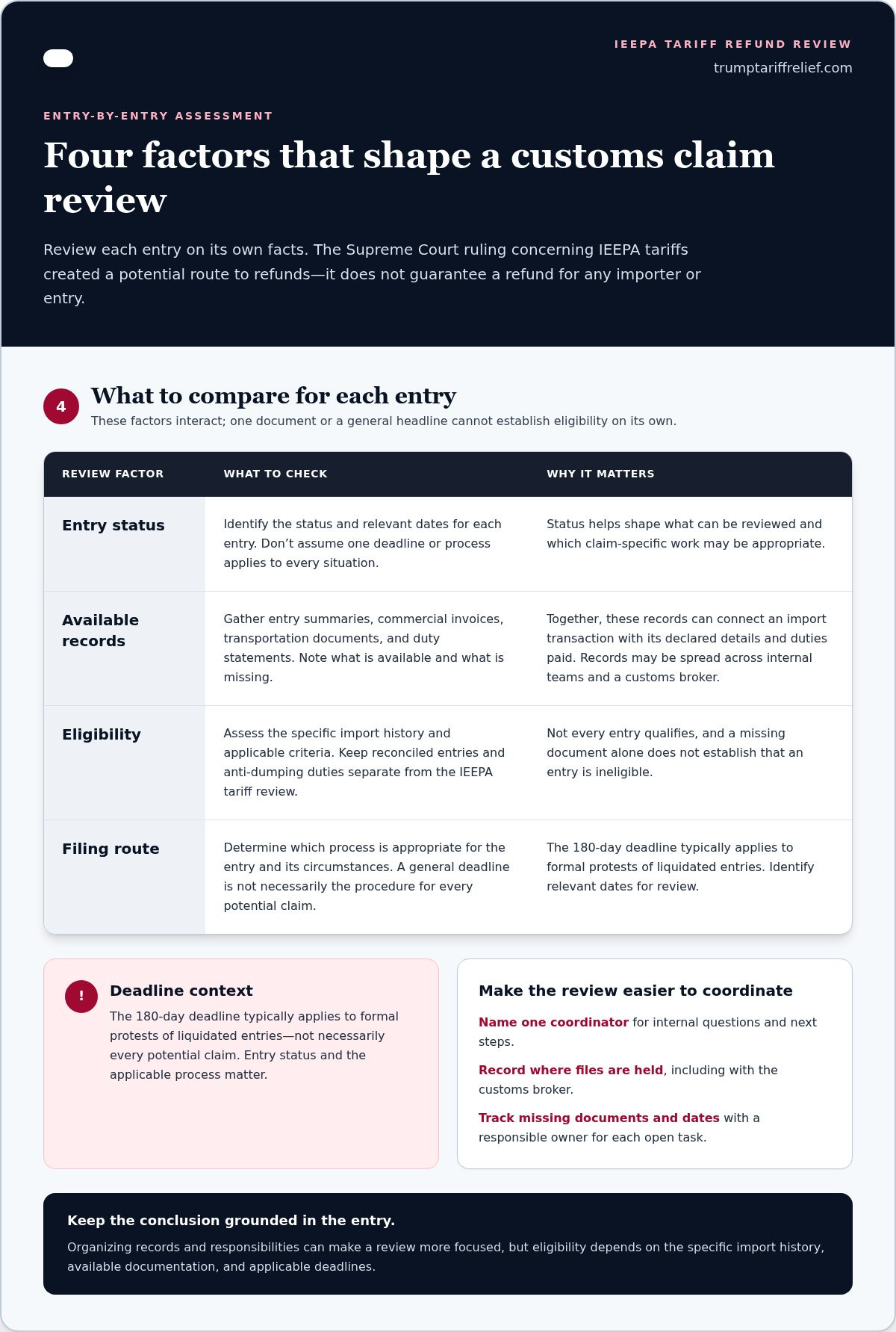
Claim work can also compete with purchasing, fulfillment, finance, and customer needs. Not every claim is equally complex or urgent. Entry status, available records, and the appropriate process can differ, so don’t treat a general headline as a conclusion about every transaction. The 180-day deadline typically applies to formal protests of liquidated entries. Identifying relevant dates matters, but that deadline is not necessarily the procedure for every potential claim.
What is within an importer’s control?
You can’t decide eligibility or control a government determination. You can make the review more orderly: identify who holds import records, name one person to coordinate the claim internally, and record which questions remain open. Start with the records you have rather than waiting for a perfect file. A list of missing documents, with an owner for finding each one, gives the next step a clear point of contact.
- Identify the internal claim coordinator and relevant finance or trade contacts.
- Note where entry and payment records are stored, including records held by your customs broker.
- Track entry status and dates for specialist review instead of assuming an entry is eligible.
Claim stress is reduced when tasks, records, and deadlines have clear owners. That structure won’t guarantee a refund, but it can replace scattered follow-ups with a focused review. Reducing stress of customs claims begins by separating what you can organize from what must be assessed, then assigning each open task a responsible person and a next action.
How Claim Complexity, Records, and Deadlines Create Pressure
A customs refund review involves more than a single yes-or-no question. Its complexity comes from how four factors interact: the status of each entry, the records available, whether the entry may meet eligibility criteria, and which filing route is appropriate. A document that helps identify a transaction won’t, by itself, establish eligibility. The review needs to connect entry details and supporting records to the claim being assessed.
That’s why a batch of imports shouldn’t be treated as one uniform claim. Entries may have different statuses, supporting files may be held in different places, and some entries may fall outside eligibility criteria. A careful review sorts those differences instead of assuming every entry qualifies or that one approach fits them all. To make reducing stress of customs claims practical, focus on organizing the facts for review rather than trying to settle every eligibility question internally.
Why entry status and documentation matter
Entry status helps shape what can be reviewed and which claim-specific work may be appropriate. Relevant records may include entry summaries, commercial invoices, transportation documents, and duty statements. Together, these records can help connect an import transaction with its declared details and duties paid. If records are incomplete or spread across departments, note what’s available and what still needs to be located. A missing document alone doesn’t establish that an entry is ineligible.
Eligibility filtering excludes reconciled entries and anti-dumping duties. Keeping those categories separate from the IEEPA tariff review helps prevent mixed records from obscuring entries that merit assessment. For a more detailed view of the records involved, use an IEEPA refund document checklist as a reference while organizing your files.
How deadline awareness lowers avoidable uncertainty
Early deadline awareness helps your team identify dates that need attention before claim work gets lost among routine priorities. Don’t assume one deadline applies to every entry or claim situation. Entry status matters, and the applicable process should be assessed against the facts of the specific entry.
The relevant date is the date of liquidation. That timeframe is important, but it shouldn’t be applied automatically to entries with a different status or treated as a substitute for an eligibility review. Record liquidation dates where available and flag entries that need timely assessment. A dedicated tariff refund deadline guide can help you understand deadline considerations in more detail.
A simple working list can reduce last-minute uncertainty without deciding the claim for you. Track entry identifiers, status, available records, missing documents, and dates requiring review. Assign an owner to each open item, then record the next action, such as locating an invoice or requesting a record from the team that maintains it. This turns a broad file into specific questions that can be assessed in sequence.
If coordinating documentation and claim-specific work is taking attention away from operations, see how specialist claim support works alongside your existing customs broker.
Compare Ways to Manage Customs Claim Work Without Taking on Everything Alone
There isn’t one right way to organize a potential IEEPA tariff refund claim. Your team can prepare records internally, coordinate with its existing customs broker, or use tariff and trade specialist assistance for claim-specific work. The practical question is how to assign the work without leaving gaps or duplicating effort. Whatever approach you choose, eligibility must be assessed, and no approach can guarantee a refund.
Self-managed preparation
Record coordination: Your team gathers and organizes available import records. Claim-specific work: Internal staff can prepare information for review, but preparation alone doesn’t establish eligibility. Importer input: Your team identifies decision-makers, fills information gaps, and tracks open questions.
Coordination through your customs broker
Record coordination: Your broker can help coordinate relevant records it holds with your team. Claim-specific work: The broker may remain involved while a specialist handles tariff claim work separately. Importer input: You provide business context and help resolve questions about your entries.
Specialist tariff claim assistance
Record coordination: Trump Tariff Relief can coordinate documentation with you and your broker. Claim-specific work: Specialist support focuses on eligibility review, documentation preparation, and appropriate filings for the claim. Importer input: You provide relevant business information and participate in decisions that require your knowledge or authorization.
When can an importer organize the preparation internally?
Internal preparation can be a useful starting point if your finance, logistics, or trade teams can locate records and identify who has authority to make decisions. Assign one coordinator to maintain a shared task list, note who owns each item, and record the next action. This helps prevent two teams from chasing the same invoice while another needed record remains uncollected. It organizes supporting information, but it doesn’t determine eligibility.
How can broker coordination and specialist support work together?
Your customs broker can remain part of the working relationship without taking on every claim-specific task. Trump Tariff Relief provides tariff and trade specialist assistance and can work directly with broker partners as a relief valve, not as a competitor or ongoing customs broker. That division can keep records moving while your business retains its existing broker relationship. The claim support process explains how specialist claim work can fit alongside broker coordination.
To choose a workable arrangement, consider where records are held, who has time to coordinate them, and whether your team can manage claim-specific steps without disrupting core operations. If internal staff can gather documents but can’t carry the review forward, specialist support may reduce the administrative load. If your broker already holds relevant records, coordination can help avoid repeated requests. An organized process makes a review more manageable, but it isn’t evidence that an entry qualifies or that funds will be recovered. Reducing stress of customs claims means assigning the work clearly while keeping the outcome in perspective.
Use a Simple System to Make a Customs Claim More Manageable
A claim becomes easier to manage when the work is visible and assigned. Set up one shared tracker, then use it to assign an owner, gather available records, note relevant deadlines, and document open questions. This keeps your team focused on what it can do now without confusing preparation with an eligibility decision or a completed filing.
A single owner and shared record list reduce avoidable coordination by showing who is responsible, what’s missing, and what happens next. Keep the tracker focused on logistics. It helps your team organize the review, but it doesn’t determine whether an entry qualifies or replace claim-specific assessment and filing work.
Create a clear claim task list
Name one internal contact to coordinate updates and list any customs broker involved. For each task, record its owner, status, missing information, next action, and relevant date. Store documents in an access-controlled location. Use the tracker to note where a record is held rather than circulating sensitive details unnecessarily. This gives authorized colleagues enough context to coordinate without turning the tracker into a repository for confidential files.
- Assign an owner. Identify the internal coordinator and the team members who can locate import, finance, or payment records.
- Gather available records. Note which documents are on hand and which are held by another team or your customs broker.
- Record dates and reminders. The 180-day deadline typically applies to formal protests of liquidated entries. Track relevant liquidation dates for review, and don’t assume the same deadline applies to every entry.
- Log open questions. Capture the question, the person responsible for resolving it, and the next step.
Reduce uncertainty before seeking an eligibility review
You don’t need a perfect file to prepare useful information for an initial review. Gather basic company information, an estimate of tariff fees paid, the regions from which you imported, and a brief inventory of available documentation. Mark estimates as estimates and distinguish confirmed records from items still being located. This gives the review a clearer starting point without asking your team to decide eligibility in advance.
Share business information through the appropriate process and limit internal access to colleagues who need it. Trump Tariff Relief keeps business information strictly confidential and doesn’t share it without explicit consent. An initial eligibility review can assess the information you provide; it doesn’t guarantee that entries qualify or that a refund will result. There’s no upfront cost, and payment is only a percentage of funds recovered.
With the owner, documents, dates, and unanswered questions in one place, your team can hand off a more organized file and keep routine operations moving. Request an IEEPA tariff eligibility review to have the available claim information assessed.
Get Specialist Help for an IEEPA Claim Without Adding Upfront Cost
Specialist support can help move an IEEPA refund claim from scattered records to a structured review. Trump Tariff Relief assists U.S. importers with tariff and trade claim work, including eligibility review, documentation preparation, and appropriate filings. This support focuses on IEEPA refund claims, not general customs services or ongoing customs brokerage. Your existing customs broker can remain involved while claim-specific work is handled separately.
The payment model avoids upfront costs: payment is only a percentage of funds recovered. That arrangement doesn’t make a refund certain. Eligibility is assessed case by case, and neither a review nor a filing guarantees recovery. Optional advanced funding may be available for qualifying claims, but it isn’t required.
What support can take claim work off the importer’s plate?
Depending on the claim and entry details, specialist work may include reviewing eligibility, organizing supporting documentation, and preparing appropriate filings, such as Post-Summary Corrections, protests, or drawback claims. The right path depends on the circumstances; those filing types aren’t interchangeable, and not every entry qualifies. Specialists can also coordinate with your customs broker so the importer isn’t left managing every document request and claim-specific task alone.
A review may use available customs and import records, including relevant CBP or ACE data, alongside supporting documents. Your team still provides business and import-history information and answers questions that require company context. The aim is to reduce administrative burden while keeping the review grounded in the facts of your entries, not to promise a particular result.
What happens when a business requests an eligibility check?
Start by submitting basic company and import-history information. The submission takes approximately 2 minutes, and you can schedule a call immediately afterward to discuss the information and potential next steps. Trump Tariff Relief responds to an eligibility check within one business day, with a 24-hour initial review. These are review timelines, not promises of eligibility or recovery.
Business information is kept strictly confidential and isn’t shared without explicit consent. For concise answers about records, timing, fees, and confidentiality, consult the frequently asked questions. Preparing a basic import-history summary can make the review more focused, but a preliminary assessment is still only an assessment. Eligibility depends on the individual claim.
If paperwork and coordination are taking time away from your business, specialist assistance can help organize the review and appropriate claim work with no upfront cost. Request an IEEPA tariff eligibility check to begin. The review can identify whether a claim may warrant further attention, but eligibility is case by case and refund outcomes can’t be guaranteed.
Move Your Claim Review Forward With Confidence
The next step doesn’t have to be a major project. Choose one person to coordinate questions and records, then decide whether your team has the capacity to manage claim-specific work or would benefit from specialist support. A focused eligibility review can help clarify what deserves attention without treating a possible refund as certain.
Reducing stress of customs claims means replacing uncertainty with a practical next action. You don’t need to resolve every question before starting. A preliminary assessment can help establish whether your import history may warrant further review, while keeping eligibility case by case and any recovery outcome uncertain.
Trump Tariff Relief responds to an eligibility check within one business day and provides a 24-hour initial review. There’s no upfront cost, and payment is only a percentage of funds recovered. Request a no-cost IEEPA eligibility check to take the next step. A clear assessment can help you move forward with greater confidence and keep your attention on running your business.
Frequently Asked Questions
Can a customs broker help reduce the stress of a tariff refund claim?
Yes. A customs broker who knows your entry records may help coordinate information with Trump Tariff Relief, which focuses on IEEPA tariff refund assistance. Your broker can remain involved in the existing broker relationship while a specialist handles claim-specific work. For example, agree on who will locate entry summaries and who will organize claim documents so requests don’t overlap. This coordination can make the process clearer, but eligibility and recovery depend on the specific claim.
What happens if my business cannot find all of its customs documents?
You can share the records you have and identify what’s missing for the eligibility review. Relevant documents may include entry summaries, commercial invoices, transportation documents, and duty statements. For example, if your finance team has duty statements but invoices are held elsewhere, note the gap and where the remaining records may be located. Reducing stress of customs claims starts with an honest inventory, not assumptions. Incomplete records don’t establish eligibility or guarantee a refund.
Does the Supreme Court ruling guarantee a refund for IEEPA tariffs?
No. The ruling enables the possibility of refunds, but recovery isn’t automatic for every importer or entry. An assessment considers your company’s import history, supporting documentation, and applicable deadlines. A review can help determine whether a potential claim merits further attention, but it isn’t a promise that funds will be recovered. Treat the ruling as a reason to assess your specific records, not as confirmation that every tariff payment is refundable.
How quickly will I hear back after requesting an eligibility check?
Trump Tariff Relief responds to an eligibility check within one business day, with a 24-hour initial review. A full assessment timeline varies with case complexity and the information available. The eligibility check and consultation are free, with no obligation. These timeframes refer to the review process, not government processing, filing decisions, or the timing of any potential refund.
Is my company’s information kept confidential during an eligibility review?
Yes. Business information is kept strictly confidential and isn’t shared without your explicit consent. The eligibility check requests basic company data, estimated tariff fees paid, import regions, and information about available documentation. Before submitting, gather the information your team can readily provide and identify any estimates as such. Claim details aren’t shared with your broker or another party without your explicit consent.
Does Trump Tariff Relief charge a fee if no refund is recovered?
No. There’s no upfront cost, and Trump Tariff Relief is paid only as a percentage of funds successfully recovered. The eligibility check and consultation are free. This contingency-based arrangement means payment depends on recovery, but it doesn’t guarantee that a claim will qualify or that a refund will result. Eligibility is assessed case by case, based on the importer’s specific history and supporting information.
Can any importer request an IEEPA tariff refund review?
U.S. importers across industries and business sizes can request an eligibility check, but that doesn’t mean every importer or entry qualifies. The assessment depends on the business’s import history, available documentation, and relevant deadlines. Eligibility filtering excludes anti-dumping duties and reconciled entries. If your records include different types of duties or entry categories, identify them clearly for review so they aren’t mistaken for potentially eligible IEEPA entries.
Ready to find out what your business may be owed?
Check My Eligibility