
What if a customs refund update shows progress but doesn’t tell you whether the money is on its way? If you’re asking how to track customs refund status, the answer isn’t one universal lookup. Claim review and payment follow-through are separate stages, and the records that show each can differ.
It’s understandable to worry when there’s no clear update, especially if you’re unsure whether a request was filed, is being processed, or has reached payment. For IEEPA refunds, CBP processes requests through CAPE in the ACE Portal, and importers use ACE reports to follow progress. CBP doesn’t send email updates on refund status, so knowing which report to check matters. A missing payment or quiet period alone doesn’t establish that a claim has failed.
This guide explains how to distinguish claim progress from payment status, which CBP and ACE records and communications to gather, and what steps to take if a refund appears stalled. You’ll also learn why eligibility must be assessed case by case and how specialist support can help track a potential IEEPA refund through disbursement.
Key Takeaways
- Learn how to track customs refund status by separating claim submission and CBP processing from disbursement and bank receipt.
- Start with importer, broker, and filing records, then use the relevant ACE reports to follow the refund trail.
- Compare entry references, importer details, filing evidence, and payment information before treating records as inconsistent.
- If a refund appears stalled, gather the documentation first and follow up with a clear record of what has, and hasn’t, happened.
- Specialist support can help assess IEEPA eligibility and track a claim toward disbursement; Trump Tariff Relief provides an initial eligibility response within one business day, with no upfront cost and payment only as a percentage of recovered funds.
How to Track Customs Refund Status: First Identify Which Stage You Mean
Before searching for an update, identify what you need to know: Was a refund request filed? Has U.S. Customs and Border Protection (CBP) processed it? Has payment been issued or received? These are different questions, and there isn’t one universal tracker that answers all of them. The distinction matters because evidence of a filing is not evidence that CBP approved a refund, and a payment record is not the same as money appearing in your bank account.
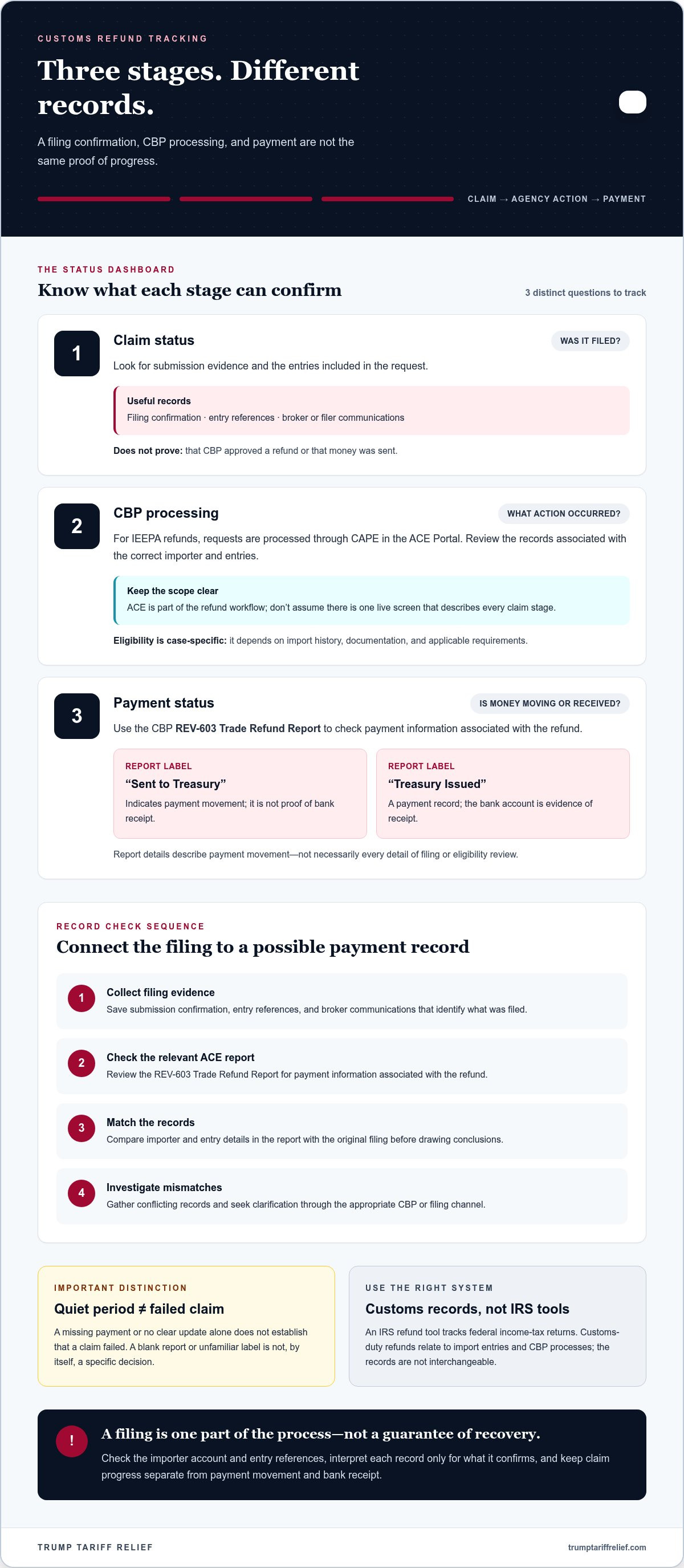
In plain language, customs refund tracking has three stages: claim status shows what happened to the filing, CBP processing records show agency action, and payment status shows whether an authorized refund is moving to the importer.
Claim status, CBP processing, and payment status are different
Claim status concerns the request itself: whether documentation was submitted and what can be established about its review. CBP processing concerns agency action on the relevant entry or refund request. Payment status comes later, when an authorized refund is being disbursed. The stages may involve different records, so check what a document actually confirms before treating it as proof of the next step.
For example, a broker’s filing confirmation may help establish that a request was transmitted. It doesn’t, by itself, show that the entry qualifies, that CBP approved a refund, or that money was sent. A payment record may indicate movement toward the importer, while the bank account provides evidence of receipt. Keep those distinctions clear when deciding what to investigate next.
IEEPA refunds also aren’t automatic for every tariff entry. Eligibility depends on the specific import history, documentation, and applicable requirements. A filing is one part of the process, not a guarantee of recovery. Treat each entry and its supporting records as case-specific.
Why tax refund trackers don’t answer customs questions
An IRS refund tool is designed for federal income-tax returns. A customs-duty refund relates to import entries and CBP processes, not an individual or business tax-return status. Although both involve refunds, their records and systems aren’t interchangeable. A tax tool can’t confirm whether a customs filing was submitted or whether CBP has acted on an entry.
That distinction starts with the underlying payment: customs duties are charges associated with imported goods. For a foundational explanation, see Customs Duty. A refund claim tied to those charges must be followed through customs-specific records rather than IRS updates.
For IEEPA refunds, CBP uses the Consolidated Administration and Processing of Entries (CAPE) system within the Automated Commercial Environment (ACE) Portal. ACE reports and relevant CBP communications are the customs-specific places to look; CBP doesn’t send email updates on refund status. Access and report availability can depend on the importer’s ACE account and the records associated with the filing, so confirm you’re reviewing the correct account and entry references. In the next step, use those identifiers to locate the records that speak to filing progress and payment.
Where to Check a Customs Refund Status in CBP and ACE Records
Start with the records closest to the filing, not a bank deposit or a general refund search. Gather the importer’s entry information, any submission confirmation, and correspondence from the customs broker or filer involved. These records help you identify what was requested and which entries it concerns. Then use the relevant CBP and Automated Commercial Environment (ACE) records to look for agency processing or payment information.
Use ACE and CBP records without assuming a live claim tracker
ACE is a customs information source used in the refund workflow, but don’t assume it offers one live screen that describes every stage of a claim. For IEEPA refunds, CBP’s REV-603 Trade Refund Report is a named resource for payment tracking. It can show whether a refund is marked “Sent to Treasury” or “Treasury Issued.” Those entries describe payment movement, not necessarily every detail of the filing or eligibility review.
To find the relevant record, use the ACE account and access available to the importer or authorized representative, and compare report details against the entry references in your filing documents. Report availability and account access can vary, so follow current CBP instructions rather than relying on old portal walkthroughs. Don’t infer a specific decision from a blank report or an unfamiliar label. Confirm that you’re viewing the right importer and entries before concluding that no record exists.
Use this sequence to connect the filing to a possible payment record:
- Collect filing evidence. Save the submission confirmation, entry references, and broker communications that identify what was filed.
- Check the relevant ACE report. Review the REV-603 Trade Refund Report for payment information associated with the refund.
- Match the records. Compare the importer and entry details in the report with the original filing before drawing conclusions.
- Investigate mismatches. If information doesn’t align, gather the conflicting records and seek clarification through the appropriate CBP or filing channel.
This record-by-record approach is more reliable than treating “refund status” as one answer. A filing document supports that a request was made; the REV-603 may provide evidence about payment movement. Neither should be stretched to establish something it doesn’t show. For an overview of how the refund process works, see how the filing and follow-through fit together.
Check ACH enrollment and payment details separately
ACH enrollment concerns electronic delivery of applicable CBP refunds. It’s a payment-readiness check, not evidence that a claim is eligible, approved, or paid. If an ACE record indicates payment movement but funds haven’t appeared, compare the business banking information on file with the authorized refund details. Check that you’re reviewing the correct business account and entry references, and ask the responsible filing contact to help resolve discrepancies.
Keep these checks distinct:
- ACH enrollment: Is the business set up to receive applicable CBP refunds electronically?
- Bank details: Do the account details align with the authorized recipient information?
- Refund evidence: Does the CBP record show payment movement for the relevant entries?
Each answer addresses a different part of the trail. If you’re unsure how to track customs refund status, match the filing evidence to ACE records first, then verify delivery details separately. This makes a follow-up more precise and helps identify whether the open question concerns the filing, CBP processing, or payment.
What Customs Refund Records Can Tell You, and What They Cannot
Each customs record answers a limited question. A filing confirmation can show that a request was submitted; it doesn’t prove that CBP accepted the claim or approved a refund. A payment record may show movement toward disbursement, while a bank statement can confirm receipt. To understand how to track customs refund status, match each record to the entries and filing it concerns, then treat it as evidence of a particular step, not a verdict on the whole claim.
| Record or event | What it may support | What it cannot establish alone |
|---|---|---|
| Filing evidence | A submission confirmation or broker record may support that a request was filed and identify related entries. | Eligibility, CBP approval, or payment. |
| CBP/ACE record | The ES-022 CAPE Entry Summary Report can connect CAPE declarations with entries and refund figures, including principal and interest. | That the importer received funds or that every listed entry qualifies. |
| Payment record | The REV-603 Trade Refund Report may show a refund as “Sent to Treasury” or “Treasury Issued.” | That the bank credited the funds. |
| Bank receipt | A matching deposit supports that funds reached the account. | That all potentially relevant entries were included or that the amount reflects every possible recovery. |
Evidence that a filing was submitted is not evidence that a refund was disbursed. Even a CBP or ACE record must be read alongside the underlying entry and filing details. For example, the ES-022 report can help connect a CAPE declaration with entries and refund amounts, while the REV-603 concerns payment movement. If a payment is rejected, CBP’s REV-613 ACH Rejected Refunds Report can help identify that issue. None of these records, by itself, settles every question about eligibility or the scope of a claim.
Missing information is not a decision. A record that isn’t visible, a report that doesn’t match immediately, or an absent deposit doesn’t by itself prove rejection, approval, or loss of eligibility. First check that the importer, entry references, filing, and payment details line up. Then identify which stage still lacks evidence and follow up on that specific gap.
Read filing and entry records in context
Keep entry summaries, duty statements, invoices, and transportation documents together with the filing confirmation and related CBP records. Use them to verify which imports and entries are under review, rather than treating a document as proof of a recoverable amount. If a record covers multiple entries, reconcile its identifiers with the entries named in the filing before drawing conclusions.
Understand liquidation, protests, and the 180-day deadline
Liquidation is a CBP milestone that finalizes an entry’s duty calculation. It matters because it can affect which procedures and time limits apply. The 180-day deadline typically applies for formal protest of liquidated entries. Don’t calculate a deadline from an incomplete record or assume the same route applies to every refund request. Verify the applicable deadline for the specific entry promptly, especially if liquidation has occurred.
No Update or Missing Payment? Take These Customs Refund Follow-Up Steps
A quiet ACE record or missing deposit calls for a focused follow-up, not an assumption that a claim has failed. Work through the records in sequence so your inquiry identifies the exact gap. If you’re figuring out how to track customs refund status after an apparent stall, start by confirming what was filed and which entries it covered.
- Gather filing evidence. Locate the submission confirmation, the filing instrument used, and any broker or CBP correspondence. If you’re assembling the required IEEPA refund documents, keep each item connected to the entries it supports.
- Confirm entry references. Compare entry numbers and importer details across your filing, entry summaries, and supporting records. A mismatch can make related records difficult to identify.
- Review CBP and ACE records. Check the relevant reports and communications for the entries in question. Note what each record shows, when you accessed it, and what remains unanswered.
- Follow up with a precise question. State the importer, relevant entries, filing instrument, records reviewed, and whether the unresolved issue concerns filing, processing, or payment.
Prepare a useful status inquiry
Build a concise evidence packet before making contact. Include entry summaries, commercial invoices, transportation documents, and duty statements, along with the filing confirmation and available CBP or ACE correspondence. Keep copies organized by entry. Describe facts rather than conclusions: for example, identify the filing record you have and the payment information you could not match.
Compare the importer name, entry references, filing details, and payment information before labeling records inconsistent. If information needs to be shared, use an appropriate, verified channel; don’t send confidential business or banking records through an unverified email or link. Customs refund review doesn’t follow one guaranteed timeline. The time needed for a full assessment varies with case complexity, and no record alone can promise a payment date.
Know when a specialist review may help
A specialist review can help clarify which filing route and records apply when the trail spans different instruments. Post-Summary Corrections, protests, and drawback claims are distinct filing instruments, not interchangeable labels for the same request. Eligibility filtering also excludes anti-dumping duties and reconciled entries. For an overview of IEEPA tariff refund eligibility and recovery, consider how the entry history and supporting documentation fit the assessment.
Trump Tariff Relief reviews eligibility case by case, manages customs documentation and appropriate filings, and tracks claims through disbursement. The initial eligibility response is within one business day; a full assessment varies with case complexity. There’s no upfront cost, and payment is only a percentage of recovered funds. Business information remains confidential and isn’t shared without explicit consent. If a stalled record leaves you uncertain about the next step, request an assessment through Trump Tariff Relief.
Track an IEEPA Refund Through to Disbursement With Specialist Support
Following an IEEPA refund means connecting eligibility, documentation, filing, and payment follow-through. Trump Tariff Relief supports U.S. businesses through that sequence, including tracking claims toward disbursement. The work begins with a case-specific eligibility review, then moves to organizing customs records, preparing appropriate filings, and monitoring the refund trail. An initial eligibility response is provided within one business day; the time required for a full assessment varies with case complexity.
This is not a promise that every entry qualifies or that every filing results in a refund. Eligibility and outcomes depend on import history, supporting documentation, and applicable deadlines. The purpose of a structured review is to identify the records and issues that matter before treating a potential recovery as certain.
What happens during an eligibility check
The review uses company and import-history information to assess potential eligibility. CBP/ACE data is examined alongside available customs documentation, and entries are filtered against eligibility criteria. Anti-dumping duties and reconciled entries are excluded from eligibility filtering. This case-by-case approach helps distinguish potentially relevant entries from records that don’t support the claim being evaluated.
Business information is kept strictly confidential and is never shared without explicit consent. As the review progresses, the focus remains on whether the available records support the next step, from documentation management to an appropriate filing and subsequent tracking.
Start with a low-friction status and eligibility review
To begin, provide basic company information, estimated tariff fees, the regions from which the business imported, and what customs documents are available. The initial submission takes approximately two minutes. This information gives the review a starting point; it doesn’t replace examination of the import history or establish that a refund will be recovered.
If a business proceeds, Trump Tariff Relief coordinates documentation and appropriate filings, working with customs brokers as partners where applicable, then follows the claim through disbursement. To see how the refund process works, consider how each record supports a different stage of recovery.
The fee structure is contingency-based: there’s no upfront cost, and payment is only a percentage of recovered funds. Advanced funding may be available for qualifying claims, but it isn’t required. A refund isn’t guaranteed, and eligibility remains dependent on the specific entries, documentation, and deadlines.
Start with a free, no-obligation eligibility check to assess whether your import history may support a potential IEEPA refund. Submit your information through Trump Tariff Relief’s eligibility review.
Turn Your Refund Records Into a Clear Next Step
A customs refund question is easier to act on when someone owns the follow-through. Set a recurring review of your filing and payment records, keep a clear audit trail, and note the next question each record leaves unanswered. That way, you can move from wondering how to track customs refund status to a focused plan for identifying what needs attention.
For IEEPA claims, an organized review can also help determine whether your import history and records support a potential recovery. Eligibility and outcomes depend on the facts of each case, so an assessment is a practical starting point, not a promise of payment.
Trump Tariff Relief keeps business information confidential and never shares it without explicit consent. There’s no upfront cost, and payment is only a percentage of recovered funds. Take the next step with a free IEEPA eligibility check.
Clear records create momentum. With the right next step, you can pursue your claim with greater confidence.
Frequently Asked Questions
How can I check my U.S. customs refund status?
Start with the filing and entry information, then compare it with available CBP or ACE records and any payment record. To understand how to track customs refund status, identify what each record actually supports: submission, agency processing, or movement of payment. For example, if a filing confirmation and a report refer to different entries, resolve that mismatch before deciding there’s no update. REV-603 is a named CBP report for trade refund payment information, not a universal claim tracker.
Can I track an IEEPA refund through the IRS refund tracker?
No. The IRS tracker concerns income-tax returns, not customs duties or IEEPA tariff claims. Use customs-related importer, entry, CBP/ACE, and payment records instead. Keep the two processes separate in your own accounting and correspondence: an IRS tax-return update can’t establish whether a customs filing was submitted or whether a CBP refund payment is moving. IRS status labels and processing estimates shouldn’t be applied to a customs claim.
Does ACH enrollment mean CBP approved my customs refund?
No. ACH enrollment sets up electronic delivery for applicable CBP refunds; it doesn’t decide whether a particular entry qualifies or whether a refund has been approved. Treat it as payment setup, not claim evidence. If your business is enrolled but you can’t match a deposit, compare the authorized recipient and banking details with the relevant entry and payment records. Don’t treat enrollment alone as proof that a refund is coming.
What documents should I gather before asking about a customs refund?
Gather entry summaries, commercial invoices, transportation documents, and duty statements, plus available filing records and CBP/ACE correspondence. Organize them by entry reference so a reviewer can connect the import, duties paid, and filing without guessing. If a document covers several entries, mark the ones related to your inquiry. These records help support a review, but possessing them doesn’t independently establish eligibility or the amount, if any, that may be refunded.
How long does it take to receive a customs refund?
There isn’t one processing timeline that applies to every customs claim. Timing depends on the specific case and its review, so a filing confirmation or eligibility response shouldn’t be treated as a payment estimate. Trump Tariff Relief provides an initial eligibility response within one business day; the full assessment varies with case complexity. Keep those review stages separate from CBP processing and the timing of any eventual payment.
What should I do if my customs refund status has not changed?
Gather your filing evidence, entry references, duty records, and CBP/ACE correspondence, then compare importer, entry, filing, and payment details before following up through the appropriate channel. A missing update alone doesn’t prove rejection or approval. If an entry has been liquidated, promptly verify the deadline that applies to your circumstances. The 180-day deadline typically applies for a formal protest of liquidated entries, so don’t delay checking case-specific dates.
Can a customs broker help me track an IEEPA refund?
A customs broker may help identify import and filing records connected to an entry. Trump Tariff Relief can partner with customs brokers while assisting with IEEPA eligibility review, documentation, appropriate filings, and tracking toward disbursement. For a smoother handoff, align the broker’s entry references and filing records with the importer’s CBP/ACE information. Each claim still requires case-specific assessment, and using a broker or specialist doesn’t guarantee that a refund will be recovered.
Is an IEEPA customs refund guaranteed after a claim is filed?
No. Submitting a claim or seeing a record update doesn’t guarantee a refund. Eligibility depends on the importer’s history, supporting documentation, the applicable filing instrument, and deadlines. Trump Tariff Relief’s eligibility check and consultation are free, with no upfront cost; payment is only a percentage of funds successfully recovered. An assessment can help clarify whether the records support a potential recovery, but the outcome remains specific to the case.
Ready to find out what your business may be owed?
Check My Eligibility