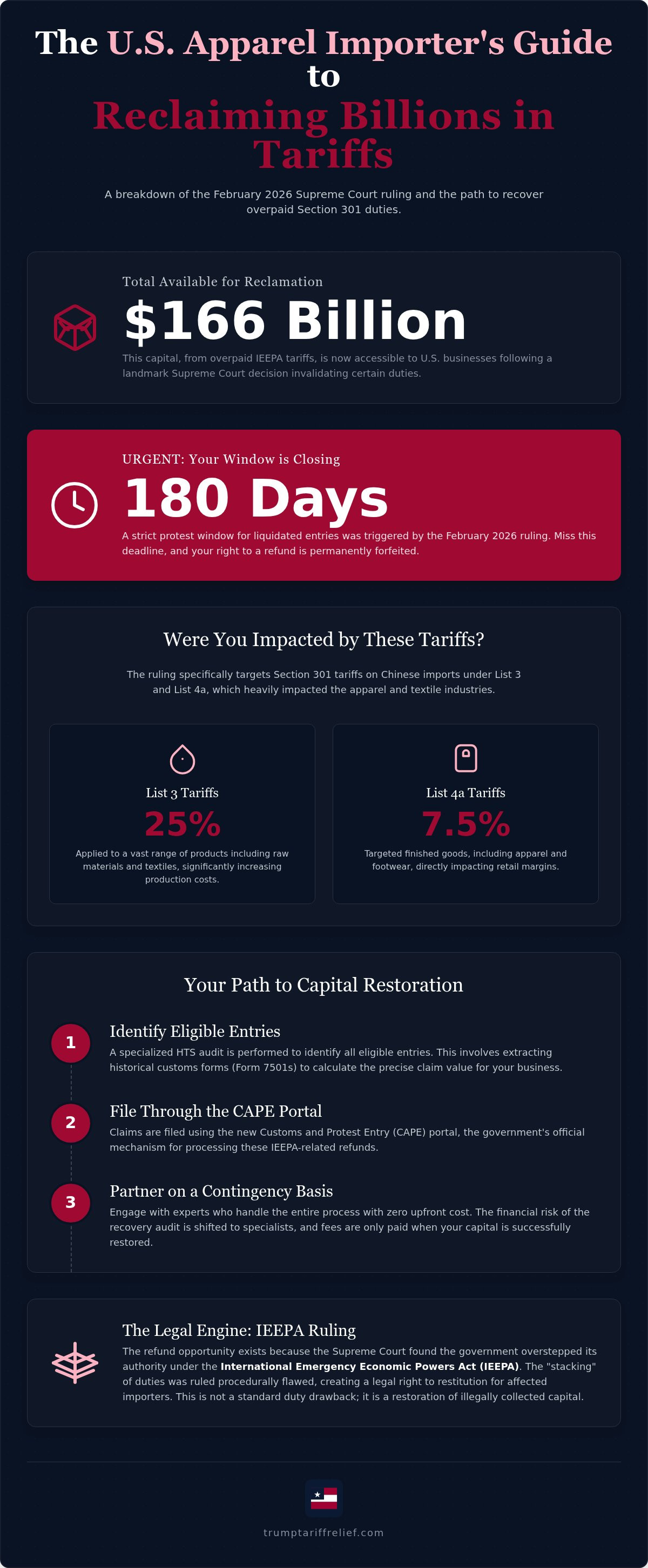
Nearly $166 billion in overpaid IEEPA tariffs is currently sitting in government accounts waiting to be reclaimed by businesses like yours. If your firm is seeking a tariff refund for apparel importers, this capital represents a critical opportunity to offset the 12.5% additional duties recently imposed on major production hubs like Vietnam and India. You've likely felt the weight of these escalating costs in a high-inflation 2026 economy. It's a heavy burden to watch your bottom line erode while navigating a bureaucracy that often feels designed to keep your money, but the February 2026 Supreme Court ruling has finally opened a clear path for recovery.
This guide reveals how you can secure millions in overpaid duties by leveraging specific IEEPA legal precedents with zero upfront financial risk. We'll show you how to navigate the complexities of the new CAPE portal and beat the strict 180-day protest window for liquidated entries. If you've paid Section 301 duties during the contested period, then you have a fleeting opportunity to restore that capital to your balance sheet. You'll learn the exact steps to identify eligible entries and partner with experts who handle the heavy lifting on a contingency basis; this ensures you only pay when your capital is successfully restored.
Key Takeaways
- Understand how the February 2026 Supreme Court ruling regarding IEEPA authority has unlocked approximately $166 billion in potential duty recoveries for U.S. businesses.
- Identify whether your HTS codes fall under List 3 or List 4a, the specific trade actions that impacted textiles and finished garments.
- Learn the exact documentation requirements to secure a tariff refund for apparel importers, including the extraction of Form 7501s for historical entries.
- Discover how a contingency-based strategy eliminates upfront costs, shifting the financial risk of the recovery audit entirely to specialized legal experts.
- Recognize the urgency of the 180-day protest window to ensure your liquidated entries remain eligible for full capital restoration.
The 2026 Landscape for Apparel Importers: Reclaiming Section 301 Duties
The current trade environment has reached a critical tipping point for the fashion industry. For years, garment and footwear distributors have absorbed the financial impact of Section 301 duties as an unavoidable cost of global sourcing. That paradigm shifted in February 2026. A landmark Supreme Court ruling confirmed that the government overstepped its statutory authority under the International Emergency Economic Powers Act (IEEPA) when implementing List 3 and List 4a tariffs. This isn't a standard duty drawback based on exports; it's a legal restoration of capital that was collected without proper authority.
Securing a tariff refund for apparel importers is now a matter of both regulatory justice and financial survival. The Court of International Trade has identified approximately $166 billion in duties that were ordered to be refunded. This capital represents "found money" that can immediately improve margins squeezed by the high inflation of the 2026 economy. While many firms focus on current forced labor investigations, they often overlook the massive backlog of recoverable payments from the 2025-2026 period. Understanding how IEEPA explained the boundaries of executive trade power is the first step in identifying your firm's eligibility for these significant refunds.
Billions in Unclaimed Duties in the Apparel Sector
The impact of the invalidated tariffs is concentrated heavily within the apparel and footwear sectors. List 3 imposed a 25% tariff on a vast array of textile products, while List 4a added a 7.5% burden on finished garments. For a mid-sized apparel importer, these percentages represent millions in lost liquidity. Many CFOs remain unaware that their entries are eligible for processing through the new CAPE portal. This system is the primary mechanism for reclaiming overpaid duties, yet it remains underutilized by brands that haven't conducted a specialized HTS audit to identify their specific claim value.
Why 2026 is the Critical Year for Action
Time is your greatest adversary in trade law. The 2026 recovery window is a finite period for importers to act before statutes of limitations permanently bar claims. The February 2026 ruling triggered a strict 180-day protest window for liquidated entries. If you miss this deadline, the government keeps your capital regardless of the court's decision. This convergence of closing IEEPA windows and new 2026 trade investigations creates a high-stakes environment. You must act now to ensure your firm is positioned to receive its full tariff refund for apparel importers before the opportunity expires.
The IEEPA Legal Mechanism: The Engine Behind Your Tariff Refund
The International Emergency Economic Powers Act (IEEPA) serves as the primary legal framework for executive trade actions during national emergencies. While Section 301 of the Trade Act of 1974 is the most recognized tool for addressing unfair trade practices, the USTR frequently utilized IEEPA to expand and maintain tariffs on Chinese imports. The current opportunity for a tariff refund for apparel importers exists because the government’s application of these powers was found to be procedurally flawed. Specifically, the "stacking" of duties on List 3 and List 4a items, covering everything from raw textiles to finished footwear, occurred without the required statutory justification. You can learn more about the IEEPA ruling and how these specific legal errors created a right to restitution.
Statutory Limits vs. Executive Authority
The cornerstone of your refund claim is the "time-limited" nature of the USTR’s authority. The law does not grant the executive branch a blank check to impose duties indefinitely. Instead, it requires a clear nexus between the original investigation and any subsequent tariff increases. When the USTR expanded the trade actions to include $200 billion in List 3 products, it bypassed critical administrative steps. Historical precedents show that when trade duties are challenged on statutory grounds, the courts often favor the restoration of capital to the private sector. There is a sharp distinction between the narrow Section 301(b) authority and the broader, more volatile emergency powers of IEEPA. If the government fails to respect these boundaries, the duties collected are legally considered overpayments.
The Role of the Supreme Court and Federal Circuit
The February 2026 Supreme Court ruling finalized years of litigation regarding the legitimacy of List 3 and List 4a. The Court determined that the USTR failed to provide a reasoned explanation for its actions, particularly regarding the impact on U.S. consumers and the apparel supply chain. This landmark decision paved the way for the current 2026 apparel refunds. Importers now face a complex "remand" process where they must demonstrate CBP compliance for every entry made during the contested period. Because these filings require an intimate understanding of the CAPE portal and precise HTS classification, specialized trade counsel is necessary to manage the documentation. If you want to see how these rulings apply to your specific HTS codes, you should start with a tariff eligibility assessment to identify your total recoverable duty value.
Evaluating Eligibility: List 3, List 4a, and Apparel HTS Codes
Identifying your firm's eligibility for a tariff refund for apparel importers begins with a precise classification of your historical entries. The USTR trade actions were divided into distinct "Lists," each targeting different stages of the apparel supply chain. List 3, which took effect in September 2018, primarily impacted textiles and raw materials with an additional 25% duty. List 4a followed in September 2019, striking finished garments and footwear with a 7.5% surcharge. If your company imported goods under these lists between February 2025 and February 2026, those entries are now subject to the Supreme Court's invalidation of IEEPA-based stacking. To verify your specific status, consult our Tariff Refund Assessment: A Guide to IEEPA Eligibility.
The highest probability for recovery lies within Chapters 61 (knitted apparel) and 62 (woven apparel) of the Harmonized Tariff Schedule. These chapters encompass the vast majority of consumer fashion imports. Because these goods already carry high Most-Favored Nation (MFN) duty rates, the addition of Section 301 tariffs created an unsustainable tax burden. A successful recovery audit identifies every entry number, HTS code, and duty payment record to build a bulletproof claim for the CAPE portal. Securing a tariff refund for apparel importers requires this granular level of detail to satisfy CBP auditors who are currently managing a massive backlog of 2026 claims.
High-Impact HTS Categories for Recovery
Footwear importers operating under Chapter 64 often see the most significant recovery amounts due to the high volume and value of these entries. If your firm utilizes "First Sale" valuation, your recovery strategy should be even more aggressive. While First Sale reduces the dutiable value, the 7.5% or 25% surcharges were still applied to that base. Mid-market apparel importers typically identify recovery opportunities ranging from 5% to 15% of their total annual duty spend. This capital restoration acts as a direct injection of liquidity into your 2026 operations, providing the necessary cash flow to offset rising production costs in alternative sourcing hubs.
Statutes of Limitations and Filing Deadlines
Urgency is the defining characteristic of the 2026 recovery landscape. You must distinguish between the "Protest Window" and the "IEEPA Statutory Window." The 180-day protest window for liquidated entries began immediately following the February 2026 ruling. If your entries liquidate and you fail to file a protest within this timeframe, your right to a refund is permanently extinguished. Waiting until the end of 2026 is a high-risk gamble that most fashion brands cannot afford. You should check the FAQ for deadline details to ensure your filing timeline is compliant with current CBP requirements and that your historical entries remain eligible for restoration.
Navigating the Refund Claim Process: A Step-by-Step Guide
Securing a tariff refund for apparel importers requires a methodical, four-phase approach that transforms years of overpaid duties into liquid capital. The complexity of the 2026 regulatory environment means that standard customs filings are no longer sufficient. You must execute a precise recovery strategy that begins with a comprehensive audit of every entry number since the inception of List 3 in September 2018. This multi-year audit identifies the specific HTS codes and duty amounts that were "stacked" under the now-invalidated IEEPA authority. Once these entries are isolated, the process moves into a rigorous documentation phase where Form 7501s and proof of payment are extracted to build a defensible recovery file.
The technical heart of the 2026 recovery is the CAPE portal filing. This system requires a sophisticated data upload that triggers immediate government validations. If your data contains even minor discrepancies, the system will flag the entry for a technical remand; this can delay your capital restoration by months. Active monitoring is essential during the final resolution phase to handle government "rejection codes" and navigate the administrative hurdles of the U.S. Customs and Border Protection (CBP) backlog. We manage this entire lifecycle to ensure your tariff refund for apparel importers is processed without delay.
Essential Documentation for Apparel Claims
The CBP Form 7501, or Entry Summary, is the single most critical document in your recovery file. It serves as the definitive record of the HTS classification, the value of the goods, and the specific Section 301 duties paid. Consistency is the primary challenge here. You must ensure that your HTS classifications remain uniform across multi-year claims to avoid triggering an unnecessary audit. For a complete list of the evidence required to support your claim, consult our Required Documents for IEEPA Tariff Refund Checklist. This preparation is the only way to satisfy the strict evidentiary standards of the 2026 remand process.
Avoiding the 15% Rejection Rate
The CAPE portal reports a 15% rejection rate for initial filings, largely due to preventable technical errors. Common pitfalls include mismatched duty amounts and incorrect entry numbers that don't align with CBP’s internal database. If your entries have already liquidated and fallen outside the standard 180-day protest window, you must utilize specific IEEPA statutory arguments to maintain eligibility. A rigorous, no-nonsense audit is required to identify these technical discrepancies before they reach the portal and result in a permanent claim rejection. If you are ready to move past the bureaucracy and reclaim your capital, you can start your recovery audit today with our specialized team.
Why a Contingency-Based Recovery Strategy is the Standard for 2026
In the high-inflation 2026 economy, fashion brands can't afford to gamble on legal fees for uncertain outcomes. A contingency-based strategy eliminates financial risk by ensuring you only pay when your capital is successfully restored. This "No Recovery, No Fee" model has become the industry standard because it perfectly aligns incentives. If we don't win your case, we don't get paid. This structure drives a far more aggressive and thorough audit than a traditional firm billing by the hour. By seeing how our recovery process works, you'll understand that we take on the heavy lifting of bureaucratic management while your team remains focused on sourcing and supply chain agility.
The complexity of the 2026 trade landscape requires an insider's touch. Letting trade experts manage the bureaucracy of the CAPE portal reduces your internal overhead and prevents your staff from being buried in historical documentation. We act as a high-performing partner, identifying every opportunity for a tariff refund for apparel importers that your standard customs broker might have missed. Our goal is the successful restoration of your overpaid duty capital with minimal disruption to your existing operations.
Contingency vs. Hourly Legal Billing in 2026
Comparing the total cost of ownership for a recovery project reveals a stark divide. Traditional legal billing requires upfront retainers and monthly invoices; these costs accumulate regardless of whether the CBP approves your claim. For apparel CFOs, this turns a "found money" initiative into a budgetary liability. The contingency model ensures transparency through percentage-based fees that guarantee full accountability. Our success is directly tied to the total value of the tariff refund for apparel importers we secure, meaning we're motivated to resolve every technical remand and rejection code with professional urgency.
Initiating Your Preliminary Assessment
Starting the recovery process doesn't require a restructuring of your current trade operations. A non-binding eligibility audit allows us to quantify your total exposure without disrupting the relationship you have with your current customs broker. We function as a specialized recovery engine, leveraging the February 2026 Supreme Court precedents to reclaim capital that was collected without statutory authority. This preliminary assessment is the first step toward reclaiming your overpaid capital today. The 2026 recovery window is finite; don't let the government keep your liquidity when a risk-free path to restoration is available.
Secure Your Capital Restoration Before the 2026 Deadlines Expire
The February 2026 Supreme Court ruling fundamentally changed the financial outlook for fashion brands. By identifying overpaid List 3 and List 4a duties, your firm can transform historical trade expenses into immediate liquidity. Successfully securing a tariff refund for apparel importers requires a deep understanding of IEEPA statutory limits and rigorous documentation. You have a finite window to act before statutes of limitations permanently bar your recovery.
You don't have to navigate this bureaucracy alone. Our expert trade counsel specializes in IEEPA litigation and handles the entire CAPE portal process for you. We operate on a strictly contingency-based model, which means you only pay if we win your refund. There are zero upfront costs, hourly billing, or consulting packages involved. Claim Your Risk-Free Tariff Recovery Assessment today to protect your margins. Righting these past trade imbalances is the first step toward a more resilient and profitable 2026.
Frequently Asked Questions
Is the Section 301 China tariff refund for apparel importers real?
Yes, it's a legitimate legal recovery based on the February 2026 Supreme Court ruling. This ruling invalidated the USTR's authority to "stack" duties under IEEPA for List 3 and List 4a entries. Approximately $166 billion has been ordered for refund by the Court of International Trade. This represents a significant capital restoration opportunity for businesses that imported textiles or finished garments during the contested periods.
How long does it take to receive a Section 301 refund in 2026?
Recovery timelines vary based on the current CAPE portal backlog and the complexity of your documentation. While some simple claims are validated within 90 days, larger multi-year audits can take six to twelve months for final resolution. The government is processing over 53 million customs entries; this has created administrative hurdles. We monitor your filing daily to address any technical remands or rejection codes immediately to accelerate your capital restoration.
Can I still file for a refund if my apparel entries have already liquidated?
You can still file, but you must act within the strict 180-day protest window following the entry's liquidation date. Liquidated entries are often more complex because they require specific IEEPA statutory arguments to remain eligible for a tariff refund for apparel importers. If you miss this finite window, your right to reclaim that capital is permanently extinguished. Our team specializes in identifying these high-risk entries to ensure they aren't overlooked.
What is the deadline for filing an IEEPA tariff refund claim?
Deadlines are entry-specific and tied to the 180-day protest window from the date of liquidation. Because the February 2026 Supreme Court ruling triggered a massive wave of filings, the government is strictly enforcing these timelines. There is no single "end date" for all claims; instead, each shipment has its own expiration. You should initiate a preliminary assessment immediately to map out your firm's specific filing schedule and prevent loss of rights.
Do I need to change my current customs broker to work with a recovery specialist?
No, you don't need to change your existing brokerage relationship. We function as a specialized recovery engine that operates independently of your daily trade operations. While your broker handles ongoing compliance and forced labor scrutiny, we focus exclusively on the multi-year audit and CAPE portal filings. This partnership ensures you receive expert trade counsel without disrupting your supply chain or your relationship with your current service providers.
What percentage of my overpaid apparel tariffs can I expect to recover?
Most apparel importers identify recovery opportunities ranging from 5% to 15% of their total Section 301 duty spend. This percentage depends on whether your goods fall under List 3 (25% duty) or List 4a (7.5% duty). A comprehensive audit of your HTS codes within Chapters 61, 62, and 64 is necessary to quantify your exact exposure. We provide a non-binding assessment to help you visualize the potential "found money" available for restoration.
What happens if the government denies my IEEPA claim through the CAPE portal?
If a claim is denied, it typically triggers a technical remand or a specific rejection code that requires immediate administrative action. Denials often stem from mismatched duty amounts or incorrect entry numbers within the documentation assembly. We handle all government correspondence and technical remands as part of our full-service management. Our contingency-based model ensures we're motivated to fight every denial until your overpaid capital is successfully restored to your balance sheet.
How much does it cost to start a tariff refund assessment for my business?
It costs nothing upfront to initiate a tariff refund for apparel importers through our specialized assessment. We operate on a strictly contingency-fee basis; this means you only pay a percentage of the capital we successfully recover for you. There are zero retainers, hourly billing, or hidden consulting packages. We take on the financial risk and the administrative heavy lifting, ensuring your firm has a low-friction path to reclaiming millions in overpaid duties.
Ready to find out what your business may be owed?
Check My Eligibility