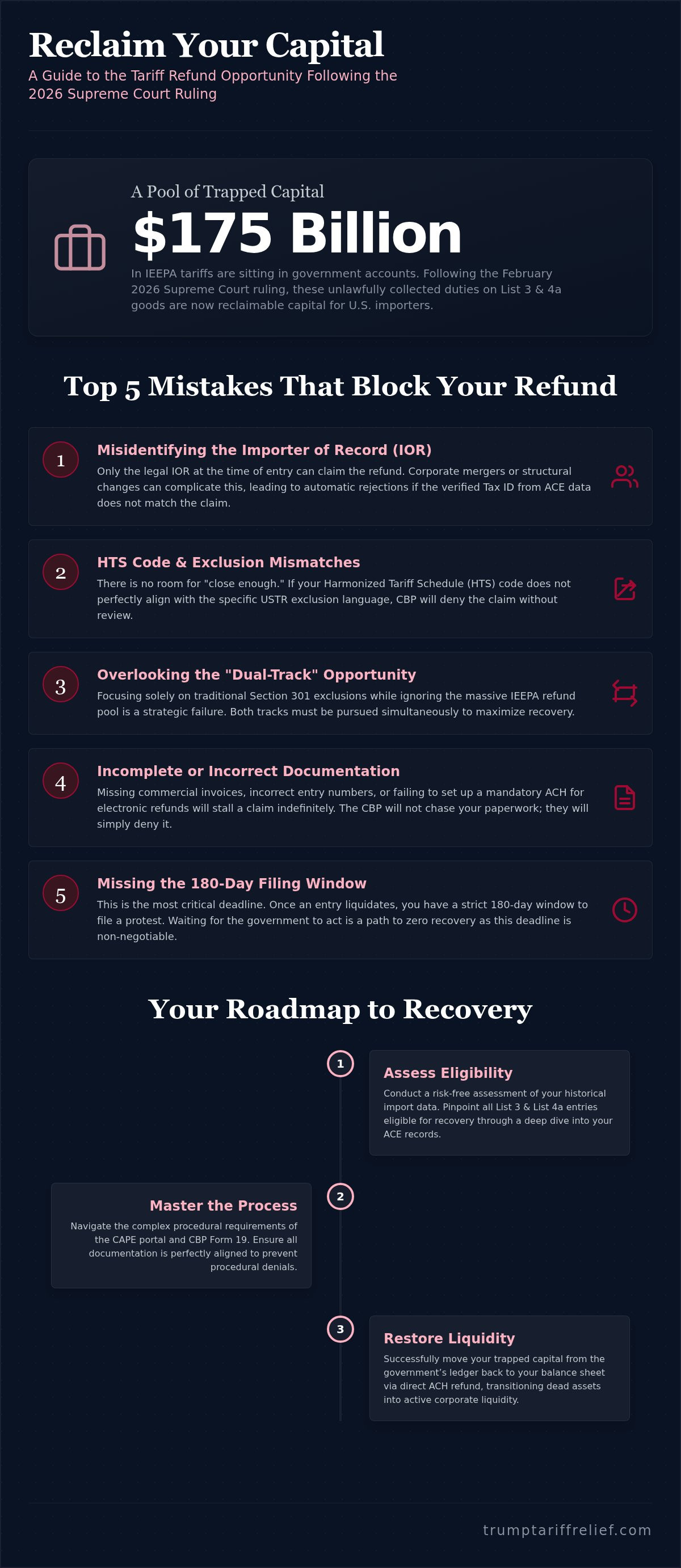
Nearly $175 billion in IEEPA tariffs are currently sitting in government accounts, yet thousands of U.S. importers are watching their refund eligibility expire due to common mistakes in tariff refund claims. You've already paid the price for volatile trade policies. Seeing your capital trapped in federal accounts during a high-interest period is a frustration no business should endure, especially after the Supreme Court ruled those specific payments unlawful in February 2026. If it feels like the bureaucracy is intentionally complex to prevent recovery, you're right to be skeptical.
This guide identifies the critical errors that trigger rejections and explains how to successfully reclaim overpaid duties on List 3 and List 4a goods. You will learn how to master the CAPE portal, meet the strict 180-day protest window, and avoid the "dual-track" errors that conflate IEEPA refunds with Section 301 duties. We are providing a clear roadmap to move your money from the government’s ledger back to your balance sheet through a professional, risk-free assessment of your recovery eligibility. Identifying these pitfalls now is the first step toward righting a financial wrong and restoring your company's liquidity.
Key Takeaways
- Differentiate between Section 301 exclusions and IEEPA unlawful duty claims to capture every available dollar of trapped capital.
- Pinpoint the common mistakes in tariff refund claims that cause federal agencies to deny valid recovery attempts, specifically regarding historical IOR data and HTS code alignment.
- Master the procedural requirements of CBP Form 19 and the CAPE portal to secure your place in the $175 billion refund pool before the 2026 deadlines expire.
- Transition from dead capital to corporate liquidity by shifting the burden of documentation and filing to an expert team operating on a results-only basis.
- Evaluate your eligibility for a risk-free assessment to determine if your List 3 and List 4a entries qualify for immediate recovery through the CAPE portal.
The 2026 Tariff Recovery Landscape: Why Most Importers Miss Out
The 2026 trade landscape is defined by a massive shift in how businesses treat U.S. customs duties. Following the February 20, 2026, Supreme Court ruling, the estimated $166 billion to $175 billion in IEEPA tariffs previously collected by the government has become reclaimable. IEEPA tariff refunds refer to the mandatory return of duties paid under the International Emergency Economic Powers Act which the court deemed were collected without proper legal authority. For many importers, this money is currently "dead capital" that sits in government accounts rather than funding operations. This trapped liquidity acts as an interest-free loan to the federal government while your own business faces high-interest borrowing costs.
Identifying these funds requires a deep dive into the Automated Commercial Environment (ACE), which serves as the definitive record for every import entry. ACE allows importers to track the liquidation status of their goods and determine which entries are eligible for immediate recovery. Failing to audit these records properly is one of the most common mistakes in tariff refund claims, as even a single missing entry number or an incorrect format can lead to a rejected filing. The government isn't going to notify you of your eligibility; the burden of identification lies entirely on the importer.
The Evolution of Refund Eligibility in 2026
The recovery process has moved far beyond simple Section 301 exclusions. While Section 301 remains active, the February 2026 ruling opened a much wider door for those who paid List 3 and List 4a duties under IEEPA authority. The government responded by launching the Consolidated Administration and Processing of Entries (CAPE) portal on April 20, 2026. This rollout is occurring in distinct phases, with Phase 1 strictly limited to unliquidated or recently liquidated entries. This has forced a psychological shift in the industry. Importers can't just be compliant anymore. They must be proactive recovery agents to protect their bottom line.
Why Waiting is the Most Expensive Mistake
Time is the primary enemy of tariff recovery. The strict 180-day protest window for liquidated entries means that every day of delay permanently forfeits your right to a refund. While new USTR investigations into forced labor practices are creating fresh tariff obligations as of July 24, 2026, they also open new administrative windows for savvy importers to challenge duty assessments. You must understand the IEEPA ruling for importers to ensure you don't miss these fleeting opportunities. Waiting for the government to issue an automatic refund is a path to zero recovery. The bureaucracy relies on your inaction to keep your capital.
Top 5 Common Mistakes in Tariff Refund Claims
Reclaiming millions in overpaid duties requires more than just submitting a request; it requires surgical precision. Many importers fail because they underestimate the complexity of the federal bureaucracy. These common mistakes in tariff refund claims often lead to immediate denials, leaving your capital permanently in government hands. Identifying these pitfalls before you file is the difference between a successful ACH recovery and a permanent financial loss.
- Mistake 1: Misidentifying the Importer of Record (IOR). Only the legal IOR at the time of entry can claim the refund. If your company has undergone mergers or structural changes, the right to recovery may be legally tied to a specific tax ID that must be verified through ACE data.
- Mistake 2: HTS Code and Exclusion Mismatches. If your Harmonized Tariff Schedule (HTS) code doesn't perfectly align with the USTR exclusion language, CBP will reject the claim. There is no room for "close enough" in tariff recovery.
- Mistake 3: Overlooking the Dual-Track Opportunity. Many businesses focus solely on Section 301 exclusions while ignoring the massive IEEPA refund pool created by the February 2026 ruling. Failing to pursue both tracks simultaneously is a strategic failure that leaves millions on the table.
- Mistake 4: Incomplete Documentation. Missing commercial invoices or failing to set up the mandatory ACH for electronic refunds will stall your claim. CBP won't hunt for your missing paperwork; they will simply deny the entry.
- Mistake 5: Missing the 180-Day Window. Once an entry liquidates, you have a strict 180-day window to file a formal protest. This is a non-negotiable deadline. You can find advice from a former U.S. Customs attorney regarding why missing this window is the most frequent cause of lost recovery.
The Importer of Record (IOR) Pitfall
The legal IOR is the only entity with the standing to file a claim. This becomes a major hurdle during corporate acquisitions. If you bought a company that overpaid tariffs in 2024, you must ensure the transfer of rights was documented correctly. We recommend verifying your IOR status through ACE data before filing any paperwork. To see how we manage these complex filings, you can review how it works.
HTS Code and Exclusion Mismatches
CBP agents compare your commercial invoice descriptions against specific USTR exclusion text. If your product is described as a "metal fastener" but the exclusion is for "steel hex-head bolts," the mismatch will trigger a denial. Meticulous correlation between your HTS codes and the exclusion language is mandatory for a successful recovery. You can check our FAQ for more details on matching specific documentation to exclusion lists.
The Dual-Track Error: Confusing Section 301 with IEEPA Rulings
Many importers stumble into one of the most critical common mistakes in tariff refund claims by treating Section 301 and IEEPA as the same legal animal. They aren't. Section 301 of the Trade Act of 1974 is a trade enforcement tool used by the USTR to combat unfair foreign practices, where recovery usually depends on specific, narrow product exclusions. In contrast, the International Emergency Economic Powers Act (IEEPA) was the administrative vehicle used to levy those same tariffs. The February 20, 2026, Supreme Court ruling didn't just grant a new exclusion; it struck down the government’s authority to collect these duties on List 3 and List 4a goods entirely.
Failing to distinguish between these two pathways often leads to "dead capital" remaining in federal accounts. If your Section 301 exclusion request was denied in the past, it does not mean your IEEPA refund claim will face the same fate. One is about the specific nature of your product; the other is about the fundamental legality of the tax itself. A sophisticated recovery strategy involves a dual-track filing that leverages both authorities to maximize the potential for successful duty recovery. By addressing both tracks, you ensure that even if a product-specific exclusion is unavailable, you still have a pathway to reclaim funds based on the unlawful nature of the original collection.
Section 301: The Exclusion Pathway
The Section 301 process is highly granular and requires identifying List 3 and List 4a goods that qualify for retroactive exclusions. For unliquidated entries, importers can file a Post-Summary Correction (PSC) to apply these exclusions and trigger a refund. This path is often blocked by technicalities or narrow product definitions that don't perfectly match your commercial invoices. If you're unsure about your specific product category or the status of your previous filings, consult our Frequently Asked Questions on Section 301 to clarify your eligibility requirements.
IEEPA: The "Unlawful" Duty Pathway
The IEEPA pathway is broader and currently offers a more powerful mechanism for capital restoration. Because the Supreme Court ruled the collection of these duties unlawful in February 2026, the refund opportunity applies to a vast range of goods regardless of whether a Section 301 exclusion exists. This ruling primarily impacts importers dealing with Chinese trade partners who were subject to the original List 3 and 4a actions. To ensure you aren't leaving millions on the table, you should review our IEEPA tariff refund recovery guide. This path bypasses the narrow "exclusion" logic and focuses on your right to reclaim overpaid capital directly through the CAPE portal.
Navigating the 180-Day Window and the CAPE Portal
The window for recovery is closing. One of the most devastating common mistakes in tariff refund claims is failing to respect the 180-day protest rule. Under 19 U.S.C. § 1514, importers have exactly 180 days from the date of liquidation to file a formal protest via CBP Form 19. If you miss this deadline, your right to reclaim that specific duty payment is legally extinguished. For entries that are still "unliquidated," you have more flexibility, but the status of these entries must be actively managed to prevent them from slipping into a permanent state of loss. This is not a process that handles itself.
Managing ongoing 2026 imports requires the use of "Protective Protests." This strategy involves filing a protest immediately upon liquidation to preserve your legal rights while the CAPE portal processes your claim. This is especially vital given the July 24, 2026, implementation of new Section 301 duties. You cannot rely on a customs broker to manage these windows automatically. Brokers typically focus on current compliance and entry filing rather than historical recovery or the litigation of past duties. The burden of vigilance sits squarely on your shoulders.
The 180-Day Countdown: When Does it Start?
Liquidation is the final calculation of duties by CBP. It's the most critical date for your CFO to track because it triggers the statute of limitations for any refund claim. You must monitor these dates through the ACE portal weekly. Waiting for a "final ruling" or a government announcement before taking action is a recipe for failure. Many importers assume the February 2026 Supreme Court ruling automatically protected their funds, but without a timely protest, those funds remain out of reach. Check our guide on Tariff Refund Statute of Limitations: Critical Deadlines to map out your specific timeline.
Success in the CAPE Portal
The Consolidated Administration and Processing of Entries (CAPE) portal, which went live on April 20, 2026, is the exclusive mechanism for IEEPA refunds. Phase 1 is strictly limited to unliquidated entries or those liquidated within 80 days of your filing date. Phase 2, intended for older entries, requires even more rigorous documentation. If CBP issues a CF 28 (Request for Information), you must respond with precise data that correlates your HTS codes to the commercial invoices. Incomplete or mismatched data is the fastest way to get a claim rejected in 2026. Technical precision is the only way to move capital from the government's ledger to yours.
Don't let bureaucracy drain your balance sheet while the clock runs out. Our team of trade experts can navigate these deadlines for you. Secure your recovery assessment today and stop the clock on expiring claims.
Eliminating Risk: The Contingency Advantage in Tariff Recovery
Traditional law firms often demand significant upfront retainers and high hourly rates to navigate trade law. This model places the entire financial risk on the importer. If the claim is denied due to technicalities, the business is out both the tariff money and the legal fees. A contingency-based recovery model flips this script. It eliminates the financial barrier to entry by aligning our interests directly with yours. We only receive a fee when you receive your refund check from the government. This is a partnership built on performance, not billable hours.
This results-only approach is designed to solve the most persistent common mistakes in tariff refund claims by ensuring every entry is audited with extreme scrutiny. Internal teams or general customs brokers often lack the specialized legal depth required to challenge CBP denials or manage complex IEEPA filings. By outsourcing the bureaucracy to trade experts, you gain an insider navigator who manages the heavy lifting of documentation and filing. This level of specialized management ensures that your claim is not just submitted, but successfully won.
Removing the Financial Barrier to Entry
Zero upfront costs allow mid-sized importers to pursue multi-million dollar recovery claims without impacting their current cash flow. While traditional firms might bill you for every phone call or research hour, our specialized team focuses solely on the outcome. We understand that in the 2026 landscape, speed is essential to beat the statute of limitations. Our experts are specifically positioned to handle the nuances of the February Supreme Court ruling, providing a level of advocacy that general corporate legal services simply cannot match. We take on the risk because we are confident in our ability to navigate the system.
Your Path to Capital Restoration
Starting your recovery doesn't require a months-long onboarding process. You can initiate a preliminary 2026 eligibility audit in under 10 minutes. We analyze your ACE data to identify every claimable entry across List 3 and List 4a goods. Once the audit is complete, our team handles the entire filing process through the CAPE portal, responding to any CBP requests for information on your behalf. The timeline from initial filing to receiving your government refund via ACH typically ranges from 60 to 90 days. You can see how our recovery process works to understand the specific steps we take to secure your capital and restore your corporate liquidity.
Secure Your Balance Sheet and Reclaim What is Yours
The 2026 trade landscape offers a rare opportunity to restore corporate liquidity by reclaiming overpaid duties. Success requires moving beyond simple compliance to active capital recovery. You've learned that precision in documentation and a clear understanding of the 180-day protest window are non-negotiable. Avoiding common mistakes in tariff refund claims, such as misidentifying the Importer of Record or failing to pursue the dual-track IEEPA and Section 301 pathways, is the only way to ensure your business doesn't forfeit millions to federal accounts.
We provide the specialized expertise needed to navigate these complex 2026 legal rulings without the burden of upfront costs. Our contingency-fee model means we only win when you do; this aligns our efforts directly with your financial restoration. Don't let the bureaucracy keep your capital while the clock runs out on your eligibility. Start your risk-free tariff recovery assessment today and take the first step toward righting this financial wrong. Your company's recovery is within reach, and we are prepared to lead the way.
Frequently Asked Questions
Is the Section 301 tariff refund real or a scam?
The opportunity is a legitimate legal reality following the February 20, 2026, Supreme Court ruling on IEEPA authority. While Section 301 duties remain active, the court invalidated the collection of specific duties on List 3 and List 4a goods. U.S. Customs has established the CAPE portal specifically to process these claims. It's an administrative process that requires meticulous documentation and legal standing to successfully reclaim overpaid capital from the government.
What is the 180-day deadline for filing a tariff protest?
Importers have exactly 180 days from the date of liquidation to file a formal protest using CBP Form 19. Liquidation is the final duty calculation by Customs; if you miss this window, your right to recovery is legally extinguished. Monitoring liquidation dates in the ACE portal is vital. One of the common mistakes in tariff refund claims is assuming this deadline is flexible, which leads to the permanent loss of claimable corporate liquidity.
Do I need to hire a lawyer for a Section 301 refund claim?
You aren't legally required to hire a lawyer, but navigating the federal bureaucracy and the CAPE portal requires specialized trade expertise. General corporate legal services often lack the specific experience needed for IEEPA and Section 301 litigation. Working with a specialized recovery team ensures your documentation is bulletproof and your protest filings are timely. This approach shifts the burden of documentation from your internal staff to experts who understand the system.
Can I still file if my customs broker says it is too late?
Yes, you should seek a secondary assessment immediately. Customs brokers focus on current compliance and entry filing; they may not be aware of the specific "Protective Protest" strategies or the multi-phase CAPE portal rollout. Even if an entry has liquidated, you may still be within the 180-day window or qualify under Phase 2 of the 2026 recovery landscape. Don't let a broker's caution prevent you from reclaiming your trapped capital.
What is the difference between a Section 301 exclusion and an IEEPA refund?
Section 301 exclusions are product-specific waivers granted by the USTR, whereas IEEPA refunds are based on the February 2026 Supreme Court ruling that deemed the collection of certain duties unlawful. You might qualify for an IEEPA refund even if your product was denied a Section 301 exclusion. Understanding this distinction is key to capturing every dollar of dead capital currently trapped in government accounts during this high-interest period.
How much does it cost to start a tariff refund claim?
Starting a claim with our team involves zero upfront costs or hourly retainers. We operate on a contingency-fee model, which means you only pay a fee if we successfully recover your overpaid duties. This removes the financial barrier to entry and aligns our interests with yours. Unlike traditional law firms that charge regardless of the outcome, we take on the risk while you benefit from a professional, risk-free eligibility assessment.
What happens if my tariff refund claim is denied by CBP?
If CBP denies your claim or issues a CF 28 Request for Information, you have legal avenues to appeal. Denials often stem from technical errors, such as HTS code mismatches or incorrect entry formats. Our specialized team handles these denials by auditing the rejected entries and providing the necessary documentation to correct the record. We manage the heavy lifting of the appeal process to ensure your capital restoration remains on track.
Can I claim refunds for tariffs paid by a company I recently acquired?
Yes, but the right to the refund must be legally transferred and documented during the acquisition. The claim must be filed under the Importer of Record's original tax ID. Misidentifying the IOR is one of the most frequent common mistakes in tariff refund claims during corporate acquisitions. We verify your IOR status through ACE data to ensure that structural changes in your company don't prevent you from reclaiming historical payments.
Ready to find out what your business may be owed?
Check My Eligibility