
The Supreme Court's February 2026 ruling didn't just strike down a law; it unlocked a $166 billion capital restoration for American industry. If you've been importing heavy equipment, you've likely watched your margins disappear under the weight of unconstitutional IEEPA duties. Securing a tariff refund for industrial machinery isn't just a standard tax filing; it's a mandatory restoration of capital that belongs on your balance sheet. We understand the frustration of battling the bureaucratic hurdles of the CBP CAPE portal while the strict three year statute of limitations ticks away.
You're entitled to more than just an acknowledgement of the error. You deserve your paid duties back with interest. This article provides a clear roadmap for U.S. manufacturers to navigate the phased federal refund portals launched in 2026. We'll examine the specific eligibility requirements for Phase 1 and Phase 2 entries, the technical documentation needed to satisfy Customs, and how an expert-led, contingency-based approach removes the financial risk from the recovery process. It's time to stop absorbing unlawful costs and start reclaiming your capital through a proven, results-oriented strategy.
Key Takeaways
- Understand how the landmark February 2026 Supreme Court ruling mandates the restoration of capital for businesses that paid unconstitutional IEEPA duties.
- Identify if your firm qualifies as the Importer of Record and learn to navigate the specific liquidation requirements for Phase 1 and Phase 2 federal portal submissions.
- Discover the strategic steps required to secure a tariff refund for industrial machinery while ensuring all customs documentation meets strict federal standards.
- Recognize the urgency of the rolling three year statute of limitations to prevent your business from missing critical deadlines for reclaiming paid duties plus interest.
- Learn the advantages of a contingency based recovery model that eliminates financial risk by providing expert filing services with no upfront costs.
What is the IEEPA Tariff Refund for Industrial Machinery?
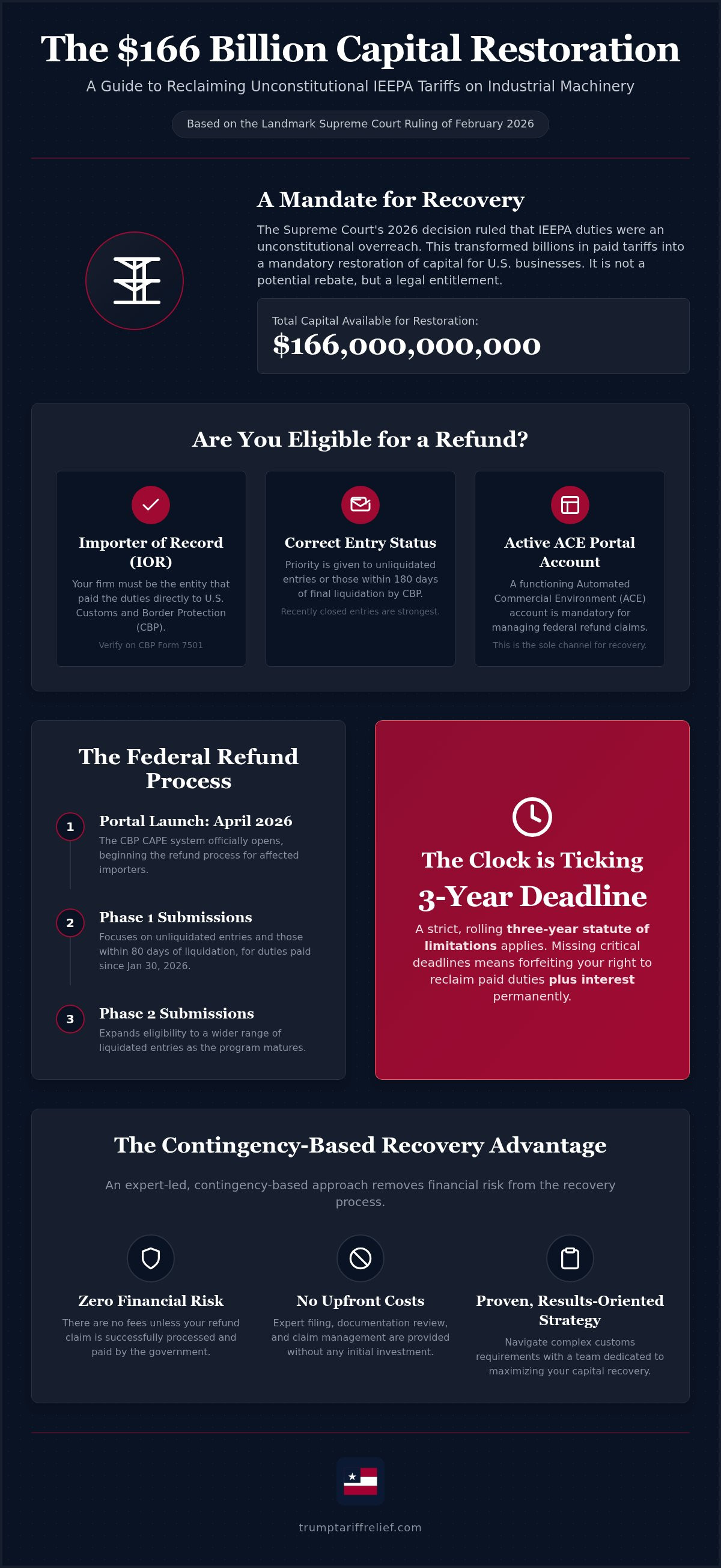
The Supreme Court didn't just suggest a change; it issued a mandate. On February 20, 2026, the Court ruled that the administration's use of the International Emergency Economic Powers Act (IEEPA) to levy massive trade duties was an unconstitutional overreach. This decision transformed billions of dollars in paid duties into a mandatory restoration of capital. For U.S. importers, a tariff refund for industrial machinery is no longer a theoretical possibility but a legal entitlement that requires immediate action.
These unauthorized payments were collected under the guise of national emergencies, but the judiciary has now corrected this executive overreach. Industrial machinery is a high priority sector for these claims because of the massive entry values and the technical sensitivity of Harmonized Tariff Schedule (HTS) codes. To understand the context of these charges, it helps to review What is a Tariff? and how it impacts global trade. The primary mechanism for reclaiming these funds is the Consolidated Administration and Processing of Entries (CAPE) system, which manages the complex flow of federal refunds through the ACE Portal.
The Legal Catalyst: Why 2026 is the Year for Recovery
The Court's decision was final. It dismantled the legal justification for billions in collected duties, creating an immediate path for U.S. businesses to claw back their capital. It's vital to distinguish these IEEPA-specific duties from Section 301 China tariffs, as the recovery pathways and legal foundations differ significantly. You can find more detail on this distinction in our guide to IEEPA explained. As of April 20, 2026, the federal refund portal has officially launched Phase 1, targeting unliquidated entries and those within 80 days of liquidation for payments made since January 30, 2026. The window is open, but it won't stay that way forever.
Impact on the Industrial Machinery Sector
For years, these tariffs acted as a hidden tax on growth. They inflated the cost of essential components, heavy equipment, and the very manufacturing tools that drive American productivity. Sub-sectors like construction equipment, agricultural machinery, and factory automation were hit hardest by these unauthorized costs. The IEEPA refund represents a critical opportunity for machinery firms to reclaim capital that was unlawfully diverted into trade duties. Reclaiming a tariff refund for industrial machinery allows firms to reinvest in R&D, upgrade facilities, or simply restore the margins that were squeezed by years of regulatory overreach. It's about righting a financial wrong and putting your capital back where it belongs: in your business.
Eligibility: Does Your Machinery Firm Qualify for a Refund?
Eligibility isn't a suggestion; it's a legal status determined by your documentation. To secure a tariff refund for industrial machinery, your business must be the Importer of Record (IOR). This is the entity that assumed legal responsibility for the goods and, crucially, the one that paid the duties directly to U.S. Customs and Border Protection (CBP). You can verify this status by reviewing your CBP Form 7501. This entry summary serves as the definitive record of what was paid and under which authority it was collected.
Current recovery efforts through the CAPE system prioritize unliquidated entries or those within 180 days of liquidation. Liquidation is the final "closing" of an entry by CBP. If your entries are still open or recently closed, you're in the strongest position for immediate recovery. You'll also need a functioning Automated Commercial Environment (ACE) Portal account. This system is the only channel for managing federal refund claims in 2026. For a deeper look at the broader context, consult the Official U.S. Government Tariff Information to see how these industrial duties were applied across the sector.
The Importer of Record (IOR) Requirement
The legal right to a refund follows the money. Only the entity that issued the payment to CBP holds the standing to reclaim it. This creates a "pass-through" dilemma for firms that purchased machinery from domestic distributors rather than importing it themselves. If you didn't import the equipment directly, you aren't the IOR. However, it's wise to review your historical vendor contracts. Some agreements include clauses regarding duty drawbacks or tax credits that might allow you to negotiate recovery from the actual importer. If you're unsure of your standing, a quick preliminary assessment can clarify your path forward.
Auditing Your Machinery HTS Codes
Success depends on precision. Industrial machinery often involves thousands of components, each with a unique Harmonized Tariff Schedule (HTS) code. You must identify which specific parts were hit by IEEPA duties rather than Section 301 or other trade measures. This requires a deep dive into your historical entry data. Coordinate with your customs brokers to pull ITRAC reports or ACE data exports to capture every eligible dollar. This audit ensures you don't leave money on the table by overlooking eligible sub-assemblies. You can learn more about this technical process in our guide on Tariff Refund Assessment: A Guide to IEEPA Eligibility and Recovery.
The Strategic Process: Filing Your Machinery Tariff Claim
Reclaiming a tariff refund for industrial machinery requires more than just filling out a digital form; it demands a tactical approach to trade litigation. We employ a 5-step strategic framework specifically designed to navigate the high-stakes complexities of the 2026 refund cycle. At the heart of this strategy is the "Tariff Recovery Audit," a deep-dive review of your historical import data that goes far beyond surface-level accounting. Because industrial machinery entries often represent significant capital outlays, even a minor discrepancy in HTS classification or valuation reconciliation can result in thousands of dollars left behind.
Step 1: The Customs Documentation Audit
Precision starts with your paperwork. You must gather every essential document, including commercial invoices, packing lists, and entry summaries (CBP Form 7501). It's not enough to simply have these on file; you must match your internal financial records to actual CBP data for absolute verification. This ensures that the amounts claimed align perfectly with the duties recorded by the government. For a complete list of what you'll need, consult our Required Documents for IEEPA Tariff Refund: The 2026 Importer’s Checklist. Without this foundation, your claim is vulnerable to administrative rejection before it's even reviewed.
Step 2: Navigating the CAPE Portal
The CAPE system isn't just a portal; it's a rigorous filter. Filing in 2026 requires strict adherence to technical requirements, including precise data field mapping and specific digital documentation standards within the ACE environment. Common pitfalls, such as failing to account for reconciliation flags or misapplying the February 2026 Supreme Court ruling, often lead to administrative delays or summary denials. This is why reviewing U.S. Customs and Border Protection Trade Remedies is essential for staying current on active regulations. For industrial machinery importers, the complexity of multi-component systems makes professional representation a necessity. Expert trade consultants act as the "active engine," managing the heavy lifting of documentation while ensuring your claim is defensible. This level of oversight mitigates the risk of government rejection and accelerates the restoration of your capital.
Steps 3-5: Valuation, Submission, and Tracking
Once the audit is complete, the third step involves a rigorous valuation reconciliation to ensure every cent of paid duty, plus potential interest, is accounted for. Step four is the formal electronic submission through the CAPE portal, where precision in HTS categorization is paramount. Finally, the fifth step focuses on diligent post-submission tracking. We monitor the status of your claim through the ACE Portal, responding to any CBP requests for information (RFIs) with professional speed. This end-to-end management ensures your tariff refund for industrial machinery moves from a pending claim to a realized capital recovery.
Statutes of Limitations: Why the Window is Closing in 2026
The law is clear: you have exactly three years from the date of payment to reclaim unauthorized duties. For many firms, the clock is already ticking toward zero. Securing a tariff refund for industrial machinery isn't a task that can be deferred while waiting for additional government guidance. The 3-year statute of limitations for IEEPA claims is a hard stop. Once that window closes, your capital is legally forfeited to the federal treasury, regardless of the Supreme Court's ruling on unconstitutionality. There's no retroactive grace period for those who miss the filing deadline.
This deadline operates on a "rolling" basis. Each individual entry has its own expiration date based on when the duty was paid or when the entry was liquidated. If you imported heavy components in early 2023, those claims are nearing their final expiration right now. For entries currently nearing the 180-day liquidation mark, we utilize a "Protective Protest" strategy. This legal maneuver preserves your right to a refund even if the CAPE portal's administrative processing faces delays. It's a vital safeguard for high-value machinery imports where the financial stakes are too high to leave to chance.
Managing the 2026 Filing Deadlines
To protect your firm's interests, you must act with precision. Start by identifying your earliest IEEPA payments and cross-referencing them against the three-year mark. You should also verify the liquidation status of every open entry in the ACE portal. Waiting for CBP to issue "final" instructions is a dangerous gamble; history shows that administrative clarity often arrives only after the statute of limitations has barred the earliest, most valuable claims. You can find a detailed breakdown of these windows in our guide on the Tariff Refund Statute of Limitations: The Critical Deadlines for IEEPA Claims.
Why Early Filers Win
The Consolidated Administration and Processing of Entries (CAPE) system is not an infinite resource. It prioritizes earlier submissions, meaning those who file first move to the front of the queue for capital restoration. As the 2026 deadlines approach, the volume of filings will likely create a bottleneck in government processing. The 3-year statute of limitations is a firm legal barrier that requires industrial machinery importers to act immediately to secure their capital. Don't let bureaucratic inertia cost your business millions in recoverable funds. Taking action now ensures your claim is processed while federal systems are at peak efficiency.
If your firm is ready to stop the clock and start the recovery process, you need an advocate who understands the urgency of trade litigation. Contact us today for an immediate eligibility assessment and ensure your claim is filed before the window slams shut.
Maximizing Recovery: The Contingency Fee Advantage
Securing a tariff refund for industrial machinery shouldn't create a new financial burden for your firm. Traditional trade consultants and legal firms typically operate on hourly billing or require heavy upfront retainers just to begin an assessment. We've dismantled this barrier by utilizing a "No Recovery, No Fee" model. This success-based structure ensures that our goals are perfectly aligned with yours; we only win when you successfully reclaim your capital. By removing the threat of mounting legal fees, we allow U.S. manufacturers to aggressively pursue the restoration of funds that were unlawfully diverted into trade duties.
Trump Tariff Relief manages the entire recovery engine from the initial audit to the final CAPE portal filing. We don't just provide advice; we perform the heavy lifting. This includes the technical reconciliation of HTS codes, the management of complex customs documentation, and the strategic navigation of the federal refund portals. Our focus remains entirely on results, ensuring that every eligible dollar from your machinery imports is identified and reclaimed before the 2026 deadlines expire.
Removing Financial Barriers to IEEPA Claims
Contingency alignment is a strategic safeguard for your firm’s operational budget. In a sector where margins are often squeezed by global supply chain volatility, the ability to explore recovery without financial risk is a significant competitive advantage. This model allows for the pursuit of complex or "uncertain" claims, such as those involving historical entries or technical reconciliation flags, that a firm might otherwise abandon to avoid upfront costs. We take on the risk because we're confident in our ability to navigate the system. You can learn more about our streamlined process by visiting How It Works. If there's no refund, there's no invoice, making the decision to audit your entries a zero-risk proposition for your business.
Specialized Trade Advocacy vs. General Accounting
Standard tax audits often miss the nuances of trade litigation. A specialized trade recovery audit requires a deep understanding of the U.S. Court of International Trade and the technicalities of the February 2026 Supreme Court ruling. General accountants typically lack the "insider" expertise needed to challenge HTS misclassifications or manage the specific data requirements of the CBP CAPE system. We provide a higher level of advocacy, acting as a specialized partner that understands the high-stakes nature of industrial machinery imports. Our expertise ensures that your claim isn't just filed, but defended with the technical precision required to survive federal scrutiny. It's time to stop absorbing the costs of unconstitutional trade policy and start the process of financial restoration.
Start Your Zero-Risk Tariff Recovery Assessment Today and secure the tariff refund for industrial machinery your business is legally owed.
Restore Your Margins Through Strategic Recovery
The February 2026 Supreme Court ruling transformed years of unlawful trade duties into a significant liquidity opportunity for the American industrial sector. You've seen how the strict three year statute of limitations makes immediate action a necessity, not a choice. Successfully securing a tariff refund for industrial machinery requires a specialized trade litigation approach that navigates the technical hurdles of the CAPE portal and the complexities of HTS reconciliation. It's time to reclaim what's yours.
As a high performing partner, we take on the heavy lifting of documentation and federal submissions on a contingency basis, ensuring your recovery effort carries zero financial risk. We're specialized experts in IEEPA and Section 301 litigation, providing the comprehensive management needed to move your claim through the federal system with precision. Don't let your hard earned capital remain in the government's hands when it belongs on your balance sheet.
Start Your Zero-Risk Tariff Recovery Assessment today. Our team is ready to act as the engine for your recovery, ensuring every eligible dollar is returned to your business.
Frequently Asked Questions
Is the IEEPA tariff refund real for industrial machinery companies?
Yes, this is a legally mandated restoration of capital following the February 20, 2026, Supreme Court ruling that found certain IEEPA duties unconstitutional. The government is required to refund over $166 billion in wrongfully collected tariffs to American businesses. Industrial machinery is a primary sector for these claims due to the high entry values and technical HTS codes that were specifically targeted by these unauthorized trade measures.
How much does it cost to file a machinery tariff refund claim?
Working with our firm involves zero upfront costs or hourly fees. We operate exclusively on a contingency fee basis, meaning we only receive payment if we successfully recover your capital. This model removes all financial risk for your business. We handle the entire assessment, documentation management, and federal portal submission process, ensuring our interests are fully aligned with your successful recovery of paid duties plus interest.
What is the deadline for filing an IEEPA tariff refund in 2026?
Deadlines are governed by a strict three year statute of limitations that begins on the date of duty payment. This creates a rolling deadline where each individual entry summary has its own expiration date. If your firm paid duties in early 2023, your window to secure a tariff refund for industrial machinery is closing right now. You must act before these individual entry windows expire to avoid permanent forfeiture.
Can I claim a refund if I purchased machinery through a domestic distributor?
Typically, the legal right to a refund belongs to the Importer of Record (IOR) who paid the duties directly to U.S. Customs and Border Protection. If a distributor imported the equipment, they are the party entitled to the claim. However, it's worth reviewing your historical purchase contracts. Some agreements include clauses regarding duty drawbacks or tax credits that might allow you to negotiate a recovery through the original importer.
How long does it take for CBP to process a machinery tariff refund?
Processing times depend on the liquidation status of your entries and the current phase of the CAPE portal. Phase 1 launched on April 20, 2026, for unliquidated entries, while Phase 2 began on June 29, 2026, for entries requiring reconciliation. While CBP strives for efficiency, the sheer volume of industrial claims can cause administrative delays. We provide active engine management to track your submission and respond to any government inquiries immediately.
What HTS codes for industrial machinery are eligible for IEEPA refunds?
Eligibility is determined by whether the specific Harmonized Tariff Schedule (HTS) code was subject to duties under IEEPA authority. This often includes heavy construction equipment, agricultural machinery, and factory automation tools. Identifying every eligible sub-component requires a specialized Tariff Eligibility Assessment. We analyze your historical entry data to ensure that every qualifying part is included in your tariff refund for industrial machinery claim to maximize your total recovery.
What is the difference between Section 301 and IEEPA tariff recovery?
Section 301 tariffs are specific to China and involve a separate legal framework. IEEPA duties were broader and were ruled unconstitutional by the Supreme Court on February 20, 2026. While both represent significant costs, the IEEPA recovery path is now clearly defined through the federal CAPE system. Our expertise covers both areas, allowing us to distinguish between these duty types and apply the correct legal strategy for each specific entry.
Can I file a claim if our machinery entries have already liquidated?
Yes, you can still file, but the technical requirements are more rigorous. While Phase 1 focuses on unliquidated entries, Phase 2 addresses entries that have already liquidated or were flagged for reconciliation. The critical factor is the three year statute of limitations. As long as you are within that three year window from the payment date, our team can manage the complex customs documentation needed to reopen and successfully claim these liquidated entries.
Ready to find out what your business may be owed?
Check My Eligibility