
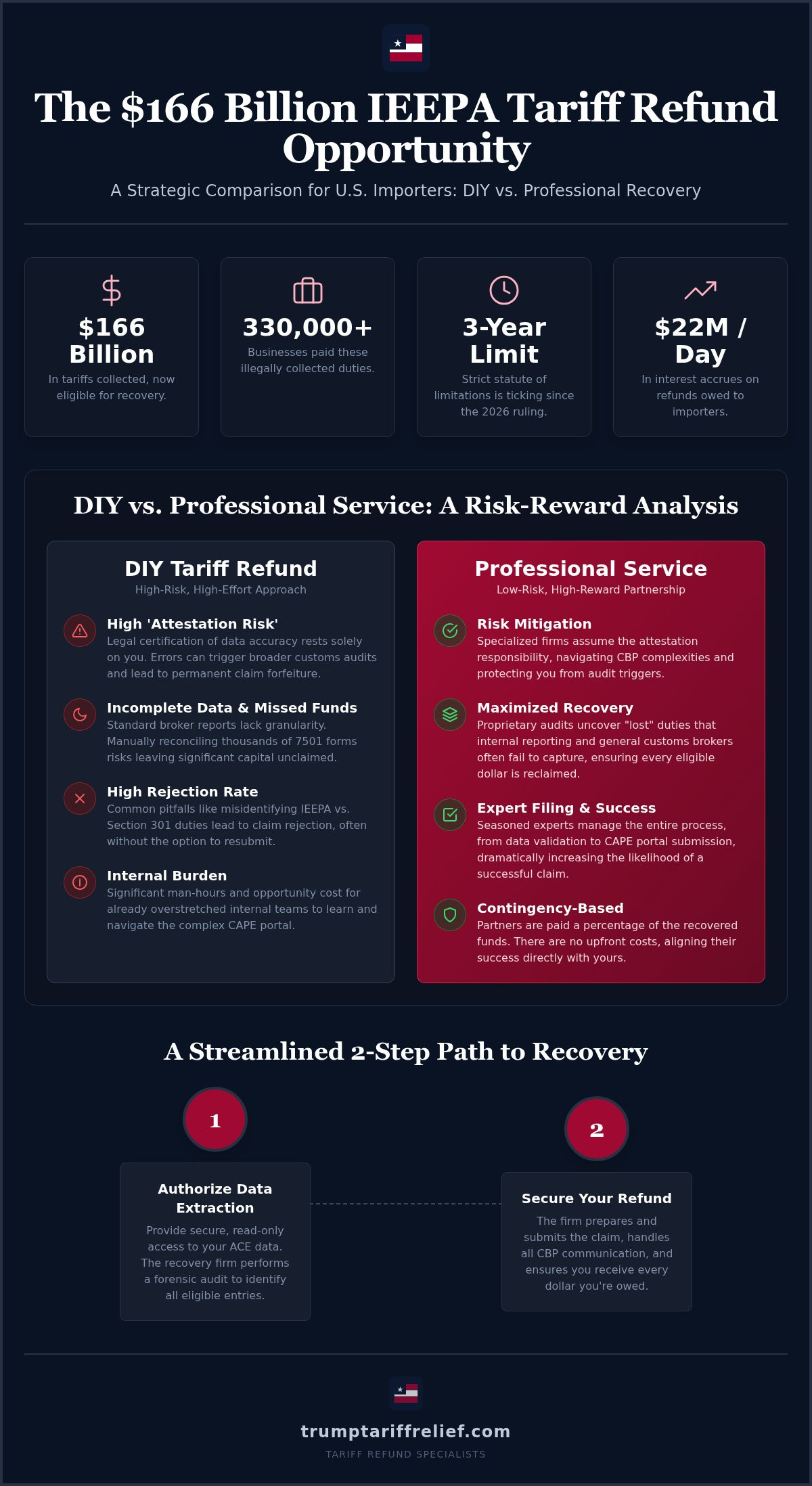
The U.S. government collected an estimated $166 billion in IEEPA tariffs from over 330,000 businesses, and following the 2026 Supreme Court ruling, that capital is finally eligible for recovery. As the clock ticks on the strict three-year statute of limitations, many importers are caught in a high-stakes debate over a DIY tariff refund vs professional service. You've likely already lost significant capital to these China duties, and the thought of leaving more money on the table because of a technicality in the CAPE portal is simply unacceptable.
We understand that your internal teams are already overstretched and the prospect of auditing years of ACE data feels like a liability. It's frustrating to see your hard-earned revenue tied up in bureaucratic red tape while interest on owed refunds accrues at a rate of $22 million per day. This guide compares the risks, costs, and actual recovery rates of filing your own IEEPA claims versus partnering with a specialized recovery firm. We'll examine the specific attestation requirements of the CAPE portal, the reality of data accuracy, and the strategic path to ensuring your business reclaims every dollar it's legally owed.
Key Takeaways
- Leverage the 2026 Supreme Court ruling to transform your past China tariff payments into liquid capital before the three-year statute of limitations expires.
- Weigh the technical risks of a DIY tariff refund vs professional service, specifically regarding the complexities of ACE data validation and CAPE portal attestation.
- Identify how a specialized recovery audit uncovers "lost" duties that standard internal reporting and general customs brokers often fail to capture.
- Learn why a contingency-based partnership offers a low-risk, high-reward alternative to the administrative burden and high rejection rates of self-filing.
- Follow a streamlined two-step roadmap to authorize data extraction and secure your portion of the $166 billion in available federal refunds.
The 2026 IEEPA Refund Landscape: A Sunk Cost Becomes an Asset
The Supreme Court's February 20, 2026, decision in Learning Resources, Inc. v. Trump stripped away the legal justification for billions in trade duties. For years, these payments were viewed as an unavoidable burden, but the court ruled that the executive branch lacked the authority to use the International Emergency Economic Powers Act (IEEPA) for broad tariff imposition. This decision effectively reclassified years of trade expenses as recoverable capital for your business. It's no longer just a compliance cost; it's an asset that belongs on your balance sheet. The IEEPA refund is a court-mandated return of illegally collected duties from 2018-2026.
What is IEEPA and Why Does it Matter Now?
IEEPA was designed to give the President power to manage economic transactions during national emergencies. In this context, it was used to implement Trump-era tariffs that bypassed the traditional constraints of Section 301 authority. The court's ruling established that IEEPA isn't a blank check for trade policy, characterizing these specific duties as an unauthorized tax. Understanding the IEEPA ruling is the first step in assessing your firm's eligibility. Many importers are currently debating a DIY tariff refund vs professional service, but the legal complexity of isolating IEEPA-specific duties from standard Section 301 duties makes this a high-stakes decision. If your team miscategorizes an entry, you risk a summary rejection from CBP.
The Billions at Stake for US Importers
Government data shows that approximately $166 billion was collected from over 330,000 businesses in 2025 alone. This isn't just a regulatory change; it's a massive capital recovery opportunity. Because the CAPE portal launched Phase 1 on April 20, 2026, the clock is already running. This is a unique, one-time chance to reclaim "lost" capital that was previously written off. How the recovery process works involves rigorous data validation to ensure every eligible dollar is captured. Every day you delay, you lose out on a portion of the $650 million in interest that accrues monthly on these owed refunds. Choosing a DIY tariff refund vs professional service requires a realistic look at whether your staff can accurately navigate the 25.1 million entries already accepted for processing by CBP as of July 2026.
DIY Tariff Recovery: Navigating the CAPE Portal Challenges
The launch of the Consolidated Administration and Processing of Entries (CAPE) portal on April 20, 2026, provided a path for recovery, but the interface is far from intuitive. While the government has simplified some aspects of the filing process, the technical burden remains firmly on the importer. Successfully reclaiming funds requires precise ACE data extraction and the isolation of specific HTS codes that fell under the IEEPA mandate. This isn't a simple case of checking a box; it's a forensic audit of your trade history. Before you begin, review our Required Documents for IEEPA Tariff Refund to see if your records are actually ready for scrutiny.
When choosing between a DIY tariff refund vs professional service, you must consider the 'Attestation Risk.' Every filing through the CAPE portal requires a legal certification that the data provided is accurate and that the goods meet specific eligibility criteria. Errors in these attestations don't just result in rejections; they can trigger broader Customs audits. Since IEEPA refunds are distinct from Official Section 301 Tariff Actions, misidentifying which duty was paid under which authority is a common pitfall that leads to permanent claim forfeiture.
The ACE Data Validation Hurdle
Standard export reports from your broker often lack the granularity needed for IEEPA recovery. You must reconcile thousands of 7501 forms against commercial invoices spanning from early 2025 through February 2024. This reconciliation is essential because CBP requires proof that the duties were actually paid and not just liquidated. If your internal team misses even a small percentage of eligible entries, you're leaving significant capital on the table. Incomplete filings are often rejected without the option to resubmit, making the initial data validation the most critical phase of the process.
Internal Labor Costs and Opportunity Cost
The man-hours required for a comprehensive internal audit are staggering. Diverting your logistics or finance team to sift through years of customs data disrupts current supply chain operations. There is also a steep hidden cost in 'learning on the fly' with government portals that are updated frequently. Most businesses find that their internal resources are better spent on growth rather than navigating a one-time regulatory maze. If you want to avoid the administrative drain, you can see how our assessment handles the heavy lifting for you.
DIY vs. Professional Service: A Strategic Risk-Reward Analysis
Choosing between a DIY tariff refund vs professional service is a decision that directly impacts your company's bottom line. While the CAPE portal provides the interface, it doesn't provide the strategy. Data from the 2026 recovery cycle suggests that unrepresented DIY claims face significantly higher rejection rates compared to those managed by specialists. This discrepancy exists because professional recovery firms utilize proprietary auditing tools to validate every entry against the 2026 Supreme Court ruling parameters. For a detailed look at the broader landscape, consult our Tariff Recovery for Importers: Strategic Guide.
The "Deep Audit" advantage is the primary driver of higher recovery totals. Internal teams typically look for obvious IEEPA duty codes, but a specialized audit identifies nuanced overlaps where duties were misclassified at the time of entry. These "lost" duties are often buried in complex shipping manifests that standard software misses. Furthermore, professional firms maintain established conduits to Court of International Trade (CIT) litigation. If CBP denies a valid claim, a specialized partner has the legal infrastructure to escalate the matter, whereas a DIY attempt usually ends at the first rejection letter.
Why Your Customs Broker is Not a Recovery Specialist
It's a common misconception that your current customs broker should handle this recovery. Brokers are experts in routine entry clearance and maintaining daily compliance; their business model is built on speed and transactional accuracy. Retroactive litigation and IEEPA recovery require a different skill set entirely. Many brokers are also hesitant to aggressively challenge government tariff authority because they prioritize their ongoing relationship with CBP. A specialized trade consultancy acts as a bold advocate for your capital, focusing exclusively on the "righting a wrong" aspect of your financial restoration without the conflict of daily brokerage operations.
The 3-Year Deadline: A Zero-Margin-for-Error Environment
The statute of limitations for these claims is absolute. Under the 2026 regulatory framework, the three-year window for IEEPA recovery is a hard deadline with no extensions for administrative errors. If your team makes a technical mistake in a DIY filing, that error can "time-bar" your business from future recovery of those specific duties. You don't get a second chance to fix an attestation once the clock runs out. Review our breakdown of the Tariff Refund Statute of Limitations: Critical Deadlines to understand exactly how much time remains for your specific entries. In this high-stakes environment, the risk of permanent capital loss far outweighs the perceived savings of an in-house attempt.
How to Evaluate a Professional Tariff Recovery Partner
Selecting the right ally for your capital recovery requires a shift in perspective. You aren't looking for a standard logistics provider; you're looking for a specialized trade advocate. When weighing a DIY tariff refund vs professional service, the primary differentiator is specific IEEPA and Section 301 litigation experience. General customs brokers are essential for daily operations, but they often lack the proprietary auditing tools necessary to cross-reference years of ACE data against the exact parameters of the 2026 Supreme Court ruling. A qualified partner must demonstrate a deep proficiency in ACE portal data extraction to ensure no eligible entry is overlooked. For a checklist on vetting potential firms, check our FAQ for provider vetting to see the standard you should expect.
The Contingency Fee Model: Aligning Incentives
The most transparent way to evaluate a partner is through their fee structure. A success-only contingency model is the ultimate proof of consultant confidence. It transforms the recovery process from an administrative expense into a zero-risk capital project. Unlike traditional legal retainers that bill by the hour regardless of the outcome, a contingency-based firm only wins when you win. This removes the financial barrier to entry for mid-sized firms that have lost significant capital but don't want to gamble on high upfront legal costs. It's a results-oriented approach that ensures your partner is as motivated as you are to maximize the final check from the government.
The Audit-to-Check Roadmap
A full-service recovery roadmap should be comprehensive, moving seamlessly from the initial assessment to the final CIT summons if necessary. Your partner should act as the primary engine, managing the heavy lifting of data authorization and the technical nuances of CAPE portal attestations. One of the most critical roles of a specialist is managing government Requests for Information (RFIs). When CBP questions the eligibility of an entry, an expert advocate provides the technical and legal documentation to defend the claim, preventing the rejections that often plague DIY attempts. The "Professional Advantage" is the strategic combination of high-level legal expertise and advanced data automation to maximize recovery totals. You can authorize your specialized recovery assessment today to ensure your claim is handled with this level of precision.
Reclaiming Your Capital: Next Steps with Trump Tariff Relief
The transition from recognizing an illegal tax to receiving a treasury deposit requires a methodical, aggressive approach. When comparing a DIY tariff refund vs professional service, the primary difference lies in the execution of the "heavy lifting." Trump Tariff Relief has streamlined this complex regulatory path into a high-performance engine designed for speed. Your capital is currently accruing interest for the government at a rate of $22 million per day. Our goal is to move that revenue back to your balance sheet before the window of opportunity closes.
Our recovery process follows five distinct, result-oriented phases:
- Step 1: The 15-minute preliminary eligibility assessment. A brief consultation to identify your potential recovery volume based on your specific import history and HTS code usage.
- Step 2: Secure ACE data authorization. We handle the technical data extraction from the Customs portal, removing the administrative burden from your internal logistics team.
- Step 3: Comprehensive multi-year duty audit and claim preparation. Our specialists conduct a forensic review of every entry to isolate IEEPA-specific duties and resolve any data discrepancies.
- Step 4: Formal filing and rigorous status monitoring. We submit the certified claims through the CAPE portal and manage all government status updates and technical inquiries.
- Step 5: Final recovery and capital restoration. Approved duties and accrued interest are returned to your company, restoring liquidity and "righting the wrong" on your balance sheet.
The Zero-Upfront-Cost Guarantee
This partnership is built on a success-only foundation. There is no downside to a professional eligibility audit because we only receive a fee if we successfully recover your capital. We take on the operational risk, the technical labor, and the legal burden, positioning ourselves as a high-performing partner rather than a traditional service provider. This model removes financial barriers, allowing mid-sized firms to pursue massive claims without gambling on upfront costs or hourly billing. If you're ready to secure your funds, you can schedule your free tariff refund assessment today.
Act Before the 2026 Deadlines Expire
The three-year statute of limitations is an absolute barrier that leaves no room for hesitation. Every day spent in "wait and see" mode is a day where your capital remains at risk of being permanently forfeited to the government. The CAPE portal phases are moving quickly, and the 2026 filing window is the only opportunity to reclaim what was lost during the IEEPA era. Choosing the path of a DIY tariff refund vs professional service is a strategic choice between administrative frustration and expert execution. Start your recovery here to ensure your business doesn't miss the final cutoff for these significant refunds.
Secure Your Capital Recovery Before the Window Closes
The 2026 Supreme Court ruling has opened a massive but fleeting window for importers to reclaim billions in unauthorized China duties. While the CAPE portal provides the interface, the choice between a DIY tariff refund vs professional service often determines whether your capital is recovered or permanently forfeited due to a technicality. The administrative burden of ACE data extraction and the legal risks of misattestation represent significant hurdles for even the most capable internal teams.
Partnering with a specialized recovery firm provides your business with deep IEEPA and Section 301 expertise and full-service ACE data management. Because our model is contingency-based, there is no recovery and no fee. This ensures that the heavy lifting is handled by experts while you maintain zero financial risk. It's time to stop letting your capital accrue interest for the government and start the process of financial restoration.
Claim Your Risk-Free Tariff Refund Assessment Today to lock in your eligibility before the three-year statute of limitations expires. Your business earned this capital; let's help you bring it home.
Frequently Asked Questions
Is the China tariff refund program real or a scam?
The refund program is entirely legitimate and stems from the February 20, 2026, Supreme Court ruling in Learning Resources, Inc. v. Trump. This decision invalidated billions in IEEPA-based duties, classifying them as unauthorized taxes. U.S. Customs and Border Protection launched the CAPE portal specifically to process these court-mandated returns. It is a formal legal restoration of capital, not a government grant or an unsolicited offer.
Can my internal accounting team handle the IEEPA refund filing?
While your team is capable of standard bookkeeping, IEEPA recovery requires specialized ACE data extraction and HTS code isolation skills. The CAPE portal demands precise technical attestations that carry legal weight. The debate between a DIY tariff refund vs professional service usually ends when internal departments realize the man-hours required for a multi-year forensic audit. Most firms find that diverting staff from core operations creates significant opportunity costs.
What is the statute of limitations for filing an IEEPA claim in 2026?
The statute of limitations is a strict three-year window from the date of entry liquidation. Because many eligible duties were paid throughout 2024 and 2025, the clock is already ticking for hundreds of thousands of entries. If you miss this deadline, your right to recover that capital is permanently forfeited. Immediate action is required to secure your place in the processing queue before these legal windows close forever.
How much does a professional tariff recovery service cost?
Specialized recovery firms typically operate on a contingency-fee basis. This means there are no upfront costs, hourly legal fees, or administrative retainers. You only pay a percentage of the capital that is successfully restored to your balance sheet. This model removes the financial risk for your business and ensures that your recovery partner is highly motivated to identify every eligible dollar buried in your past customs data.
Will filing for a refund trigger a CBP audit of our current shipments?
Filing a refund request through the CAPE portal is a standard administrative procedure. It does not automatically trigger an audit of your unrelated current shipments or daily operations. However, inaccurate attestations or data discrepancies in a DIY filing can lead to increased scrutiny from Customs officials. Professional management ensures your documentation is audit-ready and compliant, which actually reduces the risk of administrative friction with the government.
What is the difference between a CBP Protest and a CIT Summons?
A CBP Protest is an administrative challenge filed with Customs to dispute the liquidation of specific entries. If Customs denies this protest, the next step is a CIT Summons, which moves the case into the Court of International Trade. Professional services manage this entire litigation lifecycle. DIY attempts often fail because internal teams lack the legal infrastructure to escalate a claim once an initial administrative protest is rejected.
How long does it take to receive the actual refund check from the government?
CBP estimates a processing time of 60 to 90 days for approved applications submitted through the CAPE portal. This timeline begins once your declaration is certified and accepted for processing. Delays often occur due to incomplete ACE data or missed Requests for Information from Customs. Having a specialized partner monitor your claim status ensures that these government inquiries are answered immediately, keeping your refund on the fastest track possible.
Do I need a lawyer to get my money back from China tariffs?
You don't strictly need a lawyer to use the CAPE portal, but specialized legal expertise is essential if your claim is denied. When choosing a DIY tariff refund vs professional service, remember that specialists provide the litigation infrastructure that internal teams lack. A professional firm acts as your advocate in the Court of International Trade, ensuring you have the legal weight necessary to win against complex government rejections.
Ready to find out what your business may be owed?
Check My Eligibility