
Did you know that over $164.7 billion in IEEPA duties were collected from 330,000 importers before the Supreme Court finally invalidated those tariffs on February 20, 2026? That's a staggering amount of corporate capital currently held by the government; the window to reclaim it through the IEEPA refund claim process is already moving. You've likely spent years watching these costs erode your margins. Now, the challenge is mastering the technical Consolidated Administration and Processing of Entries (CAPE) tool without letting a single data error void your filing.
It's understandable if you feel overwhelmed by the strict .csv formatting requirements and the ticking 80-day clock on liquidated entries. Auditing millions of entries isn't just a clerical task. It's a high-stakes recovery mission. This definitive 2026 guide provides the roadmap you need to master the CAPE portal and ensure your documentation meets every CBP requirement. We'll break down Phase 1 eligibility, explain how to maximize your 6% to 7% statutory interest, and outline the precise timeline for your electronic ACH payout.
Key Takeaways
- Understand how the landmark February 2026 Supreme Court ruling establishes your legal right to recover billions in overpaid trade duties.
- Navigate the technical complexities of the IEEPA refund claim process using the mandatory CAPE tool and ACE Secure Data Portal.
- Identify the critical documentation and HTS classifications needed to construct a compliant CAPE Declaration that survives CBP scrutiny.
- Streamline your electronic filing strategy to secure faster ACH payouts and maximize your statutory interest recovery.
- Discover why a specialized data audit is essential to uncover eligible entries that internal reporting teams frequently overlook.
Navigating the 2026 IEEPA Refund Landscape
The International Emergency Economic Powers Act (IEEPA) has served as the primary legal engine for aggressive trade enforcement for years. Under this authority, the U.S. government collected approximately $164.7 billion in duties from over 330,000 importers. For many businesses, these tariffs weren't just a line item; they were a significant barrier to growth and a drain on operational capital. The landscape shifted permanently on February 20, 2026, when the U.S. Supreme Court ruled that many of these duties were imposed beyond the statutory limits of the Act. This landmark decision didn't just stop the collection. It created a legal obligation for the government to return billions in overpaid capital to the companies that originally paid the price.
Initiating the IEEPA refund claim process is the only way to recover these funds. This isn't a passive wait for a check in the mail. It's an active, data-driven project that requires precision and speed. U.S. Customs and Border Protection (CBP) has established a strict electronic framework for these claims, meaning your window for recovery is tied directly to your ability to navigate their new digital infrastructure. If you don't act within the prescribed timelines, that capital remains in the government's accounts forever.
The Supreme Court Ruling and the CAPE Portal
The February 2026 ruling specifically targeted the procedural overreach in the application of Section 301 tariffs, particularly those categorized under List 3 and List 4a. The Court found that the expansion of these tariffs under the IEEPA lacked the necessary administrative justification. To manage the resulting flood of claims, CBP launched the Consolidated Administration and Processing of Entries (CAPE) system on April 20, 2026. This tool, housed within the ACE Secure Data Portal, is the exclusive channel for filing. There are no paper alternatives. If your claim isn't submitted as a correctly formatted CAPE Declaration, it won't be processed.
Why the 2026 Deadline is Critical for Importers
Time is your greatest enemy in trade recovery. While the Supreme Court opened the door, the statute of limitations and CBP's phased rollout create a high-pressure environment. Phase 1 focuses on unliquidated entries and those liquidated within 80 days of your filing. This creates a rolling deadline that varies for every single import entry in your history. You can't afford "filing fatigue" or administrative delays. Missing a window by even 24 hours can result in a permanent forfeiture of your refund. For a deeper dive into the legal distinctions and how they affect your specific HTS codes, visit our IEEPA explained page. You must identify your eligible entries now to ensure you're ready to file before the portal windows close for your oldest, most valuable claims.
Phase 1: Pre-Filing Eligibility and Data Audit
Success in the IEEPA refund claim process doesn't begin with a submission; it begins with a forensic audit. Before you even touch the CAPE portal, you must possess a scrubbed, verified dataset. Attempting to file without a preliminary audit is the fastest way to trigger a CBP rejection or a lengthy compliance review. This phase is about identifying every cent you're owed across the 53 million separate import entries affected by these tariffs. If your internal data doesn't match the government's records to the decimal point, your claim will likely stall. You're not just looking for "List 3" or "List 4a" labels. You're looking for specific HTS codes that were subject to the invalidated duties. A comprehensive tariff eligibility assessment ensures that no recoverable capital is left behind due to clerical oversight.
The legal framework for these recoveries is strict. According to a recent Legal Analysis of IEEPA Tariff Refunds, the burden of proof rests entirely on the importer. You must prove not only that the duties were paid but that they fall within the specific windows invalidated by the Supreme Court. This requires a deep dive into your historical trade data, often spanning years of high-volume imports.
Identifying Qualifying IEEPA Entry Summaries
CBP Form 7501, the Entry Summary, is the DNA of your claim. This document contains the HTS classifications, duty rates, and payment dates that dictate your eligibility. To begin, you must filter your 7501 forms specifically for the duty codes associated with IEEPA enforcement. Focus on the date ranges following the initial implementation of these tariffs, but prioritize entries liquidated within the last 80 days to meet the Phase 1 filing requirements. If an entry summary shows an HTS code that was later excluded or modified, it requires manual reconciliation to ensure your CAPE Declaration remains accurate.
Reconciling ACE Reports with Internal Records
Pulling the "Trade Interface" report from the ACE Secure Data Portal is your first technical hurdle. This report provides the government's view of your import history, but it's rarely the final word. You must reconcile this data with your internal accounts payable records to confirm "duty paid" status. Discrepancies are common. Sometimes ACE shows a "liquidated" status for an entry your records show as "protested." If you find a mismatch, you must resolve it before generating your .csv upload file. Relying solely on government data often leads to missing 15% to 20% of eligible funds that were improperly coded at the time of entry. Establishing this "single version of truth" between your books and the ACE portal is the only way to ensure a seamless recovery.
Phase 2: Preparing the CAPE Declaration and Evidence
Once your audit is complete, you must translate those findings into a CAPE Declaration. This document isn't merely a spreadsheet; it's a binding legal statement certifying that your entries qualify for recovery under the 2026 Supreme Court mandate. If the narrative within your declaration doesn't align perfectly with the underlying data, CBP will discard the claim without a second look. This is where professional customs documentation management becomes the deciding factor between a successful payout and a wasted effort. You're not just requesting money back. You're asserting a legal right to capital that was collected under an invalidated executive action.
Required Documentation for a Compliant Claim
The CAPE portal operates on a strict "if-then" logic. If your entry is unliquidated, it moves to the front of the Phase 1 queue. If it's already liquidated, you must prove it was liquidated within 80 days of your CAPE Declaration filing. Your digital evidence must be formatted as a .csv file, limited to a maximum of 9,999 entry numbers per submission. Each entry summary must be supported by proof of payment, such as bank transaction IDs or ACH records, to demonstrate that the duties were actually remitted. Documentation must be clean, legible, and immediately accessible for CBP review.
Common Filing Errors That Trigger CBP Denials
Precision is your only protection against a denial. A common pitfall is the misalignment of HTS codes. With over 53 million entries impacted, it's easy for internal teams to misidentify a code that falls outside the specific IEEPA categories invalidated by the court. Another frequent error is submitting incomplete payment evidence. CBP requires a clear trail from your corporate account to their coffers. If your documentation shows any gap in the transaction history, the agency will flag the entry for a manual audit. This can delay your refund by 90 days or lead to an outright rejection. Don't let clerical oversights cost your firm its rightful capital.
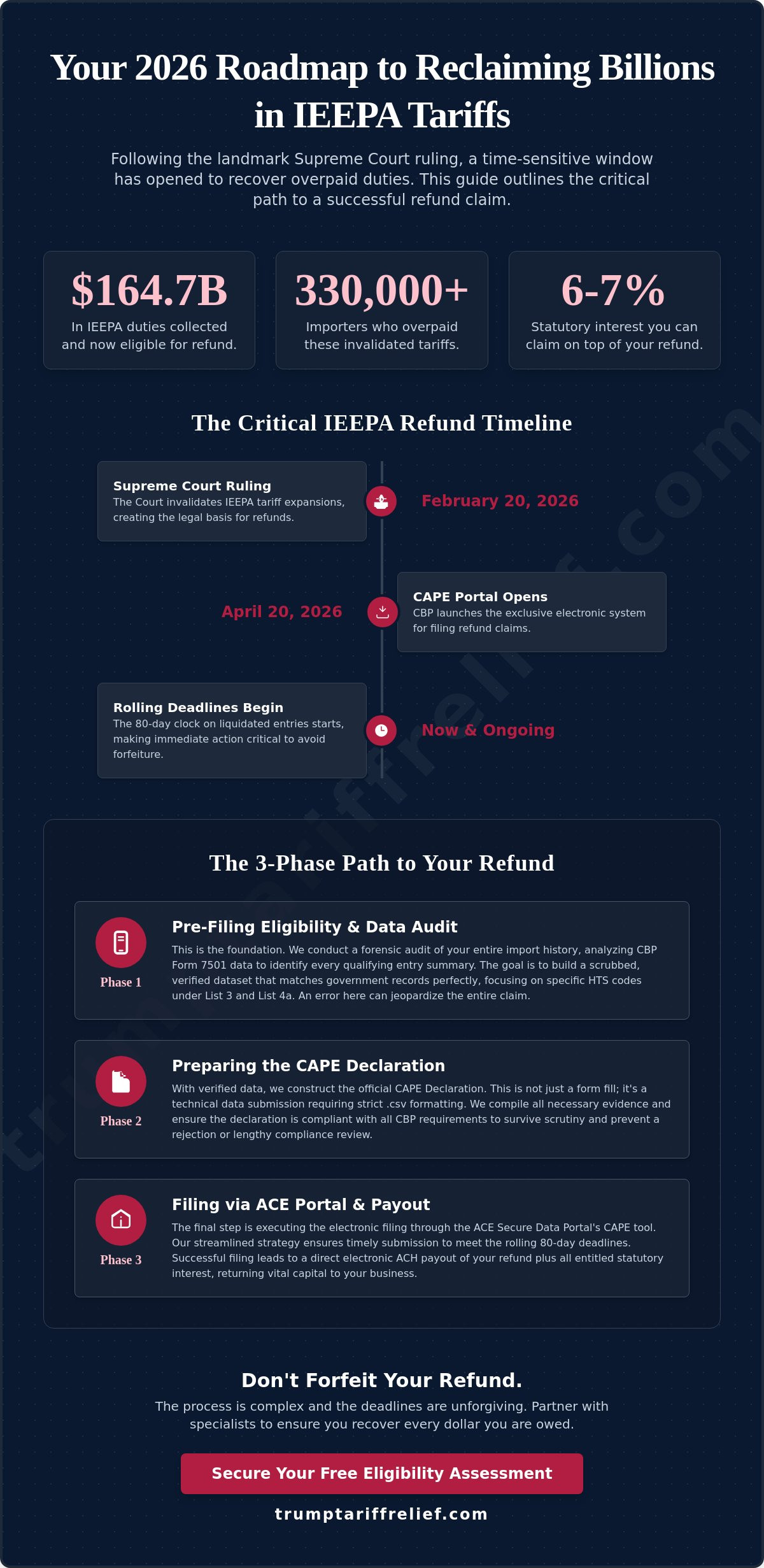
Phase 3: Executing the Filing via the ACE Portal
Executing the filing is the point where theoretical recovery becomes financial reality. The IEEPA refund claim process centers on the Automated Commercial Environment (ACE) Secure Data Portal, specifically within the "Trade" tab. This is where you'll find the CAPE tool, the government's exclusive gateway for these submissions. You aren't just uploading a list; you're interacting with a high-stakes validation engine that cross-references your data against CBP's internal records in real time. If your .csv file contains even a single syntax error or an entry number that doesn't match their database, the system will halt the entire batch. It's a no-nonsense environment that demands technical precision.
Efficiency is paramount when managing high-volume claims. Since each CAPE Declaration is limited to 9,999 entry numbers, large-scale importers often manage dozens of separate submissions. You must ensure the "Declaration Type" is set specifically to the IEEPA recovery module. This ensures your claim is routed to the correct processing queue for Phase 1 payouts. Once submitted, your ACE dashboard becomes your primary tool for tracking progress and ensuring that your capital is moving toward your accounts.
Step-by-Step Submission in the CAPE Tool
Navigating the CAPE tool requires a steady hand. After selecting the "IEEPA Refund" module, you'll need to input the specific "Claim Amount" for every entry summary included in your upload. This amount must include the principal duty paid; the system will automatically calculate the statutory interest of 6% for corporations or 7% for individuals. Before you click "Submit," perform a final validation check to ensure your ACH refund method is correctly configured in your ACE account. Without a valid electronic refund setup, CBP cannot issue your payout.
Post-Filing Monitoring and CBP Inquiries
Your work doesn't end when you hit submit. You must monitor your dashboard for status updates. "Pending Review" means your claim is in the queue, while "Accepted" indicates the technical validation is complete. Be prepared for a CBP Form 28, which is a formal Request for Information. The agency may ask for additional proof of payment or HTS classification details to verify your eligibility. CBP estimates a processing time of 60 to 90 days for valid refunds. For more details on what to expect during this window, consult our FAQ page. If you want to bypass the technical risks of the ACE portal entirely, we can manage the full IEEPA Tariff Refund Recovery on your behalf.
Maximizing Recovery with Contingency-Based Expertise
The technical hurdles of the IEEPA refund claim process are substantial. While the previous sections outlined the roadmap for recovery, the execution remains a high-stakes data project. Many corporations attempt to manage these filings internally, only to realize that their trade teams are ill-equipped for a forensic audit of this scale. A DIY approach isn't just difficult; it's financially risky. If your submission contains errors, you don't just face a delay. You face the permanent loss of eligible capital. Professional verification acts as a shield, ensuring your claim survives the inevitable scrutiny of a CBP audit. We position ourselves as your high-performing partner, taking on the heavy lifting while you focus on your core business.
Righting a financial wrong requires more than just portal access. It requires a deep understanding of the regulatory framework that governs these $164.7 billion in duties. When you choose to handle this in-house, you're betting your recovery on staff who may not have seen the specific nuances of the 2026 Supreme Court mandate. The stakes are too high for trial and error. You need a seasoned insider who has navigated these bureaucracies before and knows exactly how to move your claim through the system.
Why In-House Filings Often Fail
Internal trade departments are designed for compliance and ongoing operations, not for massive, retroactive recovery projects. They often lack the specialized software required to cross-reference thousands of historical entries against the specific HTS codes invalidated by the court. This technical gap is why internal teams often leave 15% to 20% of eligible capital on the table. Beyond the data, there's a heavy opportunity cost. Pulling your staff away from core supply chain management to spend hundreds of hours on CAPE portal uploads drains your operational efficiency. High error rates in HTS mapping are almost inevitable when non-specialists attempt to navigate the nuances of the IEEPA refund claim process.
The Trump Tariff Relief Advantage
We operate on a results-oriented model that prioritizes your financial restoration. Unlike traditional advisory firms that charge upfront fees regardless of the outcome, our contingency-fee structure means we only win when you recover your capital. This removes all financial barriers to entry. Our proven recovery process is designed to take the heavy lifting off your shoulders. We don't just file papers; we perform a deep-tissue audit to identify every cent of overpaid duty and interest you are legally owed. Our team handles everything from the initial data scrub to defending your claim against any CBP Form 28 inquiries. The window for Phase 1 recovery is moving quickly. Don't let administrative hesitation or technical errors prevent your business from reclaiming its rightful capital.
Secure Your Payout Before the Window Closes
The path to financial restoration is now clear, but it requires immediate, decisive action. Mastering the IEEPA refund claim process isn't just about data entry; it's about reclaiming the billions in capital that were improperly collected from your bottom line. You've seen the technical requirements of the CAPE portal and the necessity of a forensic audit. Now, you must choose between a risky DIY submission and a high-performing partnership that guarantees precision. Every day of delay is a day your capital remains in government accounts instead of fueling your growth.
Our specialized team of trade and legal experts is ready to perform a comprehensive audit of all your 2023 through 2026 import data to identify every eligible cent. We operate on a contingency-based model, meaning there's no recovery and no fee. This removes the financial risk and ensures our interests are perfectly aligned with your success. Don't let administrative barriers or filing fatigue prevent you from winning back what is yours. Start your no-risk IEEPA eligibility assessment today and take the first step toward righting this financial wrong. Your capital belongs in your business, and we're here to help you bring it home.
Frequently Asked Questions
What is the IEEPA refund claim process for 2026?
The IEEPA refund claim process is the mandatory electronic submission of CAPE Declarations through the ACE Secure Data Portal. Following the February 20, 2026, Supreme Court ruling, importers must identify eligible entries, format them into specific .csv files, and upload them via the CAPE tool. This system is the exclusive channel for recovering duties and statutory interest paid under invalidated trade authorities.
How long does it take for CBP to process an IEEPA refund?
U.S. Customs and Border Protection (CBP) estimates a processing window of 60 to 90 days once they accept a valid CAPE Declaration. This timeframe applies to Phase 1 claims that meet all technical formatting and documentation standards. If the agency issues a Form 28 Request for Information, the window may extend to allow for manual review and compliance verification.
Can I file for an IEEPA refund if my entries are already liquidated?
Yes, but Phase 1 is strictly limited to entries liquidated within 80 days of your filing date. If your entries were liquidated more than 80 days ago, they don't qualify for this initial phase and may be addressed in future rollout stages. Identifying the exact liquidation status of every entry is a critical step to avoid immediate rejection by the CAPE tool.
Is there a deadline for filing my IEEPA tariff refund claim?
There isn't a single fixed deadline for all claims, but Phase 1 operates on a rolling window tied to each entry's liquidation date. Since Phase 1 payments began in mid-May 2026, the priority remains on unliquidated entries and those within the 80-day post-liquidation window. Delaying your submission risks your oldest and most valuable entries falling outside the eligible recovery period permanently.
What happens if my IEEPA refund claim is denied by CBP?
If CBP denies a claim, you'll receive a notification through your ACE portal dashboard outlining the specific reason for the rejection. Common causes include HTS code misalignment, incomplete payment proof, or syntax errors in the .csv upload. You may have the opportunity to refile with corrected data, provided your entries still fall within the rolling 80-day eligibility window.
Do I need a customs broker to file through the CAPE portal?
You don't technically need a broker, but only the Importer of Record or a licensed customs broker can submit a CAPE Declaration. Given the technical complexity of bulk-uploading up to 9,999 entries per file, many firms utilize specialized partners for the IEEPA refund claim process. This ensures your data reconciliation and documentation meet the strict standards required to survive a government audit.
Are all China tariffs eligible for an IEEPA refund?
No, only specific tariffs imposed under the authority of the IEEPA qualify for recovery. The February 2026 ruling primarily impacts List 3 and List 4a duties that the Court found lacked proper administrative justification. You must conduct a precise HTS code audit to distinguish between these invalidated duties and other ongoing trade enforcement actions that remain in effect.
What is the difference between a Protest and a CAPE Declaration?
A Protest is a traditional legal challenge to a CBP decision, while a CAPE Declaration is the specific electronic tool created for this mass refund event. The CAPE system streamlines recovery for lower-complexity Phase 1 cases. Currently, entries with active protests, reconciliation flags, or drawback claims are excluded from the CAPE rollout and will be addressed in later phases.
Ready to find out what your business may be owed?
Check My Eligibility