
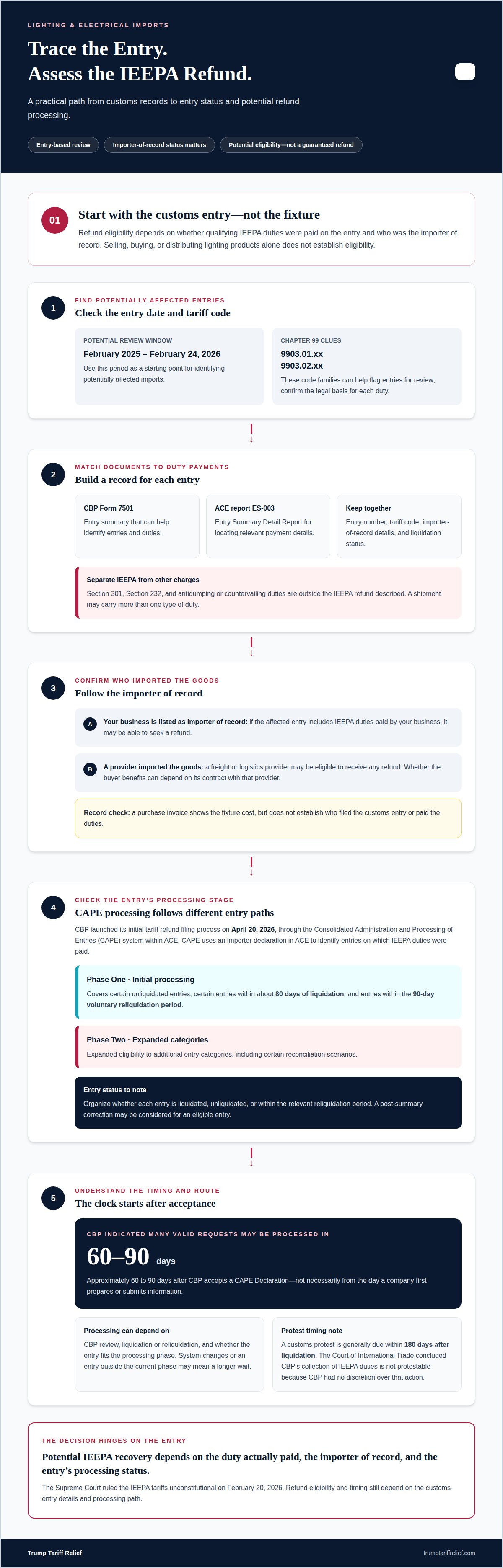
The fixture itself doesn’t decide refund eligibility; the customs entry does. A tariff refund for lighting fixture importers may be available when the importer of record paid qualifying IEEPA duties on entries, including entries with qualifying Chapter 99 codes beginning 9903.01.xx or 9903.02.xx. The potential review window covers imports entered between February 2025 and February 24, 2026.
The Supreme Court ruled the IEEPA tariffs unconstitutional on February 20, 2026, but recovering duties still depends on entry details, importer-of-record status and the processing stage. It’s understandable to want a clear answer on whether your lighting or electrical shipments qualify, and when any refund might arrive. This guide explains what records can help identify affected entries, how refund processing timelines may work, and why the distinction between IEEPA duties and other tariffs matters. It also covers the practical considerations for importers whose suppliers or logistics providers handled the customs entries.
Key Takeaways
- Eligibility depends on whether qualifying IEEPA duties were paid on the customs entry, not simply on whether the shipment contained lighting or electrical products.
- Refund timing can depend on entry status and processing stage; CBP indicated that many valid claims may be processed within approximately 60 to 90 days after accepting a CAPE Declaration.
- Importer-of-record status matters: when another entity entered the goods, contracts can affect whether your business benefits from a refund.
- Separate potentially refundable IEEPA duties from Section 232, Section 301, and antidumping or countervailing duties, which are outside the refund described.
Importers Continue to Eye IEEPA Tariff Refunds - What Should You Know?
The Supreme Court ruled IEEPA tariffs unconstitutional on February 20, 2026, but gave no refund instructions. Eligibility turns on the customs entry, the duties paid, and who acted as importer of record.
U.S. Importer Refund Eligibility
U.S. importer refund eligibility concerns which importers paid duties under the tariffs invalidated by the courts. Yes, lighting fixture importers may qualify if they were the importer of record and their entries included IEEPA duties. On March 4, 2026, the U.S. Court of International Trade stated that importers of record whose entries faced IEEPA duties were entitled to the benefit of the Supreme Court decision. That distinction matters: buying or distributing fixtures alone doesn't establish eligibility if another entity imported them.
Potentially Refundable IEEPA Duties
Potentially refundable IEEPA duties are charges collected under the specific tariff measures imposed using the International Emergency Economic Powers Act. Imports entered between February 2025 and February 24, 2026, are a starting point for identifying potentially affected entries. Chapter 99 HTS codes beginning with 9903.01.xx and 9903.02.xx can help identify them. The IEEPA tariff measures are distinct from other customs duties, so a code and the legal basis for each charge matter.
Records of IEEPA Duties Paid
Importer records connect a tariff payment to a specific entry and the entity that paid it. CBP Form 7501, the entry summary, can help identify entries and duties; the ACE Entry Summary Detail Report, code ES-003, can also help locate relevant payment details. Compare entry records with duty-payment information to distinguish IEEPA charges from other amounts. Keep the entry number, tariff code, importer-of-record details, and liquidation status together, since these details shape the refund process.
Section 301 tariffs apply to many imports from China, including lighting fixtures or related components when their entries carry those duties. They aren't included in the IEEPA refund described here; Section 232 tariffs and antidumping or countervailing duties are also excluded. A shipment can carry more than one type of duty, so separate the IEEPA line items from other charges before assessing potential recovery.
Refund processing timelines
Refund timing depends on entry status and CBP processing, not simply on when a company paid IEEPA duties. CBP launched its initial tariff refund filing process on April 20, 2026, through the Consolidated Administration and Processing of Entries (CAPE) system within ACE. For lighting importers, the key question is whether an entry fits the phase being processed and has the details needed for review.
CAPE uses an importer declaration in ACE to identify entries on which IEEPA duties were paid. Phase One covers certain unliquidated entries and certain entries within about 80 days of liquidation. CBP’s initial system also applies to entries within the 90-day voluntary reliquidation period. Phase Two expanded eligibility to additional entry categories, including certain reconciliation scenarios. These stages mean eligible entries may move through different processing paths.
CBP indicated that it expects to process many valid refund requests within approximately 60 to 90 days after accepting a CAPE Declaration. That period begins after acceptance, not necessarily when a company first prepares or submits information. Processing can also depend on CBP’s review and liquidation or reliquidation of the entry. The refund process has involved system changes, so a pending claim may take longer if an entry falls outside the current processing phase.
For a lighting fixture tariff entry, the importer can organize entry records and identify whether the entry is liquidated, unliquidated, or within the relevant reliquidation period. A post-summary correction may be considered for an eligible entry. A customs protest is generally due within 180 days after liquidation, but the Court of International Trade concluded that CBP’s collection of IEEPA duties is not protestable because CBP had no discretion over that action. The appropriate route therefore depends on the entry’s status and the issue being raised.
CBP’s CAPE system is designed to process refunds through ACE, rather than requiring each company to rely only on a separate court case. For importers assessing this path and its documentation demands, tariff eligibility assessment can help clarify which entries merit attention.
Importer of Record eligibility
In the United States, the importer of record is the entity officially responsible for importing goods and interacting directly with U.S. Customs and Border Protection (CBP). For an IEEPA refund, that role matters because eligibility connects to the customs entry and the importer responsible for it, not simply to the company that sold or used the fixtures. The Supreme Court’s February 20, 2026, decision addressed duties imposed under the International Emergency Economic Powers Act; it didn’t make every downstream buyer the claimant.
If a lighting distributor is listed as importer of record on an affected entry and paid IEEPA duties, it may be able to seek a refund. If a freight or logistics provider imported the fixtures, that provider may be the party eligible to receive any refund. Whether the buyer can benefit may then depend on its contract with the provider. A purchase invoice shows the fixture cost, but does not establish who filed the customs entry or paid the duties.
ACE access is a practical part of claim preparation. Importers may need 3-4 weeks to set up a new ACE account, so account access can affect how quickly entry information is assembled. Keep the importer’s ACE details aligned with the company name and entry records. If a broker or logistics provider handled entries, obtain the relevant records through the business relationship and identify which entity appears as importer of record.
For each potentially affected shipment, gather the entry summary, entry number, duty-payment details, importer identity, and any records showing who bore the charge. Match these documents to the company’s purchase and supplier records. A lighting manufacturer that imports directly may have the entry records itself. A retailer buying through an intermediary may need to review its contract to determine whether any recovery can be shared. These distinctions matter because the party entitled to a refund and the party that ultimately benefits may differ.
Importer-of-record status is a threshold question, not a product classification. The company named on the entry, the payment trail, and the relevant contract help establish whether it paid the IEEPA duties or must rely on another party’s agreement to share any recovery.
Tariff refund claims for lighting and electrical products
For lighting and electrical imports, recovery depends on the duty’s legal basis, not the product alone. A tariff refund for lighting fixture importers concerns qualifying IEEPA charges, not every tariff assessed on a shipment.
Recovery Through Exclusions or Court Rulings
Recovery through exclusions or court rulings depends on which tariff was imposed on the fixture entry. A Chinese-made light may carry Section 301 duties, but the Supreme Court’s IEEPA ruling did not invalidate Section 301 tariffs. An exclusion from a tariff and an IEEPA refund are different routes. If an entry includes both Section 301 and IEEPA duties, only the qualifying IEEPA charge falls within this refund process.
Current Refund Programs and CBP Guidance
CBP’s CAPE process is the current mechanism for submitting eligible IEEPA refund claims. CBP released detailed tariff refund guidance and visual guides on April 13, 2026, and launched its initial filing process on April 20, 2026. CAPE Phase 2 expanded eligibility to additional entry categories, including certain reconciliation scenarios. For a tariff refund for lighting fixture importers, match each claim to its entry and duty category rather than treating all tariff payments as one balance.
Denied Claims and Classification Risks
Claim risks arise when entry details don’t support the requested refund or tariff categories are confused. The Court of International Trade ordered unliquidated entries subject to IEEPA tariffs liquidated without those duties, and qualifying liquidated entries reliquidated without them. A wrong code or incomplete duty breakdown can obscure which charges qualify. For example, labeling a Section 301 payment as an IEEPA duty could misstate the claim. Entry status and accurate classification matter.
Align product classifications, entry records, and duty line items before submitting claims for lighting and electrical goods. Assess your tariff refund eligibility for affected entries.
Trump Tariff Relief: IEEPA Tariff Refund Recovery
Trump Tariff Relief helps importers assess and pursue potential IEEPA tariff refunds, including duties tied to lighting and electrical entries. If your records show potentially eligible duties, a Tariff Eligibility Assessment can help identify the relevant entries and documentation.
Through IEEPA Tariff Refund Recovery, Trump Tariff Relief manages the process from eligibility assessment and customs documentation to government filings. The service is contingency-based, with no upfront cost: payment is only a percentage of funds successfully recovered. This can suit businesses seeking help with a claim without paying an upfront service cost, although recovery depends on the claim and its outcome.
Contact Trump Tariff Relief to discuss your importer records and potential next steps.
Turn the Refund Opportunity Into a Clear Next Step
A tariff refund for lighting fixture importers is more than a customs issue. It can affect cash-flow planning, supplier discussions, and how finance teams document past import costs. Bring the relevant teams together around a consistent record of the imports and payments under review. This gives decision-makers a clearer basis for prioritizing the work and assessing how a potential recovery fits business plans.
Keep the process focused: align the relevant entry information, payment records, and commercial documents, then identify any gaps. If internal teams handle several product lines or suppliers, a structured review can help keep a potential IEEPA claim distinct from unrelated tariff issues. Outcomes depend on the entries and supporting documentation, so assess eligibility carefully before deciding how to proceed.
Trump Tariff Relief can support that review and manage the recovery process. Contact Trump Tariff Relief to discuss a practical next step for your business. With a clear record and focused support, you can move forward with greater confidence.
Frequently Asked Questions
Do I need to take action to secure a tariff refund, and when must I do it?
Yes. Organize the entry records, confirm who was importer of record, and track each entry’s liquidation status. A protest of customs liquidation is normally due within 180 days, but the Court of International Trade concluded CBP’s collection of IEEPA duties itself is not protestable. That deadline isn’t a universal CAPE filing deadline; the appropriate route depends on the entry and the issue involved.
Can I file an IEEPA refund claim myself?
Yes. An importer can use its ACE account to submit an importer declaration through CAPE, identifying entries on which IEEPA duties were paid. The filing depends on accurate entry-level information, so organize entry summaries and duty statements before submitting. If your business needs a new ACE account, setup may take 3-4 weeks. Importers can also use specialized assistance with eligibility review, documentation, and filing.
Do I qualify for a refund?
You may qualify if your business was the importer of record on a U.S. entry and paid duties imposed under IEEPA. For example, directly importing fixtures under your company’s name differs from buying them from a domestic distributor that imported them. The relevant entry and payment records help establish the connection. Product type alone doesn’t determine eligibility, and Section 301, Section 232, and AD/CVD duties aren’t IEEPA refunds.
How exactly will the refund system work?
CBP’s CAPE process operates through ACE. The importer declaration identifies entries with IEEPA duties paid, and CBP reviews entries for processing through liquidation or reliquidation without those duties. CBP requires importers to enroll in ACH Refund to receive duty refunds electronically. Keep ACH enrollment details aligned with the importer account, as arranging electronic payment is separate from identifying entries and filing the declaration.
How many importers are impacted?
The stated figures are 330,000+ importers impacted and 53 million total entries subject to IEEPA tariffs. Those totals describe the scale of the refund workload, not the number of approved claims. A lighting or electrical importer still needs to connect its own customs entries, paid duties, and importer-of-record information. Industry-wide totals can’t establish whether a particular company or entry qualifies.
What about older or different entries?
Older entries aren’t automatically excluded, and a newer entry isn’t automatically eligible. CBP’s process distinguishes unliquidated entries from liquidated entries and considers whether an entry fits a processing phase. Different tariff categories also remain distinct: an IEEPA refund process doesn’t turn Section 301, Section 232, or antidumping and countervailing duties into IEEPA payments. Review the entry’s liquidation history alongside its duty basis.
Ready to find out what your business may be owed?
Check My Eligibility