
Getting tariff money back depends on who paid the IEEPA duty and which entries qualify. In phase 1, businesses may qualify if they were the Importer of Record or licensed customs broker that directly paid IEEPA tariffs. Qualifying payments may be refundable up to 100%, plus applicable statutory interest. CBP charges no fee to process a refund; professional recovery arrangements are separate.
For businesses seeking tariff money back, eligibility depends on entry status, who paid the duties, and whether the claim meets documentation and deadline requirements. This guide explains which entries may qualify, what can make an entry ineligible, and how to prepare and track a claim. It also distinguishes government processing from professional recovery fees. Getting tariff money back involves eligibility review, documentation, filing, and follow-up, with no guarantee of a refund.
Key Takeaways
- Entry status can determine whether a tariff payment belongs in a refund claim, so eligible and excluded entry categories matter.
- CAPE is the CBP portal used to prepare, submit, and manage tariff refund claims.
- Refund progress depends on accurate entry records and the claim’s processing status; electronic payment details also matter.
- Professional support can coordinate eligibility assessment, customs documentation, and claim management through the recovery process.
Who is eligible to request an IEEPA tariff refund?
The U.S. Supreme Court ruled on February 20, 2026, that the Administration’s IEEPA tariffs were unconstitutional and must be refunded. During phase 1, a business may qualify if it was the Importer of Record or the licensed customs broker that directly paid IEEPA tariffs. Paying higher prices to a supplier, by itself, doesn’t establish that role.
CBP issues refunds only to the Importer of Record or the Notify Party designated on CBP Form 4811. The refund recipient must also have U.S. bank account information in an ACE Portal account. A broker that filed entries but didn’t directly pay the IEEPA duties shouldn’t assume it qualifies as the refund recipient. These distinctions help determine whose claim and payment details matter.
Eligible importers may recover up to 100% of qualifying tariffs, plus applicable statutory interest. That can restore duties paid, but it doesn’t compensate automatically for every wider business impact, such as higher purchase costs or reduced sales. The tariff refund is tied to qualifying customs payments, not a general calculation of economic harm.
Small-business estimates show the potential scale, not a guaranteed individual result. From May through August 2026, estimated refunds attributable to identified U.S. small-business importers totaled about $35 billion, with an estimated average of $149,000 per importer. These figures describe estimated refunds across identified businesses; an importer’s amount depends on its own qualifying entries and payments.
Refunds aren’t allocated through a stated small-business priority in the current process. The proposed Tariff Refund Act of 2026 would direct CBP to prioritize small businesses, but a proposal isn’t the same as an enacted rule. Separately, the federal government returned $166 billion in duties collected under the Administration’s IEEPA tariffs from March 2025 through February 2026. That total doesn’t determine any single importer’s claim.
How does tariff money back assistance compare with similar services? The service a business uses does not determine CBP eligibility. The key questions are whether the entries meet the refund criteria and whether the required duties were paid by the eligible importer. Customer feedback cannot establish eligibility either: CBP’s entry and payment records guide the assessment.
Eligible and ineligible entries
Eligibility depends on each entry’s status and whether it can be included in a CAPE Declaration. The refund process launched on April 20, 2026, and phase 1 covers unliquidated entries and entries within CBP’s voluntary reliquidation period. During phase 1, those categories don’t require a case in the U.S. Court of International Trade to receive an IEEPA tariff refund.
Liquidation matters because it can change which route applies. CBP’s voluntary reliquidation period for phase 1 is 90 days. If an entry falls outside that period, it may not qualify for the same phase 1 filing route. A protest disputing a liquidated or reliquidated refund amount must be filed within 180 days after liquidation or reliquidation, according to U.S. Customs and Border Protection.
Not every entry type can be included in a CAPE Declaration. The excluded types are 23, 08, 09, and 047. Their exclusion from this declaration means the filing cannot simply group them with eligible entries. Classification by entry type is therefore a key part of preparing a complete claim.
Consolidation has practical limits, too. A CAPE Declaration CSV file must be no larger than 1 MB, and each entry number must contain 11 characters without dashes. The filer must be directly associated with the entries through the 3-digit prefix of the ACE filer code. These requirements determine whether entries can be grouped in the submission.
As of March 4, 2026, about 20.1 million U.S. import entries remained unliquidated. That figure shows the scale of entries potentially relevant to phase 1, not the eligibility of any particular importer. A professional entry and claim review can organize the filing around entry status, type, and filer association before submission.
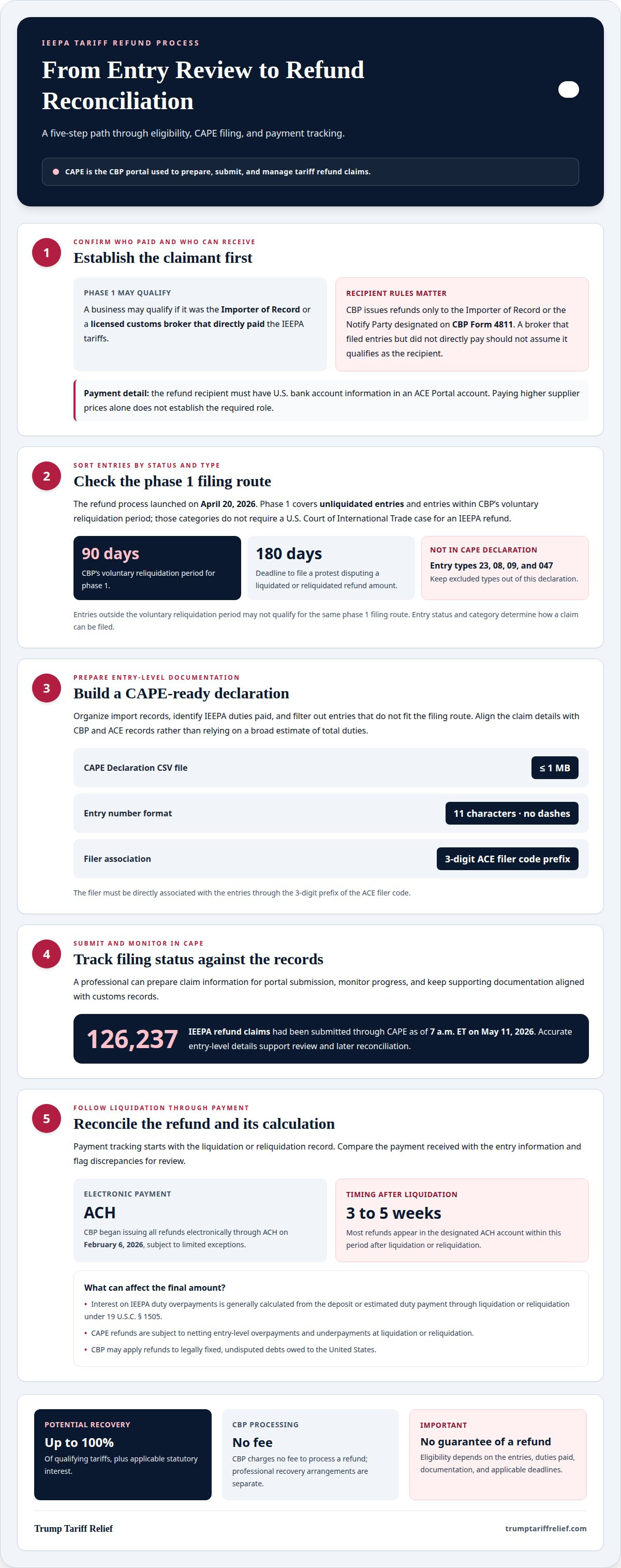
How a professional manages claim submission and progress tracking
The refund process begins by organizing import records, identifying duties paid under the International Emergency Economic Powers Act (IEEPA), and filtering out entries that do not fit the filing route. Trump Tariff Relief reviews relevant CBP and ACE data and prepares the documentation needed for the appropriate claim. This structured review helps align claim information with customs records.
Next, the professional prepares the claim information for portal submission and monitors its progress. As of 7 a.m. ET on May 11, 2026, 126,237 IEEPA refund claims had been submitted through CAPE. That volume makes clear why accurate entry-level records matter: a claim’s details must support review and later reconciliation, rather than rely on a broad estimate of total duties paid.
Payment tracking starts with the liquidation or reliquidation record. CBP began issuing all refunds electronically through ACH on February 6, 2026, subject to limited exceptions. Most refunds appear in the designated ACH account 3 to 5 weeks after liquidation or reliquidation. A professional can track the filing and compare the payment received with the entry information, helping identify a discrepancy that may need attention.
Refund calculations can involve more than the original duty amount. Interest on IEEPA duty overpayments is generally calculated from the deposit or estimated duty payment through liquidation or reliquidation under 19 U.S.C. § 1505. CBP may also apply refunds to legally fixed, undisputed debts owed to the United States. CAPE refunds are subject to netting overpayments and underpayments for an entire entry at liquidation or reliquidation.
These steps connect submission with the final accounting. A professional tracks entry status, filing progress, liquidation, and payment, while keeping the supporting documentation aligned. Understanding how IEEPA tariffs and refunds work helps clarify why payment timing and amounts can depend on entry-level processing, not simply the date a claim was filed.
How does Ariff Money Back work?
A professional recovery process moves from eligibility review to documentation, filing, and payment tracking. Trump Tariff Relief assesses whether the business and its customs entries may qualify. The importer provides relevant entry and duty records so the review can connect each payment with the supporting customs documentation. Clear records help distinguish potentially eligible IEEPA duties from unrelated import charges.
Next, Trump Tariff Relief organizes supporting documents and prepares the appropriate government filing. This can include matching entry details, identifying documentation gaps, and assembling information for submission. The specialist manages the paperwork and filing process, so the importer does not have to coordinate each step alone.
After submission, the professional monitors claim progress and payment status. Refund amounts can be affected by entry processing, liquidation or reliquidation, interest calculations, and offsets against certain unpaid federal debts. A payment may therefore differ from a simple total of estimated duties. Tracking the claim against its entry records helps explain how the final amount was reached.
Professional recovery costs are separate from government processing. Trump Tariff Relief works on a contingency basis: there are no upfront costs, and the firm receives a percentage only if funds are recovered. This no win, no fee arrangement ties payment to a successful recovery. Refund eligibility and outcomes depend on the specific import history and supporting documentation.
For a business with multiple entries, coordinated documentation and filing can reduce the administrative burden while keeping the claim grounded in its records. The professional manages the review, document preparation, government filing, and follow-up. Start a tariff refund assessment to determine whether professional recovery support fits your claim.
Trump Tariff Relief
Trump Tariff Relief helps businesses assess eligibility and manage IEEPA tariff refund claims. Its Tariff Eligibility Assessment reviews whether an importer and its entries may qualify. Customs Documentation Management organizes the supporting records, while IEEPA Tariff Refund Recovery manages the claim through filing and progress tracking.
This support can be useful when a business has multiple entries, uncertain eligibility, or limited internal capacity to coordinate documentation and follow-up. Trump Tariff Relief focuses on the IEEPA refund process, not ongoing customs brokerage or general corporate legal services. The work is contingency-based, with no upfront costs and payment only as a percentage of funds recovered.
For help assessing eligibility and managing an IEEPA refund claim, contact Trump Tariff Relief.
Move from eligibility to a clear next step
A refund claim is a record-based process connecting import entries, duty payments, and the business entitled to receive any recovered funds. If you are considering whether to pursue tariff money back, a practical first step is to gather your import history and supporting records. Each entry and payment needs to be assessed against the claim requirements, and eligibility is not automatic.
Trump Tariff Relief assesses eligibility, manages customs documentation, and handles IEEPA tariff refund recovery. This support can help internal teams connect entry records to claim requirements and track a filing through the process. The review and outcome depend on the business’s import history, deadlines, and supporting documentation.
Take the next step when you’re ready to discuss your situation. Contact Trump Tariff Relief to explore a path forward for your business.
Frequently Asked Questions
Are there any fees or charges to receive a tariff refund?
CBP doesn’t charge a fee to process a tariff refund. Professional assistance has a separate fee arrangement: Trump Tariff Relief works on a contingency basis and receives a percentage only if funds are recovered. For example, if a claim produces no recovery, there’s no success fee. Ask how the service fee applies to recovered funds so you can distinguish it from government processing charges.
How can a professional help prepare for a potential refund of IEEPA duties?
A tariff specialist can assess import history and organize information for an eligibility review. The assessment uses basic company details, estimated IEEPA tariff payments, import regions, and available records. Entry summaries, commercial invoices, transportation documents, and duty statements can help connect payments to specific entries and support a refund claim.
How can a professional help you prepare?
Trump Tariff Relief reviews available CBP and ACE data, filters entries for eligibility, assembles supporting records, and prepares the appropriate filing. A documentation package may include entry summaries, commercial invoices, transportation documents, and duty statements. The eligibility review excludes categories such as antidumping duties and reconciled entries, keeping the claim focused on potentially eligible IEEPA duties.
How long will it take for me to get my refund?
Timing depends on claim processing and the entry’s liquidation or reliquidation, not only the filing date. Most U.S. IEEPA duty refunds appear in the designated ACH account 3 to 5 weeks after liquidation or reliquidation. That period is not the total claim timeline: review, documentation, and government processing can add time, so the payment date varies with the claim’s progress.
What is Ariff Money Back?
Getting tariff money back means seeking repayment of qualifying duties paid under the International Emergency Economic Powers Act. Refunds are not automatic for every importer or every tariff-related business cost. Trump Tariff Relief can assess import records, prepare supporting documentation, and manage the claim process. Eligibility depends on the specific entries, deadlines, and records.
Who is eligible for Ariff Money Back?
Eligibility generally centers on the Importer of Record or a licensed customs broker that directly paid the IEEPA duties. CBP issues refunds to the Importer of Record or a Notify Party designated on CBP Form 4811, with U.S. bank account information in ACE. A business that absorbed higher supplier prices isn’t automatically the refund recipient; the entry and payment roles matter.
Ready to find out what your business may be owed?
Check My Eligibility