
The Court of International Trade has ordered U.S. Customs and Border Protection to return $166 billion in invalidated IEEPA tariffs, yet many importers remain paralyzed by the Department of Justice's June 2 appeal. It's understandable if you feel overwhelmed by the technicalities of the CAPE platform or the fear that a missed statute of limitations will leave your capital in government hands forever. You need a sophisticated tariff refund claim strategy that bypasses bureaucratic friction and protects your bottom line from further exposure.
We've analyzed the phased rollout of the refund process to ensure you don't leave money on the table. You'll learn how to deploy a high-impact recovery plan that addresses the complexities of unliquidated entries versus those currently caught in legal limbo. This guide provides a definitive roadmap for the 2026 landscape, showing you exactly how to audit your documentation and secure your full refund with zero financial risk. We're moving past simple administrative filing into a specialized approach that prioritizes your recovery and rights a significant financial wrong.
Key Takeaways
- Pinpoint the critical 2026 deadlines and regulatory shifts that opened a multi-billion dollar window for reclaiming Section 301 duties.
- Command the technical requirements of the CAPE platform to successfully manage unliquidated entries and secure interest-bearing refunds.
- Contrast the financial benefits of a specialized tariff refund claim strategy against the hidden costs and audit gaps of internal filing.
- Accelerate your documentation process by leveraging automated technology to audit years of Form 7501 Entry Summaries with surgical precision.
- Deploy a no-risk recovery framework that uses a contingency-based model so you don't have to divert internal resources or pay upfront fees.
The 2026 IEEPA Refund Landscape: Why Strategy Matters Now
The trade environment shifted permanently on February 20, 2026, when the Supreme Court invalidated billions in tariffs collected under the International Emergency Economic Powers Act (IEEPA). This decision wasn't just a legal victory; it was a financial catalyst for U.S. importers who have been overpaying for years. On March 4, 2026, the Court of International Trade (CIT) followed up by ordering U.S. Customs and Border Protection (CBP) to refund all $166 billion worth of these duties. If your business paid duties on List 3 or List 4a goods, you're sitting on a significant capital recovery opportunity that requires an immediate, high-impact tariff refund claim strategy to execute before deadlines close.
While the opportunity is massive, the window is narrow. The Department of Justice's June 2, 2026, appeal of the CIT refund order has introduced a new layer of complexity. This isn't the time for a wait-and-see approach. Importers are moving away from the slow, individual protest model and toward the Consolidated Administration and Processing of Entries (CAPE) platform, which launched on April 20, 2026. This system is designed for speed, but it demands precision. A single documentation error can result in a rejected claim, leaving your capital locked in government accounts while your competitors reinvest their recovered funds into growth.
The Legal Catalyst: From Ruling to Recovery
The invalidation of these tariffs addresses a long standing overreach in trade policy. By striking down the use of IEEPA for these specific Section 301 duties, the courts have paved the way for importers to reclaim capital that was unlawfully collected. This is about more than just numbers; it's about righting a financial wrong that has burdened U.S. supply chains for years. The current focus remains on unliquidated entries and those liquidated within the last 80 days. This represents the first phase of a massive redistribution of trade capital. If you don't have a plan to identify these entries now, you're essentially handing that money back to the Treasury.
The Cost of Inaction for US Importers
Waiting is the most expensive mistake an importer can make in this environment. Every day an entry moves closer to final liquidation is a day you risk losing your right to recovery. Unclaimed refunds don't just sit there; they actively weaken your balance sheet and give your competitors a liquidity advantage. You can learn more about IEEPA explained to understand how these timelines affect your specific imports. If you don't act before the statute of limitations expires on older entries, that capital is gone forever. The complexity of the CAPE system and the ongoing DOJ appeals mean that only those with a structured documentation plan will successfully navigate the 2026 landscape.
The CAPE Evolution: Strategic Trends in Phased Recovery
The launch of the Consolidated Administration and Processing of Entries (CAPE) platform on April 20, 2026, marked a definitive shift in how importers interact with U.S. Customs and Border Protection. We've moved away from the era of manual, disparate protests toward a highly automated, consolidated system within the ACE Portal. While this transition promises efficiency, it also introduces a rigid framework where technical errors lead to immediate disqualification. A successful tariff refund claim strategy now requires a data-centric approach that aligns with the government's phased rollout rather than a one-time administrative filing.
This evolution isn't just about software; it's about a fundamental change in the recovery timeline. According to a National Retail Federation analysis, the economic significance of these refunds for the retail sector alone is staggering, making the precision of your filings more critical than ever. Because CBP is processing refunds in distinct waves, your business must prepare for a multi-year engagement to capture capital from different entry categories as they become eligible. You can understand our recovery process to see how we manage these shifting phases on your behalf.
Phase 1: The Low-Hanging Fruit
Phase 1 targets the most accessible capital: unliquidated entries and those that have recently cleared the 80-day post-liquidation window. To participate, importers must ensure their ACE Portal accounts are active and their ACH bank information is verified for electronic duty refunds. As of 2026, CAPE Phase 1 criteria encompass unliquidated entries and those liquidated within 80 days of a claim, specifically targeting tariff payments made from January 30, 2026, onward. If your documentation isn't categorized to isolate these specific entries, you're delaying a refund that CBP anticipates issuing within 60 to 90 days of declaration acceptance.
Phases 2 & 3: Navigating Liquidated Entry Complexity
The real strategic challenge lies in Phases 2 and 3, which involve entries that are finally liquidated or past the standard protest period. The Department of Justice appeal filed on June 2, 2026, has cast a shadow over these older entries, making the recovery path less certain but no less valuable. Success here depends on specialized auditing that goes beyond surface-level records. You must begin aggregating Form 7501 Entry Summaries now to build a "Data Goldmine" that will be required when the CAPE platform expands its functionality. By identifying these overlooked recovery opportunities early, you position your business to move the moment the next wave of government processing begins, ensuring no capital is left behind due to technical expiration.
Once these funds are secured, they can be utilized for high-impact business needs or even corporate rewards; for instance, The Russell Travel Team (Lightning Travel) specializes in curating luxury vacations and leisure travel for those looking to celebrate their financial successes.
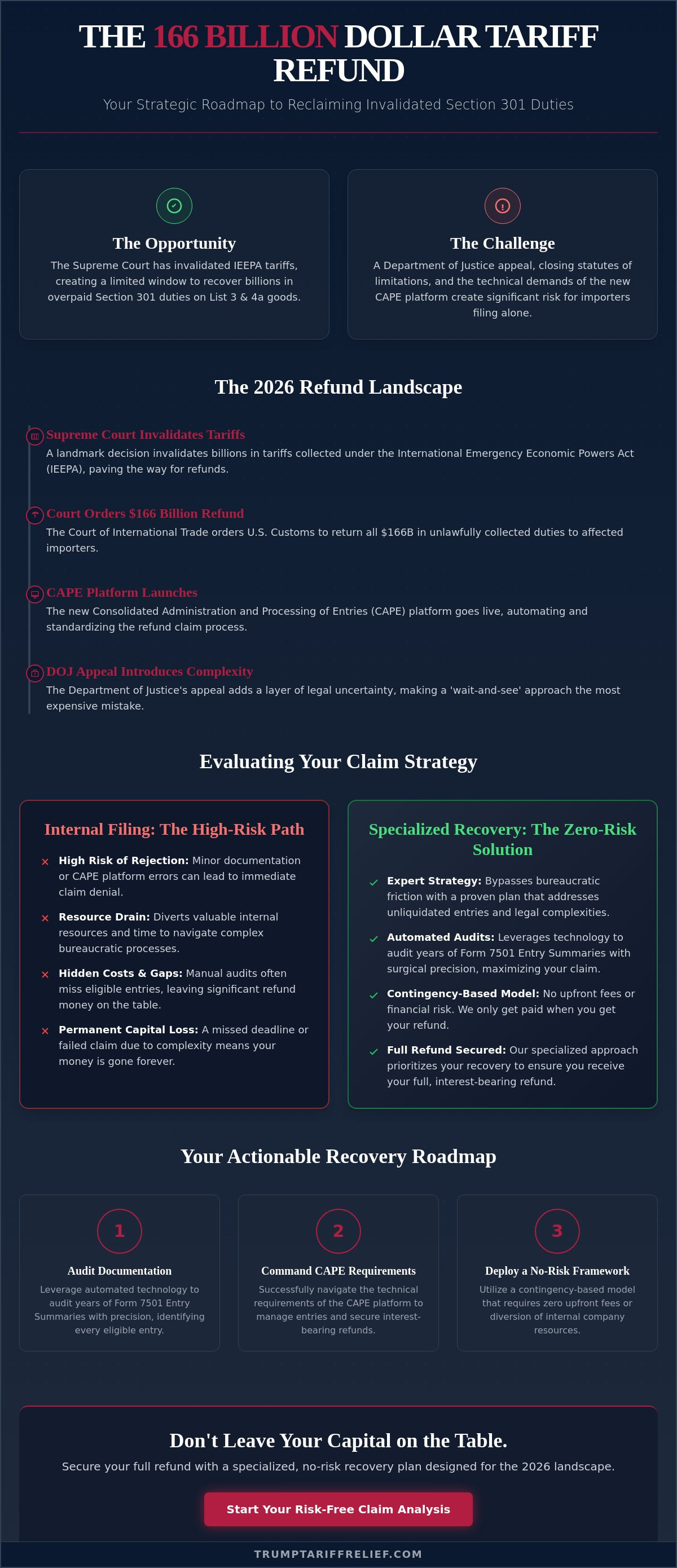
Evaluating Your Claim Strategy: Internal Filing vs. Professional Recovery
The government provides the platform, but they don't provide the strategy. Deciding between an internal DIY approach and professional recovery is the most critical pivot point in your tariff refund claim strategy. While your internal logistics or legal teams are capable, they're often already stretched thin by daily operations. Diverting these high-value resources to audit years of Entry Summaries (Form 7501) creates a massive opportunity cost that often outweighs the perceived savings of a DIY filing. If your team misses a single qualifying entry or misinterprets a phased deadline, that capital remains permanently out of reach.
The Official IEEPA Duty Refund Guidance outlines the summarized actions needed to request a refund, but it glosses over the exhaustive auditing required to capture every cent. There's a significant "audit gap" in most internal filings. Without specialized technology to scan thousands of entries, businesses often settle for "the big ones" and leave millions in smaller, aggregated refunds on the table. This is why we see a decisive shift toward specialized recovery partners who treat tariff reclamation as a surgical operation rather than an administrative task.
The Pitfalls of the DIY Approach
Common errors in CAPE Declarations often lead to frustrating delays or outright denials. For instance, each individual declaration is capped at 9,999 entries. If your business has a high volume of imports, managing multiple declarations requires flawless data mapping. Your current customs broker might seem like the logical choice, but their focus is typically on forward-looking compliance and ongoing brokerage, not historical recovery auditing. They often lack the specific forensic tools needed to cross-reference years of customs data with the evolving eligibility criteria of 2026, leading to missed opportunities in your recovery portfolio.
The Logic of Contingency-Based Recovery
Contingency-based recovery has become the dominant trend for 2026 because it shifts the entire financial risk away from your balance sheet. By opting for a success-based fee model, you eliminate upfront costs and ensure that your recovery partner is highly motivated. The incentives are perfectly aligned; a professional firm only wins when you recover your capital. This model allows you to see how our recovery process works to protect your interests without diverting capital from your core business objectives. It's a high-stakes narrative of restoration where the partner takes on the heavy lifting while you reap the financial rewards.
Vetting your partner is the final safeguard. The rise of the IEEPA refund opportunity has unfortunately attracted scammers. Just as the International Investigative Group emphasizes the necessity of rigorous due diligence in personal matters, businesses must apply similar investigative scrutiny when selecting a recovery consultant. CBP has issued clear warnings that any communication requesting a fee to process a refund is fraudulent, as the government does not charge for these filings. Legitimate trade experts will never ask for upfront payments. They'll focus on a thorough Tariff Eligibility Assessment and documentation management, positioning themselves as a powerful ally in righting the financial wrong of these invalidated duties.
Actionable Roadmap: Building a Robust Documentation Strategy
Documentation is the bedrock of any successful recovery. If your records are incomplete or disorganized, your tariff refund claim strategy will fail at the first hurdle. You must treat your historical trade data as a "Data Goldmine" that requires precise extraction. This involves more than just keeping digital receipts; it requires a systematic excavation of every transaction that occurred during the targeted IEEPA periods. While the government's CAPE platform simplifies the submission process, the burden of proof remains entirely on the Importer of Record.
The complexity of the 2026 landscape means that a manual review of your files is no longer sufficient. You need to leverage technology that can scan thousands of Entry Summaries to identify every qualifying duty payment. This isn't just about administrative compliance; it's about reclaiming capital that belongs on your balance sheet. By building a robust documentation strategy now, you ensure that your business is prepared to move the moment a recovery window opens, rather than scrambling to find paperwork while the statute of limitations ticks away.
Critical Documents for Your Claim File
Accurate Importer of Record (IOR) data is your non-negotiable starting point. You need a comprehensive file of Entry Summaries (Form 7501) and definitive proof of duty payment for every single claim you intend to file. Organizing this data by Harmonized Tariff Schedule (HTS) codes is essential to verify that your imported goods fall under the primary recovery targets, specifically List 3 and List 4a. If you can't definitively prove that the duties were paid on these specific lists, the recovery engine stalls before it even begins.
Beyond recovering capital on these imports, companies must also maintain efficient waste management for industrial materials; Tired Tyres offers specialized services for the collection and disposal of scrap tires and industrial rubber products to streamline your operations.
Verification and Audit Protocols
A robust protocol includes a "gap analysis" to identify missing entries that your internal systems might have overlooked. You must also ensure your ACH bank information is perfectly synchronized with the ACE Portal to avoid administrative payment delays once your claim is approved. Verifying liquidated entry dates is critical to ensure you don't waste resources filing expired claims that fall outside the current recovery window or the 80-day post-liquidation threshold for Phase 1. This level of forensic detail is what separates a successful recovery from a rejected declaration.
Mapping your filing against the three year statute of limitations is a high-stakes race. While the CAPE system is live as of April 2026, the clock is ticking on older entries that may soon become ineligible for recovery. Authorized Customs Brokers are vital links in the recovery chain, but the specialized auditing required for historical IEEPA claims often goes beyond their standard compliance duties. Leveraging automated technology to scan years of Entry Summaries allows you to identify recovery points that manual reviews simply miss, ensuring your claim is both comprehensive and legally defensible.
For importers in the tech industry, managing the lifecycle of their products is just as vital as duty recovery; 億鑫鴻景電子 (Yixin Hongjing Electronics) provides professional recycling services for electronic parts and components to help businesses reclaim value from surplus assets.
Secure your comprehensive documentation audit now to ensure no capital is left behind.
Executing Your Recovery with Trump Tariff Relief
The government's CAPE platform provides the mechanism for recovery, but Trump Tariff Relief provides the engine. We don't just file paperwork; we deploy a comprehensive tariff refund claim strategy designed to navigate the legal and technical hurdles that cause internal teams to stumble. Our focus is singular: identifying every dollar of overpaid duty and returning it to your balance sheet. By acting as your specialized recovery partner, we take on the bureaucratic heavy lifting, allowing you to focus on running your business while we secure your capital. Once your liquidity is restored, you may wish to learn more about Global Exclusive Trading (GET) to explore how their export trading services can help you expand into international markets.
The dominant trend in 2026 is moving away from traditional legal models that charge by the hour. Unlike firms that create barriers with upfront retainers, our "No-Risk, High-Reward" model is built entirely on contingency. This means our incentives are perfectly aligned with your success. We don't get paid unless you recover your funds. This approach eliminates the financial risk of pursuing older or more complex entries, ensuring that your quest for justice doesn't become another line item on your expense report.
Why We Are the National Leader in IEEPA Recovery
Our position as a national leader stems from a deep specialization in the specific legal precedents surrounding the Supreme Court's IEEPA ruling. We've developed a proprietary auditing process that goes far beyond standard customs brokerage checks. Our technology scans years of data with surgical precision, finding refunds that others miss. Whether you're a mid-sized importer or a large-scale enterprise, our national reach ensures we can serve your business across all U.S. industry sectors, providing the elite advocacy required to win against complex government systems.
Start Your Recovery Today
The window for recovery is open, but it's narrowing. Waiting until the later phases of the CAPE rollout is a strategic mistake that could result in expired claims or missed deadlines. The immediate next step is securing your preliminary eligibility assessment to determine exactly how much capital is waiting to be reclaimed. This assessment is the foundation of your recovery, providing a clear roadmap for your specific imports without any initial cost. You can read our FAQ for more details on how we handle the complexities of your claim.
Don't let your capital remain in government hands. We are ready to serve as your powerful ally in this high-stakes environment. Our team manages the end-to-end CAPE filing process, from documentation management to the final issuance of your refund. It's time to right the financial wrong of these invalidated tariffs. Contact us today to begin your zero-risk implementation and reclaim what's yours.
Secure Your Financial Restoration Today
The invalidation of IEEPA tariffs has opened a fleeting window to reclaim significant capital. The complexity of the CAPE system and the DOJ's recent appeal make professional advocacy essential. You've learned that a successful recovery depends on acting before the 80-day liquidation window closes and maintaining a forensic documentation audit. A robust tariff refund claim strategy shouldn't be a burden on your internal team or a gamble with your budget; for companies managing complex tax obligations across the US, UK, and EU, CiDATax SRL offers the specialized regulatory support needed to ensure total compliance.
Trump Tariff Relief stands as your powerful ally. We offer specialized expertise in IEEPA and Section 301 recovery. We provide comprehensive management of the entire CAPE filing process so you can focus on growth while we handle the bureaucracy. Because we operate on contingency-based fees, you only pay if we recover your money. There is no financial risk to identifying what you're owed and righting this financial wrong.
Secure Your No-Risk Eligibility Assessment Now
The capital you've overpaid belongs on your balance sheet, not in a government account. Let's work together to restore your liquidity and strengthen your competitive edge for the years ahead.
Frequently Asked Questions
Is the IEEPA tariff refund real or a scam?
The IEEPA tariff refund is a legitimate recovery opportunity resulting from the February 20, 2026, Supreme Court decision that invalidated specific duties. U.S. Customs and Border Protection launched the CAPE platform on April 20, 2026, specifically to process these $166 billion in court ordered refunds. While the opportunity is real, you must remain vigilant against fraudulent communications. Legitimate recovery partners operate on a contingency basis and will never ask for upfront filing fees, as CBP does not charge for processing these claims.
What is the deadline for filing an IEEPA tariff refund claim in 2026?
The most critical immediate deadline is the 80 day window following the liquidation of an entry. For Phase 1 of the CAPE rollout, eligibility is strictly limited to unliquidated entries and those that have liquidated within the last 80 days. Because the statute of limitations on older entries is subject to ongoing litigation following the June 2 Department of Justice appeal, your tariff refund claim strategy should prioritize filing as soon as an entry becomes eligible to prevent permanent capital loss.
How much does it cost to hire a tariff refund consultant?
Top tier recovery firms typically utilize a contingency fee model, meaning there are no upfront costs for your business. You only pay a percentage of the capital successfully recovered from CBP, which aligns the consultant's incentives with your financial goals. This success based structure allows you to pursue a comprehensive tariff refund claim strategy without diverting capital from your operational budget. For those who want to learn more about Truck Accident Calculator to see how data-driven tools can estimate legal claim values in other sectors, it is clear that accuracy is paramount in any recovery effort. It's a low risk partnership where the consultant takes on the technical heavy lifting while you receive the reclaimed funds.
Can I claim a refund for tariffs paid on already liquidated entries?
Yes, you can claim refunds for liquidated entries if they fall within the 80 day post liquidation window defined in Phase 1. For entries that liquidated more than 80 days ago, the path to recovery is more complex and depends on future CAPE phases and the outcome of the DOJ’s June 2 appeal. We recommend identifying these older entries now and preparing your documentation so you can act immediately when the government expands its processing functionality to include finally liquidated entries.
What is the CAPE tool and do I need an ACE account to use it?
The Consolidated Administration and Processing of Entries (CAPE) platform is the sole electronic mechanism for submitting IEEPA refund requests. You must have an active Automated Commercial Environment (ACE) Portal account to receive your refund. CBP uses this system to consolidate entries and automate the issuance of duty payments plus interest. If your ACE account is not properly configured with verified ACH bank information, your refund check will face significant administrative delays.
How long does it take to receive a tariff refund check from CBP?
CBP anticipates that valid IEEPA refunds will be issued within 60 to 90 days after the acceptance of a CAPE Declaration. These refunds are typically issued electronically via ACH to the bank account linked to your ACE Portal. The total amount will include interest calculated by the IRS from the date of your original duty payment to the date the refund is issued. Ensuring your initial documentation is flawless is the best way to maintain this 90 day momentum.
Will filing for a refund trigger a customs audit of my other entries?
Filing a CAPE Declaration is a specific request for a court mandated refund and is not a red flag for a general customs audit. This process is a response to a Supreme Court invalidation of specific tariffs, making it a standard administrative procedure for thousands of U.S. importers. While CBP always maintains the right to verify entry data, the recovery process focuses strictly on the HTS codes and duty payments associated with the invalidated IEEPA lists rather than your unrelated trade activities.
Are Section 301 List 1 and List 2 duties eligible for these refunds?
No, Section 301 List 1 and List 2 duties are not eligible for recovery under the current IEEPA invalidation. The Supreme Court ruling and subsequent CIT order specifically target the tariffs collected under List 3 and List 4a. If your recovery efforts focus on the wrong lists, your claims will be rejected. This distinction is why a professional Tariff Eligibility Assessment is vital to ensure you are only pursuing entries that have a legitimate legal path to restoration.
Ready to find out what your business may be owed?
Check My Eligibility