The president can’t simply turn tariff revenue into refund checks for households: tariff revenue goes into the U.S. Treasury’s general fund, and Congress has authority to authorize spending from it. For businesses, the route to get my money back from tariffs depends first on who paid Customs directly. A U.S. customs protest must be filed within 180 days of liquidation, according to U.S. Customs and Border Protection.
It’s understandable to expect tariff costs to be returned to the people who ultimately bore them. But a consumer’s costs and a business’s refund claim are different: generally, the importer of record paid the tariff to the government and may be entitled to a refund. This article explains who may seek recovery, what the protest deadline means, and how the Supreme Court’s ruling on the challenged IEEPA tariffs affects the process. It also explains why proposed tariff rebate checks are separate from refunds claimed by importers.
Key Takeaways
- Liquidation status and timing help determine which refund route may still be available for an import entry.
- Eligible duty drawback claims may recover up to 99% of eligible customs duties, taxes, and fees paid on qualifying imported goods, according to U.S. Customs and Border Protection.
- The party that ultimately bears a tariff’s cost may differ from the party entitled to claim a refund, so identifying the importer of record matters.
- Be cautious of unsolicited refund offers that promise guaranteed results or request sensitive customs records before explaining their process.
The 180-day protest deadline
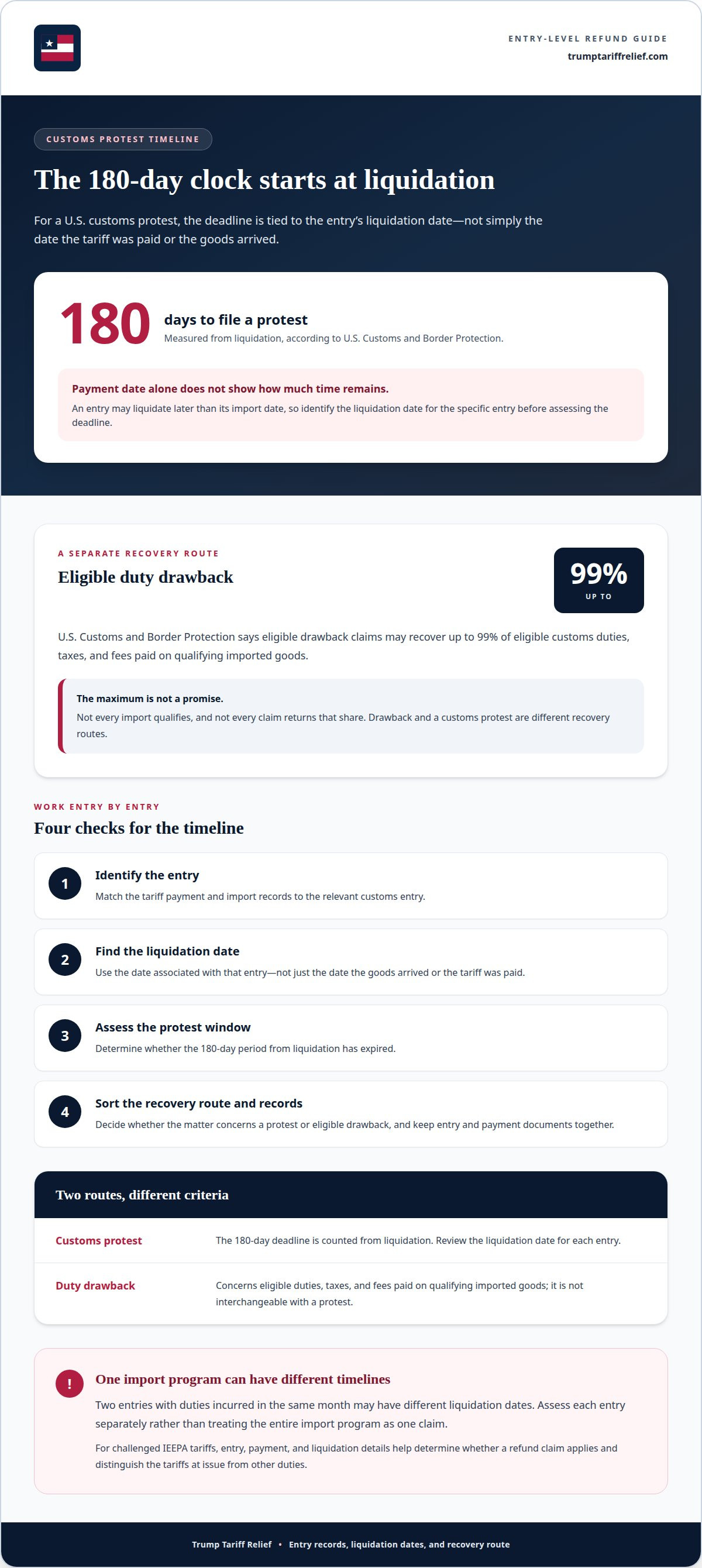
The clock for a U.S. customs protest starts at liquidation, not simply when an importer pays a tariff. U.S. Customs and Border Protection says a protest must be filed within 180 days of liquidation. That distinction matters: an entry’s liquidation date may be later than its import date, so the payment date alone does not establish how much time remains.
Liquidation is the point to focus on when assessing a specific entry. Start by identifying the relevant entry and its liquidation date in the customs records. Then calculate whether the 180-day period has expired. If there are multiple entries, assess each date separately; shipments from the same supplier can have different entry and liquidation timelines.
A protest and a duty drawback claim are different recovery routes. The protest deadline applies to a customs protest. Drawback concerns eligible duties, taxes, and fees paid on qualifying imported goods. According to U.S. Customs and Border Protection, U.S. duty drawback claims may recover up to 99% of eligible customs duties, taxes, and fees paid on qualifying imported goods. The 99% figure is a maximum, not a promise that every import qualifies or that every claim returns that share.
- Identify the entry: Match the tariff payment and import records to the relevant customs entry.
- Find liquidation: Locate the liquidation date associated with that entry, rather than relying only on the date goods arrived.
- Sort the recovery route: Determine whether the matter concerns a protest or eligible drawback, because they are not interchangeable.
- Organize supporting records: Keep entry and payment documents together so dates and amounts can be assessed consistently.
For example, two entries that incurred duties in the same month may have different liquidation dates, so their protest windows need separate review. Missing a deadline can affect whether the protest route remains available. For a business with many entries, reviewing each date is more useful than treating the entire import program as one claim.
The challenged IEEPA tariffs add another layer: the entry, tariff payment, and liquidation details matter when determining whether a refund claim applies. Reviewing the IEEPA tariff rules alongside entry records helps distinguish the tariffs at issue from other duties. The key first step is a clear entry-level timeline, followed by identifying the recovery path that fits those records.
Who pays U.S. tariffs
The importer of record pays the tariff to the U.S. government. That party, rather than the shopper who later buys the goods, is entitled to any refund. A consumer may still bear some of the cost through higher prices, but paying more at checkout doesn’t automatically create a customs refund claim.
This distinction separates the flow of money from the right to seek repayment. An importer can pay duties when goods enter the country, then decide how those costs affect pricing. A retailer may absorb some costs, pass some along, or use a mix of approaches. The consumer’s share depends on those business decisions, while refund eligibility depends on who paid Customs directly.
The Tax Foundation estimated that IEEPA tariffs cost the typical American household $700 in 2025. Consumers were projected to pay 55% of Trump’s tariffs in 2025. These figures describe household costs, not the amount an individual household can claim from the government. Consumers generally lack a contractual relationship with the importer of record that would entitle them to that importer’s tariff refund.
- Importer of record: The party paying the tariff to the government may pursue a refund tied to its eligible entries.
- Customs broker: A broker may file on behalf of the direct payer, rather than claiming a refund for itself.
- Business customer: A company buying imported goods domestically may face tariff-related price increases, but that alone doesn’t make it the importer.
- Household consumer: A shopper may bear an indirect cost through prices without being the party that paid Customs.
For example, a U.S. business imports a product and pays the tariff. A retailer later sells it to a household at a price that reflects some of its costs. The importer’s payment and the consumer’s purchase are separate transactions. A refund claim is tied to the customs payment, not simply to a later receipt or credit-card statement.
To identify the relevant payer, trace the import transaction: establish which business entered the goods, which party paid the duty, and whether a broker acted for that party. Those details help distinguish an importer’s refund claim from a consumer’s higher purchase cost. Businesses reviewing challenged IEEPA duties can use an IEEPA tariff eligibility assessment to understand which tariff category their entries involve.
What scams should I avoid when seeking a tariff refund?
Urgency can make a tariff refund offer sound more credible than it is. Treat an unexpected email promising fast payment as a reason to pause, especially if it demands an immediate transfer or sensitive records. A familiar-looking logo or Customs terminology doesn’t prove who sent the message. Verify the sender using contact details you already trust, not links or phone numbers in the message.
Be cautious of guarantees. A caller who promises a specific refund before reviewing entry records can’t establish eligibility through a sales pitch alone. Refund outcomes depend on the customs entries and the applicable recovery route. Don’t share banking credentials, account passwords, or one-time security codes with anyone claiming they’re needed to release funds. These details can expose business accounts without helping establish a customs claim.
- Pressure to pay immediately: Pause if an offer says a refund will disappear unless you pay or sign at once.
- Guaranteed results: Treat a promised payment amount as a warning if no one has examined the relevant import records.
- Unusual payment instructions: Be wary of requests to send funds through gift cards, cryptocurrency, or a personal account.
- Unverified identity: Don’t rely on a display name, logo, or caller ID as proof of a person’s authority.
- Excessive data requests: Share only records needed for an explained purpose, using a secure method.
For example, a message may claim that a refund is already approved, then ask for a bank password to “release” it. Stop there. A customs refund process should be explained in terms of entry records, claim steps, and who is authorized to act. A request for a password verifies none of those things.
Before authorizing work, get the scope and payment terms in writing. Confirm which records are needed, who will handle them, how they’ll be protected, and what actions you’re authorizing. Keep copies of signed documents and messages. If someone contacts you unexpectedly, independently verify their identity before sharing customs documents or changing payment details.
For an offer involving IEEPA duties, ask which entries and records the process covers. A clear process distinguishes an eligibility review from a guaranteed recovery and explains the next steps. Review the tariff refund recovery process before sharing records or authorizing a claim.
Trump Tariff Relief
Trump Tariff Relief helps businesses assess potential IEEPA tariff refunds and manage the related records and recovery process. If your company paid duties directly, a Tariff Eligibility Assessment can help determine whether entries may qualify. Customs Documentation Management helps organize claim records, while IEEPA Tariff Refund Recovery supports the recovery process.
This service is for businesses pursuing refunds, not consumers seeking repayment for higher retail prices. It can help when import records are complex or multiple entries need review. Trump Tariff Relief works on a contingency basis: there is no upfront cost, and payment is only a percentage of funds successfully recovered.
Contact Trump Tariff Relief to discuss your tariff refund situation.
Turn your next step into a clear recovery plan
For a business seeking to get its money back from tariffs, the next step is to turn import records into a focused recovery plan. Establish which entries may qualify, organize the supporting documents, and understand the proposed action before authorizing it. A structured review helps your team assess the work involved and make informed decisions without reacting to pressure or uncertainty.
Trump Tariff Relief can support that process through a Tariff Eligibility Assessment, Customs Documentation Management, and IEEPA Tariff Refund Recovery. The right starting point depends on what your business needs to resolve. If you’re ready to discuss your situation, contact Trump Tariff Relief. A clear next step can put your recovery efforts on firmer ground.
Frequently Asked Questions
What Are Tariff Refunds and How Can You Claim Them?
A tariff refund is repayment of eligible customs duties previously paid on imported goods. The route depends on the entry and the basis for recovery: an importer may pursue a customs protest or, for qualifying goods, a duty drawback claim. For a protest, U.S. Customs and Border Protection sets a deadline of 180 days from liquidation. The claim must relate to the relevant import records.
Can U.S. consumers get refunds for tariffs they paid on imported goods?
Generally, a consumer can’t claim a customs refund simply because tariffs affected a purchase price. The consumer paid a retailer, not U.S. Customs and Border Protection. Anyone seeking a price adjustment from a seller should review the purchase terms and the seller’s policies. That is separate from an importer’s customs refund claim.
Who is eligible for a tariff refund in the United States?
Eligibility generally rests with the party that directly paid U.S. tariffs, or a customs broker acting on that party’s behalf. A business that bought goods domestically doesn’t become the customs claimant just because tariff costs affected its purchase price. For an importer, eligibility depends on the entries, duties paid, applicable recovery route, and supporting records, not simply on importing from a particular country.
How do I request a refund of tariffs paid on an imported purchase?
If you’re trying to get your money back from tariffs on a retail purchase, first distinguish the store transaction from a customs payment. Consumers generally can’t file a customs refund claim based only on a receipt. If the seller charged an amount specifically as a tariff-related adjustment, contact the seller about the transaction and its refund policy. Keep the receipt and any written explanation of the charge.
How can an importer claim a refund of customs duties from U.S. Customs and Border Protection?
An importer should identify the entries and duties involved, then determine which recovery route applies. A customs protest must be filed within 180 days of liquidation, according to U.S. Customs and Border Protection. Qualifying goods may instead fit a drawback claim. The importer’s entry history and documentation guide the claim preparation, so entries should be assessed individually rather than combined by supplier or purchase date.
What documents are needed to claim a tariff refund?
Useful records include entry summaries, commercial invoices, transportation documents, and duty statements. Together, they connect imported goods with the customs entry and duties paid. Grouping records by entry helps reviewers compare shipment details with payment information. Keep related correspondence and claim documents too, since they can clarify what was submitted and how the entry was handled.
Ready to find out what your business may be owed?
Check My Eligibility