
A tariff refund can carry no U.S. Customs and Border Protection processing charge, while a separate professional recovery service may have its own fee arrangement. To get tariffs refunded, the first step is establishing whether your entries and duties qualify. CBP does not charge fees to process tariff refunds, and IEEPA refund claims use the CAPE process through the ACE Portal.
Before pursuing a claim, get clarity on both eligibility and fees. CBP’s processing charges are separate from professional recovery fees. Trump Tariff Relief reviews potential eligibility, organizes supporting documentation, and manages the refund process. This guide explains what may qualify, which records support an assessment, and how the service’s contingency-based fee works, so you can understand the next steps before deciding how to proceed.
Key Takeaways
- CBP doesn’t charge a fee to process tariff refunds; separate professional recovery services may have their own fee terms.
- Eligibility depends on the entry, the tariff paid, and who acted as the Importer of Record or directly paid the duties.
- Entry summaries, invoices, and proof of payment can help support an estimate and organize a refund claim.
- Estimate the potentially refundable IEEPA duties separately from other duties, then account for entry status and any required review.
Are there any fees or charges to receive a tariff refund?
CBP handles U.S. customs-duty refund claims. Consumers generally cannot claim duties included in a retail purchase. A consumer who was the Importer of Record and paid duties may have a claim tied to those entries. CBP does not charge a fee to process tariff refunds, while professional recovery support has separate fee terms.
- Separate government charges from professional fees. CBP does not charge to process a refund. Professional support is different: Trump Tariff Relief’s recovery service operates on a contingency-fee basis, with no upfront costs and payment only if a refund is successfully recovered.
- Account for court oversight and process uncertainty. Judge Richard Eaton of the U.S. Court of International Trade must approve the tariff-refund process before it proceeds. Whether claims require litigation or follow a separate administrative process has been unclear, so the applicable route depends on the process governing the entries.
- Have a professional organize the CAPE filing through ACE. A professional reviews entry and payment records, identifies potentially eligible entries, and prepares a CAPE Declaration for submission through the Automated Commercial Environment (ACE) Portal. Importers need an ACE Portal account and bank account information for electronic payment. U.S. Customs and Border Protection says valid IEEPA refunds are generally expected within 60 - 90 days after acceptance of a CAPE Declaration, unless further review is required.
- Track processing through the right records. CBP doesn’t email CAPE status updates. The filer can monitor ACE Reports, including the REV-615 Trade CAPE Detail Refund Report, or coordinate status through the customs broker connected to the filing.
- Address errors through the formal review route. An ineligible entry, filer mismatch, or inconsistent payment documentation can prevent a claim from proceeding as expected. If CBP’s liquidated or reliquidated refund amount is disputed, U.S. Customs and Border Protection allows a protest within 180 days after liquidation or reliquidation.
Eligibility for refunds of tariffs struck down by the Supreme Court
In the United States, eligibility generally centers on the Importer of Record (IOR) or a licensed customs broker that directly paid the IEEPA tariffs. The Supreme Court ruled on February 20, 2026, that IEEPA does not authorize the president to impose tariffs.
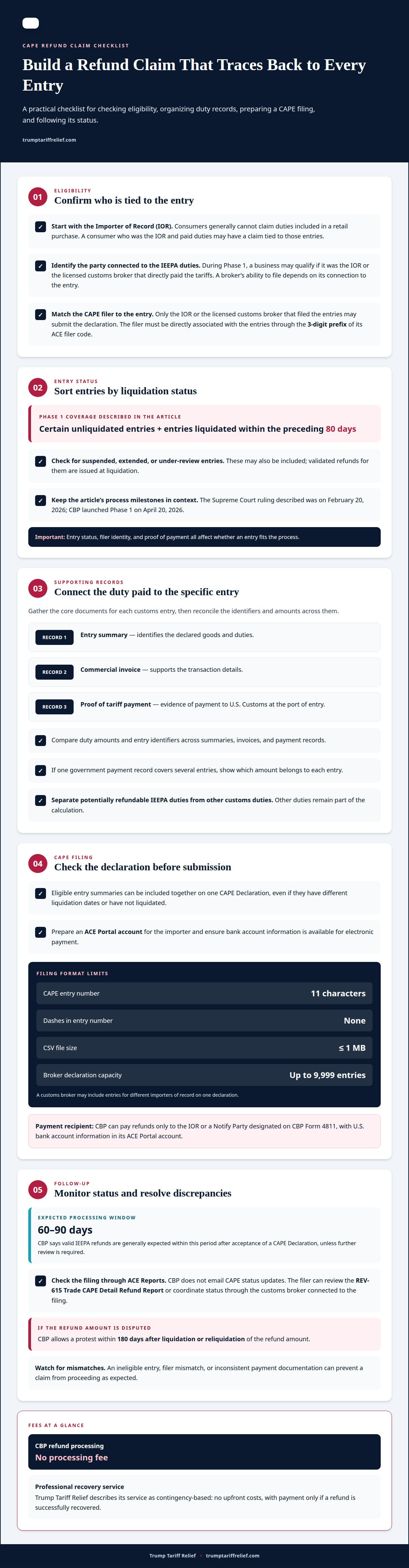
- Identify the responsible importer or broker. Match each entry to its IOR and the licensed broker involved. During Phase 1, a business may qualify if it was the IOR or the licensed customs broker that directly paid the tariffs. A broker’s ability to file also depends on its connection to the entry.
- Sort entries by liquidation status. Phase 1 covers certain unliquidated entries and entries liquidated within the preceding 80 days. Entries with suspended, extended, or under-review liquidation status may also be included; validated refunds for those entries are issued at liquidation.
- Check who can submit the CAPE Declaration. Only the IOR or the licensed customs broker that filed the entries may submit it. The filer must be directly associated with the entries through the 3-digit prefix of its ACE filer code. CBP launched Phase 1 on April 20, 2026.
- Connect the claim to proof of payment. Reconcile entry records with duty-payment evidence, then isolate the IEEPA amount from other duties. CBP can pay refunds only to the IOR or a Notify Party designated on CBP Form 4811 with U.S. bank account information in its ACE Portal account.
- Use a professional review to resolve eligibility questions. Entry status, filer identity, and proof of payment determine whether a claim fits the process. A professional eligibility review can organize those records and identify entries for consideration.
Entry summaries and proof of duties paid
- Build a document set for each customs entry. Gather the entry summary, commercial invoice, and proof of tariff payment made to U.S. Customs at the port of entry. The summary identifies the declared goods and duties; the invoice supports the transaction details. Together, these records help connect the International Emergency Economic Powers Act (IEEPA) duty to the specific import and importer.
- Reconcile payment evidence against the entry summary. A professional compares the duty amounts and entry identifiers across summaries, invoices, and payment records. If a government payment record covers several entries, the reconciliation should show which amount belongs to each entry. This step separates potentially refundable IEEPA duties from other customs duties that remain part of the calculation.
- Organize entries by CAPE eligibility and status. Phase 1 covers certain unliquidated entries and entries liquidated within the preceding 80 days. Eligible entry summaries can be included together on one CAPE Declaration, even if they have different liquidation dates or have not liquidated. Organizing by status helps prevent eligible entries from being overlooked during filing.
- Prepare the electronic filing data carefully. CAPE Declaration entry numbers must contain 11 characters without dashes, and a CSV file may not exceed 1 MB. A customs broker may include up to 9,999 entries for different importers of record on one declaration. The professional checks these formatting limits before submitting through the Automated Commercial Environment (ACE) Portal.
- Maintain an auditable record set. CBP has not introduced new recordkeeping requirements for a CAPE Declaration; existing applicable requirements continue. A professional can index entry summaries, invoices, payment evidence, and filing details so each claimed duty traces back to its supporting documents. That organized file helps address discrepancies and keeps the international trade documentation connected throughout the refund process.
Methodology and limitations of refund estimates
- Isolate the IEEPA duty for each entry. Start with the entry summary and identify the duty attributed to tariffs imposed under the International Emergency Economic Powers Act. Separate that amount from ordinary customs duties and other charges. For example, CBP’s example uses a 5% general duty and a 10% IEEPA duty: the IEEPA portion is refundable, while the general duty remains applicable. A company seeking to get tariffs refunded should base its estimate on the IEEPA amount, not the total duty bill.
- Match amounts to payment records. Compare each entry’s duty details with customs payment records and invoices. If one payment covers multiple entries, allocate it using the entry-level amounts rather than treating the full payment as potentially refundable. Inconsistent or missing records can leave the estimate incomplete because the calculation depends on duties actually paid and attributable to eligible imports.
- Classify entries by liquidation status. An entry’s status affects whether it can be included in the applicable CAPE filing and when a refund may be processed. Distinguish unliquidated entries from liquidated or reliquidated entries, and flag entries subject to review. ACE Portal reports can help reconcile filing data, but an estimate must still reflect the status of each entry.
- Account for adjustments and interest. At liquidation or reliquidation, CBP nets overpayments and underpayments across the entire entry under 19 C.F.R. § 159.1. U.S. Customs and Border Protection says interest is generally calculated from the duty deposit or estimated payment through liquidation or reliquidation. An outstanding debt to the United States may also reduce the amount paid.
- Treat the result as an estimate, not a promised payment. The final calculation depends on eligible entries, payment evidence, entry status, interest, and adjustments made during processing. A preliminary total can differ from CBP’s final refund. For businesses working to get tariffs refunded, request a tariff refund eligibility assessment to have the records and estimate reviewed against the CAPE process.
Trump Tariff Relief: IEEPA Tariff Refund Recovery
Trump Tariff Relief helps businesses pursue IEEPA tariff refunds through eligibility assessment, documentation management, and recovery filings. Turn to the service when your entry summaries and payment records need to be assessed, organized, and prepared for the refund process. The team reviews the available records to identify potentially eligible duties and manage the supporting documentation.
Trump Tariff Relief works on a contingency-based basis: there are no upfront costs, and you pay only a percentage of funds successfully recovered. There is no win, no fee. This can suit importers who want professional support without an initial service charge. If records are incomplete or entries have different liquidation statuses, an eligibility assessment can help determine which entries may qualify and what documentation is needed. Refund outcomes are not guaranteed.
For help assessing eligibility and managing the refund process, contact Trump Tariff Relief.
Put Your Refund Claim in Motion
An estimate is only a starting point. Identify the entries that may qualify, gather supporting records such as entry summaries and duty statements, and track each claim’s status. A complete, organized file helps your business make an informed decision about pursuing a potential recovery, rather than relying on a rough total alone.
For businesses seeking to get tariffs refunded, Trump Tariff Relief provides IEEPA Tariff Refund Recovery, Tariff Eligibility Assessment, and Customs Documentation Management. Start with an eligibility review to understand which entries may qualify, then organize the records needed to prepare and manage the appropriate filings. This moves the process from scattered documents toward a claim based on your actual entries and payments.
Take the next step at a pace that fits your business. Contact Trump Tariff Relief to discuss your potential claim and move forward with greater clarity.
Frequently Asked Questions
How can a professional help prepare for a potential refund of IEEPA duties?
An eligibility review starts with your import history and the information needed to assess it. Trump Tariff Relief uses basic company data, estimated tariff fees paid, import regions, and available documentation. Your business information is kept confidential and is never shared without explicit consent. An initial response is provided within one business day; the full assessment timeline varies with case complexity.
How does a professional prepare a tariff refund claim?
Trump Tariff Relief reviews available CBP and ACE data, filters entries for potential eligibility, and assembles supporting documents. Its eligibility filtering excludes anti-dumping duties and reconciled entries. Depending on the entry and claim, the filing may involve a Post-Summary Correction, protest, or drawback claim. The team then tracks the filing through disbursement, keeping the claim connected to its supporting records.
What documents should I provide a professional to claim a tariff refund?
Gather entry summaries, commercial invoices, transportation documents, and duty statements. These records connect imported goods to declared entries and duty payments. For an initial eligibility check, Trump Tariff Relief also needs basic company data, estimated tariff fees paid, import regions, and information about available documentation. If records are stored in different systems, note where they can be accessed.
What are the deadlines and time limits for tariff refund claims?
For a protest contesting a liquidated or reliquidated IEEPA refund amount, U.S. Customs and Border Protection specifies a 180-day filing period after liquidation or reliquidation. Phase 1 CAPE filings cover certain entries liquidated within the preceding 80 days, as well as qualifying unliquidated entries. These are different timing rules, so a professional evaluates each entry’s status and the relevant filing route separately.
How does a professional check whether tariffs paid are refundable?
Trump Tariff Relief compares your import history and entry records with IEEPA duties paid, then reviews the importer’s role, entry status, and supporting documentation. The assessment excludes anti-dumping duties and reconciled entries. Because eligibility depends on your specific import history and available evidence, the review identifies which entries may proceed to further claim preparation. A refund is not guaranteed.
How are tariff refunds calculated, including interest and fees?
An estimate begins with potentially refundable IEEPA duties and accounts for entry-level adjustments and interest. CBP generally calculates interest from the duty deposit or estimated payment through liquidation or reliquidation. Trump Tariff Relief charges no upfront fee and is paid only a percentage of funds successfully recovered. The final amount depends on CBP’s processing and the applicable adjustments.
Ready to find out what your business may be owed?
Check My Eligibility