
A tariff refund isn’t automatic: eligibility depends on who paid the IEEPA duty and the status of each entry. To get money back from tariffs through Phase 1, a business generally needs to have been the importer of record or the licensed customs broker that directly paid the duty. The filing window also matters: Phase 1 covers certain unliquidated entries and entries liquidated within the preceding 80 days.
The process of getting money back from tariffs can feel like a moving target when entry records, payment details, and liquidation dates are spread across different systems. Those details help determine which entries may qualify and who can submit a CAPE Declaration.
This guide explains how to assess eligibility, review liquidation timing, and assemble import, export, and recordkeeping documents. You’ll also learn what to do if an entry is outside the Phase 1 window, so you can organize the facts and pursue the appropriate refund path.
Key Takeaways
- Start by identifying who was the importer of record or directly paid the IEEPA duties, since that determines who may file.
- Review each entry’s liquidation status and timing to see which refund pathway may apply and whether a protest deadline matters.
- Bring entry summaries, payment details, shipment records, invoices, and export documents together to support the claim.
- Organize records by entry and keep them available, so eligibility and supporting evidence can be assessed efficiently.
Refund eligibility for importers of record and customs brokers
Start by identifying who paid the IEEPA duties, then match each entry to its filing and liquidation status. Eligibility and refund routing depend on these records.
-
Confirm who may claim a refund
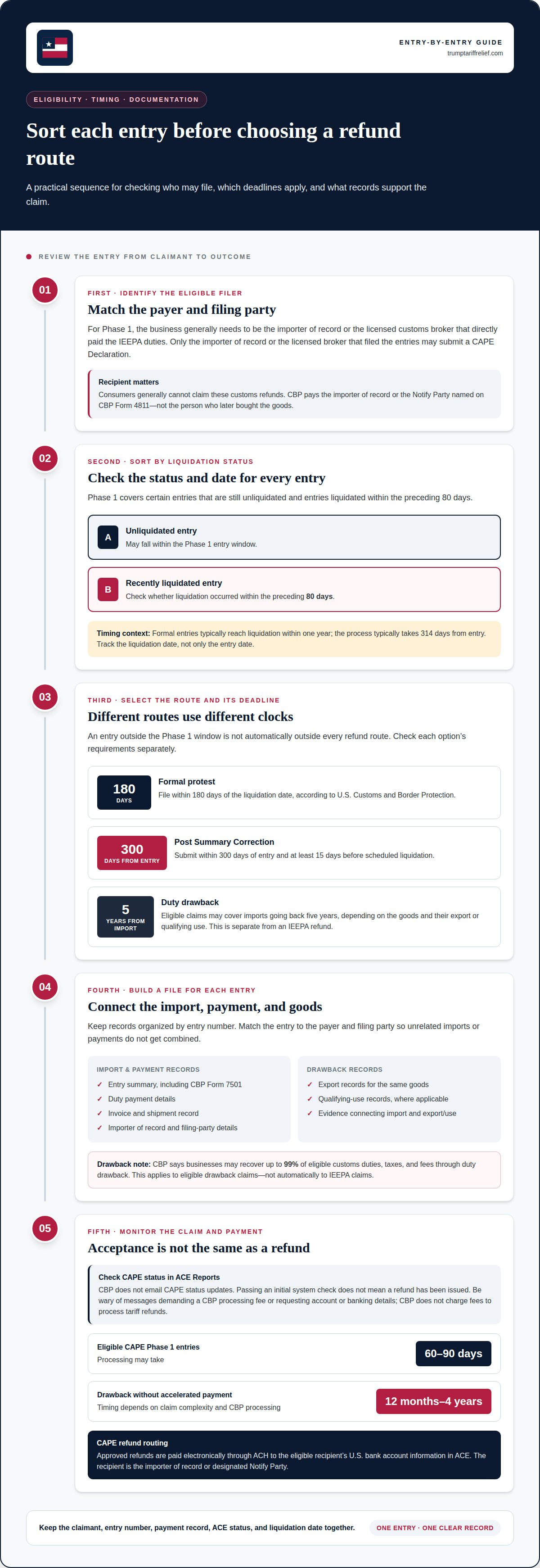
Identify the importer of record or licensed customs broker that directly paid the IEEPA duties. During Phase 1, only the importer of record or the licensed broker that filed the entries may submit a CAPE Declaration. Consumers generally cannot claim these customs refunds because CBP pays the importer of record or the Notify Party named on CBP Form 4811, not the person who later bought the goods.
-
Check claim eligibility and approval
Match the entry number, payer, and filing party before assessing eligibility. To check whether a claim is eligible or approved, review its status in ACE Reports; CBP does not email CAPE status updates. Passing an initial system check does not mean a refund has been issued. When reviewing common IEEPA refund questions, distinguish filing acceptance from payment.
Be wary of messages demanding a CBP processing fee or claiming to provide an official status update by email. CBP does not charge fees to process tariff refunds and does not email CAPE status updates. Use ACE Reports to check status, and do not share account or banking details in response to unsolicited messages.
- Check the liquidation date before choosing a next step. According to U.S. Customs and Border Protection, a formal protest against a liquidation must be filed within 180 days of the liquidation date. Record the date and preserve the entry documents. Missing that deadline can affect the available route for challenging a liquidation.
Then consider how a recovered refund could fit into the company’s finances. Walmart and Costco pledged to use tariff refunds to lower prices for shoppers.
- Confirm how an approved refund will be routed. CAPE refunds are paid electronically through ACH to the eligible recipient’s U.S. bank account information in ACE. The importer of record or designated Notify Party receives the funds, not every business or consumer affected by the original tariff.
Keep the filing party, payment record, ACE status, and liquidation date together. These details help distinguish a potentially eligible claim from a filing that belongs to another party or needs attention to its protest deadline.
Eligible entries and liquidation timing
Sort entries by liquidation status and import date before choosing a refund route. The applicable filing deadline depends on whether you pursue an IEEPA refund, protest a liquidation, or claim duty drawback.
There isn’t one deadline for every customs duty refund claim with CBP. For a formal protest, U.S. Customs and Border Protection sets a deadline of 180 days from liquidation; Phase 1 CAPE timing follows a separate entry window.
-
Verify importer and drawback eligibility
Match each entry to the importer of record and the party that paid the duties. For the IEEPA process, the importer of record or the licensed customs broker that filed the entry may submit a CAPE Declaration. Duty drawback is a separate route: eligible claims may cover imports going back five years from import, depending on the goods and their export or qualifying use.
Keep the two routes distinct. An entry eligible for an IEEPA refund does not automatically qualify for drawback. Review the IEEPA tariff rules alongside the entry and transaction record before selecting a filing path.
-
Check the filing deadline
Start with the entry’s liquidation status and date. Phase 1 covers certain unliquidated entries and entries liquidated within the preceding 80 days. If the entry falls outside that window, don’t assume every refund route is closed; a protest or drawback claim has separate requirements and timing.
For a formal protest, file within 180 days of liquidation, according to U.S. Customs and Border Protection. A Post Summary Correction follows another schedule: it must be submitted within 300 days of entry and at least 15 days before scheduled liquidation. Identify the action that applies before preparing a submission.
- Track liquidation rather than relying only on the entry date. Formal entries typically reach liquidation within one year, with the process typically taking 314 days from entry. That interval can affect whether an entry remains unliquidated or has entered a limited refund window.
For eligible CAPE Phase 1 entries, processing may take 60-90 days; excluded categories may take longer. Without accelerated payment, drawback refunds may take 12 months to 4 years, depending on claim complexity and CBP processing. Record the route and status for each entry separately.
Import and export documentation
Build a document set for each entry, then keep IEEPA refund evidence separate from drawback records. The Supreme Court ruling on tariffs under the International Emergency Economic Powers Act concerns a different recovery route from duty drawback.
- Match each import record to its entry summary, duty payment, invoice, and shipment record. CBP Form 7501 can help identify entry details and connect the importer with the duties paid. Keep documents organized by entry number, so the claim does not combine unrelated imports or payments.
- For an IEEPA claim, align the entry information with the importer of record and the party that paid the duties. The administration’s emergency tariffs involved different entries and duty amounts, so a claim should identify the specific import and tariff payment at issue. Preserve the original records supporting each entry.
- For drawback, connect import records with export or qualifying-use records for the same goods. U.S. Customs and Border Protection says businesses may recover up to 99% of eligible customs duties, taxes, and fees through duty drawback. That percentage applies to eligible drawback claims, not automatically to IEEPA refunds.
- Assemble export evidence alongside the related import documents, invoices, and transaction records. Link the records by shipment or transaction instead of relying on a summary total. This helps show how imported goods relate to exports and supports review of whether the goods and duties qualify.
- Before submission, reconcile each entry’s importer, duty amount, and supporting documents. A CAPE Declaration cannot be amended after filing and acceptance, although a filer may submit a new declaration for eligible entries not previously submitted. Accurate records matter before filing, not just during later government review.
Documentation and recordkeeping preparation
Organize evidence by entry before filing, and keep payment, shipment, and export records connected. A clear record helps show CBP which duties relate to each import.
- Create a separate file for each entry with its entry summary, commercial invoice, shipment record, and duty payment evidence. Add export documents when the goods support a drawback claim. This structure lets a reviewer trace the import through the transaction without relying on a combined total or unrelated invoice.
- Retain drawback-related records for at least three years after claim liquidation. Keep the import and export evidence, transaction records, and claim materials together for that period. If a shipment includes multiple products, preserve documents identifying the goods and their relationship to the entry, rather than keeping only a general payment summary.
- Prepare the ACE Portal details required for electronic refunds. Importers of record and customs brokers need an ACE Portal account, with bank account information added to that account. CBP pays CAPE refunds through Automated Clearing House, so payment details should match the eligible recipient. Keep access and payment records with the filing materials.
- Keep documents for emergency economic powers act tariff claims separate from drawback files. The Supreme Court ruling concerned IEEPA tariffs, while drawback has its own eligibility evidence, including qualifying export or use records. Label each folder by claim type, entry, and payment so records passed between teams remain traceable and separate government filing paths do not get mixed.
For a structured review of entry and supporting records, organize your claim documents with Customs Documentation Management before filing.
Trump Tariff Relief
Trump Tariff Relief helps businesses assess IEEPA refund eligibility, organize customs records, and manage the refund recovery process. Turn to the team when entry records, payment evidence, and liquidation dates need to be brought together for a clear claim review. Its services include Tariff Eligibility Assessment, Customs Documentation Management, and IEEPA Tariff Refund Recovery.
If you’re ready to discuss your entries and supporting documents, contact Trump Tariff Relief.
Turn Your Refund Review Into a Clear Next Step
The next step is to turn scattered entry details into a practical recovery decision. A focused review can help your team distinguish entries that may qualify from those needing a different approach, while aligning documentation and filing priorities. That clarity supports planning around recovered duties and avoids treating every import as the same claim.
Trump Tariff Relief supports this work with IEEPA Tariff Refund Recovery, Tariff Eligibility Assessment, and Customs Documentation Management. If your business is assessing how to get money back from tariffs, bring your entry and payment records into the conversation so the review can address your actual import history.
Contact Trump Tariff Relief to discuss your tariff refund situation. A well-organized first step can put your business in a stronger position to move forward.
Frequently Asked Questions
How can I prepare for a potential refund of IEEPA duties?
Prepare your company and import-history details, estimated IEEPA duties paid, import regions, and available records. Organize the information and note which entries need further review. Trump Tariff Relief keeps business information confidential and never shares it without explicit consent. The eligibility check has no upfront cost, and payment is only a percentage of funds successfully recovered.
What Documentation Should You Gather?
Gather entry summaries, commercial invoices, transportation documents, and duty statements. Match each item to the relevant shipment and payment record instead of relying on a total across multiple imports. If goods were exported, keep related export and transaction records with the import file. Clear connections between documents help show which goods, entry, and duties each claim concerns.
What are IEEPA tariffs?
IEEPA tariffs are import duties imposed under the International Emergency Economic Powers Act, a federal law cited as authority for those tariffs. On February 20, 2026, the U.S. Supreme Court ruled that IEEPA does not authorize the president to impose tariffs. That ruling concerns the legal basis for the duties; a business’s refund eligibility still depends on its import records and claim circumstances.
When Should Businesses Expect a Refund?
There is no single payment date for every business. Timing depends on whether entries qualify for the applicable refund process, their status, and the government’s processing and payment steps. Filing a claim and receiving an approved refund are different stages. Track the claim in ACE Reports and keep its status with the related entry and payment records.
Who can get a refund of U.S. tariffs or import duties?
For a business seeking to get money back from tariffs, the importer of record that paid the IEEPA duties is generally the eligible claimant; a licensed customs broker may file when it directly paid the duties or acts for the importer. A consumer who paid a retailer’s price generally is not the customs claimant. The key distinction is who appears in the customs entry and payment records.
How do I request a refund of tariffs paid on imported goods?
To get money back from tariffs on imported goods, first identify the entries and confirm who paid the IEEPA duties. The eligible importer of record or the licensed broker that filed the entries submits a CAPE Declaration for eligible entries. The filer may need to provide account details for electronic payment. Keep submission details and entry references together to track claim status in ACE Reports.
Ready to find out what your business may be owed?
Check My Eligibility