
Could you get a tariff refund without paying a service fee upfront? Eligible importers may be able to recover up to 100% of qualifying tariffs paid under the International Emergency Economic Powers Act, plus applicable statutory interest. For professional recovery assistance, the fee model described here requires no upfront payment; a fee is due only if a refund is successfully recovered.
It’s reasonable to want clear answers before starting a claim, especially when eligibility depends on entry status and accurate payment records. This guide explains who may qualify, how portal submissions work, and which import, shipment, invoice, and payment documents can support a request. You’ll also learn what to expect from the process so you can make an informed decision about getting help to get a tariff refund.
Key Takeaways
- Eligibility depends in part on an entry’s status and whether it was subject to IEEPA duties; identifying the right category is the first step.
- A portal request depends on accurate entry information and active ACH refund enrollment, so submission preparation matters.
- Organize importer-of-record details, shipment and transaction records, entry summaries, and proof of payment to support the claim.
- A professional eligibility assessment and customs documentation management can help businesses prepare a refund request and manage the recovery process.
Who is eligible to request an IEEPA tariff refund?
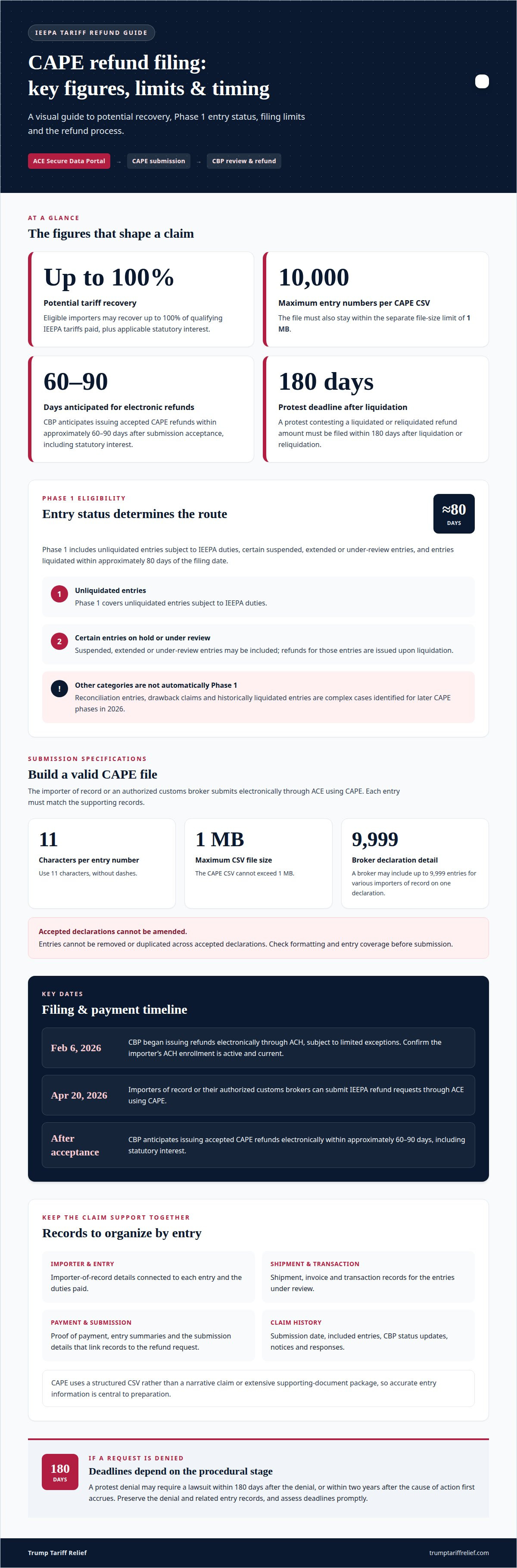
Eligible importers may recover up to 100% of qualifying IEEPA tariffs paid, plus applicable statutory interest. If U.S. Customs and Border Protection (CBP) denies a request, assess the entry’s status and dispute deadlines promptly. A protest contesting the liquidated or reliquidated refund amount must be filed within 180 days after liquidation or reliquidation, according to the U.S. Congress. If CBP denies a protest, a lawsuit deadline may also apply.
- Identify the importer of record. Establish which importer is associated with each entry and the duties paid. Importers of record, or their authorized customs brokers, can submit IEEPA refund requests electronically through the ACE Secure Data Portal using CAPE. Keep importer details connected to the entry documentation, rather than treating a shipment’s buyer or consignee as automatically entitled to claim.
- Confirm the tariff basis. Match each duty payment to IEEPA, the International Emergency Economic Powers Act. On February 20, 2026, the U.S. Supreme Court ruled that IEEPA does not authorize the president to impose tariffs. That ruling concerns IEEPA duties; it does not make every tariff payment eligible for an IEEPA refund.
- Classify each entry by status. CAPE Phase 1 includes unliquidated entries subject to IEEPA duties. It also covers certain suspended, extended, or under-review entries, with refunds for those issued upon liquidation. Entries liquidated within approximately 80 days of the filing date are also included in Phase 1.
- Separate other entry categories. Do not assume every historical entry fits Phase 1. Reconciliation entries, drawback claims, and historically liquidated entries are complex cases identified for later CAPE phases in 2026. An entry’s status and tariff basis determine whether it fits the current submission route.
- Address a denial by its procedural stage. For a protest denial, a lawsuit must be filed within 180 days after the denial, or within two years after the cause of action first accrues. Preserve the denial and related entry records so the protest or court filing addresses the specific disputed refund claim.
How a professional submits a refund request through the portal
Tariff refunds aren’t automatic. An eligible IEEPA refund request must be submitted electronically through the ACE Secure Data Portal using CAPE by the importer of record or an authorized customs broker.
- Confirm the importer’s portal access. The professional identifies the importer of record and confirms the ACE account can support the filing. They coordinate access through authorized users rather than relying on informal account sharing. The importer may need to provide business details and authorization for the professional to act on its behalf.
- Review electronic refund enrollment. Before filing, the professional checks whether the importer’s ACH refund enrollment is active and current. CBP began issuing refunds electronically through ACH on February 6, 2026, subject to limited exceptions. The professional coordinates enrollment steps with the importer and makes sure the designated account information is accurate.
- Prepare the CAPE submission. Beginning April 20, 2026, importers of record or their authorized customs brokers can submit IEEPA refund requests through ACE using CAPE. The professional matches entry numbers to supporting records and prepares the structured CSV file, rather than a narrative claim or an extensive document package. Each entry number must contain 11 characters without dashes.
- Validate file limits before filing. A CAPE CSV file may include no more than 10,000 entry numbers and cannot exceed 1mb. A broker may include up to 9,999 entries for various importers of record on one declaration. The professional reviews formatting and entry coverage before submission because accepted declarations cannot be amended, and entries cannot be removed or duplicated across accepted declarations.
- Track acceptance and payment details. The professional monitors the filing status and confirms that ACH details remain aligned with the importer’s enrollment. CBP anticipates issuing accepted CAPE refunds electronically within approximately 60-90 days after submission acceptance, including statutory interest. A clear refund submission workflow helps keep portal access, records, and filing steps coordinated.
Recordkeeping to support a refund claim
For a protest contesting a liquidated or reliquidated IEEPA refund amount, file within 180 days after liquidation or reliquidation, according to the U.S. Congress. A professional organizes the supporting records and tracks each claim’s procedural status.
-
Provide records for the refund claim
Gather importer-of-record information and shipment, invoice, and transaction records for the entries under review. Trump Tariff Relief organizes documents by entry and connects each record to the relevant IEEPA duty payment and refund request. This structure helps identify missing or inconsistent information before submission.
Keep the original records together with the submission details and any CBP notices. CAPE uses a structured CSV file, rather than narrative claims or extensive supporting documentation, so accurate entry data is central to preparation. A professional also separates entries by status and claim category, helping prevent complex cases from being mixed into a straightforward filing.
-
How your refund provider tracks the refund claim
Track each claim’s submission date, the entries included, and every CBP status update. Trump Tariff Relief maintains this history alongside supporting documentation, so the importer can follow whether a claim has been submitted, accepted, or needs further attention. Keep notices and responses with the same claim file.
Track complex entries separately. CBP plans additional CAPE phases later in 2026 for reconciliation entries, drawback claims, and historically liquidated entries. A professional can distinguish those categories from claims handled in Phase 1, then organize records for the relevant refund process. If CBP issues a decision affecting a liquidated or reliquidated amount, record its date promptly because the 180-day protest period runs from that event. Clear records support compliance and help the claim remain traceable through electronic processing.
Entry summaries and proof of payment
Build a document trail that connects each entry to its importer, IEEPA duties, and payment. A professional can use that trail to prepare consistent refund claims.
- Match each entry summary to its entry number. Gather CBP Form 7501, an example of an entry summary used to support a tariff refund claim. Organize summaries by entry number and importer of record. This helps connect the goods and declared entry details with the corresponding duty assessment. Keep separate records for entries with different statuses, rather than combining them into one indistinguishable file.
- Link payment evidence to the assessed duties. Assemble available customs payment confirmations, accounting records, and transaction documents for each entry. The goal is to show how the payment record corresponds to the duty amount and entry summary. If a ledger groups multiple payments, preserve the underlying transaction detail so each amount can be traced to its entry.
- Reconcile invoices and shipment records. Pair supplier invoices and shipment documentation with the relevant entry summary and payment information. For example, a shipment file can show which commercial invoice relates to a particular import entry. Note discrepancies for review before claim preparation; inconsistent importer names, entry references, or amounts can make records harder to reconcile.
- Preserve a complete claim file. Store submitted claim details, supporting documents, and CBP correspondence together. Include a record of which entries were included and when the filing occurred. CAPE submissions began April 20, 2026, making a clear timeline useful for organizing electronic claims and later status updates. Retain the original records as well as working copies used during preparation.
- Connect the evidence to the refund request. A professional can map entry summaries and payment records to the claim, identify gaps, and organize the supporting file. For help coordinating this documentation, work with Trump Tariff Relief on Customs Documentation Management.
Trump Tariff Relief: IEEPA Tariff Refund Recovery
Trump Tariff Relief helps businesses pursue IEEPA tariff refunds through eligibility assessment, claim preparation, and customs documentation management. Turn to the team when you need help identifying potentially eligible entries, organizing records, or managing the refund process from assessment through government filing.
The process begins with reviewing importer and entry information, then organizing the documentation needed to support a claim. IEEPA Tariff Refund Recovery is contingency-based: there are no upfront costs, and clients pay only a percentage of funds successfully recovered. This may suit businesses seeking professional support without an upfront service payment.
To discuss your situation and start an eligibility check, contact Trump Tariff Relief.
Move Your Refund Claim Forward
The next step is turning a possible recovery into a clear, organized claim. A focused eligibility review helps determine which entries warrant attention and what supporting records each claim needs. That clarity gives your business a practical basis for deciding how to proceed, rather than leaving a potential recovery unresolved.
Trump Tariff Relief offers IEEPA Tariff Refund Recovery, Tariff Eligibility Assessment, and Customs Documentation Management. These services help businesses seeking professional support to get a tariff refund and coordinate the records and filing steps involved in a claim.
Bring your questions and import information to the next conversation. A closer review can help establish a path forward for your situation. Contact Trump Tariff Relief to discuss your refund claim and take the next step with confidence.
Frequently Asked Questions
Are there any fees or charges to receive a tariff refund?
Trump Tariff Relief charges no upfront cost for refund recovery. Payment is only a percentage of the amount successfully recovered, so there is no service fee if no refund is recovered. This contingency-based arrangement applies to the firm’s service fee, not every possible government or banking charge. The eligibility check and consultation are free, and refund eligibility depends on your import history and documentation.
How long will it take for me to get my refund?
For accepted CAPE submissions, CBP anticipates issuing refunds electronically within approximately 60-90 days after acceptance, including statutory interest. That timeframe follows acceptance, not the start of eligibility review or claim preparation. If an entry must first be liquidated, its processing status also affects when payment can proceed. Keep the claim status and ACH enrollment information current while awaiting disbursement.
How can a professional prepare for a potential refund of IEEPA duties?
The eligibility check requires basic company data, estimated tariff fees paid, import regions, and information about available documentation. These details help frame the initial review and identify which import history needs closer analysis. A business can designate an authorized contact to coordinate questions about its entries, payment history, and records during the assessment.
How can a refund professional prepare?
Trump Tariff Relief screens import records against relevant claim categories before preparing a filing. Its eligibility filtering excludes anti-dumping duties and reconciled entries. The team can identify eligible entries, assemble supporting records, prepare the appropriate filing instrument, and track the submission through disbursement. Eligibility depends on the importer’s specific history and documentation, not simply on having paid tariffs.
What documentation should you provide for a refund claim?
Provide entry summaries, commercial invoices, transportation documents, and duty statements when available. For example, a duty statement can help connect a payment to the import activity shown in an entry summary. Include basic company details, estimated tariff fees paid, and import regions for the eligibility check. Organize documents by entry so Trump Tariff Relief can connect records and identify gaps during claim preparation.
Who is eligible for a tariff refund in the United States?
Eligibility generally concerns the importer of record and entries with qualifying IEEPA duties. CAPE Phase 1 covers eligible unliquidated entries, plus certain suspended, extended, or under-review entries; refunds for the latter are issued upon liquidation. A customs broker authorized by the importer may submit the electronic request. The entry’s tariff basis and status matter, so paying duties alone does not establish eligibility.
Ready to find out what your business may be owed?
Check My Eligibility