
Potential refunds could reach as high as $175 billion, according to Yale Budget Lab, but the Supreme Court did not decide whether or how importers will be repaid. Its 6-3 ruling held that tariffs imposed under IEEPA were unlawful. For a business owner, how the Supreme Court tariff ruling affects my business depends on more than that headline: the tariffs your imports bore, the contracts allocating tariff costs, and the refund process all matter.
It makes sense to ask whether your business can recover money already paid or whether the decision will change what you pay next. A ruling against one tariff authority does not automatically refund past duties or rewrite your supply contracts. Here’s what the decision changes, what remains unresolved, how contract terms affect who bears tariff costs, and why updated assumptions about prices and import expenses matter when planning hiring and investment.
Key Takeaways
- Separate IEEPA-related import costs from tariffs imposed under other authorities to understand which expenses may change.
- Use tariff exposure and potential cost shifts to frame hiring and investment decisions, rather than treating the ruling as a complete forecast.
- Review contract terms to see how tariff costs are allocated between importers, suppliers, and customers.
- Understand what the ruling decided, what it left unresolved, and which customs records may matter when assessing refund eligibility.
Potential effects on prices, consumption, and inflation
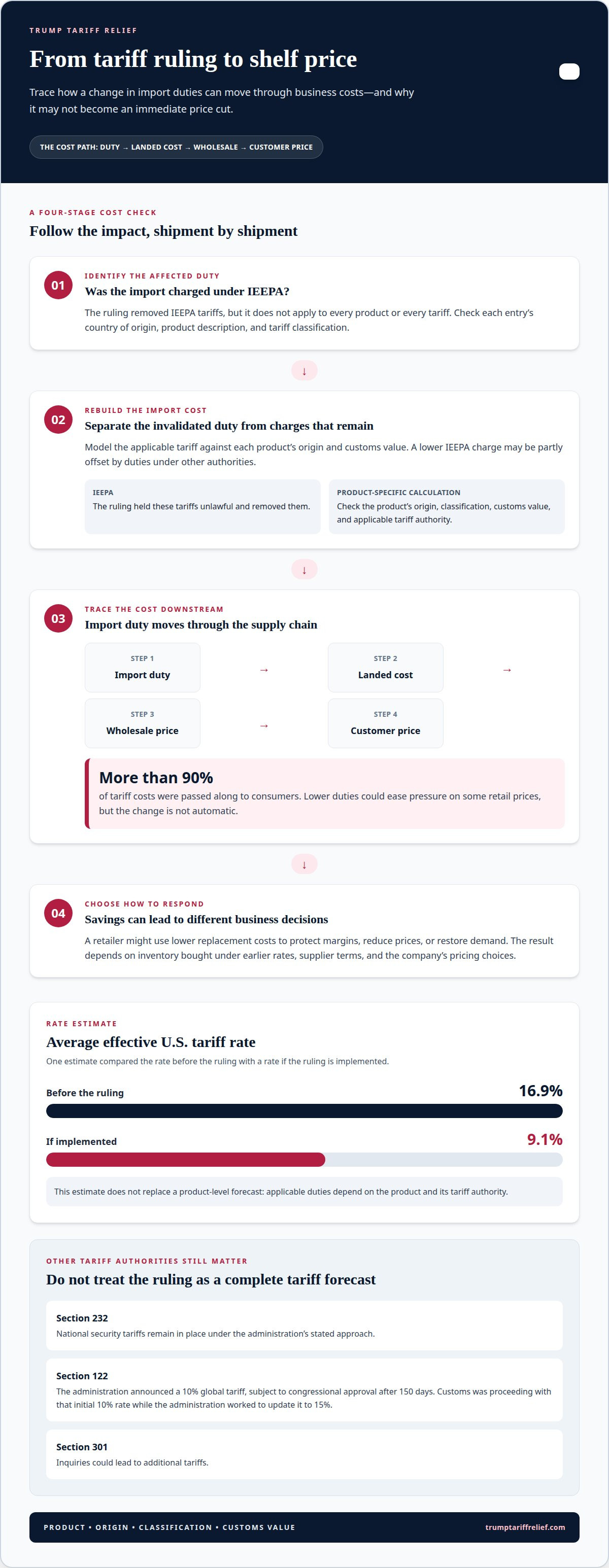
The ruling removed IEEPA tariffs, which had raised the cost of affected imports. For U.S. businesses, duties and landed costs on those goods may fall, but replacement tariffs could offset some savings. The final effect depends on the product’s origin and the tariff authority that applies.
Price changes can travel through several stages: import duty, landed cost, wholesale price, then customer price. More than 90% of tariff costs were passed along to consumers, so lower duties could ease pressure on some retail prices. But the size and timing of any price change depend on inventory bought under earlier rates, supplier terms, and how a company sets prices.
One estimate put the average effective U.S. tariff rate at 16.9% before the ruling and 9.1% if it is implemented. That change could reduce costs for import-dependent businesses and influence consumer spending. A retailer might use lower replacement costs to protect margins, reduce prices, or restore demand. Those choices differ by business; tariff savings do not automatically become price cuts.
Other duties still matter. Section 232 national security tariffs remain in place under the administration’s stated approach. After the ruling, the administration announced a 10% global tariff under Section 122, subject to congressional approval after 150 days. Customs was proceeding with that initial 10% rate while the administration worked to update it to 15%. Section 301 inquiries could also lead to additional tariffs.
For a landed-cost forecast, separate the invalidated IEEPA duty from any Section 232, Section 301, or Section 122 charge. Then model the applicable rate against each product’s origin and customs value. This makes the price decision more useful: a business can distinguish a genuine reduction in import expense from a change in tariff authority. Inflation effects depend on how those costs move through supply chains and consumer prices, not on the ruling alone.
Business certainty for hiring and investment decisions
The ruling does not create the same planning picture for every business. A manufacturer importing components faces different exposure from a retailer importing finished goods. State-level effects also vary with local industry mix, suppliers, and reliance on imported inputs. The federal ruling concerns IEEPA tariffs, but a company’s actual exposure depends on its products and other applicable duties. That distinction matters before approving a new hire, expanding a facility, or committing to a long-term supply agreement. To assess how the Supreme Court tariff ruling affects my business, start with the imports and costs that shape those decisions.
Legal and compliance risks remain. The Supreme Court did not decide whether or how the government should refund importers. U.S. importers may need protests or Post-Summary Corrections to preserve refund rights, and statutory deadlines may apply. Other tariff authorities can still affect imports. A business relying on a single assumed tariff rate could misstate costs or overlook a filing deadline. Organize entry records, duty payment details, product classifications, and supplier invoices for the relevant shipments.
For current rates and official Customs and Border Protection guidance, consult the agency’s official trade resources. Check each rate against the product’s classification, country of origin, and entry timing. Then separate IEEPA duties from charges imposed under other authorities. This gives finance and operations teams a clearer basis for updating landed-cost assumptions without treating one ruling as a complete tariff forecast.
For hiring and investment decisions, model more than one cost scenario. A business considering another production shift, for example, can compare expected import expenses under its current sourcing plan with costs under alternative suppliers. Tie each scenario to the affected products and applicable tariff authority. If projected savings depend on a possible refund, keep that amount separate from operating cash available today. This helps executives distinguish potential recovery from dependable cost reductions.
That discipline supports decisions without freezing them. A company can stage hiring, defer a discretionary equipment commitment, or proceed with an investment that remains viable across its scenarios. Revisit assumptions when official tariff guidance changes or new trade measures take effect. Asking how the Supreme Court tariff ruling affects my business means tracking the legal basis for duties while maintaining shipment-level records and careful forecasts.
Contract terms and who pays tariffs
The ruling applies to IEEPA tariffs on imports from Canada, Mexico, and China, as well as reciprocal tariffs affecting dozens of countries. It covers goods entered under the IEEPA measures, not every product from those origins. Review each entry’s country of origin, product description, and tariff classification to identify whether it carried an affected duty.
For a U.S. sale, the importer, usually the customer, pays tariffs by default. A contract can shift that cost through its pricing and duty-allocation terms. For example, a supplier agreement may set a delivered price or specify that the buyer bears import duties. Those clauses shape who absorbs a cost change between the parties. They do not, by themselves, establish who paid Customs or is entitled to a refund.
Review records systematically, connecting each customs entry to its commercial paperwork:
- Match entry summaries and duty-payment records to the product, origin, and classification.
- Identify entries that included IEEPA tariffs, then separate those amounts from duties under other authorities.
- Reconcile entry records with customs bond documentation and related shipment files.
- Compare contract clauses, invoices, and customer credits to see how tariff costs were allocated or passed through.
U.S. importers may need to file protests or Post-Summary Corrections to preserve refund rights, and statutory deadlines may apply. Exporters are entitled to refunds on tariffs declared unlawful only if they paid those tariffs themselves. A supplier that reimbursed a U.S. buyer under contract may have a different position from one that simply adjusted its invoice. The payment trail and agreement terms matter.
Prices, supply commitments, and inventory plans may also need adjustment. If a buyer bore the duty, lower future import costs could change its purchasing assumptions; if a contract fixed the price, the benefit may not transfer automatically. Review renewal clauses and tariff-adjustment language before changing orders. IEEPA tariff rules and scope help clarify which duties the ruling addressed, while entry-level records connect that scope to a company’s shipments.
The affected origins include Canada, Mexico, China, and countries subject to reciprocal tariffs, but only goods entered under the IEEPA measures are covered. The applicable tariff classification depends on the product and customs entry.
Supreme Court ruling on tariffs imposed under IEEPA
On 20 February 2026, the U.S. Supreme Court ruled 6-3 that tariffs imposed under IEEPA were unlawful. The decision covered the 2025 measures, including tariffs on imports from Canada, Mexico, and China, and reciprocal tariffs affecting dozens of countries. In Learning Resources, Inc. v. Trump, Case No. 24-1287, the Court addressed whether IEEPA authorized those duties.
The Court’s central point was statutory: IEEPA does not expressly authorize tariffs or duties. Enacted in 1977, the law gives the president emergency economic powers, but its text does not mention tariffs. The Court also relied on the Major Questions Doctrine, which requires clear congressional authorization for actions with major economic and political significance. That reasoning limits this use of IEEPA; it does not erase every tariff authority.
That distinction defines the ruling’s reach. The global IEEPA tariffs, which ranged from 10% to 50%, are no longer in effect. Tariffs imposed under other authorities are not automatically invalidated by this decision. For example, a business should distinguish an IEEPA duty on an entry from a separate duty imposed under another statute before assessing the ruling’s effect.
The decision did not resolve repayment. The Supreme Court did not decide whether or how the federal government should refund importers who paid IEEPA tariffs. The ruling establishes that the tariffs were unlawful, but it does not itself provide a refund amount, procedure, or payment date. Importers’ records still matter: entry documents and duty-payment records connect a claim to specific shipments and charges.
For businesses, the practical takeaway is to separate three questions: whether an entry carried an IEEPA tariff, whether another tariff also applied, and who paid the duty. Those distinctions shape both exposure and potential recovery. A focused assessment of your IEEPA tariff eligibility can help identify entries for review and organize the documentation tied to them.
Trump Tariff Relief
Trump Tariff Relief helps businesses assess how the IEEPA ruling may affect their imports and potential recovery. Its Tariff Eligibility Assessment and Customs Documentation Management support reviews of tariff exposure and shipment records. For potentially eligible entries, IEEPA Tariff Refund Recovery manages the refund process, from eligibility review through government filings.
The service is contingency-based: there are no upfront costs, and payment is only a percentage of funds successfully recovered. This support may help if your business paid IEEPA tariffs and needs assistance connecting customs records to potential refund eligibility. Contact Trump Tariff Relief for a no-cost eligibility check.
Turn tariff uncertainty into a clearer next move
Understanding how the Supreme Court tariff ruling affects my business means turning a legal decision into a practical plan. Bring your import records and business priorities together so decisions about sourcing, cash flow, and growth rest on a clearer picture. A focused review can distinguish potential recovery from funds available for current operations and keep future commitments grounded in your company’s actual exposure.
Start with the question that matters most to your business now: whether past tariff payments, upcoming imports, or both need attention. A focused eligibility review can identify where records and potential eligibility deserve a closer look, without treating the ruling as a guarantee of a refund or a forecast of future costs.
If you’re ready to assess your situation, contact Trump Tariff Relief to discuss a practical next step. Clearer information can help you move forward with greater confidence.
Frequently Asked Questions
What does the US Supreme Court's tariff ruling mean for exporters to the US?
For exporters, the ruling does not automatically establish eligibility for a refund. The U.S. importer usually pays duties, and an exporter is entitled to a refund on tariffs declared unlawful only if it paid those tariffs itself. Contract terms, payment records, and any reimbursement arrangement can clarify who bore the charge. For example, a supplier that repaid its U.S. customer may have a different payment trail from one that did not.
What is the next step following the recent Supreme Court decision on tariffs?
Start by identifying shipments that may have carried IEEPA duties and linking them to customs entry and payment records. Separate those charges from duties imposed under other authorities, then organize invoices and related shipping documents. If your business paid the duties, timely customs filings may matter because statutory deadlines can apply. A careful entry-by-entry review helps distinguish potential recovery questions from changes affecting future imports.
What's the outlook?
The outlook depends on which tariff authority applies to each import, not solely on the IEEPA decision. Other measures may continue or change, including tariffs under Section 232 and new measures announced under Section 122. For business planning, treat possible refunds separately from operating cash and compare import-cost scenarios against current policy. That approach gives hiring, purchasing, and investment decisions a firmer basis as tariff measures evolve.
What Supreme Court ruling on tariffs is relevant, and when was it issued?
The relevant decision is Learning Resources, Inc. v. Trump, Case No. 24-1287. On 20 February 2026, the U.S. Supreme Court ruled 6-3 that tariffs imposed under IEEPA were unlawful. The case addressed the president’s use of that emergency law to impose tariffs. For a particular shipment, the key practical question is whether its customs entry included an IEEPA duty covered by the ruling.
Which tariffs did the Supreme Court uphold, strike down, or limit?
The Court struck down tariffs imposed under IEEPA; it did not rule that every U.S. tariff was invalid. Section 232 national security tariffs remain in place under the administration’s stated approach. After the decision, an executive order set an initial 10% tariff under Section 122, while the administration worked to update the rate to 15%. Section 122 measures are limited to 150 days without congressional approval for an extension.
When do the ruling and any related tariff changes take effect?
The Supreme Court issued its ruling on 20 February 2026, and the global IEEPA tariffs are no longer in effect. A later executive order set an initial 10% tariff under Section 122; Customs was proceeding on that basis while the administration worked to update the rate to 15%. The Section 122 authority allows tariffs for 150 days, with congressional approval required for an extension.
Ready to find out what your business may be owed?
Check My Eligibility