
Did you know that while broad litigation often ends in a stalemate, U.S. Customs and Border Protection has already accepted approximately $85 billion in refund claims for IEEPA-related duties? For many businesses, getting tariff money back for furniture imports isn't just a possibility; it's a critical financial recovery milestone that's currently sitting on the table. You've likely watched your hard-earned capital sit idle in government accounts for years, creating a massive drag on your 2026 cash flow. It's frustrating to know that your furniture imports were subjected to unlawful duties while the clock on the three-year statute of limitations continues to tick.
We understand the urgency of righting this financial wrong and restoring the capital your business deserves. This guide reveals the exact steps to reclaim 100% of your eligible IEEPA duties through a streamlined, low-risk process. You'll learn how to master the CAPE system and bypass the typical bureaucratic hurdles that keep most importers from their money. We're going to break down the eligibility requirements and the specific filing timeline you need to follow to restore your operational capital before the window closes for good.
Key Takeaways
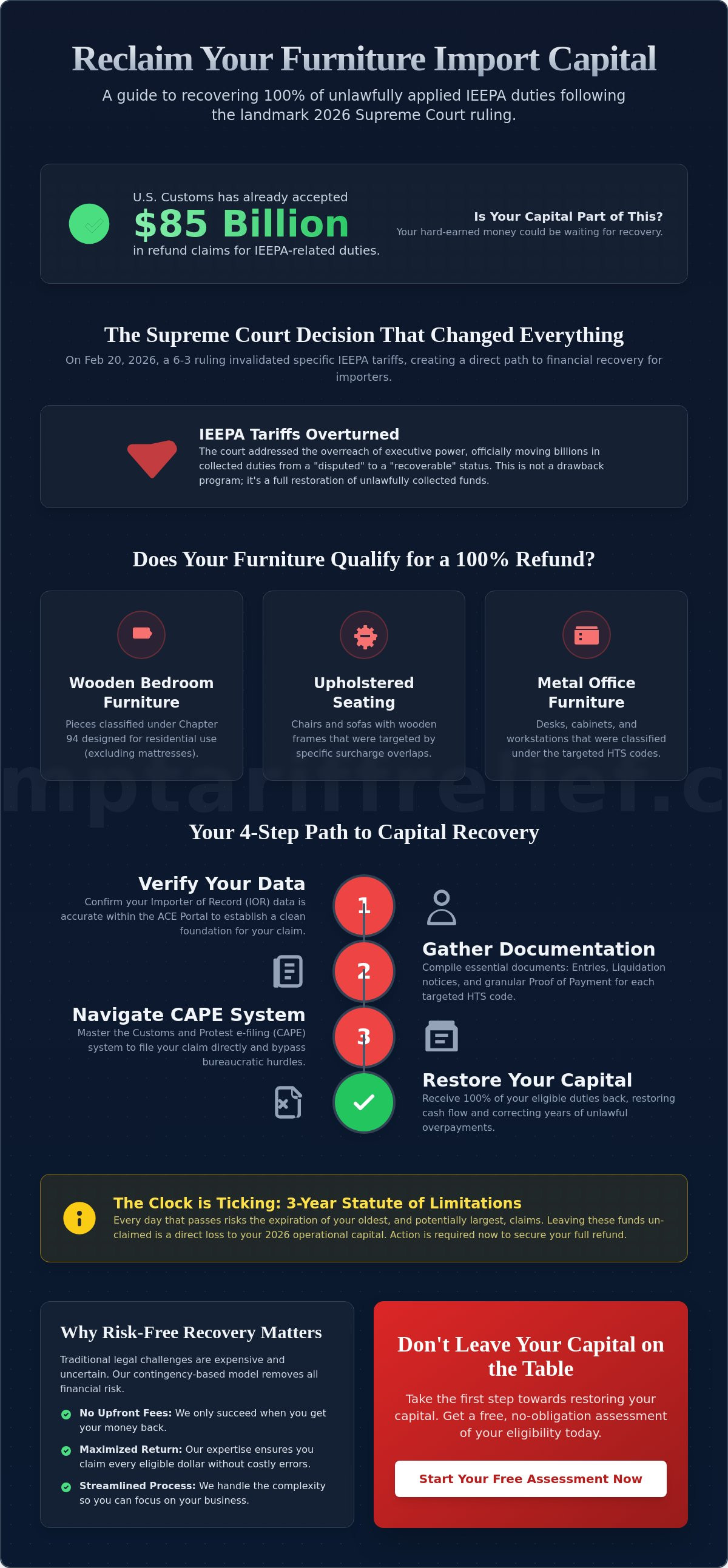
- Understand how the landmark Supreme Court ruling invalidated specific IEEPA tariffs, creating a massive opportunity for immediate financial restoration.
- Identify whether your specific HTS codes for wooden bedroom furniture, upholstered seating, or metal office furniture qualify for 100% duty recovery.
- Discover the exact documentation required to navigate the CAPE system and succeed in getting tariff money back for furniture imports before the statute of limitations expires.
- Learn how to streamline your filing through the ACE portal by verifying your Importer of Record data and providing granular proof of payment.
- Explore why a contingency-based recovery model removes the financial risk of high legal fees while maximizing your total capital return.
Reclaiming Furniture Import Capital After the IEEPA Ruling
The regulatory environment for furniture importers shifted dramatically in early 2026. For years, your business has likely absorbed the heavy cost of tariffs that were, as it turns out, applied without proper legal authority. The 2026 Supreme Court ruling effectively invalidated tariffs imposed under the International Emergency Economic Powers Act (IEEPA), opening a direct path for getting tariff money back for furniture imports. This isn't a mere suggestion or a "wait-and-see" scenario; it's a definitive legal correction that demands immediate action from every furniture retailer and wholesaler in the United States.
Furniture importers were uniquely targeted by these reciprocal and "fentanyl" tariffs, which added layers of cost to already thin margins. If you've been operating under the weight of these duties, reclaiming this lost capital is now a fiduciary duty. Leaving these funds in government hands is equivalent to leaving cash on the table during a liquidity crisis. While many importers are familiar with the Duty drawback program for exported goods, this recovery is different. It's a full restoration of duties paid under a specific, invalidated legal framework.
The Impact of the Supreme Court Decision on Furniture Importers
The 6-3 ruling specifically addressed the overreach of executive power regarding "reciprocal tariffs" that disproportionately affected the furniture sector. This decision triggered a mandatory refund phase that officially initiated in April 2026, moving these funds from a "disputed" status to a "recoverable" one. For US-based furniture brands, this ruling restores competitive parity. It allows you to reinvest capital into 2026 operations that was previously locked away in unlawful surcharges. If your business imported upholstered seating or wooden bedroom sets during the targeted periods, you are now standing at the front of the line for capital restoration.
IEEPA vs. Section 301: Navigating the Legal Landscape
Confusion often arises because furniture imports were hit by multiple tariff types. You must understand that while some Section 301 tariffs remain in place, the IEEPA-based surcharges are now fully refundable. This distinction is critical because furniture items often fall under "List 3" and "List 4a" categories, where both types of duties may have been applied. Navigating this overlap requires a precise IEEPA assessment to ensure you're claiming every dollar available. Getting tariff money back for furniture imports requires isolating these specific IEEPA entries from your general customs data. On February 20, 2026, the Supreme Court issued its landmark ruling that officially struck down the use of IEEPA for the broad imposition of these specific trade duties.
Determining Eligibility for Your Furniture HTS Codes
Identifying which products qualify is the most technical hurdle in the recovery process. Your eligibility hinges entirely on whether your specific furniture items were classified under Harmonized Tariff Schedule (HTS) codes targeted by the IEEPA proclamations. While the economic impact of the IEEPA tariff ruling suggests a massive pool of recoverable funds, those dollars are only accessible if your entries match the invalidated proclamations. For many, getting tariff money back for furniture imports depends on a granular review of every entry filed during the enforcement window.
The IEEPA surcharges didn't apply to every item in your catalog. They focused on specific categories that the government deemed part of a broader trade conflict. If your shipments included the following, you're likely sitting on significant recoverable capital:
- Wooden bedroom furniture: Pieces designed for residential use, excluding mattresses.
- Upholstered seating: Chairs and sofas with wooden frames that were hit by specific surcharge overlaps.
- Metal office furniture: Desks, cabinets, and workstations classified under Chapter 94.
A professional Tariff Eligibility Assessment can clarify your standing within minutes by cross-referencing your historical data against the invalidated HTS list.
Common Furniture HTS Codes Eligible for Refunds
Most eligible items fall under Chapter 94 of the HTS. We pay close attention to 9403.50, which covers wooden furniture used in bedrooms. This category saw some of the highest IEEPA surcharges. Similarly, 9401.61, covering upholstered seats with wooden frames, often carried "List 3" or "List 4a" surcharges that were later reclassified under IEEPA authority. You must verify that your broker didn't misclassify these items, as even a small digit error can disqualify an entry from getting tariff money back for furniture imports.
Liquidated vs. Unliquidated: Why Entry Status Matters
The status of your entry determines your path to recovery. In the context of the 2026 CAPE system, "liquidation" is the final calculation of duties by CBP. If an entry is unliquidated, it's still technically open, making it easier to adjust during "Phase One" of the rollout. If an entry is liquidated, you're bound by the 180-day rule. You have exactly 180 days from the date of liquidation to file a protest. If you miss this window, the entry is legally closed, and the capital is likely lost. Don't wait for CBP to notify you; proactive monitoring of your liquidation dates is the only way to protect your right to a refund.
The Documentation Hurdle: Entries, Liquidations, and Proof of Payment
The government won't hand your money back voluntarily. The burden of proof lies entirely with the importer to demonstrate that IEEPA duties were actually paid. For furniture wholesalers handling high-volume, multi-container entries, this documentation hurdle can feel insurmountable. You're often dealing with thousands of line items across hundreds of shipments, each requiring a forensic level of detail to satisfy CBP auditors. If you can't produce the paper trail, your claim for getting tariff money back for furniture imports will stall before it even starts.
CBP requires specific data points from the Automated Commercial Environment (ACE) portal to validate any furniture tariff refund claim. This includes entry numbers, dates of import, and the exact dollar amount of the IEEPA surcharge paid. For the furniture industry, where shipping volumes are massive, managing this data extraction is a complex task. Trump Tariff Relief specializes in Customs Documentation Management, ensuring that every eligible dollar is identified and supported by the necessary evidence.
Essential Documents for Your Furniture Refund Claim
CBP Form 7501, the Entry Summary, is the bedrock of your claim. This document definitively proves the duty amounts paid at the time of entry. However, a Form 7501 isn't enough on its own. Your commercial invoices must match the HTS codes listed in the refund filing with absolute precision. If your invoices describe "wooden bedroom sets" but the filing lists a different HTS category, CBP will likely reject the entry. You can review the full required documents for IEEPA tariff refund to ensure your internal records are audit-ready.
Auditing the ACE Portal for Missing Opportunities
Identifying hidden IEEPA surcharges in complex furniture shipment records is the most difficult part of the audit. Surcharges were often bundled into general duty payments, making them difficult to spot without a deep dive into the ACE portal. You must verify ACH payment records against entry summaries to ensure the money actually left your account. Discrepancies between broker records and actual CBP liquidation data are frequent, especially if your broker has since merged or gone out of business. If you're struggling with missing records from a defunct broker, a professional audit is the only way to reconstruct the data needed for getting tariff money back for furniture imports.
Step-by-Step Guide to Filing Your Furniture Tariff Refund Claim
The window for financial recovery is not indefinite. The filing process involves navigating the newly activated Claims and Protest Entry (CAPE) system within the ACE portal. It's a high-stakes race against the clock where precision is the only currency CBP accepts. Before you can begin getting tariff money back for furniture imports, you must verify your Importer of Record (IOR) information is current. Any discrepancy in your corporate tax ID or legal address will trigger an immediate rejection of your claim. Each entry must be individually flagged for IEEPA refund eligibility; there is no "easy button" for mass recovery.
Deadlines are exceptionally strict in the 2026 landscape. Missing the statute of limitations means the permanent loss of capital that belongs on your balance sheet. With new Section 301 tariffs proposed for July 2026, the urgency to reclaim existing capital has never been higher. You need that cash flow to offset the 10% to 12.5% rates currently being debated in Washington. To ensure your filing is handled with professional gravitas, you can initiate your IEEPA recovery assessment today.
Phase One: Enrolling in the CAPE Refund System
Importers cannot simply send an email to request their funds. You must update your ACE portal account to enable IEEPA-specific functionality. This involves a technical handshake between your IOR data and the CAPE module. It's also critical to set up ACH direct deposit within the portal. Without this, you'll be stuck waiting for paper checks that are notoriously slow to process. You can learn more about the technical requirements of how it works to prepare your digital infrastructure.
Phase Two: Executing the Furniture-Specific Protest
Efficiency is built through organization. You should group your entries by HTS code, such as the wooden bedroom furniture (9403.50) discussed in previous sections, to streamline the CBP review process. You'll be required to submit a "Statement of Fact" for each group. This document must clearly articulate why the furniture items fall under the invalidated IEEPA proclamations. Once submitted, you can monitor the progress through the 2026 CBP dashboard, which provides real-time updates on your claim status.
Avoiding Common Filing Pitfalls
The most frequent mistake furniture importers make is attempting "blanket" filings. CBP routinely rejects these for furniture imports because the HTS codes and duty rates vary too significantly between shipments. You must also manage the three-year statute of limitations for IEEPA claims with extreme care. If an entry is older than three years from the date of payment, the CAPE system will automatically lock you out. Review the tariff refund statute of limitations to ensure your oldest entries don't expire while you're still gathering data.
Leveraging Contingency-Based Recovery to Maximize Your Furniture Refund
Traditional trade attorneys typically demand high hourly rates that begin accruing before you see a single dollar in return. For a furniture importer, these legal fees can quickly erode the very capital you're trying to reclaim. It's a model that places all the financial risk on your business while providing no guarantee of success. If the recovery process hits a bureaucratic snag or a CBP rejection, you're still left holding the bill for the hours spent. This outdated approach is particularly punishing for mid-sized furniture retailers who need to protect their 2026 cash flow above all else.
Trump Tariff Relief operates on a strict contingency basis; we only receive payment if you successfully receive your refund. This model creates a powerful alignment of interests. Our motivation is directly tied to the total recovery amount, ensuring we leave no eligible entry behind. By removing the barrier of upfront costs, we've made getting tariff money back for furniture imports accessible to every business regardless of their current legal budget. We take on the heavy lifting of the Customs Documentation Management and the legal burden of the filing, allowing your team to stay focused on core furniture operations.
The Advantage of Success-Based Tariff Recovery
Eliminating upfront financial risk is essential for furniture businesses managing tight inventory cycles. When you partner with a contingency-based firm, you're not just hiring a service provider; you're gaining a high-performing ally. If there's no recovery, there's no fee. This "no-nonsense" approach ensures that every hour we spend auditing your ACE portal data is focused on identifying winning entries. It's an ideal solution for businesses that want the expertise of a seasoned insider without the unpredictability of hourly billing.
Why Specialized Furniture Expertise Matters
The nuance of HTS classification is where most furniture refund claims are won or lost. There's a significant distinction between "parts of furniture" (HTS 9403.90) and "finished furniture" (HTS 9403.50) in IEEPA filings. CBP often issues rejections based on these subtle classification overlaps, hoping the importer won't have the technical expertise to counter the decision. Our team understands these industry-specific hurdles and has the specialized knowledge to challenge HTS misclassifications effectively. We ensure that every component, from upholstered frames to metal desk supports, is correctly categorized to maximize your total recovery. Don't let a technicality stand between your business and its capital. You can get your free furniture tariff eligibility assessment today to see exactly how much your business is owed.
Secure Your 2026 Operational Capital Now
The 2026 Supreme Court ruling has finally cleared the path for furniture importers to right a massive financial wrong. By navigating the technical complexities of the CAPE system and auditing your historical HTS classifications, you can restore significant capital to your balance sheet. This recovery process is about more than just reclaiming past losses; it's about securing your competitive edge as new trade regulations loom in late 2026. Getting tariff money back for furniture imports requires a level of technical precision that standard customs brokers simply aren't equipped to provide.
Trump Tariff Relief manages the entire administrative and legal burden on a strict contingency basis. You'll gain access to our specialized HTS code expertise and full-service management of the ACE portal filing with zero upfront financial risk. If we don't recover your funds, we don't get paid. It's a high-stakes partnership designed to restore your cash flow with total transparency. Don't let the three-year statute of limitations expire on your eligible entries while your capital sits idle in government accounts.
Start Your Free Furniture Tariff Recovery Assessment and reclaim the capital your business deserves today.
Furniture Tariff Recovery: Frequently Asked Questions
Is the China furniture tariff refund real after the 2026 ruling?
Yes, the February 20, 2026 Supreme Court decision is a definitive legal reality that invalidated specific IEEPA-based duties. While other Section 301 litigation reached different conclusions, these specific surcharges were ruled unlawful. If your furniture business paid these reciprocal or "fentanyl" duties, the path to a 100% refund is now officially open through the CAPE system.
How much of my furniture import duties can I actually get back?
You can reclaim 100% of the IEEPA-specific surcharges paid during the enforcement window. This doesn't include your standard HTS base duties, but it covers the entire additional surcharge amount that was applied under the invalidated proclamations. Getting tariff money back for furniture imports often restores millions in liquidity for high-volume wholesalers and retailers who were disproportionately targeted.
What is the deadline for furniture importers to file an IEEPA claim?
The statute of limitations generally allows for claims within three years from the date you paid the duties. However, if your entries have already liquidated, you must file a formal protest within 180 days of the liquidation date. Missing these federal deadlines results in a permanent forfeiture of your right to recover that capital, making immediate action essential.
Do I need a customs broker or a specialist like Trump Tariff Relief?
Standard customs brokers are designed for entry filing, not complex legal recovery or forensic HTS auditing. A specialist firm provides the legal advocacy and "no-nonsense" contingency model required to navigate the ACE portal's new CAPE module. We manage the entire administrative burden and handle CBP pushback, which most traditional brokers aren't equipped to do.
What happens if my furniture entries have already been liquidated?
Liquidated entries are still eligible for recovery if you're within the 180-day protest window. CBP considers these files closed, so you must proactively flag them for IEEPA-specific review using precise documentation. If your 180-day window has already expired, your eligibility depends on specific administrative remedies that our team can evaluate during a preliminary assessment.
How long does it take for CBP to process a furniture tariff refund?
Current processing estimates for the 2026 CAPE rollout suggest a window of 90 to 180 days for validated claims. Your speed of recovery depends heavily on the accuracy of your "Statement of Fact" and whether you've enabled ACH direct deposit in the ACE portal. Any documentation errors can move your claim to the back of the processing line.
Can I claim refunds for furniture imported from countries other than China?
Yes, you can claim refunds for any entries hit by the invalidated IEEPA surcharges regardless of the country of origin. While China was the primary focus of these trade actions, certain reciprocal duties were applied to other sourcing hubs. We'll audit your entire import history to ensure every eligible dollar from every country is included in your filing.
What are the most common HTS codes for furniture that qualify for a refund?
The most frequent qualifiers include 9403.50 for wooden bedroom furniture and 9401.61 for upholstered seats with wooden frames. Metal office furniture classified under 9403.10 also appears frequently in successful recovery filings. Getting tariff money back for furniture imports requires a forensic match between these specific codes and the invalidated executive proclamations.
Ready to find out what your business may be owed?
Check My Eligibility