
Your internal records aren't just filing history; they're the only thing standing between your company and a share of the $166 billion currently held by U.S. Customs. Following the February 2026 Supreme Court ruling, the door to financial restoration is officially open, but it won't stay open forever. You've likely felt the mounting pressure of these duties since early 2025, and we understand the frustration of managing fragmented data across various customs brokers. Identifying the exact documents needed for tariff refund claim is the first critical step toward righting this financial wrong and securing the capital your business is owed.
It's easy to feel overwhelmed by the technical jargon of the new CAPE system or the rigid 180-day deadlines for liquidated protests. You need a clear, no-nonsense path to verification that doesn't involve upfront legal costs or administrative guesswork. This guide serves as your professional roadmap, offering a definitive checklist of required documentation and a streamlined process for eligibility. We'll break down the complex distinctions between entry types and show you how to master the recovery process with the confidence of a seasoned industry insider.
Key Takeaways
- The landmark 2026 Supreme Court ruling has effectively transformed your previous IEEPA tariff payments into recoverable accounts receivable.
- Mastering the specific documents needed for tariff refund claim, such as CBP Form 7501 and commercial invoices, is essential to avoid administrative denials.
- Your recovery strategy depends on whether entries are liquidated or unliquidated, as each category follows a different regulatory timeline for filing.
- The new CAPE portal requires a precise digital declaration, making accurate record-keeping more important than ever for a successful refund.
- Professional documentation management allows you to identify every eligible dollar across years of fragmented data without risking upfront capital.
The 2026 IEEPA Ruling: Why Your Documentation is Now Currency
The February 20, 2026, Supreme Court decision sent a shockwave through the global trade community. By ruling that the International Emergency Economic Powers Act (IEEPA) does not grant the executive branch the authority to impose broad, permanent tariffs, the Court effectively invalidated billions of dollars in collected duties. For your business, this isn't just a legal victory; it's a financial catalyst. What were once considered "lost" tax payments have been transformed into valid accounts receivable. However, the $166 billion currently held by U.S. Customs and Border Protection (CBP) won't return to your balance sheet without a fight. This ruling represents a rare moment where the legal pendulum swings back in favor of the importer, yet the complexity of recovery remains high.
CBP initiated the refund rollout on April 20, 2026, through the new Consolidated Administration and Processing of Entries (CAPE) system. While the government acknowledges the ruling, it hasn't automated the repayment process. The burden of proof rests entirely on you, the importer of record. You must proactively identify, verify, and submit the specific documents needed for tariff refund claim to reclaim your capital. If you don't act, the government keeps the money. It's that simple. Success requires more than just a passing interest in the law; it demands a surgical approach to your historical data. Every entry from the past year must be scrutinized for eligibility under the new CAPE guidelines.
Understanding the IEEPA Tariff Refund Opportunity
The scope of this recovery is specific. It covers the "Fentanyl/trafficking" tariffs effective February 4, 2025, and the "Liberation Day reciprocal" tariffs that began on April 5, 2025. This is a distinct legal pathway from the ongoing Section 301 litigation. If your goods were caught in these specific IEEPA-authorized categories, you are likely part of the 301,000 importers eligible for relief. You can find a deeper breakdown of these legal distinctions in our guide on IEEPA Explained.
The Financial Stakes of Proper Record-Keeping
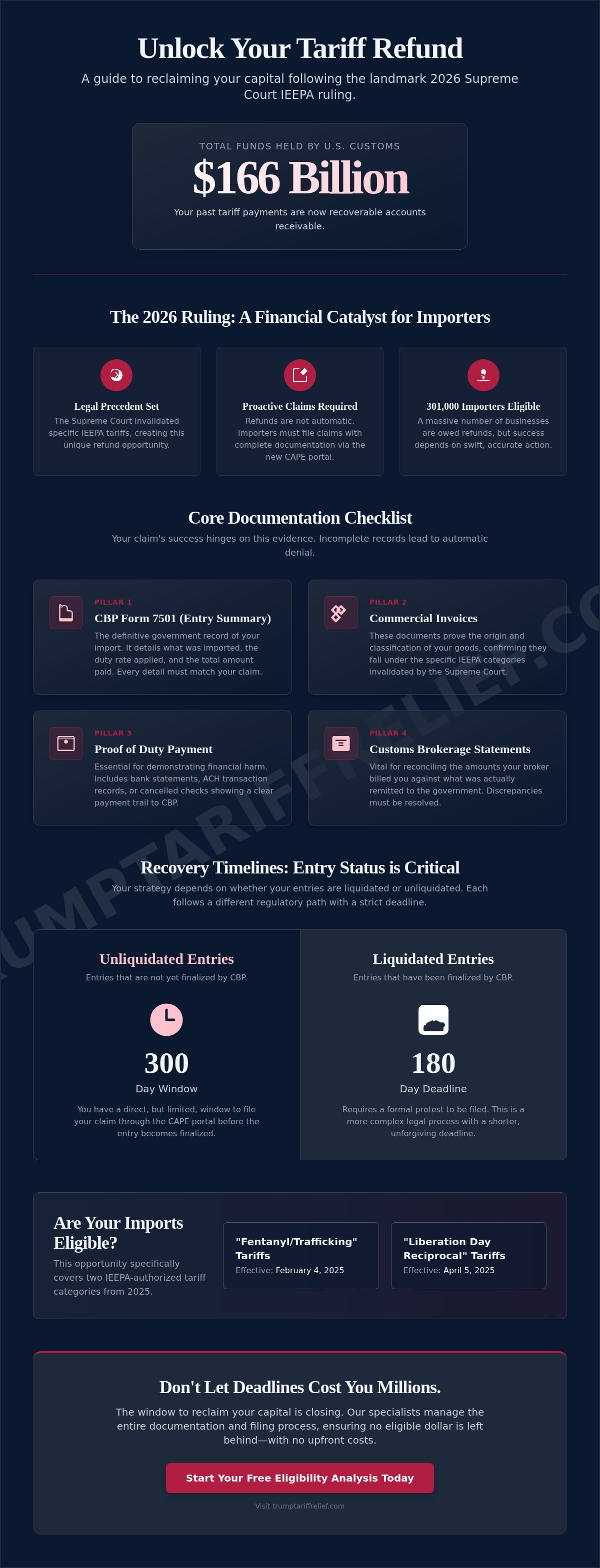
In the world of customs recovery, documentation is your only currency. If you're missing even a single entry summary (CBP Form 7501), you could be leaving thousands of dollars on the table. The 2026 filing windows are strictly "use it or lose it." Unliquidated entries generally have a 300-day window, while liquidated entries require a formal protest within 180 days. Internal audits aren't just a suggestion; they're the first step in your recovery journey. Without an organized repository of the documents needed for tariff refund claim, your chance to recover significant capital will vanish as deadlines pass.
Core Checklist: Documents Needed for Tariff Refund Claim
Securing your refund isn't just about filing a paper claim; it's about building an airtight evidentiary case. To win back your capital, you must compile a specific set of documents needed for tariff refund claim that satisfy CBP's heightened scrutiny. If your records are incomplete, your claim will be rejected before a human even reviews it. This is not a time for "close enough" accounting. You need the original digital footprints of every transaction that occurred under the IEEPA mandates of 2025.
Your recovery folder must contain four foundational pillars:
- CBP Form 7501 (Entry Summary): This is the definitive record of what was imported, the duty rate applied, and the total amount paid to the government.
- Commercial Invoices: These prove the origin and classification of the goods, confirming they fall under the specific IEEPA categories invalidated by the Court.
- Proof of Duty Payment: Bank statements, ACH transaction records, or cancelled checks that show a clear path from your treasury to CBP.
- Customs Brokerage Statements: These are vital for reconciling what your broker billed you versus what was actually remitted to the government.
The Essential Entry Summary (Form 7501)
Form 7501 is the bedrock of your recovery. You must verify that the Importer of Record (IOR) number matches your current corporate identity exactly. Within these forms, look for the specific duty codes associated with the 2025 "Fentanyl" or "Liberation Day" actions. If you've lost physical copies or your previous broker has gone dark, you can pull digital entry reports via the ACE Portal. For liquidated entries, this data will eventually populate the CBP Form 19 Protest Information required for a formal challenge. Without a verified 7501, your claim has no legal standing.
Verifying Proof of Payment
CBP requires definitive proof that the duty was actually paid, not just assessed. This is where many importers stumble. You must distinguish between the "Total Invoice Value" paid to your supplier and the specific "Duties Paid" to the government. If you use Periodic Monthly Statements (PMS), your ACE reports are your best friend. They provide the definitive ACH record that CBP accepts as proof of settlement. If your broker paid on your behalf, you must reconcile their billing statements with the CBP entry summary to prove the funds were transferred. If you're struggling to locate these records across multiple brokers, a professional eligibility assessment can help you centralize your data and identify missing gaps in your documents needed for tariff refund claim.
Liquidated vs. Unliquidated Entries: Documenting the Difference
The success of your recovery hinges on a single technical status: liquidation. In the world of U.S. Customs, liquidation is the final computation of duties on an entry. Once an entry liquidates, the government considers the transaction closed. This status dictates your entire filing timeline and the specific documents needed for tariff refund claim. If your entries are still unliquidated, you're in the fast lane for recovery. If they've already liquidated, you're facing a much stricter 180-day window to file a formal protest. Understanding where your entries sit in this cycle is the difference between a successful capital injection and a permanent financial loss.
The 2026 refund rollout prioritizes unliquidated and recently liquidated entries. To manage this effectively, you must reconcile your internal accounting with the CBP Form 4333-A, also known as the Notice of Liquidation. Many importers struggle to match their payment records with these official notices, leading to missed deadlines. You can't rely on your customs broker to alert you to these dates; you must proactively monitor the status of every IEEPA-impacted entry to ensure you don't miss the window for a legal challenge.
Identifying Unliquidated Entries
Unliquidated entries are those that haven't yet reached the end of the standard 314-day liquidation cycle. These represent your "low-hanging fruit" because they can often be corrected via a Post-Summary Correction (PSC) rather than a formal protest. To identify these, you must pull an "Open Entry" report from the ACE Portal. This report acts as a real-time audit of your active liabilities. Because these entries aren't finalized, the administrative hurdle is lower, making them the fastest path to restoring your cash flow. We recommend prioritizing these in your initial documentation gathering to secure early wins in the recovery process.
The Protest Process for Liquidated Entries
Once an entry has liquidated, your only recourse is a formal protest. This process is governed by the official customs protest regulations, which mandate a strict 180-day filing limit from the date of liquidation. For these claims, you must document a "Legal Error" based on the 2026 Supreme Court ruling. This is more complex than a simple correction. You'll need to provide a narrative that connects the specific documents needed for tariff refund claim to the Court's decision. Trump Tariff Relief specializes in managing this high-stakes protest documentation on your behalf, ensuring that every "Mistake of Fact" or "Legal Error" is clearly articulated to CBP. If you're unsure if your entries have already passed this critical 180-day mark, our detailed IEEPA guide can help you calculate your remaining filing windows.
The CAPE Declaration: Filing Your Claim with CBP
On April 20, 2026, U.S. Customs and Border Protection launched the Consolidated Administration and Processing of Entries (CAPE) system. This digital framework is the exclusive gatekeeper for all IEEPA-related duty recoveries. If you intend to reclaim your share of the billions in collected tariffs, you must navigate the CAPE portal with absolute precision. The system is designed for high-volume processing, but it's also highly sensitive to data discrepancies. A single mismatched digit between your electronic filing and your documents needed for tariff refund claim will trigger an automatic system rejection, potentially pushing your claim past the 2026 deadlines.
The documentation flow within CAPE requires you to upload verified entry summaries and commercial invoices in a specific sequence. You'll also need to provide valid digital signatures and pass an Importer of Record (IOR) verification check. Security is paramount. As of February 6, 2026, CBP mandates that all refunds be issued via the Automated Clearing House (ACH). This means your ACE account security is no longer just an IT concern; it's a financial safeguard. Scammers are actively targeting the 301,000 eligible importers with phishing attempts. Protecting your ACE credentials and ensuring your ACH enrollment is accurate are essential steps to ensure your recovered capital actually reaches your bank account.
Setting Up Your ACE Secure Data Portal
Your ACE portal is the engine room of your recovery. To begin, you must provide documentation that verifies your business identity, including your tax ID and current corporate address. If your contact information doesn't match the IOR database exactly, CBP will freeze your access. Many businesses choose to grant "Third-Party Access" to specialized recovery consultants to handle the technical heavy lifting. This allows experts to pull your historical reports and manage the filing without compromising your primary administrative control. You can learn more about this collaborative process in our frequently asked questions.
Filing the CAPE Declaration
The CAPE Declaration is the primary vehicle for IEEPA refunds in 2026. This electronic document allows you to batch multiple entry numbers into a single claim, significantly streamlining the recovery of duties paid across various shipments. However, batching increases the risk of error. If one entry summary in a batch of fifty is missing its corresponding proof of payment, the entire declaration may be returned for correction. Common filing errors often stem from outdated classification codes or missing invoice origin details. To avoid these delays, ensure your documents needed for tariff refund claim are fully audited before you hit the submit button. If you're ready to secure your capital, you can start your customs documentation management today to ensure every entry is accounted for.
Streamlining Recovery: The Professional Documentation Advantage
Managing thousands of entries across multiple years is a logistical nightmare for even the most robust trade departments. While you now understand the specific documents needed for tariff refund claim, the sheer volume of data often leads to missed opportunities. With over 53 million entries impacted by the IEEPA ruling, searching for eligible duties manually is inefficient and prone to error. Specialized trade experts leverage advanced automation to scan your entire import history, identifying every eligible dollar that falls under the 2026 mandate. This isn't just about filing paperwork; it's about forensic financial recovery that ensures no capital is left behind.
The "No Upfront Cost" model makes professional documentation management a risk-free proposition for your business. We take on the administrative heavy lifting and the technical risks associated with the CAPE portal. If we don't recover your funds, you don't pay. This alignment of interests ensures that your claim is handled with the urgency and precision it deserves. In a year defined by strict 180-day protest windows and complex digital declarations, having an assertive ally in your corner is the most effective way to right this financial wrong. For companies also navigating broader commercial disputes or requiring litigation support, Fridman Legal offers expert counsel to protect your interests.
Why Contingency-Based Recovery Wins
Internal staff hours are expensive, and your team likely already has a full plate. Diverting them to hunt down 2025 entry summaries can cost more in lost productivity than the value of the refund itself. A professional recovery firm provides a "steady hand" during the 2026 deadline crunch, ensuring that every filing meets CBP's rigorous standards. You can see a detailed breakdown of how we streamline this complex journey by reviewing How It Works. By choosing a contingency-based partner, you convert a potential administrative burden into a streamlined capital injection.
Your Preliminary Eligibility Assessment
We've designed our intake process to be as low-friction as possible. To begin identifying the documents needed for tariff refund claim for your specific business, we only require your Importer of Record (IOR) number and temporary ACE portal access. Once we have these details, our team performs a comprehensive audit of your IEEPA-impacted entries. We provide a 48-hour "Initial Recovery Estimate," giving you a clear picture of the capital available for reclamation without any initial commitment. The window for IEEPA recovery is closing, and the government won't wait for your records to be organized. Start your free assessment today and reclaim the capital your business is legally owed.
Reclaim Your Capital Before the 2026 Recovery Window Closes
The 2026 Supreme Court ruling has shifted the burden of action onto your business. With billions in IEEPA duties waiting to be reclaimed, the difference between a successful refund and a permanent loss is the precision of your data. You've seen how the distinction between liquidated and unliquidated entries dictates your filing timeline, and how the CAPE system demands absolute accuracy. Organizing the documents needed for tariff refund claim is no longer just an administrative task; it's a high-stakes financial priority that requires a seasoned insider's touch.
Trump Tariff Relief provides a national service for all U.S. importers, offering expert trade consultants who manage the entire CAPE process on your behalf. Our model is entirely contingency-based: if we don't recover your money, you don't pay a fee. Don't let fragmented records or complex bureaucracy prevent you from righting this financial wrong. Get Your Free Tariff Eligibility Assessment today and let us secure the capital your business is legally owed. Your restoration starts now.
Frequently Asked Questions
Is it too late to claim my tariff refund for 2024 or 2025 entries?
No, it isn't too late, but your window for action is narrow and depends on the status of your entries. For unliquidated entries, you generally have 300 days from the entry date to file a Post-Summary Correction. For liquidated entries, the law mandates a strict 180-day limit from the date of liquidation to file a formal protest. Because the ruling covers IEEPA tariffs collected after February 4, 2025, many importers are currently within their primary recovery window.
What happens if my original customs broker is no longer in business?
You can still successfully recover your funds because you, as the importer of record, own the transaction data. You aren't dependent on a former broker to provide the documents needed for tariff refund claim if you have access to the ACE Secure Data Portal. You can pull your historical CBP Form 7501 and payment reports directly from the government's database to build your claim folder without third-party assistance.
Do I need a separate document for Section 301 vs. IEEPA refunds?
Yes, you must maintain a clear distinction between these different tariff authorities. The 2026 Supreme Court ruling is specific to IEEPA-authorized duties, such as the fentanyl trafficking and reciprocal tariffs. Section 301 duties, primarily related to China trade, are governed by separate legal frameworks and aren't covered by the CAPE Declaration process. Mixing these in a single filing will lead to an immediate administrative denial.
How long does it take for CBP to process the refund once documents are submitted?
Processing times vary depending on the complexity of your batch filing, but the CAPE system is designed for faster electronic settlement than legacy methods. Once CBP approves your declaration, the refund is issued exclusively via the Automated Clearing House (ACH). Since the electronic mandate took effect on February 6, 2026, importers enrolled in ACH typically see funds settled in their accounts significantly faster than those waiting for paper checks.
Can I file for a refund if I don’t have an ACE Portal account?
No, an active ACE Portal account is a mandatory requirement for filing a CAPE Declaration in 2026. CBP has fully digitized the refund process to handle the high volume of claims following the Supreme Court decision. If your business doesn't have an account, you must either register immediately or authorize a specialized recovery partner to manage the digital submission and documentation flow on your behalf.
What is the "burden of proof" for proving I paid the tariffs?
The burden of proof requires you to demonstrate a definitive financial link between your corporate treasury and U.S. Customs. You must present the specific documents needed for tariff refund claim, which include the CBP Form 7501 and a corresponding ACH or bank record. CBP won't issue a refund based on an invoice alone; you must prove the duty was actually remitted and settled with the government.
Are there fees associated with filing the CAPE Declaration through CBP?
CBP doesn't charge a direct administrative fee for filing a CAPE Declaration, a Post-Summary Correction, or a formal protest. However, the internal costs of auditing thousands of entries and the risk of permanent forfeiture due to filing errors are significant. Most importers find that professional management is more cost-effective than attempting to navigate the technical requirements of the CAPE portal with internal staff who may lack specialized trade expertise.
What is the deadline for filing IEEPA tariff refund claims in 2026?
Deadlines are rolling and specific to each individual entry's timeline. You have 300 days for unliquidated corrections and 180 days for protests following the date of liquidation. While the Court of International Trade allows a two-year statute of limitations for certain lawsuits, the administrative windows for direct CBP refunds are much shorter. If you don't file within these specific 180 or 300-day periods, you lose the right to recover that capital.
Ready to find out what your business may be owed?
Check My Eligibility