
A court can invalidate a tariff authority without making every importer’s refund automatic. That distinction is central to understanding what is IEEPA and how the law relates to tariffs. The International Emergency Economic Powers Act gives the president tools to address certain national emergencies, but it doesn’t create a blanket right to impose tariffs or guarantee repayment when a specific tariff action is challenged.
If legal language and fast-moving headlines have blurred the difference between the law and actions taken under it, you’re not alone. On February 20, 2026, the Supreme Court ruled in Learning Resources, Inc. v. Trump that IEEPA doesn’t authorize the president to impose tariffs unilaterally. The ruling matters, but it doesn’t automatically establish refund eligibility for every business that paid duties.
This guide explains IEEPA in plain English, distinguishes the statute from tariff actions taken under it, and explains why import history, documentation, and deadlines matter when assessing potential refunds. Trump Tariff Relief provides IEEPA tariff eligibility assessments and refund recovery assistance at no upfront cost. Payment is only a percentage of funds recovered, and refund outcomes are not guaranteed.
Key Takeaways
- Learn what is IEEPA and how the law relates to certain economic actions during a declared national emergency.
- Separate the statute from a specific tariff action, then assess what a court ruling may mean for potential refund claims.
- Start reviewing a claim by identifying affected entries and gathering entry summaries, commercial invoices, transportation documents, and duty statements.
- Check applicable deadlines carefully: a formal protest for a liquidated entry generally must be filed within 180 days of liquidation.
- Trump Tariff Relief reports $166 B+ in IEEPA duties collected by U.S. Customs as of Dec 2025; that figure does not mean every importer or entry qualifies for a refund.
What Is IEEPA? The Law’s Meaning in Plain English
The International Emergency Economic Powers Act, or IEEPA, is a federal law concerning certain international economic powers during a declared national emergency. In plain English, it provides a framework for addressing certain economic transactions connected to other countries when an emergency has been declared. This describes the law’s general subject, not every power it contains or how a particular action under it should be assessed.
That distinction matters for businesses. A statute establishes a legal framework; an administration’s policy or government action applies that framework to a specific situation. The law itself is not a tariff rate, a list of goods subject to duties, or a refund program. Those questions depend on the particular action and the legal and administrative steps connected to it.
What does IEEPA stand for?
IEEPA is the abbreviation for the International Emergency Economic Powers Act. Readers often encounter it in trade and economic policy coverage because actions taken under the statute can affect international economic transactions, including transactions relevant to businesses that import goods. The acronym may appear beside a headline about a specific policy, but it names the law, not the policy itself.
For a broader historical and provisions overview, see the International Emergency Economic Powers Act (IEEPA) Wikipedia entry. When assessing a particular government action, the statute and relevant official materials provide more detail than the acronym alone.
What does the law generally address?
IEEPA concerns certain international economic transactions in the context of a declared national emergency. The declaration provides the emergency context; a separate action then relies on relevant legal authority and identifies the transactions it affects. The details matter: the statute is the framework, while the action is the specific measure taken under it.
Think of it as the difference between a rulebook and a move made under its rules. Knowing that a policy cites IEEPA does not, by itself, tell you which goods or transactions it covers, what duties may apply, or what remedy a business might pursue. Those answers require examining the specific action and its scope.
So, if you’re asking what is IEEPA, the short answer is that it’s a federal emergency-powers law concerning certain international economic matters. It should not be confused with any one tariff measure. A tariff is a specific charge or policy action; IEEPA is a statute that may be cited as part of the legal basis for government action. The law itself does not establish an automatic process for returning duties.
Keeping these categories separate gives importers a clearer starting point when reading policy announcements. First identify the law being cited. Then identify the particular action taken under it and the transactions that action addresses. Only then can a business consider what the measure may mean for its import records and possible next steps.
How IEEPA Works: Emergency Declarations and Economic Powers
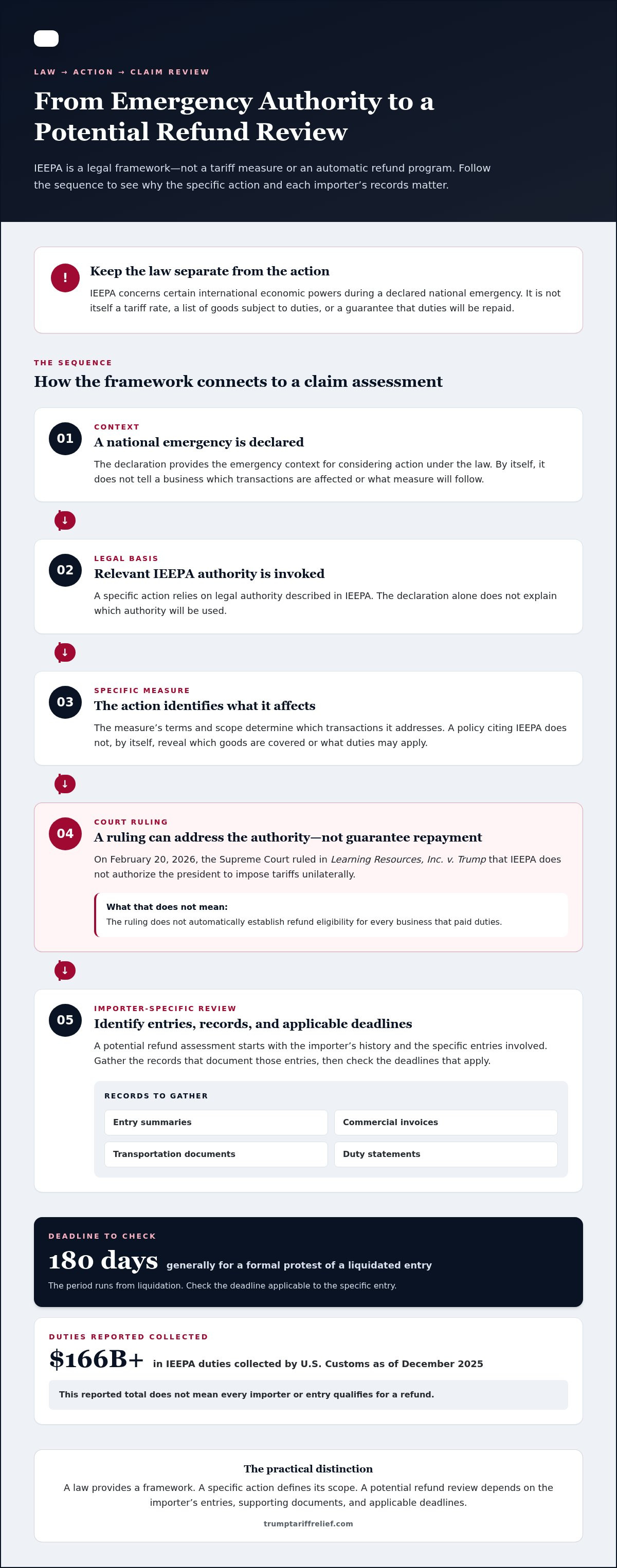
IEEPA is best understood as a framework, not a switch that automatically activates the same policy whenever an emergency is declared. The general sequence is: a national emergency is declared, relevant authority under the law is invoked, and a specific action addresses certain international economic transactions. The action’s details determine what is affected.
- Emergency declaration: The government identifies a national emergency as the context for considering action under the law.
- Relevant authority: The action relies on legal authority described in IEEPA. A declaration alone doesn’t explain which authority will be used.
- Specific measure: The government takes an action affecting certain transactions. Its scope depends on the terms of that action.
This sequence is a plain-language summary, not a substitute for the statutory text. The Cornell Law School IEEPA Analysis discusses the law’s framework and the distinction between IEEPA and particular measures taken under it. For a specific policy, examine the relevant official action rather than infer its effects from the statute’s name alone.
Why does a declared national emergency matter?
A declared national emergency matters because it provides the context in which the law’s relevant authority may be used. In this setting, “emergency” refers to the declared national condition associated with an action under the statute. The term alone doesn’t tell a business which transactions are affected or what measure will follow.
Nor does every declaration automatically produce the same economic response. One declaration may be connected to an action affecting particular transactions; another may lead to a different measure or no comparable measure. The declaration, the authority relied upon, and the action’s terms must be considered separately.
What kinds of activity does the IEEPA framework concern?
In broad terms, the framework concerns certain international economic transactions. These can include commercial or financial dealings connected to activity across national borders. For a business, that broad description may make IEEPA relevant to trade discussions, but it doesn’t establish that a specific import, payment, or contract is covered by a particular government action.
The practical question is not simply whether a news story mentions IEEPA. It is whether the specific measure identifies the business activity or transactions at issue, and how its language applies. For example, a headline may report an action involving international economic activity, while the action itself defines which transactions it reaches. The headline is a starting point, not a full account of scope.
This distinction also helps avoid a common misreading: the law’s emergency framework is not itself a tariff schedule, a universal restriction, or a refund mechanism. If you’re asking whether a particular import entry may be affected by an IEEPA-related measure, a focused tariff eligibility assessment can help connect the legal context to the relevant records without assuming an outcome.
IEEPA and Tariffs: What the Connection Does, and Does Not, Mean
The link between IEEPA and tariffs is easy to misread. IEEPA is the statute; a tariff is a specific government measure, and a refund claim is a separate effort to recover duties paid. Keeping these categories distinct helps businesses understand what a court ruling may change and what still needs to be assessed.
| Category | What it means | What it does not establish |
|---|---|---|
| IEEPA | A federal law cited as the basis for certain actions during declared national emergencies. | A tariff rate or automatic refund program. |
| Specific tariff action | A particular measure imposed under a claimed legal authority, with its own scope and terms. | That every importer or entry was affected in the same way. |
| Potential refund claim | A separate assessment of whether particular duties may be recoverable. | That a refund is guaranteed just because a tariff was challenged or invalidated. |
Is IEEPA itself a tariff or a refund program?
No. IEEPA is a statute, not a tariff schedule or a standing refund program for every importer. A specific tariff action is a measure taken under a claimed authority; a refund claim concerns whether duties paid under that action may be recoverable. The law’s name alone cannot identify which entries were affected or determine the result of a claim.
This distinction is especially important for businesses whose customs records include different types of duties. A payment associated with one tariff measure should not be treated as interchangeable with other duties simply because they appear in the same import history. The relevant action and entry-level records help establish what was paid and under which measure.
Does the Supreme Court ruling mean every importer gets a refund?
No. On February 20, 2026, the Supreme Court ruled in Learning Resources, Inc. v. Trump that IEEPA does not authorize the president to impose tariffs unilaterally. The ruling created the possibility of refunds for duties collected under the invalidated IEEPA-based tariffs, but it does not mean every importer automatically qualifies or will recover funds.
Eligibility is assessed case by case. Import history helps identify potentially affected entries; supporting documentation helps establish the duties paid; and applicable deadlines may affect available options. For a formal protest involving a liquidated entry, the standard deadline is 180 days from the date of liquidation, not the import or payment date. The entry’s status and timeline therefore matter.
Trump Tariff Relief’s eligibility filtering excludes anti-dumping duties and reconciled entries. It is important to distinguish potentially relevant IEEPA tariff payments from other amounts in a company’s customs records. If you’re asking what is IEEPA in the context of recovery, the statute and court ruling provide legal context, while the records and deadlines for specific entries shape the refund assessment.
How to Read an IEEPA Tariff Claim: A Practical Check for Businesses
A headline about IEEPA tariffs can signal an important legal development, but it doesn’t show whether a particular business paid the duties at issue or whether its entries may qualify for a refund assessment. Start with the records, not assumptions. Use this sequence to organize the review:
- Identify the claim. Determine whether the issue concerns duties collected under an IEEPA-based tariff action, rather than another tariff or duty category.
- Identify potentially affected entries. Review import history to find entries that may relate to the specific action. A general news headline alone doesn’t establish that an entry is covered.
- Locate supporting records. Gather entry summaries, commercial invoices, transportation documents, and duty statements. Together, these records can help connect shipments, declared information, and duties paid.
- Check deadlines. Note each entry’s liquidation status and date, then assess any applicable filing deadline promptly.
What should an importer identify first?
Begin by establishing whether the business paid IEEPA duties and which import entries may be involved. Then match the entries to the available paperwork. An entry summary can help identify the import entry; commercial invoices and transportation documents provide shipment context; duty statements can help show what was assessed or paid. Organize records by entry so the details don’t blur together.
Headlines summarize developments, not individual customs histories. Even if a report discusses an IEEPA tariff action, it doesn’t prove that every shipment, duty payment, or importer is within its scope. The specific entries and their records are the practical starting point.
Why do documentation and deadlines matter?
Documents help establish import history and support an eligibility assessment by tying a potential claim to particular entries and payments. Missing or mismatched records can make that review harder, so preserve relevant customs and shipping paperwork and note any gaps. For a plain-language refresher on IEEPA basics, keep the statute and the specific tariff action distinct as you review the claim.
The 180-day deadline typically applies to formal protests of liquidated entries. The period is measured from the date of liquidation, not the date of importation or payment. Because entry status and deadlines are specific to the record, don’t assume a general summary determines the right next step. A current, case-specific assessment can connect the relevant import history, documentation, and timing.
Once the records are assembled, a tariff eligibility assessment can help determine whether specific entries may warrant further review. Potential recovery isn’t automatic; the assessment turns on the claim, supporting documents, and applicable deadlines.
What IEEPA Means for Importers Considering a Refund Assessment
Understanding the law is only the starting point. The separate business question is whether specific tariff entries may qualify for a refund assessment. Trump Tariff Relief reports $166 B+ in IEEPA duties collected by U.S. Customs as of Dec 2025. That figure signals the scale of duties involved, not the amount any particular importer can recover or proof that every entry is eligible.
An assessment considers your company’s import history, the entries involved, available documentation, and applicable deadlines. A court ruling may create a path to pursue potential recovery, but it doesn’t make refunds automatic. Each claim requires a review of its own facts.
What happens during an eligibility check?
The initial eligibility check uses practical information to connect your business to the relevant imports. Be prepared to share:
- Basic company information
- An estimate of IEEPA tariff fees paid
- The regions from which you imported
- Available customs, payment, and shipping documentation
Trump Tariff Relief provides an initial response within one business day, with a 24-hour initial review. The full assessment timeline varies with case complexity because import histories and supporting records differ. Business information is kept strictly confidential and never shared without explicit consent.
The review determines whether specific entries may warrant further attention; it does not promise a result in advance. Potential recovery depends on the claim, its records, and applicable deadlines. Anti-dumping duties and reconciled entries are excluded from Trump Tariff Relief eligibility filtering.
Where can an importer learn about the recovery process?
The IEEPA tariff refund recovery guide explains the general process, from initial review through potential recovery. Trump Tariff Relief assists with eligibility review, customs documentation management, and appropriate filings, including Post-Summary Corrections, protests, or drawback claims. The work focuses on the specific entries and records involved.
There’s no upfront cost for this assistance, and payment is only a percentage of what is recovered. This no win, no fee structure does not guarantee that a claim will qualify or result in recovery. It means payment is tied to recovered funds rather than charged upfront. Any assessment depends on the facts and applicable requirements of the claim.
If your business paid IEEPA tariffs, you can submit basic information for a no-cost, no-obligation assessment. The review can help determine whether your import history and available documentation support further consideration, without assuming that every payment is refundable.
Turn the Legal Context Into a Clear Next Step
Knowing what is IEEPA gives you a starting point, but the practical value comes from applying that understanding to your own import history. Before deciding what to do, consider the entries, supporting records, and timing together. A broad policy headline can’t answer those questions for your business.
A focused review can help clarify whether specific payments may warrant further attention. It won’t predetermine the outcome, but it can help you understand the next step based on your records rather than assumptions.
If your business paid IEEPA-related duties, request a no-cost IEEPA eligibility check to explore whether your entries may qualify for assessment. Trump Tariff Relief handles the eligibility review, documentation, and filing process with no upfront cost, and is paid only a percentage of funds recovered.
Frequently Asked Questions
What does the International Emergency Economic Powers Act allow the President to do?
IEEPA concerns certain presidential action affecting international economic transactions in the context of a declared national emergency. The specific authority and action must be read in the statute and the relevant official materials. It does not mean every emergency triggers the same measures. In its February 20, 2026 ruling, the Supreme Court held that IEEPA does not authorize the president to impose tariffs unilaterally.
Is IEEPA the same thing as a tariff?
No. IEEPA is a federal statute, while a tariff is a specific government measure that can impose a charge on imports. A business reviewing a customs payment should identify the measure connected to that charge instead of assuming every tariff relates to IEEPA. This distinction is useful when import records contain duties imposed under different authorities, since a possible refund assessment concerns the specific payments and entries at issue.
Can IEEPA tariffs be refunded automatically?
No. Payment of an IEEPA-related duty does not by itself establish that a refund will be issued. A business needs to identify the relevant entries and payment history, then consider the records and procedures that apply to its situation. Keep entry-level documents together with duty statements so the amounts can be traced. Anti-dumping duties and reconciled entries are excluded from Trump Tariff Relief eligibility filtering.
Does the Supreme Court ruling guarantee an IEEPA tariff refund?
No. The Supreme Court ruling made the possibility of refunds relevant for duties collected under the invalidated IEEPA-based tariffs, but it did not guarantee recovery for every importer. A claim still depends on specific import history, supporting documentation, and applicable deadlines. A business’s general record of importing during the tariff period is not a substitute for identifying the entries and payments connected to its potential claim.
What documents may an importer need for an IEEPA tariff refund eligibility check?
Useful records include entry summaries, commercial invoices, transportation documents, and duty statements. They help connect a shipment to its customs entry and show relevant payment details. For instance, an invoice can provide transaction information, while an entry summary identifies an entry for review. Gather records by entry when possible and note any missing documents. The assessment can then consider the materials alongside the company’s import history.
How long is the protest deadline for liquidated entries?
The 180-day deadline typically applies for formal protests of liquidated entries. It is measured from the date of liquidation, not the date the goods were imported or the duties were paid. Check the liquidation date shown in the entry records and keep it distinct from other shipment dates. Because deadlines and available steps may depend on an entry’s status, a current, case-specific assessment is more useful than relying on a general timeline alone.
Ready to find out what your business may be owed?
Check My Eligibility