
Over $200 billion in duty deposits was improperly extracted from U.S. commercial importers before federal courts dismantled unilateral executive trade actions in 2026. Following the Supreme Court's landmark ruling in Learning Resources, Inc. v. Trump and the subsequent lapse of Section 122 surcharges, having IEEPA vs Section 122 tariffs explained is essential for any business seeking to untangle its legal liabilities and protect its balance sheet.
It's infuriating to watch your critical working capital sit frozen in contested customs accounts while federal agencies quietly rewrite administrative procedures. You shouldn't have to absorb unlawful assessments just because executive actions tested the boundaries of statutory trade law. In this guide, you'll understand the statutory differences between IEEPA and Section 122 tariffs, assess your legal exposure, and learn how to recover duties paid under unlawful executive trade actions. We review the court precedents curbing presidential tariff power, outline rigid CBP protest deadlines, and map out the administrative steps necessary to audit your historical entries before your refund window closes for good.
Key Takeaways
- Get IEEPA vs Section 122 tariffs explained to identify your company's refund eligibility.
- Discover how statutory 150-day limits restrict unilateral executive balance-of-payments surcharges.
- Understand why federal courts curtailed executive tariff powers under binding judicial precedents.
- Master critical 180-day CBP protest deadlines before customs liquidations become permanent.
- Recover unlawfully assessed import duties through contingency-based customs data audits.
What Are IEEPA and Section 122 Tariffs? Statutory Origins and Executive Powers
Commercial importers facing sudden trade penalties must recognize that the President does not hold plenary taxation power. Article I, Section 8 of the U.S. Constitution vests the authority to assess duties solely in Congress. When an administration levies sweeping border surcharges, it relies entirely on delegated statutory authorities. Having IEEPA vs Section 122 tariffs explained clarifies the strict legal bounds governing these two separate mechanisms and exposes why executive overreach creates direct pathways for duty recovery.
Every dollar deposited at customs connects to a specific statutory authority. If that foundation proves defective, your legal standing to reclaim funds solidifies immediately.
The International Emergency Economic Powers Act (IEEPA) Framework
Enacted in 1977, the International Emergency Economic Powers Act grants the executive branch broad authority to regulate transactions during declared national emergencies under 50 U.S.C. § 1701. Historically, presidents deployed IEEPA to freeze foreign assets, block rogue banking channels, and enforce trade embargoes against hostile foreign nations. You can review our detailed breakdown on IEEPA explained to examine past applications.
Problems arose when executive orders contorted this statute into an instrument for universal peacetime taxation. When the White House used emergency declarations to penalize trading partners, it bypassed congressional taxing prerogatives. Because the statute never explicitly references tariffs, duties, or revenue collection, the courts ultimately found these sweeping assessments unlawful.
Section 122 of the Trade Act of 1974 Explained
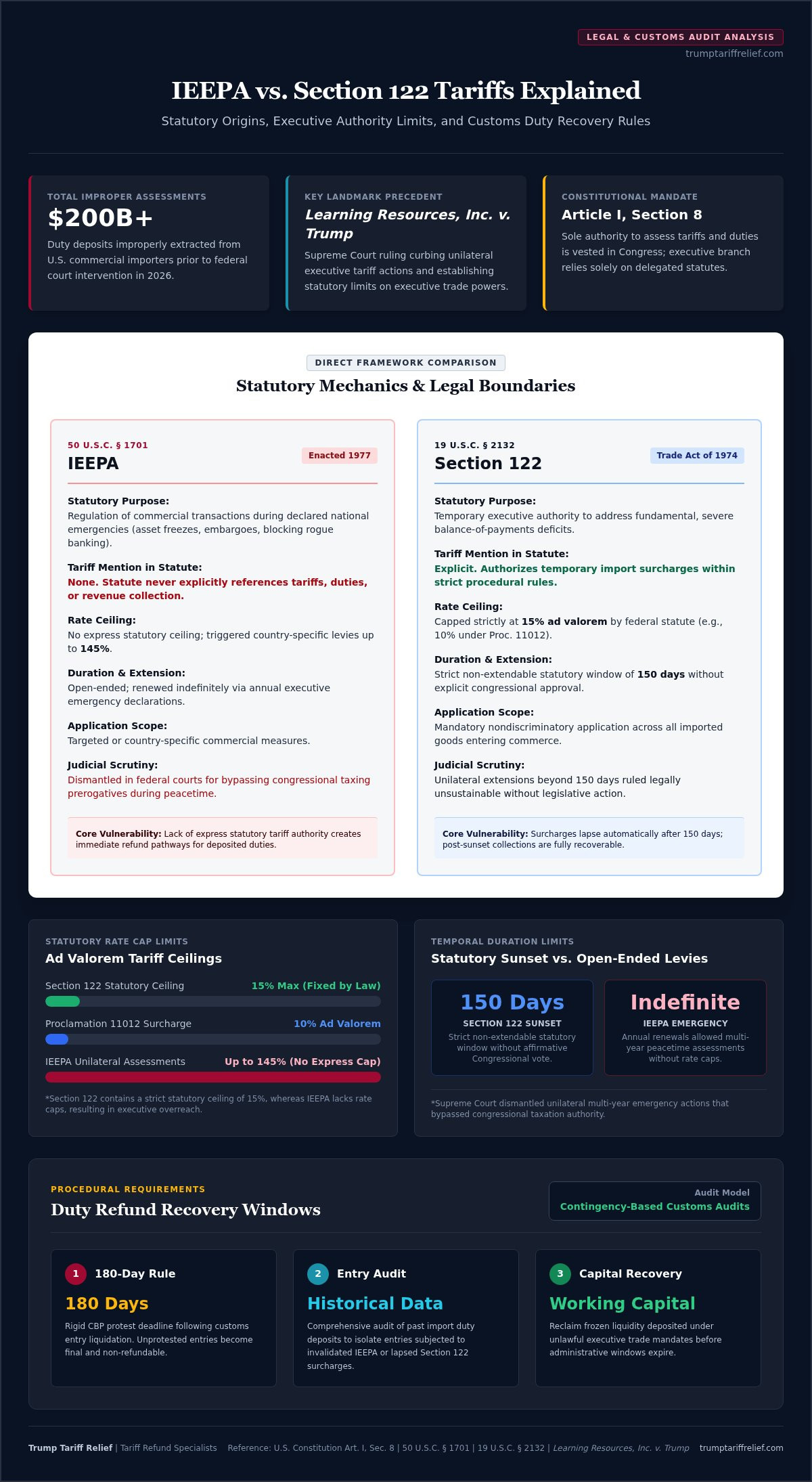
Section 122 of the Trade Act of 1974 (19 U.S.C. § 2132) takes a completely different statutory approach. Congress passed this provision to grant temporary presidential authority during severe balance-of-payments deficits, establishing rigid statutory limits that contrast sharply with open-ended emergency claims:
- Authorizes temporary import surcharges capped strictly at 15 percent ad valorem.
- Limits unilateral executive implementation to a non-extendable window of 150 days.
- Requires nondiscriminatory application across all imported goods entering national commerce.
- Mandates explicit congressional approval to extend tariff measures beyond the initial window.
When the executive branch invoked Section 122 via Proclamation 11012, it attempted to justify a 10% across-the-board surcharge using modern trade deficits. Under IEEPA vs Section 122 tariffs explained, this distinction matters: Section 122 explicitly mentions surcharges, but its strict procedural boundaries and Bretton Woods balance-of-payments definitions make unilateral extensions legally unsustainable.
IEEPA vs Section 122 Tariffs Explained: Direct Comparison and Legal Limits
Most legal commentary treats emergency trade powers as abstract doctrine. For commercial importers with working capital locked up in customs bonds, real-world statutory mechanics determine whether duty deposits can be reclaimed. Having IEEPA vs Section 122 tariffs explained through a side-by-side comparative framework reveals structural limits that directly affect an importer's cash flow.
The core differences between these executive tools center on rate caps, statutory duration, and how strictly Congress curtailed executive discretion.
Tariff Rates, Caps, and Duration Rules Compared
The primary operational divide between these statutes rests in how their limits are codified under federal law:
- Section 122 caps surcharges strictly at 15 percent ad valorem under statute.
- Section 122 expires automatically after 150 days unless Congress passes extending legislation.
- IEEPA contains no express rate ceiling, triggering country-specific levies up to 145%.
- IEEPA authorizations renew indefinitely through annual executive emergency declarations.
The codified text of the statutory framework highlights how Section 122 was engineered to restrict presidential reach. Under the 19 U.S.C. § 2132 balance-of-payments authority, the executive branch cannot levy open-ended import taxes; it faces an unyielding 150-day statutory sunset.
Congressional Oversight and Non-Delegation Constraints
Under the Major Questions Doctrine, executive agencies cannot claim sweeping authority over billions in economic revenue without explicit congressional authorization. Section 122 survived legal scrutiny initially because Congress wrote tight, narrow boundaries directly into the statute. In contrast, invoking IEEPA to levy universal border taxes bypasses the constitutional revenue powers reserved for the legislative branch. If you're concerned about how these changing legal standards impact your commercial operations, request a tariff eligibility assessment to identify contested entries across past quarters.
Impact on Importers: Product Scope and Global Reach
Statutory design shapes which products get hit at the border:
- Section 122 dictates non-discriminatory application across all imported goods entering commerce.
- Section 122 Proclamation 11012 created a flat 10% global surcharge under HTSUS 9903.03.01.
- IEEPA duty mandates targeted specific jurisdictions and designated trade categories selectively.
- Both statutory regimes required immediate classification updates on entry summary documentation.
When studying IEEPA vs Section 122 tariffs explained side by side, importers see that while Section 122 expired under statutory limits on July 24, 2026, IEEPA duty deposits collected prior to judicial intervention require assertive administrative recovery to unlock.
Judicial Scrutiny and Precedents: Why IEEPA Tariffs Face Supreme Court Challenges
Executive trade maneuvers reached a decisive turning point on February 20, 2026. In Learning Resources, Inc. v. Trump, the U.S. Supreme Court ruled 6–3 that IEEPA does not grant the President peacetime tariff authority. Having IEEPA vs Section 122 tariffs explained under current judicial review reveals how the courts systematically dismantled the legal foundations of unilateral emergency taxation.
When federal judges struck down these mandates, they created an actionable legal opening for U.S. commercial importers to reclaim unconstitutionally collected funds.
The Constitutional Battle Over Executive Taxation
Article I, Section 8 of the Constitution explicitly reserves the power to lay and collect taxes, duties, and imposts to Congress. Under the Major Questions Doctrine, executive agencies cannot claim sweeping authority over vast sectors of the economy without unmistakable statutory direction. Recent Supreme Court tariff ruling analysis highlights that emergency powers statutes cannot serve as a backdoor for border taxation. Economic sanctions address rogue foreign actors; they cannot impose broad domestic levies on commercial supply chains.
Court of International Trade (CIT) Jurisprudence
The U.S. Court of International Trade maintains exclusive jurisdiction under 28 U.S.C. § 1581 over commercial customs disputes. Following the Supreme Court's ruling, CIT judges applied rigorous scrutiny to alternative executive actions. In State of Oregon v. United States (Slip Op. 26-47), the CIT held that standard trade deficits don't satisfy Section 122's balance-of-payments threshold. Key procedural realities include:
- CIT retains exclusive jurisdiction over contested customs duty assessments and protests.
- Judges actively review executive compliance with statutory balance-of-payments criteria.
- Litigation dockets preserve importer claims while Department of Justice appeals proceed.
The Landmark Precedent Defining Duty Refunds
Judicial invalidation confirms that customs deposits collected under unlawful orders must be refunded with statutory interest pursuant to 19 U.S.C. § 1505. Examine our deep-dive on understanding the IEEPA tariff ruling for critical case context.
Court victories do not trigger automatic Treasury disbursements for every company. Customs entries run on rigid administrative liquidation clocks. With IEEPA vs Section 122 tariffs explained through this lens, importers must file timely protests under 19 U.S.C. § 1514 within 180 days of liquidation to prevent improper assessments from becoming permanent losses.
Duty Refund Eligibility and Recovery: Protecting Your Capital Across Both Regimes
Court victories remain hollow if your duty deposits sit permanently in the U.S. Treasury. For commercial importers, obtaining full relief requires an operational strategy that navigates CBP's administrative processing mechanisms. Getting IEEPA vs Section 122 tariffs explained at an execution level means understanding how entry documentation, electronic portal tools, and customs deadlines interact to determine your financial recovery.
Securing duty refunds follows four rigorous operational steps:
- Conduct a forensic audit of Automated Commercial Environment (ACE) entry summaries.
- Determine the specific Chapter 99 classification, executive authority, and liquidation status.
- Lodge timely administrative protests under 19 U.S.C. § 1514 to preserve standing.
- Deploy electronic ACE portal filings to process reliquidations and interest disbursements.
Auditing Import Entries and CBP Form 7501
Recovery starts by pulling complete ACE entry records across all disputed import dates. Commercial importers must cross-reference CBP Form 7501 entry summaries against Chapter 99 classifications, distinguishing between HTSUS 9903.03.01 (Section 122) and emergency country-specific tariff codes (IEEPA). Understanding how CBP categorizes these transactions is essential; see our comprehensive breakdown of how it works to ensure every deposit record aligns with federal compliance standards.
Navigating Strict Statutory Deadlines and Liquidation Windows
Customs entries follow strict legal clocks. Under 19 U.S.C. § 1501, CBP has a 90-day window to voluntarily reopen and reliquidate entries. Once an entry formally liquidates, importers face an unbending 180-day deadline under 19 U.S.C. § 1514 to file a formal administrative protest. If you miss that cutoff, the liquidation becomes final and conclusive against your business, terminating your statutory recovery rights regardless of court precedent.
To automate these determinations, CBP launched the Consolidated Administration and Processing of Entries (CAPE) tool within the ACE Portal. While Phase 1 and Phase 2 addressed unliquidated and recently liquidated entries (<80 days), Phase 3 expands electronic processing up to 9,999 entries per CSV batch, providing a systematic pathway for active claims.
Strategic Recovery Pathways for Commercial Importers
Recovering capital requires close alignment between customs documentation management and federal protest procedures. Because systemic executive challenges often require protective actions under 28 U.S.C. § 1581 before the CIT, importers cannot rely solely on standard freight broker workflows. When evaluating IEEPA vs Section 122 tariffs explained from an operational standpoint, having an integrated data audit ensures your business doesn't forfeit statutory interest entitlements payable under 19 U.S.C. § 1505.
Don't let your working capital remain trapped in customs deposits. Submit your entry records today for an immediate tariff eligibility assessment to identify your refund exposure.
How Trump Tariff Relief Recovers Your Unlawfully Paid Tariff Deposits
Traditional trade firms treat customs recovery as an open-ended billing exercise. They charge steep hourly retainers regardless of whether CBP returns a single cent to your corporate bank account. Trump Tariff Relief operates on a completely different model. We provide national U.S. commercial importers with dedicated advocacy focused entirely on tariff recovery, eliminating financial risk while securing the full duty repayments owed to your business.
As established when having IEEPA vs Section 122 tariffs explained, executive trade actions leave behind complex regulatory hurdles. We manage that friction directly so you can reclaim trapped operating capital without diverting internal resources.
Zero-Risk, Contingency-Based Recovery Representation
Corporate balance sheets shouldn't take on new expenses to correct executive overreach. We represent commercial importers across the country on a strict contingency basis:
- Zero upfront retainer fees or hidden hourly administrative charges.
- Complete alignment where our fee is collected only after refunds clear.
- Full financial protection ensuring your business incurs no downside risk.
You can review the straightforward onboarding process through how it works to see how our team initiates your claims.
Full-Service Administrative and Legal Documentation
Recovering contested duties from CBP requires precise customs documentation management and deep mastery of ACE data systems. Our team handles every operational phase of the recovery lifecycle:
- Forensic extraction and reconciliation of historical ACE entry summaries.
- Drafting and lodging compliant 19 U.S.C. § 1514 administrative protests.
- Monitoring CIT suspense dockets to execute timely reliquidations and payouts.
We do the heavy administrative work, identifying eligible entries, verifying Chapter 99 declarations, and ensuring your claims include statutory interest entitlements under 19 U.S.C. § 1505.
Take Immediate Action Before Filing Windows Expire
Customs liquidation clocks don't pause while executive trade policies get sorted out in Washington. Every week an unprotested entry crosses the 180-day liquidation threshold, that capital vanishes permanently. Having IEEPA vs Section 122 tariffs explained clarifies that administrative delay is your greatest financial threat. Review common importer concerns on our frequently asked questions page, and protect your company's refund rights before statutory filing deadlines expire.
Reclaim Your Capital Before Customs Liquidation Deadlines Expire
Having IEEPA vs Section 122 tariffs explained makes one reality crystal clear: executive trade authorities operate under finite legal lifespans, but CBP liquidation rules run on an even stricter clock. When courts strike down emergency duty regimes, the government doesn't disburse restitution automatically. Preserving and recovering your capital requires timely, structured administrative action before your 180-day protest windows lapse permanently.
Trump Tariff Relief delivers specialized national advocacy for U.S. commercial importers across manufacturing, retail, and tech. Our dedicated team manages the end-to-end recovery lifecycle, auditing historical ACE data and filing compliant customs documentation to secure your funds plus statutory interest. Operating on a pure contingency model with zero upfront or hourly costs, we take on the operational friction so your business assumes no financial risk.
Every week you wait allows active entries to finalize beyond recovery. Secure your tariff eligibility assessment right now, and let our specialists reclaim the duties your business is rightfully owed.
Frequently Asked Questions
Can the President legally use IEEPA to impose across-the-board tariffs on all imports?
No. The Supreme Court established in Learning Resources, Inc. v. Trump that IEEPA does not grant the President peacetime tariff authority. Article I, Section 8 of the U.S. Constitution reserves taxation and customs duties strictly to Congress. While IEEPA permits economic sanctions and asset freezes during foreign emergencies, deploying it as a universal import tax exceeds statutory limits and violates the Major Questions Doctrine.
What is the primary difference between IEEPA tariffs and Section 122 tariffs?
Having IEEPA vs Section 122 tariffs explained comes down to statutory intent and structural limits. IEEPA addresses foreign national security emergencies without explicit tariff language, leading courts to strike down emergency duty actions. Section 122 of the Trade Act of 1974 explicitly authorizes balance-of-payments import surcharges. However, Section 122 caps duties at 15 percent ad valorem and automatically sunsets after 150 days unless Congress passes extending legislation.
How much time do importers have to challenge and recover unlawfully assessed duties?
Commercial importers have exactly 180 days from the official date of entry liquidation to lodge a formal administrative protest under 19 U.S.C. § 1514 with CBP. If your entries have not yet liquidated, CBP can voluntarily reliquidate them within 90 days under 19 U.S.C. § 1501. Missing these statutory windows bars your business from reclaiming duty deposits, making immediate entry audits critical.
Does Section 122 require congressional approval to keep tariffs in place long term?
Yes. Section 122 contains a strict statutory sunset provision that terminates presidential surcharge authority after 150 days. The executive branch cannot unilaterally renew or extend these measures under the statute. Unless Congress votes to pass affirmative legislation extending the surcharge before the 150-day window expires, the duties lapse automatically, as occurred with Proclamation 11012 in July 2026.
Can my business recover tariffs paid if our entries have already liquidated?
Recovery depends on when liquidation occurred and whether you took timely administrative action. Entries liquidated within the past 180 days remain eligible for formal 19 U.S.C. § 1514 protests. For older entries liquidated beyond 80 days, CBP Phase 3 CAPE processing provides a pathway for importers with active CIT complaints. Understanding IEEPA vs Section 122 tariffs explained helps determine which entries qualify before liquidation finality locks out recovery.
What import documentation is required to file an IEEPA tariff refund claim?
Claiming an IEEPA duty refund requires complete customs entry records pulled from the Automated Commercial Environment (ACE). Specifically, your business needs CBP Form 7501 Entry Summaries, commercial invoices, packing lists, and bills of lading. These records verify the exact Chapter 99 duty rates assessed, entry dates, liquidation status, and the total dollar amounts deposited with customs during the contested trade action periods.
How does contingency-based tariff recovery work with Trump Tariff Relief?
Trump Tariff Relief operates on a pure performance model with zero upfront retainer costs or hourly fees. Our specialized trade professionals manage the complete lifecycle, providing end-to-end customs documentation management, forensic ACE data audits, and CBP administrative protest filings. We collect an agreed percentage fee only after the U.S. Treasury disburses your duty refund, ensuring national commercial importers assume no downside financial risk.
Ready to find out what your business may be owed?
Check My Eligibility