
The federal government is currently sitting on a $166 billion debt owed to American importers, and the clock is ticking on your right to reclaim it. Following the 2026 Supreme Court ruling that declared 2025 IEEPA duties unconstitutional, a massive financial restoration is underway. You've likely felt the sting of these illegal duties on your bottom line for months. It's natural to feel skeptical about government agencies returning cash, but the results are already hitting corporate balance sheets. High-profile examples of companies getting tariff refunds include Walmart's $2.9 billion recovery and Target's $994 million injection, proving that the path to restoration is officially open.
You deserve to know if your industry is eligible for a piece of this $160 billion pool without fearing a complex audit or more administrative red tape. We'll break down the specific sectors successfully recovering funds and clarify the critical differences between Section 301 and IEEPA rulings. This guide provides a clear, low-risk roadmap to identifying your own recovery opportunities. You'll learn how to navigate the current CBP processing phases and secure the interest-bearing refunds your business is legally entitled to receive.
Key Takeaways
- Understand the 2026 Supreme Court ruling that invalidated IEEPA-based tariffs, opening a $166 billion refund pool for U.S. importers.
- Review high-profile examples of companies getting tariff refunds, including Walmart’s $2.9 billion recovery and Apple’s $2.2 billion impact on gross margins.
- Discover how manufacturing and medical equipment firms are successfully reclaiming historical duties on industrial machinery and vital components.
- Learn the exact two-step process to audit your historical import records and identify specific HTS codes eligible for recovery.
- Identify how a contingency-fee partnership removes the financial barriers and administrative burden of filing complex customs claims.
The $160 Billion Windfall: Why Companies are Getting Tariff Refunds in 2026
The Supreme Court's February 20, 2026, decision in Learning Resources, Inc. v. Trump fundamentally shifted the trade landscape. By ruling that the executive branch overstepped its authority under the International Emergency Economic Powers Act (IEEPA), the court invalidated billions in collected duties. This isn't a theoretical victory; it's a $166 billion mandate for the federal government to return capital to the businesses that paid it. If your company acted as the Importer of Record (IOR) on CBP Form 7501, you're the legal owner of these funds. Downstream wholesalers or retail customers can't claim this money. Only the entity that directly paid the duties to Customs and Border Protection (CBP) can initiate a recovery.
The window for action is narrow. Federal law imposes a strict three-year statute of limitations on these claims, and for many, the deadline is approaching fast. We've already seen massive examples of companies getting tariff refunds as the CAPE system processes billions in backlogged entries. Waiting for the government to volunteer a check is a losing strategy. You must proactively identify your eligibility and file the necessary documentation before your legal right to these funds expires. By studying the examples of companies getting tariff refunds in your specific sector, you can better estimate the potential impact on your own cash flow.
The Legal Catalyst: IEEPA vs. Section 301
Distinguishing between these legal authorities is critical for your recovery strategy. While Section 301 tariffs focus on unfair trade practices, the IEEPA measures were based on national emergency powers that the Supreme Court has now deemed insufficient for revenue generation. Specifically, the ruling invalidated duties on List 3 and List 4a imports that were assessed under these emergency declarations. Because the court found these tariffs in the second Trump administration were unauthorized by statute, the Department of the Treasury is legally required to reliquidate affected entries and issue refunds with interest.
The Scale of the Recovery Opportunity
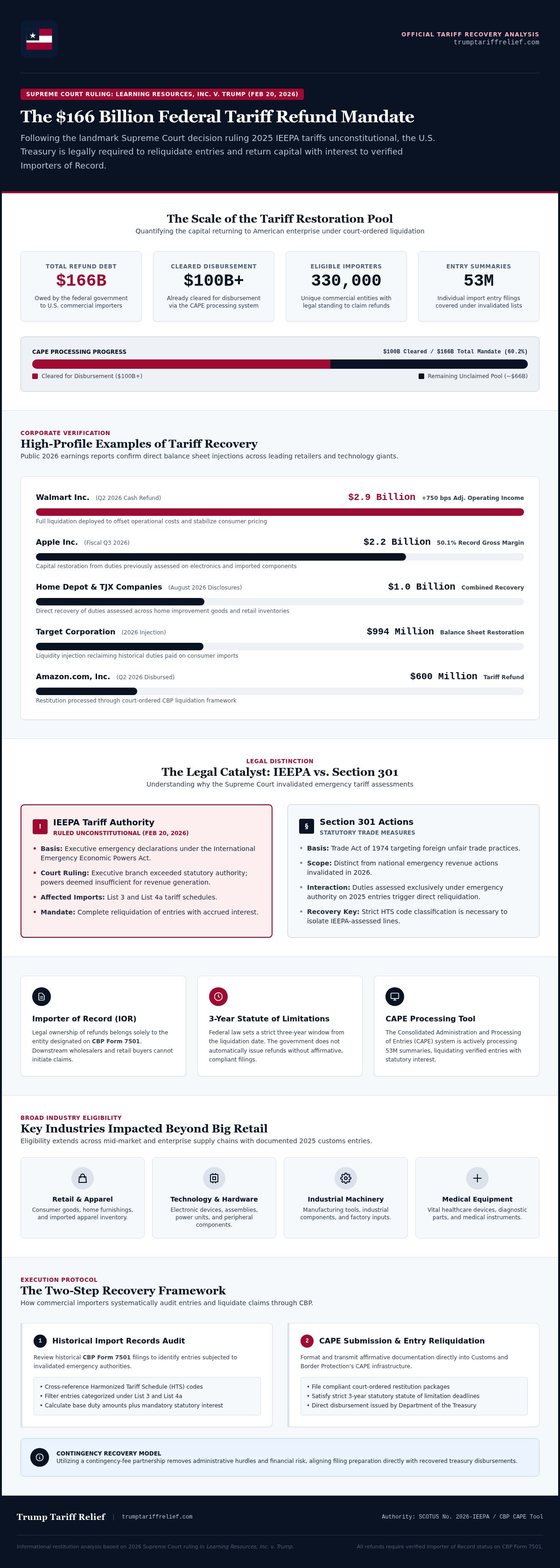
Approximately 330,000 unique commercial importers are currently eligible to reclaim their share of this windfall. Many business owners mistakenly believe this capital is "gone" or absorbed into the federal budget, but the reality is that the funds are actively being distributed through the Consolidated Administration and Processing of Entries (CAPE) tool. Over $100 billion has already been cleared for disbursement to companies that took the initiative to file. To understand the granular legal mechanics behind these specific duties, you can read our detailed breakdown on IEEPA Explained. The scale is unprecedented, covering 53 million entry summaries that represent a massive injection of liquidity for U.S. businesses.
Tech Giants and Retail Leaders: High-Profile Examples of Tariff Recovery
The scale of the IEEPA and Section 301 recovery is no longer speculative. Public earnings reports from 2026 confirm that billions are flowing back to the nation's largest importers. These examples of companies getting tariff refunds serve as a blueprint for any business still questioning the legitimacy of the "China tariff refund." Apple Inc. set the benchmark in its fiscal Q3 2026 report, confirming a $2.2 billion impact that lifted its gross margins to a record 50.1%. This isn't just an accounting adjustment; it's a massive restoration of capital that was previously locked in illegal duties.
Walmart Inc. has demonstrated the most aggressive recovery strategy to date. In Q2 2026 alone, the retailer received a $2.9 billion cash refund. By leveraging these funds to offset rising operational costs, Walmart is maintaining price stability for consumers while enjoying a 750-basis-point benefit to its adjusted operating income. Similarly, Amazon.com reported receiving $600 million in tariff refunds during the same period. These figures prove that the federal government is indeed liquidating entries for those who follow the proper court-ordered tariff refund procedures.
Other examples of companies getting tariff refunds include Home Depot and TJX Companies, who disclosed a combined $1 billion in recoveries during August 2026. These disclosures highlight that the recovery process is active and functioning at a high volume. While these giants have the resources to manage complex filings, the same legal mechanisms are available to mid-sized importers who paid the same unauthorized duties.
The Tech Sector: Recovering Costs on Electronics
Consumer electronics importers face some of the most complex documentation requirements due to the sheer volume of components. Identifying the correct HTS codes is the difference between a full recovery and an administrative denial. Major players are reclaiming duties on everything from printed circuit boards to finished hardware. For a deeper look at how electronics importers can navigate these requirements, see our strategic guide to IEEPA refunds. Precision in documentation is the only way to ensure your claim survives CBP scrutiny.
Retail and Apparel: Reclaiming Capital on Consumer Goods
High-volume retailers like Nike and Target are seeing early payouts because their import data is often the most standardized. Nike has successfully clawed back an estimated $300 million in List 3 duties, while Target reported $994 million in pretax refunds in Q2 2026. This capital injection allowed Target to raise its full-year EPS guidance by $1.65 per share. If your business imports clothing or footwear, you likely have significant capital tied up in the same entries. You can assess your eligibility now to ensure you don't miss the 2026 filing window.
Beyond the Fortune 500: Sector-Specific Examples of Successful Claims
The media focus on retail giants often obscures a critical reality: the $160 billion refund pool belongs to businesses of all sizes. Whether your company is seeking a $50,000 recovery or a $50 million payout, the legal mechanism remains the same. These examples of companies getting tariff refunds demonstrate that success isn't reserved for the Fortune 500. Mid-sized manufacturing and healthcare firms are now the primary beneficiaries of the ongoing 2026 reliquidation process. If you paid the duty, you own the claim.
Manufacturing firms have been particularly successful in reclaiming duties on industrial machinery and raw materials. Many small-to-mid-sized factories are using these recovered funds to modernize their production lines or offset the rising cost of domestic labor. Success in this sector depends heavily on identifying specific HTS codes that were caught in the Court of International Trade Section 301 litigation. If your facility imports specialized components or heavy equipment, you should perform a Tariff Eligibility Assessment to determine your recovery potential before the statute of limitations expires.
Manufacturing and Industrial Recovery
Industrial importers often face complex audits because their shipments include a wide variety of raw materials and sub-assemblies. However, once the eligibility of a specific HTS code is established, the recovery typically covers multiple years of import history. We've seen examples of companies getting tariff refunds in the manufacturing space where the capital injection was used to bridge cash flow gaps caused by historical duties. The process is methodical, but the results are legally guaranteed for valid entries.
Medical and Healthcare Importers
The medical equipment sector has also secured significant wins. Importers of vital healthcare components, such as sensors for diagnostic machinery or specialized alloys for surgical tools, are successfully reclaiming millions in historical duties. For these companies, the refund acts as a non-dilutive capital injection for research and development. Because medical device components often fell under the most contested tariff lists, they frequently qualify for the most favorable refund categories under current 2026 CBP processing phases.
Construction and HVAC companies are another group seeing high success rates. Building materials, including aluminum extrusions and climate control components, were heavily taxed under the 2025 emergency measures. Firms in the construction space are using this capital to stabilize their bidding prices in a volatile market. The government is legally mandated to return these funds, but the burden of proof rests entirely on the importer to provide the correct customs documentation. Don't assume your business is too small to qualify; the law applies to every dollar of unconstitutional duty paid.
How Your Business Can Replicate These Recovery Results
While high-profile examples of companies getting tariff refunds like Apple and Walmart highlight the potential for massive recoveries, the actual process requires rigorous technical execution. You don't need a Fortune 500 legal team to succeed. However, you do need a methodical approach to identifying and documenting your claims. The federal government is currently processing over $160 billion in valid claims, but they won't issue a check unless your filing is flawless and timely.
To replicate the success of major importers, your business must follow a structured five-step recovery plan:
- Step 1: Comprehensive Audit. Perform a deep-dive review of all import records from 2018 through 2024 to capture every eligible entry.
- Step 2: HTS Identification. Filter your data to identify specific HTS codes that fall under the IEEPA and Section 301 rulings.
- Step 3: Document Organization. Secure your Entry Summaries (CBP Form 7501) and Commercial Invoices to prove duty payment.
- Step 4: Formal Filing. Submit your claim through the CAPE tool or file formal protests before the final 2026 deadlines.
- Step 5: Status Monitoring. Track your claim through the CBP administrative processing phases to ensure it moves toward reliquidation.
The examples of companies getting tariff refunds in 2026 all share one common trait: they acted quickly once the Supreme Court invalidated the emergency duties. If you delay your audit, you risk losing visibility into older entries that are still eligible for recovery.
The Critical Role of Customs Documentation
Missing paperwork is the primary reason CBP denies valid claims. If your documentation doesn't clearly list your business as the Importer of Record, the refund will be rejected. You must verify that your internal records match the data stored in the Automated Commercial Environment (ACE). For a full breakdown of the paperwork you need to win, see our required documents for IEEPA tariff refunds. Organizing these files now prevents administrative delays later.
Navigating the Statute of Limitations
The "3-Year Rule" is the most dangerous obstacle for importers today. By late 2026, the window for reclaiming duties paid during the initial 2023 emergency period is rapidly closing. Many firms have already lost their eligibility by adopting a "wait and see" approach. The government is not required to notify you when your filing window expires. You can check the specific cutoffs in our guide on the tariff refund statute of limitations. Don't leave your capital in the government's hands. Start your recovery audit today to secure your refund before the 2026 deadlines expire.
Securing Your Refund with Trump Tariff Relief
The technical burden of reclaiming thousands or millions in duties shouldn't fall on your internal staff. While previous sections provided examples of companies getting tariff refunds, those successes were the result of meticulous legal and documentation management. Trump Tariff Relief functions as your specialized advocate, navigating the friction of CBP bureaucracy to ensure your capital is returned. We operate on a pure contingency-fee basis, meaning we only receive payment if you successfully win your refund. This model eliminates the financial barrier for importers and aligns our success directly with your recovery.
Our "we-do-the-work" narrative is designed for efficiency. We manage the full lifecycle of the claim, from the initial eligibility audit to the final filing of reliquidation orders. If your business paid illegal IEEPA duties, you have a legal right to restoration, but that right is temporary. Once the 2026 deadlines pass, any unclaimed capital is legally forfeited to the federal government. We provide the protective strength needed to claw back these funds before the window of opportunity snaps shut.
The Advantage of Professional Recovery Services
General customs brokers are essential for moving goods, but they often lack the specialized focus required for historical IEEPA recovery. Most brokers focus on current compliance rather than retroactive litigation. Our team identifies "hidden" eligible entries that internal audits frequently overlook, ensuring no capital is left on the table. By studying the most complex examples of companies getting tariff refunds, we've developed proprietary methods to verify Importer of Record status across millions of historical entry summaries.
Start Your Free Eligibility Assessment Today
The first step toward financial restoration is a low-friction preliminary audit. We examine your import history to identify specific HTS codes and entry dates that qualify under the 2026 Supreme Court and CIT rulings. This Tariff Eligibility Assessment provides a clear roadmap of your potential recovery with zero upfront risk. Visit our How It Works page to initiate your assessment and secure your share of the $160 billion pool before the statute of limitations expires.
Secure Your Capital Before the 2026 Deadlines
The window to reclaim illegal IEEPA duties is narrowing by the day. We have explored the examples of companies getting tariff refunds across diverse sectors, proving that the $166 billion government liability is being liquidated for those who take decisive action. Whether you're a mid-sized manufacturer or a large-scale importer, the legal right to financial restoration is yours to claim. The 2026 reliquidation process is active, but it requires a steady hand to navigate the complex documentation requirements of the CBP.
Our specialized IEEPA legal experts handle the full lifecycle of your recovery, from the initial document audit to the final filing. Because we operate on a contingency-fee basis, there's zero upfront risk to your business; we only get paid when you receive your check. Don't let your hard-earned capital become a permanent gift to the federal government. Claim Your Share of the $160 Billion: Start Your Free Assessment Now. Your financial restoration is a matter of law, and we're prepared to help you secure every dollar you're owed.
Frequently Asked Questions
Is the China tariff refund real or a scam?
The refund is a legitimate legal mandate resulting from the February 2026 Supreme Court ruling in Learning Resources, Inc. v. Trump. The court found that IEEPA duties were unconstitutional, requiring the government to return approximately $166 billion. CBP has already disbursed over $100 billion to commercial importers. This is a court-ordered restoration of capital, but it requires businesses to proactively file claims before the statute of limitations expires.
How much did Apple get back in tariff refunds?
Apple confirmed a $2.2 billion impact from tariff refunds in its fiscal Q3 2026 earnings report. This recovery was a primary driver in lifting the company's gross margins to 50.1%. While Apple is a high-profile case, their success demonstrates the technical validity of the recovery process. Their filing followed the same administrative procedures and CAPE tool requirements available to any importer of record that paid these unauthorized duties.
Which companies are eligible for IEEPA tariff refunds?
Any commercial entity that acted as the Importer of Record for goods on List 3 or List 4a is eligible for recovery. This includes over 330,000 unique businesses across the technology, retail, and manufacturing sectors. If your company paid duties under the 2025 emergency declarations, you own the legal claim to those funds. Eligibility is determined by the specific HTS codes used and the dates the entries cleared customs.
What is the deadline for filing a tariff refund claim in 2026?
Deadlines are governed by a strict three-year statute of limitations from the date of entry or final liquidation. For many 2023 shipments, the window for recovery is closing in late 2026. Importers covered by specific reliquidation orders had to submit valid IOR numbers before the July 30, 2026, cutoff for Phase 3 processing. Missing these statutory deadlines results in a permanent legal forfeiture of your right to reclaim that capital.
Can small businesses get tariff refunds, or is it just for large corporations?
Small and mid-sized businesses are fully eligible for these recoveries. While media reports often highlight examples of companies getting tariff refunds like Walmart or Target, the legal mechanism is identical regardless of company size. A $50,000 claim follows the same regulatory path as a $50 million claim. Many smaller firms are successfully using these recovered funds to modernize their equipment or stabilize their 2026 operational budgets.
How long does it take for the government to process a tariff refund?
Processing times vary depending on the entry status and the filing phase. Unliquidated entries handled through CAPE Phase 1 are typically processed faster than older, finally liquidated entries. As of August 2026, CBP has already cleared roughly 60% of total government liabilities. However, manual filings face significantly higher denial rates. Using specialized trade experts can help avoid the administrative bottlenecks that cause delays for many unverified claims.
What documents do I need to prove I paid the tariffs?
You must provide CBP Form 7501, also known as the Entry Summary, along with the associated commercial invoices. These documents prove your status as the Importer of Record and verify the specific HTS codes and duty amounts paid. Accurate documentation is the most critical factor in securing approval. If your internal records are incomplete, our team can help reconstruct your import history using data from the Automated Commercial Environment (ACE).
Do I have to pay upfront fees for tariff recovery services?
No, Trump Tariff Relief operates on a pure contingency-fee basis. You don't pay any upfront costs or hourly consulting fees for our services. We only receive a percentage of the refund after the government successfully returns your capital. This model ensures that examples of companies getting tariff refunds include businesses of all sizes that want to avoid financial risk while pursuing their legal right to a full restoration.
Ready to find out what your business may be owed?
Check My Eligibility