
Every dollar your business overpaid in Section 301 duties is currently a decaying asset, and without immediate action, it becomes a permanent donation to the U.S. Treasury. You aren't alone if you feel the weight of this ticking clock, as many importers remain paralyzed by the technical complexity of trade litigation. The reality is that the IEEPA tariff refund deadline is fast approaching, and once this 2026 window closes, the legal path to financial restoration disappears forever.
It's understandable to feel confused by the conflicting timelines between standard CBP protest windows and the broader APA statutes of limitations. You've worked hard to build your enterprise, and leaving millions on the table due to a procedural oversight is a risk you can't afford. This article provides the clarity you need to reclaim what's yours. We'll outline the critical 2026 filing milestones, provide a comprehensive document checklist to expedite your recovery, and introduce a streamlined, low-risk method to audit your customs data without draining your internal resources.
Key Takeaways
- 2026 represents the critical tipping point for importers to reclaim Section 301 duties before the three-year lookback window permanently expires.
- Understand the legal distinction between the six-year APA statute of limitations and standard administrative protests to ensure no capital is left behind.
- Identify how specific liquidation dates from your 2023 to 2025 import records dictate your business's eligibility for financial recovery.
- Follow a proven five-step strategy to submit your claim successfully before the IEEPA tariff refund deadline expires.
- Leverage a contingency-based partnership that manages the technical documentation and legal filing with zero upfront costs to your firm.
The IEEPA Tariff Refund Window: Why 2026 is the Critical Year
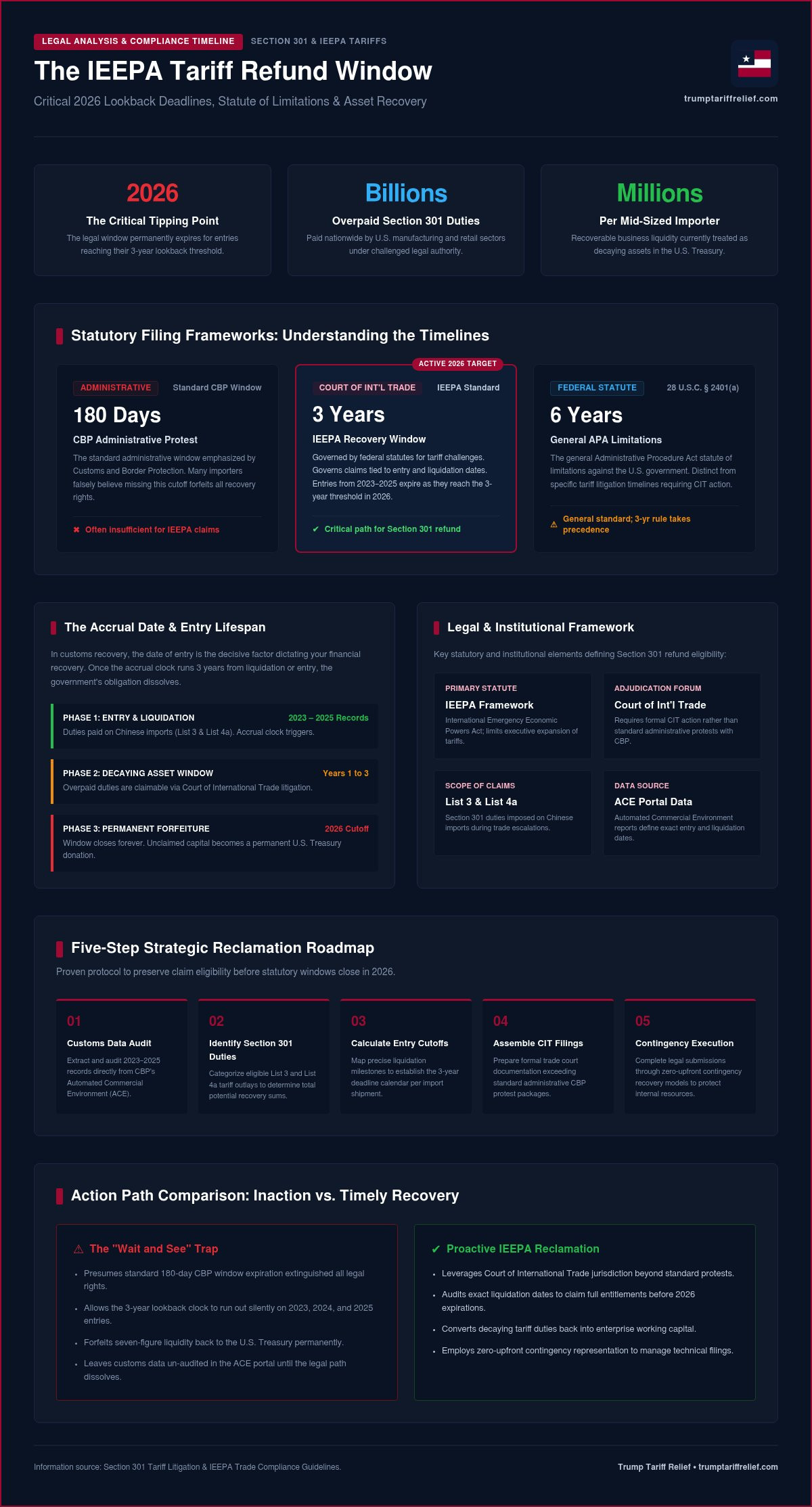
The IEEPA tariff refund isn't a government handout; it's the reclamation of capital that was collected under questionable legal authority. Specifically, these claims focus on the recovery of Section 301 duties imposed on Chinese imports, where executive overreach has been challenged in federal courts. For U.S. businesses, 2026 has emerged as the definitive tipping point. Because of the standard three-year lookback period for administrative and legal challenges, entries made during the peak of trade tensions are rapidly reaching their expiration. If you don't act now, the capital your business injected into the Treasury through these tariffs will be permanently forfeited.
Massive financial stakes define this period for the manufacturing and retail sectors. Companies across the country have collectively overpaid billions, and for a mid-sized importer, this often represents millions in recoverable liquidity. While U.S. Customs and Border Protection (CBP) typically limits protest windows to a narrow 180 days, legal precedents allow for a much broader window under federal statutes of limitations. Understanding the IEEPA tariff refund deadline is the difference between a successful recovery and a total loss of claimable assets.
The Legal Foundation of IEEPA Claims
The core of these recovery efforts rests on the International Emergency Economic Powers Act (IEEPA). This act defines the scope of a President's authority to regulate international commerce during declared emergencies. Recent litigation has argued that the expansion of Section 301 tariffs exceeded this delegated power. This legal shift effectively transformed what were once considered "fixed costs" or "paid duties" into "recoverable assets." You can learn more about the specifics of this legal framework at IEEPA explained. We view this as a unique, time-sensitive window to right a financial wrong, but the law only protects those who actively assert their rights.
Why Importers Often Miss the Cutoff
Misconceptions in trade compliance often lead to the "wait and see" trap, which is the most dangerous error an importer can make. Many businesses believe that if they missed the initial 180-day CBP protest window, they've lost their chance. This is false. However, eligibility is a decaying asset. Every day that passes from the date of your original entry brings you one step closer to the final IEEPA tariff refund deadline. Once that statute of limitations expires, even the strongest legal argument won't get your money back. Success requires a proactive audit of your 2023 through 2025 records before the window slams shut in 2026.
Understanding the 3-Year Statute of Limitations for Tariff Claims
While U.S. Customs and Border Protection (CBP) often emphasizes the 180-day protest window, the Administrative Procedure Act (APA) provides a more robust framework for recovery through the Court of International Trade. For many importers, the IEEPA tariff refund deadline is governed by a three-year statute of limitations rather than the general six-year window found in 28 U.S.C. § 2401(a). This distinction is vital because the APA specifically regulates how federal agencies implement trade policy. If your claim isn't filed within this specific three-year window, the government's legal obligation to return your capital dissolves entirely.
The "accrual date" is the most critical variable in your recovery timeline. This is the moment the clock starts ticking, usually triggered by the date of entry or the final liquidation of duties. Once this date passes the three-year mark, your window for legal action closes permanently. You can find detailed technical requirements in the CBP IEEPA duty refund guidance, which outlines how these claims are processed within the Automated Commercial Environment (ACE) portal.
Section 301 vs. IEEPA Filing Timelines
The timing for recovery varies significantly between List 3 and List 4a imports. Many businesses that paid duties on entries throughout 2023 and 2024 are now finding themselves at a crossroads as they enter 2026. Because these claims are tied to the specific dates of importation, a delay of even a few weeks can result in the forfeiture of seven-figure sums. In the world of customs recovery, the date of entry is the only date that dictates your financial destiny.
The Role of the Court of International Trade (CIT)
A standard administrative protest with CBP is often insufficient for IEEPA-related recoveries. These claims typically require a formal filing with the Court of International Trade (CIT), a process that demands a high level of legal and technical precision. Unlike a simple clerical correction, a CIT filing challenges the underlying authority of the duty collection itself. This is why a specialized approach is necessary to ensure your documentation meets the court's rigorous standards before the IEEPA tariff refund deadline expires. You can learn more about how IEEPA works and why the CIT is the primary venue for these high-stakes disputes. If you are unsure whether your 2023 entries are still eligible, you should request a preliminary assessment to secure your position.
Determining Your Specific Eligibility Cutoff Date
Identifying your specific window for recovery requires a surgical review of your 2023 through 2025 import records. While previous sections established the legal framework, the practical application depends entirely on your specific entry data. The IEEPA tariff refund deadline isn't a singular date on a calendar; it's a rolling threshold that moves forward every day. To secure your claim, you must navigate the 28 U.S. Code § 2636 statute of limitations, which dictates the jurisdictional filing windows for the Court of International Trade. Missing this window by even 24 hours results in the permanent loss of claimable capital.
Your internal audit should focus heavily on the "Liquidation Date." While the date of entry initiates the lookback period, liquidation represents the final administrative determination by CBP. If an entry hasn't liquidated, you may still have options for post-summary corrections to adjust duty payments. However, once liquidation occurs, the 180-day clock for protests begins, often overlapping with the broader three-year APA window. Prioritizing high-value entries that are closest to this three-year expiration is the only way to prevent capital forfeiture. This is especially true for manufacturers with high-volume, recurring shipments where the cumulative loss of "expired" entries can reach seven figures in a matter of months.
Tracking Import Dates and Liquidation
To begin your assessment, gather your CBP Form 7501 data. You'll need to extract specific data points, including the entry number, the date of entry, and the specific HTS codes to identify List 3 and List 4a commodities. Differentiating between "entered for consumption" and "liquidated" status is vital. List 3 items, which faced a 25% duty rate, often represent the highest recovery potential. List 4a items, while taxed at a lower rate, still contribute significantly to the millions currently left on the table by uninformed importers. If your internal resources are stretched thin, manual data extraction is often the first point of failure in a recovery strategy.
The "Rolling Deadline" Effect
Many executives mistakenly wait for a "final ruling" before filing, but this creates a dangerous "rolling deadline" effect. Because the statute of limitations looks back exactly three years from the date of your filing, every week you delay causes another week of 2023 entries to expire. You aren't just missing one deadline; you're losing money every seven days. This decay makes manual audits the enemy of recovery. For a deeper breakdown of these specific windows, read our guide on the Tariff Refund Statute of Limitations: The Critical Deadlines. In 2026, speed is your most valuable asset, and a proactive filing is the only way to freeze the clock on your eligible entries.
Strategic Steps to Secure Your Claim Before Expiration
Securing a multi-million dollar refund requires more than just awareness; it demands a disciplined, rapid execution strategy. As we move through 2026, the IEEPA tariff refund deadline is no longer a distant concern but an immediate operational priority. Manual audits are a liability in this environment. They are too slow, prone to human error, and often result in missed entries that could have yielded significant returns. To reclaim your capital, your business must transition from passive observation to active recovery using a structured five-step approach.
- Data Extraction: Pull comprehensive reports from the Automated Commercial Environment (ACE) to identify every Section 301 duty payment made since 2023.
- HTS Filtering: Isolate List 3 and List 4a commodities to determine the exact scope of your eligible overpayments.
- Document Verification: Cross-reference entry summaries with commercial invoices to ensure data integrity.
- Protective Filings: Submit "Protective Protests" or Court of International Trade filings to toll the statute of limitations and freeze your eligibility.
- Formal Recovery: Execute the final legal claim to move the funds from the U.S. Treasury back to your corporate accounts.
Data verification is the most critical hurdle in this process. The government frequently rejects claims based on minor clerical discrepancies between the entry summary and the proof of payment. Ensuring your data is "audit-ready" before submission is the only way to prevent administrative delays that could push your filing past the final IEEPA tariff refund deadline.
Documentation Audit for Fast Filing
Speed depends on the "Big Three" documents: your Entry Summary (Form 7501), the Commercial Invoice, and the Proof of Payment. Without these, your claim is effectively dead on arrival. You must digitize and organize these records into a bulk-submission format to handle the high volume of entries typical for retail and manufacturing importers. For a complete list of technical requirements, consult our Required Documents for IEEPA Tariff Refund: The 2026 Importer’s Checklist. Organizing these assets now prevents a last-minute scramble that often leads to forfeited claims.
Bypassing Internal Bureaucracy
Internal friction is often the greatest barrier to recovery. To get CFO approval in under 48 hours, focus on the contingency-fee model. This isn't a budget-draining legal project; it's a "no recovery, no fee" partnership that requires zero upfront capital. When you frame the project as a risk-free way to inject liquidity into the balance sheet, budgetary objections disappear. You can see how our recovery process works to explain the streamlined workflow to your executive team. If you're ready to stop the decay of your claimable assets, start your eligibility assessment today and secure your place in the 2026 recovery window.
Trump Tariff Relief: No-Risk Recovery Before the Deadline
Trump Tariff Relief serves as the definitive advocate for U.S. importers facing the rapid expiration of their recovery rights. While general consultants offer broad advice, we provide a focused, results-oriented engine designed specifically to navigate the complexities of trade litigation and federal bureaucracy. We understand that the IEEPA tariff refund deadline represents a high-stakes moment for your balance sheet. Our mission is to ensure that no business forfeits its legitimate capital due to the sheer weight of customs documentation or a lack of specialized legal resources.
We position ourselves as the active engine in the recovery process. This means we take on the heavy lifting while your team remains focused on core business operations. From the initial data audit of your 2023 entries to the final submission through the Automated Commercial Environment, our insider experts manage every technical detail. We don't just provide a roadmap; we execute the entire journey to ensure your claim meets the rigorous standards required for government approval.
Our Contingency-Based Recovery Model
The most common barrier to recovery is the perceived cost of a legal challenge. Traditional firms often demand hourly fees that create a high-risk scenario for the importer, regardless of the outcome. We eliminate this objection entirely through a contingency-fee model. This means our success is tied directly to your financial restoration; if we don't recover your funds, you don't pay a fee. This approach removes the #1 objection from CFOs and allows for immediate project approval without a dedicated legal budget.
By removing the financial risk, we take on 100% of the burden. We manage the entire lifecycle of the claim, from the initial assessment and HTS filtering to the final filing with the government. This ensures that your entries are processed with the speed necessary to beat the 2026 IEEPA tariff refund deadline. We are not just a service provider; we are a high-performing partner that transforms a complex regulatory hurdle into a streamlined path for capital injection.
Start Your Eligibility Assessment Today
The window for action in 2026 is narrow, and every week of delay results in the permanent loss of eligible entries. A preliminary assessment is the only way to gain total clarity on your standing and protect your firm from the rolling deadline effect. This initial step requires minimal time from your staff but provides the peace of mind that comes from knowing exactly which assets are still claimable and which are nearing expiration.
Don't let the government keep capital that belongs on your balance sheet. Our team is prepared to move quickly to secure your position before the statute of limitations expires. To take the first step toward reclaiming your overpaid duties, Contact Trump Tariff Relief for a Free Eligibility Assessment. We are ready to serve as your specialized mentor through this final window of opportunity.
Reclaim Your Capital Before the 2026 Window Closes Forever
The duties your business paid aren't just past expenses; they're claimable assets with a fast-approaching expiration date. We've established that the three-year statute of limitations under the APA makes 2026 the definitive year for action. Every entry from 2023 that you fail to audit now represents a missed opportunity for significant capital restoration. Successfully meeting the IEEPA tariff refund deadline requires a partner who understands the technical nuances of the Court of International Trade and the Automated Commercial Environment.
Trump Tariff Relief offers a high-performing, low-risk path to recovery. Our contingency-fee model means there's $0 upfront cost, and our specialized experts manage your documentation from start to finish. We take on the risk and the bureaucracy so you can focus on your core operations. Don't let your overpayments become a permanent donation to the government when that capital belongs on your balance sheet.
Secure Your Refund Before the Deadline - Free Assessment
Your business has already done the hard work of competing in a difficult trade environment. Now, let's do the work of bringing your money home.
Frequently Asked Questions
Is it too late to claim an IEEPA tariff refund in 2026?
No, it isn't too late, but the window is rapidly closing. While entries from early 2023 are reaching their three-year expiration, many 2024 and 2025 imports remain eligible for recovery. You must act now to freeze the statute of limitations through a formal filing. Every week you delay causes more of your past duty payments to fall outside the recovery window, making an immediate assessment essential for your balance sheet.
What is the exact deadline for Section 301 List 3 refunds?
There is no single universal date; instead, the IEEPA tariff refund deadline follows a rolling three-year statute of limitations from the date of entry or liquidation. For List 3 items imported in early 2023, the cutoff dates are occurring right now in 2026. You must calculate the specific expiration for each entry summary to ensure you don't forfeit millions in potential capital restoration due to a simple administrative oversight.
How long does the IEEPA tariff refund process actually take?
The timeline for recovery typically ranges from several months to over a year, depending on the complexity of your data and the government's processing speed. While the initial eligibility assessment is completed quickly, the formal litigation and Treasury disbursement phases require patience. We manage the entire lifecycle of the claim to ensure your documentation remains compliant through every stage of the federal bureaucracy, providing you with regular status updates.
Can I still file if my customs broker already liquidated the entries?
Yes, you can still file even if your entries have already liquidated. While liquidation usually triggers a 180-day protest window with CBP, the Administrative Procedure Act (APA) allows for a broader three-year legal challenge through the Court of International Trade. This means that even if your standard broker protests have expired, our specialized legal framework can still identify opportunities to reclaim your overpaid Section 301 duties.
What happens if I miss the IEEPA refund deadline?
If you miss the filing window, your right to reclaim those specific duty payments is permanently extinguished. The U.S. Treasury is under no legal obligation to return funds once the statute of limitations has expired. This loss of capital is irreversible, which is why we emphasize the urgency of auditing your 2023 and 2024 records immediately. Inaction effectively turns your recoverable assets into a permanent donation to the federal government.
Are there any upfront costs to filing an IEEPA claim with Trump Tariff Relief?
There are zero upfront costs for businesses partnering with Trump Tariff Relief. We operate on a strict contingency-fee basis, meaning we only receive a percentage of the funds we successfully recover for your company. If we don't win your refund, you don't owe us anything. This model removes all financial risk and ensures our team is highly motivated to maximize your recovery before the eligibility windows close.
Do I need a lawyer to meet the IEEPA filing deadline?
While you aren't strictly required to hire an outside firm, meeting the IEEPA tariff refund deadline requires specialized legal and trade expertise that goes beyond standard customs brokerage. These claims involve complex litigation in the Court of International Trade rather than simple clerical protests. Our team provides the necessary legal gravitas and technical management to navigate these high-stakes filings, ensuring your documentation meets the rigorous standards required for a successful recovery.
Does the 2026 deadline apply to all industries equally?
Yes, the 2026 milestones apply to any U.S. business that imported goods subject to Section 301 tariffs, regardless of their specific industry. Whether you are in retail, manufacturing, or technology, the same three-year statute of limitations governs your ability to reclaim overpaid duties. The primary variable isn't your sector, but rather the specific dates of your import entries and the HTS codes associated with your List 3 or List 4a commodities.
Ready to find out what your business may be owed?
Check My Eligibility