
Every dollar sitting in excessive customs duty payments is working capital actively suffocating your operational liquidity. If high borrowing costs have restricted your hiring decisions or delayed critical inventory orders, understanding the direct tariff refund impact on cash flow changes your company's entire financial trajectory.
You already know how frustrating it feels to watch corporate margins compress while substantial reserves remain locked away in federal accounts. Following historic judicial rulings that invalidated billions in emergency import duties under IEEPA, leaving that capital behind simply isn't an option when market competition demands financial agility.
You'll discover how strategic duty recovery injects vital, non-dilutive liquidity straight onto your balance sheet to fund expansion. We will examine the exact cash flow mechanics, clarify the proper GAAP reporting for duty clawbacks, and provide a clear, risk-free roadmap to reclaim your capital without incurring upfront costs.
Key Takeaways
- Evaluate the direct tariff refund impact on cash flow to convert dormant customs overpayments into immediate, operational capital.
- Apply standard US GAAP treatment to duty recoveries, strengthening your operating cash flow metrics and reporting transparency.
- Stop absorbing customs losses or risking customer retention through price increases when federal recovery mechanisms are available.
- Target reclaimed liquidity toward retiring expensive short-term debt and securing favorable inventory procurement terms.
- Audit historical customs documentation and execute filings through a contingency model that protects your existing cash reserves.
How Import Tariffs Drain Working Capital and Operational Liquidity
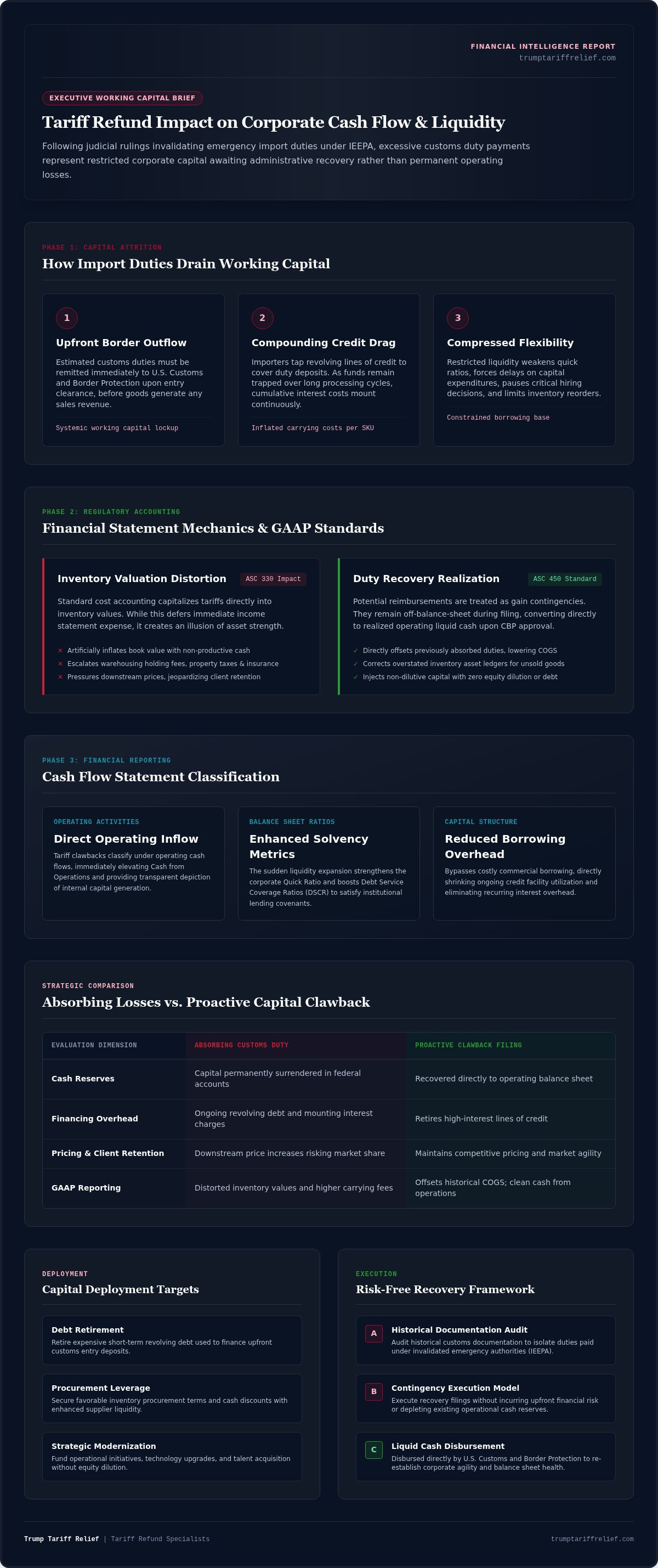
Every commercial import triggers an immediate cash outflow long before inventory generates a single dollar of revenue. While standard economic theory defines what a tariff is in terms of border protection and trade policy, corporate finance teams experience it as an aggressive drain on working capital. Importers must remit estimated customs duties to U.S. Customs and Border Protection upon entry clearance, systematically locking away vital liquidity that could otherwise fund operations.
Financing these mandatory payments creates a severe compounding drag. Many mid-market businesses rely on revolving lines of credit to cover upfront customs deposits. When those payments sit trapped in customs accounts across lengthy shipping and processing cycles, interest charges accumulate month after month. The resulting cash pinch quickly compresses operational margins, forcing management teams to delay capital expenditures, pause strategic hiring, and scale back inventory reorders.
Evaluating the true tariff refund impact on cash flow begins with recognizing that excessive duty assessments aren't permanent operating losses. They represent restricted corporate capital awaiting administrative recovery.
The True Cost of Trapped Capital in Customs Entries
When businesses surrender cash for disputed or unlawful customs duties, those funds remain locked in federal accounts for extended operating cycles. This structural delay damages corporate solvency in several distinct ways:
- Escalating Debt Service: Tapping credit facilities to fund duty deposits inflates carrying costs, adding ongoing borrowing expense to every imported SKU.
- Compressed Borrowing Base: Trapped funds weaken quick ratios and current liquidity, restricting bank lines precisely when operational flexibility matters most.
- Delayed Strategic Investments: Every dollar stranded in customs deposits is a dollar unavailable for equipment upgrades, software modernization, or key talent acquisition.
Inventory Valuation Distortions and Carrying Expenses
Standard cost accounting often capitalizes tariffs into inventory values under ASC 330. While this defers immediate expense recognition on the income statement, it creates a dangerous illusion of asset strength. In reality, book inventory values become artificially inflated with non-productive customs cash. Warehousing that overvalued stock drives up holding fees, property taxes, and insurance premiums.
To offset these bloated carrying expenses, businesses frequently raise prices on downstream commercial buyers, directly risking customer retention and market share. Reviewing the underlying statutory basis via our breakdown of IEEPA explained helps finance executives separate legitimate product value from reclaimable customs duties, clearing the way for strategic balance sheet remediation.
Financial Statement Mechanics: Where Duty Refunds Hit Cash Flow
Securing a customs clawback triggers an immediate, beneficial shift across your corporate financial reporting. Under standard US GAAP guidelines, potential tariff reimbursements represent gain contingencies governed by ASC 450. Because accounting standards prohibit the recognition of contingent gains before realization, these claims remain off the balance sheet during the filing phase. Once U.S. Customs and Border Protection approves the claim and issues the disbursement, that capital moves directly into realized liquid cash, delivering a substantial tariff refund impact on cash flow.
When the funds land, the accounting entries reflect two clear movements. On historical ledgers, the recovery offsets previously absorbed duties, directly lowering your cost of goods sold (COGS) or correcting inventory asset accounts if that stock remains unsold. More importantly, operating activities receive an immediate non-dilutive liquidity boost, bypassing the need for additional commercial debt or restrictive equity structures.
Mapping Duty Recoveries to the Statement of Cash Flows
Corporate finance leaders frequently ask where these inflows land. Tariff clawbacks are classified under operating cash flows, creating measurable advantages across key financial metrics:
- Operating Inflows: Cash from operations jumps immediately, providing a cleaner depiction of internal capital generation.
- Enhanced Solvency Ratios: The sudden liquidity expansion strengthens your Quick Ratio and improves Debt Service Coverage Ratios (DSCR), satisfying institutional covenants.
- Reduced Borrowing Overhead: Recovered capital allows firms to replace expensive short-term trade finance mechanisms with unencumbered cash reserves.
Balance Sheet Remediation and Tax Considerations
On the balance sheet, liquid cash directly replaces unresolved administrative claims, instantly cleaning up enterprise valuation metrics. The inflow also includes statutory interest; for corporate overpayments, federal rates reached 6% in Q3 2026, creating an additional non-operational cash component that must be reported as taxable interest income.
Managing this transition requires tight coordination between your finance team and trade recovery specialists. Proper execution ensures that customs entries reconcile cleanly against your fiscal reporting calendar. Reviewing the initial filing steps through our breakdown of how it works helps leadership teams establish clear timelines, turning stranded customs line items into fully realized working capital.
Absorbing Duty Losses vs. Proactive Capital Clawback: Strategic Comparison
Many executive teams treat customs duties as an inevitable operational cost, quietly writing off border tariffs as lost margin or passing the price increases directly to buyers. Raising prices on commercial customers introduces immediate vulnerability, driving long-standing accounts toward competitors with more agile supply networks. Passively absorbing these payments creates an even steeper penalty, bleeding working capital while leaving significant balance sheet assets untouched.
Analyzing the actual tariff refund impact on cash flow exposes why proactive recovery is an essential corporate priority. Nearshoring and vendor realignment may reduce future tax burdens over several years, but structural changes do nothing to retrieve cash already remitted on historical customs entries. Proactive administrative clawbacks recover those trapped resources now, turning historical expenses back into liquid operating cash.
The Hidden Vulnerability of Passive Expense Absorption
Treating customs duties as unrecoverable overhead causes permanent balance sheet erosion. Every dollar quietly absorbed directly reduces EBITDA and deprives your organization of non-dilutive capital needed for core operations. Strict statutory deadlines govern federal trade refunds. If an importer fails to challenge eligible entries within mandatory administrative windows, those funds revert permanently to the U.S. Treasury, forfeiting capital that should be funding enterprise expansion.
Executing Administrative Remedies to Reclaim Capital
Pursuing administrative remedies through U.S. Customs transforms forgotten duty payments into substantial liquidity events. However, managing manual protests internally often drains compliance teams and exhausts internal bandwidth. Importers face extensive paperwork, strict data matching requirements, and intricate regulatory scrutiny.
A specialized contingency partner eliminates that friction entirely. By auditing entry summaries, validating eligibility, and handling administrative submissions, external specialists perform the heavy lifting without depleting your internal resources. You can review how structured claims proceed through our guide on how it works, securing an efficient, zero-risk pathway to unlock balance sheet liquidity.
Deploying Reclaimed Liquidity to Strengthen Business Operations
Securing a substantial customs disbursement delivers immediate financial relief, but corporate performance ultimately depends on capital redeployment. While external analysts often recommend placing excess reserves into low-yield money market accounts, active importers achieve far greater returns by reinvesting those funds directly into operational bottlenecks. Understanding the broader tariff refund impact on cash flow allows leadership teams to transform past customs losses into a durable commercial advantage.
According to an August 2026 Federal Reserve Bank of Atlanta survey, 75.2% of eligible firms plan to retain recovered duty funds as cash, while more than half intend to fund capital projects or research and development. Only 14.8% plan to temporarily lower prices. That decisive focus on internal balance sheet preservation underscores the real value of capital recovery: it provides non-dilutive liquidity to fuel core commercial expansion without selling equity or taking on punitive debt.
Eliminating High-Interest Inventory Debt
Retiring short-term debt facilities should be the immediate priority for mid-market finance teams. When import duties were originally paid, many businesses tapped revolving credit lines, accumulating steady interest expenses that steadily reduced gross margins. Deploying recovery proceeds to wipe out these obligations generates immediate balance sheet benefits:
- Eliminating Interest Drag: Paying down revolving debt drops interest overhead straight to the bottom line, accelerating net income growth.
- Restoring Revolving Capacity: Clearing credit lines rebuilds vital headroom, giving purchasing teams the elasticity required to handle high-volume seasonal inventory spikes.
- Protecting Operational Cash: Unencumbered cash flows remove the persistent threat of covenant breaches during sudden downturns.
Reinvesting in Supply Chain Elasticity and Growth
Once costly short-term credit facilities are cleared, recovered capital acts as an internal engine for operational expansion. Importers can fund domestic manufacturing upgrades, onboard specialized technical staff, or launch new product iterations without waiting for outside financing rounds.
This liquidity also delivers immense leverage across global supply chains. Importers with unencumbered cash can negotiate early payment discounts with component suppliers, capturing significant margin improvements on procurement. You can also deploy capital to diversify vendor networks across stable trade jurisdictions, building critical resilience against future tariff volatility. If your company holds unrecovered import duties, partner with Trump Tariff Relief to audit your historical customs entries and turn trapped trade deposits into unencumbered operating capital.
Accelerating Tariff Refund Recovery Without Upfront Financial Risk
Traditional customs consultancies and corporate law firms typically propose hourly billing structures to pursue trade disputes. Committing significant retainer fees to recover your own money directly compounds the initial balance sheet strain. Importers shouldn't take on fresh financial liabilities to reclaim capital that judicial rulings have already deemed improperly collected.
A performance-driven model alters that dynamic entirely. Eliminating upfront expenditures allows businesses to experience the full tariff refund impact on cash flow without endangering existing liquidity reserves. Specialized recovery teams assume the administrative heavy lifting, aligning incentives so that financial restoration doesn't compete with day-to-day operating needs.
Step-by-Step Capital Clawback Roadmap
Reclaiming trapped customs funds requires a disciplined administrative procedure to navigate federal agency channels smoothly:
- Customs Data Assessment: Reviewing historical customs entries to identify every eligible transaction and establish an exact baseline of recoverable overpayments.
- Documentation Assembly: Extracting entry summaries (CBP Form 7501), commercial invoices, and proof-of-payment logs to build an airtight evidentiary portfolio.
- Administrative Petitions: Structuring formal refund claims under relevant judicial precedents and submitting them directly through federal processing systems to ensure expedited adjudication.
The Zero-Risk Contingency Recovery Advantage
Attempting to manage tariff clawbacks internally routinely overburdens corporate compliance and tax teams. Administrative rules, system requirements, and strict agency timelines demand deep procedural expertise that general accounting staff simply don't have time to manage.
Contingency representation eliminates this operational friction. Seasoned trade analysts handle the filings, monitor agency processing, and resolve bureaucratic inquiries while your finance team maintains full focus on driving commercial growth. Because representation requires zero upfront capital, your existing cash reserves remain completely protected during the entire review process.
Importers ready to secure trapped capital and revitalize balance sheet liquidity can partner with Trump Tariff Relief for a risk-free assessment, turning historical customs deposits into unencumbered operating cash.
Reclaim Your Working Capital and Accelerate Operational Growth
Surrendering working capital to improper customs assessments directly constrains your commercial potential. As regulatory filing windows tighten, unlocking the substantial tariff refund impact on cash flow becomes an essential priority for balance sheet restoration. Reclaiming these overpayments retires costly revolving debt, improves core solvency metrics, and delivers non-dilutive liquidity straight back into your business.
You don't need to risk existing cash reserves or burden internal compliance teams to recover what's rightfully yours. Our nationwide trade recovery specialists provide comprehensive entry management, navigating complex IEEPA claims from initial documentation audits through final federal disbursement. Because we operate strictly on a 100% contingency-based model with zero upfront costs, your balance sheet remains fully protected throughout the entire administrative process.
Take decisive action before statutory windows expire. Claim Your Capital with Trump Tariff Relief today and transform trapped customs deposits into fuel for operational growth.
Frequently Asked Questions
How quickly does a successful tariff refund impact corporate cash flow?
Valid claims generally disburse within 60 to 90 days after CBP acceptance through the CAPE system. Once federal processing clears, disbursements land directly into your corporate accounts via electronic transfer. This rapid payment delivers a measurable tariff refund impact on cash flow, providing immediate working capital to replenish drained reserves, settle outstanding procurement liabilities, or invest in core operations without waiting on long-term tax cycles.
Can duty refunds be recognized on our financial statements before cash arrives?
Under US GAAP, anticipated tariff clawbacks represent gain contingencies under ASC 450, meaning they cannot be recognized on financial statements before realization. Your finance team must wait until federal authorities approve and disburse the claim before recording the inflow. Once realized, the recovery is recognized on the statement of cash flows under operating activities, reducing historical cost of goods sold or adjusting inventory balances accordingly.
What happens if our company financed import tariffs using a credit line?
Recovered duties allow your organization to pay down high-interest credit lines immediately, eliminating the ongoing debt service that suppresses operating margins. When the government issues refund payments, leadership can redirect that capital toward retiring outstanding principal. This debt reduction instantly frees up borrowing capacity on existing credit facilities, lowering monthly interest expenses and giving your purchasing team essential headroom for seasonal procurement.
Is there any financial risk to our cash reserves when pursuing a claim?
Pursuing a claim involves zero financial exposure to your existing cash reserves when working under a contingency recovery model. Trump Tariff Relief manages the complete recovery process without upfront retainer fees or hourly consulting charges. You pay a percentage only when the federal government successfully disburses your refund. If your entries do not yield a cash recovery, your company owes nothing.
How does a tariff refund affect our previously filed corporate tax returns?
Duty clawbacks generally do not require amending past corporate tax returns under the tax benefit rule. Instead, the refunded duties represent gross income in the tax year your business receives them, provided the original payments reduced prior taxable income. Any statutory interest paid alongside the duty principal also counts as taxable interest income. Your corporate tax advisor should reconcile these entries during year-end filings.
Can importers claim interest on the duties collected by the government?
Yes, federal statutes require U.S. Customs to pay interest on duty overpayments. For corporate claims, the interest rate reached 6% in Q3 2026, while non-corporate entities receive 7%. These statutory rates ensure that importers are compensated for the entire duration their capital was held in government accounts, amplifying the positive tariff refund impact on cash flow beyond the base recovery amount.
What documents are required to audit our potential cash flow recovery?
Starting a preliminary eligibility audit requires your basic customs entry documentation. Key records include CBP Form 7501 (Entry Summary), commercial invoices, delivery receipts, and verification of duty payment. Our team uses your ACE portal data and historical entry logs to reconstruct transaction trails, quantify exact duty overpayments, and manage the required administrative filings without placing administrative strain on your internal accounting staff.
Ready to find out what your business may be owed?
Check My Eligibility