
Your business isn't just a victim of shifting trade policy; it's a creditor to the U.S. government. This latest section 301 lawsuit update confirms that while the USTR announced new tariffs on 60 economies on July 23, 2026, the legal path for reclaiming previous List 3 and List 4A duties has never been clearer. You've likely watched significant capital vanish into the federal treasury, perhaps dismissing those sunk costs as an unavoidable tax on global trade. It's an exhausting cycle of regulatory shifts that leaves many executives feeling anxious about missing their window for financial restoration.
We're here to change that narrative by showing you how to leverage the IEEPA precedent to secure the refunds your company deserves. You'll gain a precise understanding of the 2026 legal landscape and identify a low-risk way to pursue capital recovery without the burden of upfront fees. We'll walk through the current status of the July 2026 filings and outline the exact steps our experts take to manage your customs documentation and government filings to ensure you don't leave money on the table.
Key Takeaways
- Navigate the latest section 301 lawsuit update to understand how litigation has shifted from the Court of International Trade toward high-stakes appellate petitions.
- Discover how the IEEPA precedent provides a distinct, strategic channel for reclaiming capital that bypasses the hurdles of traditional Section 301 litigation.
- Identify your specific "ticking clock" by analyzing the strict three-year statute of limitations tied to the date of your final tariff payments.
- Learn how to secure a comprehensive Tariff Eligibility Assessment on a contingency-fee basis, removing all upfront financial risk from the recovery process.
- Understand why specialized trade experts are essential to navigate the bureaucratic complexities of the CBP and USTR in the current 2026 landscape.
The 2026 Section 301 Lawsuit Update: Where Do Claims Stand?
Thousands of American importers are currently navigating a high-stakes legal bottleneck. This section 301 lawsuit update highlights a critical transition point for businesses that paid billions in List 3 and List 4A duties. While the initial mass litigation involved over 6,000 plaintiffs, the focus has shifted from the Court of International Trade to the highest levels of the American judiciary. The landscape became even more complex on July 23, 2026, when the U.S. Trade Representative (USTR) announced new Section 301 duties on 60 different economies. This expansion, effective July 24, 2026, followed a June determination regarding forced labor practices. It underscores a persistent reliance on aggressive trade policy, but it also creates a fresh wave of legal resistance. New lawsuits filed on July 24 and 27, 2026, by plaintiffs like Burlap and Barrel and Collective Horology prove that the industry is ready to fight back against what many call arbitrary enforcement.
Recent Rulings from the Court of International Trade
Recent judicial opinions from the Court of International Trade have focused heavily on the USTR's procedural compliance. Importers from List 3 and List 4A have argued that the government failed to provide adequate country-by-country analysis or respond to the 1,600 written comments submitted during the public period ending July 6, 2026. If the courts determine the USTR acted in an "arbitrary and capricious" manner, it could invalidate the legal basis for billions in collected duties. For many businesses, these rulings represent the first step toward reclaiming significant working capital. Our team monitors these opinions daily to ensure our recovery strategies align with the latest judicial thinking, focusing on the specific procedural failures that benefit our clients.
The Role of the Supreme Court in 2026
The current status of petitions for certiorari indicates that the Supreme Court is now the final arbiter of Section 301's reach. While legal experts analyze the history of Section 301 of the Trade Act of 1974, your business cannot afford to stay in "wait-and-see" mode. Waiting for a final judicial determination often results in missing strict filing deadlines that are already ticking. You need a strategy that doesn't rely solely on the outcome of a single massive case. By understanding how IEEPA precedents differ from standard Section 301 arguments, you can identify a separate, specialized path to recovery. This path remains viable regardless of the Supreme Court's immediate timeline, offering a shortcut through the bureaucracy for those who act decisively to preserve their rights.
IEEPA vs. Section 301: The New Catalyst for Refunds
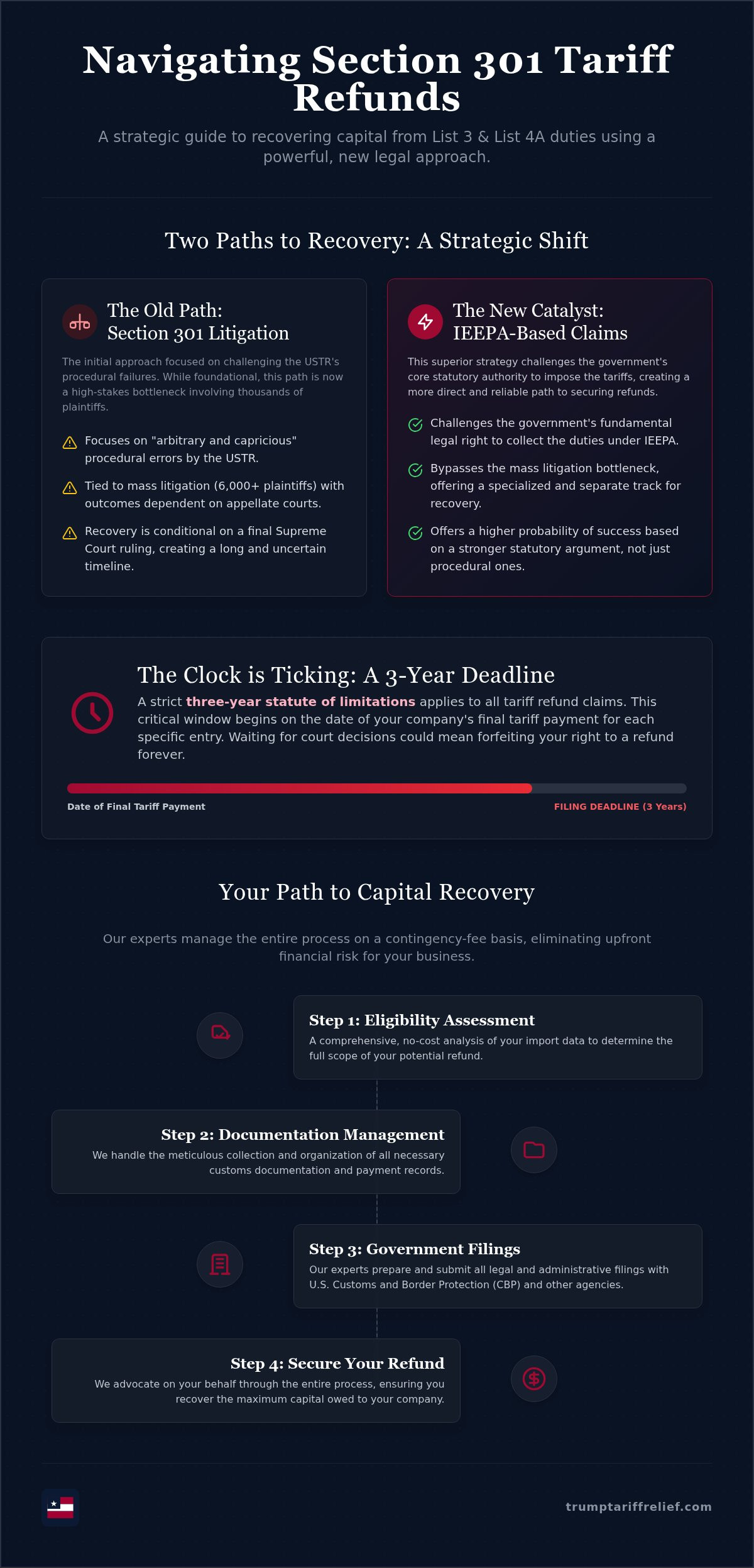
Many importers feel stuck after following the initial mass litigation that dominated headlines for years. This section 301 lawsuit update reveals a crucial shift in strategy that most general corporate counsel have overlooked. While the original cases focused on the USTR's failure to follow administrative rules, a more powerful legal tool has emerged. The International Emergency Economic Powers Act (IEEPA) provides a different framework for challenging the legitimacy of List 3 and List 4A tariffs. If your recovery efforts have stalled, it's likely because you're still relying on procedural arguments instead of statutory ones. Identifying this distinction is the key to unlocking capital that many businesses have already written off as lost.
The Landmark Ruling Explained
A significant legal precedent recently challenged the government's broad authority to impose indefinite duties under the guise of national emergencies. This ruling is a game-changer for businesses impacted by List 3 and List 4A because it addresses the core statutory authority used to justify the tariffs. It highlights that the executive branch cannot use IEEPA to bypass the specific limits set by Congress. IEEPA authority allows the President to regulate international economic transactions during a declared national emergency, provided those actions don't exceed the specific powers granted by the statute. When the government exceeds this authority, the tariffs it collects become illegitimate, creating a direct path for financial restoration.
Why Importers are Pivoting to IEEPA Claims
Importers are moving toward IEEPA-based claims because they offer a higher probability of success than traditional procedural challenges. In a standard section 301 lawsuit update, the debate often centers on whether the government's explanation for a tariff was "good enough." Courts often give significant deference to federal agencies in those scenarios. Statutory challenges are different. They ask a simpler, more binary question: Did the law allow the action in the first place? By focusing on IEEPA, businesses can bypass much of the bureaucratic gridlock and procedural hurdles associated with the mass litigation.
This pivot is particularly effective because it targets the statutory foundation of the duties rather than the USTR's homework. You can learn more about the IEEPA ruling and how it creates a unique recovery channel for your specific industry. We've seen that businesses focusing on this statutory path often find a much faster route through the system. It's a strategic shortcut that moves your claim out of the crowded mass litigation pool and into a specialized recovery track. To see where your company stands, you should consider a professional Tariff Eligibility Assessment to determine if your previous payments fall under this high-probability recovery window.
Statute of Limitations: The 3-Year Deadline for 2026 Filings
The most dangerous mistake an importer can make is assuming the legal clock stops while they wait for a court to rule. This section 301 lawsuit update serves as a stark warning: the statute of limitations is a firm barrier, not a flexible guideline. For those pursuing recovery through the IEEPA framework, you generally face a strict three-year window from the date of your last tariff payment to file a claim. If you paid duties on List 3 or List 4A goods in 2023, your opportunity to reclaim those funds is rapidly evaporating in 2026. Many executives mistakenly believe that being part of a mass litigation "tolls" or pauses their specific deadline, but IEEPA-based recovery requires distinct, timely action to preserve your rights.
Calculating your specific firm's deadline requires a granular review of your entry data. The "ticking clock" begins at the moment of liquidation, which is when the government finalized your duty payment. If you wait for a final judicial determination from the Supreme Court, you might find that while the law eventually falls in your favor, your specific entries have already aged out of eligibility. Protecting your capital means acting before the deadline, not after the headline. Our Tariff Eligibility Assessment is designed to identify these expiring entries immediately, ensuring no viable claim is left behind due to administrative delay.
The Ticking Clock for List 3 and List 4A
For many U.S. importers, 2026 represents a critical "cliff" year. A significant portion of the tariffs paid during the height of the trade dispute reached their three-year maturity this year. If your eligibility for specific entries expires, that capital is permanently forfeited to the treasury. You can review the critical deadlines for IEEPA claims to see how these dates align with your previous trade activity. Missing these windows by even a single day can invalidate a claim worth hundreds of thousands of dollars.
Tolling and Procedural Safeguards
There is a common myth that the government will automatically extend deadlines during active litigation. The reality is much harsher. While "tolling" exists in very specific legal scenarios, it's rarely a safe bet for individual corporate recovery. Filing a protest with Customs and Border Protection (CBP) can sometimes provide a procedural safeguard, but it's not a substitute for a comprehensive recovery strategy. If you don't have a specialized team managing your Customs Documentation Management, you risk falling into a procedural trap that closes the door on your refund. Immediate assessment is the only way to ensure your statute of limitations is protected.
The Recovery Process: Reclaiming Capital Without Financial Risk
The shift from theoretical legal battles to actual financial restoration requires a tactical approach. While the latest section 301 lawsuit update provides the necessary legal foundation, the physical act of reclaiming capital often feels like an insurmountable bureaucratic maze for busy executives. Our recovery engine is designed to remove these barriers, transforming a complex legal right into a streamlined business asset. We handle the heavy lifting, from initial data extraction to the final government filing, ensuring your internal resources remain focused on your core operations. This "we-do-the-work" narrative isn't just a promise; it's a structural reality of how we partner with our clients to right the financial wrongs of the past several years.
Once a claim is filed, it enters the government verification phase. During this period, Customs and Border Protection (CBP) reviews the entry data and the statutory basis for the refund. This stage requires precise documentation and a seasoned hand to navigate any administrative inquiries. The typical timeline from filing to refund issuance varies based on agency bandwidth, but our proactive management ensures your claim moves through the system with maximum momentum. We don't just file and wait. We advocate for your recovery at every step of the verification process.
The Contingency-Fee Advantage
We believe that businesses shouldn't have to pay to recover money that was wrongfully taken from them. That's why we operate on a strict contingency-fee model. This approach removes all upfront costs and hourly billing, ensuring that our interests are perfectly aligned with yours. If we don't win your refund, you don't pay a fee. This standard of recovery allows you to pursue significant capital restoration without any impact on your current cash flow or budget. You can see the full breakdown of how our recovery process works and why it represents the lowest-risk path to financial restoration available in 2026.
Managing Customs Documentation
The biggest hurdle for most importers is the state of their historical records. Organizing years of entry data, especially for List 3 and List 4A, can be a logistical nightmare. Our trade experts specialize in Customs Documentation Management, helping you identify and reconstruct missing or incomplete records. We pull data directly from government sources when necessary to ensure your claim is airtight. Before you begin, you should review the Required documents for IEEPA refund to understand the specific data points needed for a successful filing. If you're ready to stop the financial bleeding, you should request a Tariff Eligibility Assessment today to see exactly how much capital your business is eligible to reclaim.
Securing Your Refund: Why Professional Advocacy is Vital
The administrative environment in 2026 has reached a level of complexity that requires more than just standard legal oversight. This section 301 lawsuit update proves that while the judicial doors are opening, the actual hallway to recovery is crowded with bureaucratic hurdles. The USTR’s July 23, 2026, announcement regarding new duties on 60 economies has shifted the focus of Customs and Border Protection (CBP) toward aggressive enforcement. In this high-stakes climate, a simple filing error or a miscategorized entry can lead to an immediate denial of your claim. Professional advocacy isn't just a luxury; it's a structural necessity for businesses that want to ensure their previous List 3 and List 4A payments are fully restored.
General corporate counsel, while skilled in broad litigation, often lacks the specialized trade infrastructure required to manage these claims. Most internal legal teams aren't equipped to perform the deep forensic data extraction needed to identify every eligible entry from 2023 and 2024. They might understand the broad strokes of the section 301 lawsuit update, but they frequently miss the specific statutory nuances of IEEPA recovery. By partnering with a specialized team, you position your business for the maximum possible recovery amount. We act as your "insider" navigator, using a proven engine to move your claim past the roadblocks that typically stall unassisted filings.
The Value of Specialized Expertise
Trade consultancy is a distinct discipline that operates outside the boundaries of general legal services. While a law firm might focus on the "if" of a case, our team focuses on the "how" of the recovery. We bring a specialized understanding of IEEPA-specific filings, which require a different evidentiary standard than traditional Section 301 protests. You need a partner that understands the automated systems and data protocols used by CBP to process mass refunds. Successful recovery is a technical trade process requiring forensic data analysis, not just a legal one. This technical precision ensures that your claim is airtight before it ever reaches a government reviewer's desk.
Your Preliminary Assessment
Taking the first step toward restoration shouldn't involve financial risk or operational strain. Our process begins with a comprehensive Tariff Eligibility Assessment to determine exactly which of your previous entries qualify for a refund under current precedents. During this initial check, we identify the specific "cliff" dates for your firm to ensure no deadlines are missed. You can get started with zero financial commitment, as our contingency-fee model means we only succeed when you do. If you have lingering questions about the process or your specific eligibility, you can review our frequently asked questions about tariff relief to gain further clarity on the 2026 landscape. The window for action is narrow, and a preliminary assessment is the only way to confirm your path to recovery.
Reclaim Your Capital Before the Recovery Window Closes
The path to financial restoration is no longer a matter of waiting on a single judicial outcome. This section 301 lawsuit update confirms that while procedural battles continue, the IEEPA precedent has already unlocked a high-probability channel for reclaiming List 3 and List 4A duties. Your primary obstacle isn't the government's defense; it's the strict three-year statute of limitations that permanently forfeits your capital if you remain inactive. Success in 2026 requires moving beyond general legal theory and into forensic trade recovery.
We provide a nationwide service for the manufacturing, retail, and tech sectors, offering the specialized expertise in IEEPA and Section 301 recovery needed to navigate this bureaucracy. Our model ensures there are no upfront costs; we only get paid if you do. This partnership allows you to pursue significant capital restoration with zero financial risk to your current operations. Don't let your legitimate refunds expire in a government treasury when the legal framework for their return is already in place.
Claim Your Capital: Get Your Free Tariff Eligibility Assessment Today
Your business has already paid the price of shifting trade policies. Now, it's time to secure the restoration you deserve and put that capital back to work for your firm's future.
Frequently Asked Questions
Is the Section 301 lawsuit still active in 2026?
Yes, the litigation remains active with ongoing petitions for certiorari to the Supreme Court as of mid-2026. While the initial mass litigation at the Court of International Trade has evolved, the core legal challenges regarding the USTR's authority are still being adjudicated. This section 301 lawsuit update confirms that the judicial path for duty restoration is still a primary focus for thousands of American importers.
Can I still get a refund if I didn't join the original lawsuit?
Yes, you can still pursue financial restoration through the IEEPA precedent even if you were not among the original 6,000 plaintiffs. This recovery channel operates on a separate legal foundation that focuses on statutory authority rather than the procedural errors cited in the mass litigation. You must, however, initiate a claim before your specific three-year statute of limitations expires to preserve your eligibility for a refund.
How much does it cost to file a Section 301 or IEEPA refund claim?
Filing a recovery claim through our specialized engine involves zero upfront costs or hourly billing. We operate exclusively on a contingency-fee basis, which ensures our interests are perfectly aligned with your business's success. We only receive a fee if we successfully secure a refund check for your company, making this a low-risk, high-reward partnership for manufacturing and retail firms.
What is the difference between Section 301 and IEEPA refunds?
Section 301 refunds are typically based on procedural arguments regarding how the government implemented the tariffs, while IEEPA refunds challenge the statutory authority of the executive branch to collect duties indefinitely. This distinction is critical because IEEPA claims provide a strategic shortcut that bypasses the gridlock of the larger section 301 lawsuit update. Identifying which path fits your entry data is the first step in our assessment process.
How long does the government take to process tariff refund checks?
Processing timelines vary based on the current bandwidth of Customs and Border Protection and the complexity of your specific entry data. While some administrative reviews are completed within a few months, others may take longer to reach final issuance. We manage the entire government filing process and documentation to ensure your claim moves through the federal bureaucracy with maximum efficiency and momentum.
Which tariff lists (List 1, 2, 3, 4A) are currently eligible for recovery?
List 3 and List 4A tariffs are the primary targets for IEEPA-based recovery efforts in 2026. These lists represent the vast majority of duties paid during the trade dispute and are most susceptible to the statutory challenges currently gaining traction in the courts. While List 1 and List 2 remain part of the broader trade conversation, the most immediate opportunities for capital restoration reside within the later lists.
What happens if the Supreme Court rules against the importers?
A negative Supreme Court ruling on the procedural Section 301 case does not automatically invalidate the separate statutory path provided by IEEPA precedents. Because these two recovery tracks rely on different legal arguments, one can remain viable even if the other faces judicial setbacks. This is why we advocate for a specialized approach that doesn't rely solely on the outcome of a single massive court case.
Is there a minimum refund amount required to file a claim?
There is no official government minimum, but the forensic nature of Customs Documentation Management makes the process most effective for firms with significant tariff exposure. We typically partner with businesses in the manufacturing and tech sectors that have paid substantial duties on List 3 and List 4A goods. A preliminary eligibility assessment will confirm if your potential recovery amount justifies the technical data extraction required for a successful filing.
Ready to find out what your business may be owed?
Check My Eligibility