
Over $166 billion in manufacturing capital is currently sitting in government accounts rather than on your balance sheet, all due to a decade of unconstitutional trade enforcement. Since the Supreme Court’s landmark February 2026 ruling, the window to reclaim these funds has finally opened, but the technical complexity of the new CAPE system is already causing widespread paralysis across the industry. You've likely spent years watching your margins shrink under these illegal levies, and the prospect of navigating the ACE Portal or facing a CBP audit feels like just another barrier to your financial restoration. Securing an IEEPA tariff refund for manufacturers isn't just about paperwork; it's about reclaiming the liquidity your operations need to scale.
We understand that your priority is running a plant, not decoding federal filing manuals. You deserve a recovery process that is as efficient as your production line. This guide provides a step by step manufacturing framework to help you reclaim millions in duties plus interest with minimal effort from your internal team. We will walk through the mandatory ACH enrollment steps, explain the specific criteria for Phase 1 eligibility, and show you how to bypass the technical hurdles of the CAPE portal to ensure your claim is processed without any disruption to your daily manufacturing operations.
Key Takeaways
- Understand how the 2026 Supreme Court ruling invalidated specific trade actions, opening a critical window to recover millions in unconstitutional duties.
- Identify if your business qualifies as the Importer of Record and learn how to map your specific HTS codes to secure an IEEPA tariff refund for manufacturers.
- Discover a five-step operational framework that moves your claim from initial data extraction to electronic Treasury refund with zero upfront costs.
- Learn the truth about customs audit triggers and how to manage attestation liabilities to ensure your filing is both accurate and legally sound.
- Leverage a specialized, contingency-based recovery model that eliminates financial risk and allows you to focus on your core manufacturing operations.
Reclaiming Manufacturing Capital: The IEEPA Tariff Refund Opportunity
U.S. manufacturers have spent years operating under the weight of trade duties that the highest court in the land has now declared illegal. This is not a tax break or a government subsidy; it's a court ordered restoration of capital that was seized through the overreach of executive power. The February 2026 Supreme Court ruling officially invalidated billions in duties collected under the International Emergency Economic Powers Act (IEEPA), creating an immediate mandate for the Treasury to return those funds to the businesses that paid them. For the first time in nearly a decade, the path to an IEEPA tariff refund for manufacturers is clear, but the window to act is strictly defined by new federal processing phases.
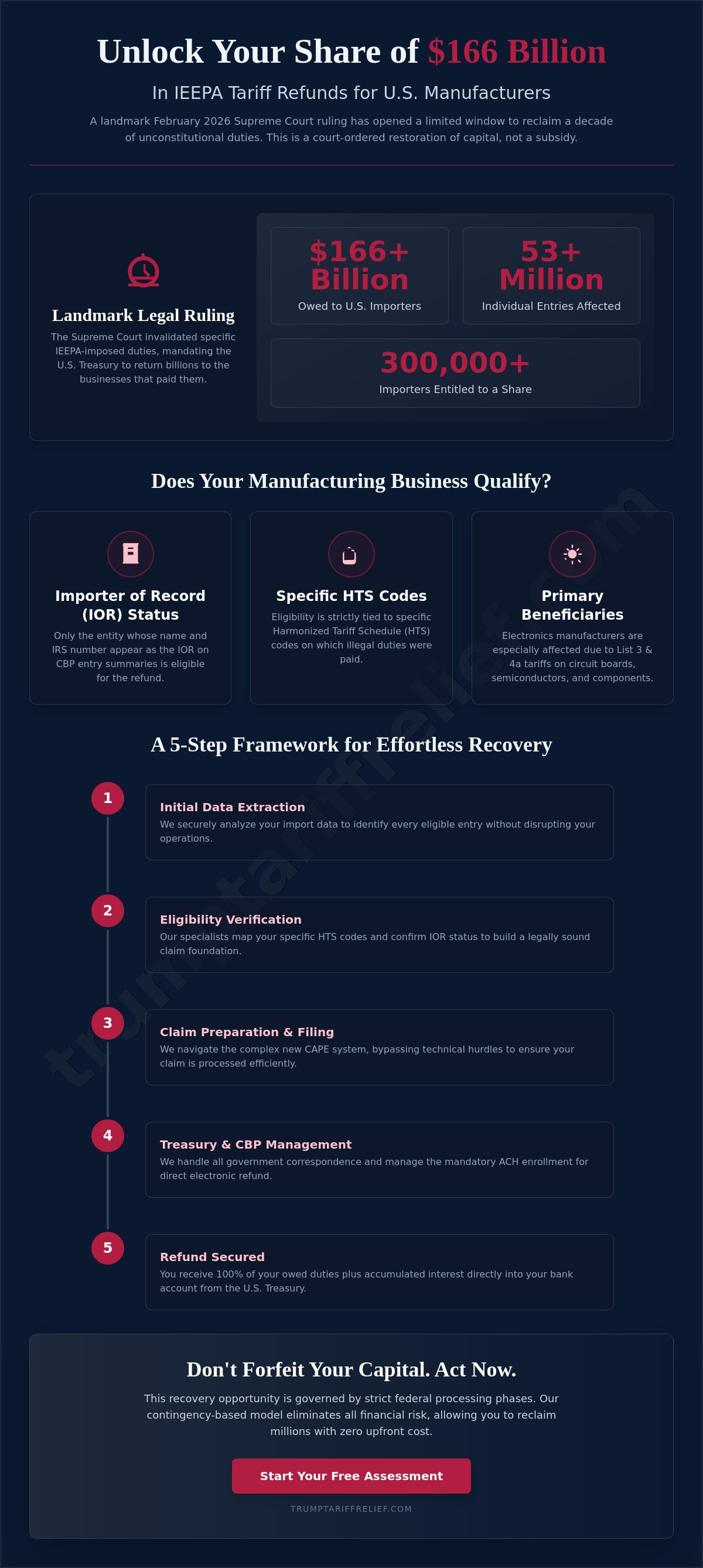
The scale of this recovery is unprecedented. Verified data shows that approximately $166 billion is currently owed to U.S. importers across 53 million individual entries. For many manufacturers, this represents a significant portion of their annual operating margin that has been tied up in government accounts for years. These funds were collected under trade actions that exceeded the legal authority granted by Congress, making this recovery a matter of both financial necessity and legal justice. If your supply chain relies on imported industrial components, you're likely one of the 300,000 importers entitled to a share of this massive restoration. Securing an IEEPA tariff refund for manufacturers is the only way to ensure this capital returns to your balance sheet where it belongs.
The Landmark Supreme Court Ruling and Manufacturing
The legal landscape shifted fundamentally on February 6, 2026, when the Supreme Court upheld a decision that specific IEEPA imposed duties were unauthorized. The Court of International Trade (CIT) subsequently ordered an expedited refund process, recognizing that prolonged withholding of these funds would cause irreparable harm to the domestic manufacturing base. This ruling specifically targets duties paid on industrial machinery, raw materials, and intermediate goods that were caught in the crossfire of escalating trade disputes. The court's directive is final: the money must be returned, and the process must be automated through the newly launched CAPE system.
Why Electronics Manufacturers are Primary Beneficiaries
Electronics manufacturers bore a disproportionate burden of the invalidated List 3 and List 4a tariffs. These levies inflated the cost of essential circuit boards, semiconductors, and assembly components, forcing many firms to delay critical innovations or increase prices to remain solvent. Recovering these duties allows for a direct infusion of liquidity that can be immediately pivoted toward R&D and domestic production capacity. Understanding the nuances of these invalidated lists is the first step in building a successful claim. You can find a detailed breakdown of the legal timeline and affected lists in our guide to IEEPA Explained, which clarifies how the recovery process applies to specific electronics supply chains.
Determining Eligibility: Does Your Supply Chain Qualify for a Refund?
The first step in securing an IEEPA tariff refund for manufacturers is confirming your legal standing as the Importer of Record (IOR). Only the entity that directly paid the duties to U.S. Customs and Border Protection (CBP) is eligible to receive the refund. If your manufacturing firm used a third party or a customs broker, you must verify that your company’s name and IRS number appear as the IOR on the entry summaries. The legal justification for these claims stems from the Supreme Court ruling on IEEPA tariffs, which clarified that the executive branch lacked the authority to impose these specific levies indefinitely. If you don't hold the IOR status, you cannot claim the funds, even if you ultimately bore the cost of the tariff through higher vendor pricing.
Eligibility is strictly tied to specific Harmonized Tariff Schedule (HTS) codes found within the invalidated List 3 and List 4a actions. While competitors often speak in generalities, manufacturers must look specifically at components in Chapters 84 and 85, which cover industrial machinery and electronics. If your imports included printed circuit assemblies, electric motors, or specialized manufacturing tools, your entries likely fall within the scope of this recovery. You must also distinguish between unliquidated entries and those that have already liquidated. For entries that liquidated more than 180 days ago, you must have a timely protest on file to preserve your rights; otherwise, the government may consider the transaction final despite the unconstitutional nature of the collection. You can request a preliminary assessment to verify your specific HTS code eligibility before beginning the filing process.
Identifying Qualified IEEPA Entries in Your ACE Data
Manufacturers should begin by pulling historical data from the Automated Commercial Environment (ACE) Secure Data Portal. You need to filter your reports specifically for Section 301 duties that were triggered under IEEPA authority rather than Section 232 or other trade actions. The key document for this verification is the CBP Form 7501, also known as the Entry Summary. This form contains the exact duty amounts paid and the entry dates required for a valid claim. If your internal records are incomplete, an ACE data pull is the only authoritative way to ensure every eligible dollar is accounted for in your IEEPA tariff refund for manufacturers.
The CAPE Portal: Phase 1 vs. Phase 2 Requirements
The Consolidated Administration and Processing of Entries (CAPE) system is the exclusive gateway for these refunds. As of April 20, 2026, Phase 1 is officially open, but it's limited to unliquidated entries and those within 80 days of liquidation. If your entries fall outside this narrow window, they're categorized under Phase 2, which requires a more rigorous documentation process. Manufacturers with older liquidated entries must prepare for Phase 2 by organizing their protest documentation and proof of payment now. This structured approach ensures that you're ready to submit the moment the next filing window opens, preventing further delays in capital restoration.
How to Execute an IEEPA Refund Claim: A Step-by-Step Operational Guide
Filing for an IEEPA tariff refund for manufacturers is not a passive application; it's a rigorous data validation project. Because the Consolidated Administration and Processing of Entries (CAPE) system is automated, any discrepancy between your filing and the government’s internal records will result in an immediate rejection. At Trump Tariff Relief, we operate on a contingency basis, meaning our specialized recovery framework is provided with no upfront cost to your organization. We only collect a fee when the Treasury successfully issues your refund. This alignment of interests ensures that every entry is scrutinized for accuracy before submission, maximizing the principal recovery and the statutory interest that the government is legally required to pay on top of your original duties.
The execution phase requires a clinical approach to customs documentation. CBP isn't simply handing out checks based on estimates; they're validating millions of individual entry numbers against historical ACE data. As the National Retail Federation explains the IEEPA tariff refund process, the burden of proof rests entirely on the importer to demonstrate that their goods fell under the invalidated lists. If your internal records don't perfectly mirror the government’s data, you risk losing your place in the Phase 1 queue. Precision in the early stages of this five step process is the only way to ensure a seamless transition from data extraction to the final electronic payment via ACH.
Step 1: Validating Customs Data and Entry Records
The recovery begins with a comprehensive audit of your import history during the relevant IEEPA period. You must cross reference every HTS code against the invalidated tariff lists to ensure 100% accuracy. This is the stage where we identify potential discrepancies, such as misclassified goods or incorrect duty rates, before they reach the CBP portal. By conducting this pre-emptive audit, you insulate your business from the risk of filing errors that could trigger a broader compliance review. Accuracy here is the foundation of a successful IEEPA tariff refund for manufacturers.
Step 2: Preparing and Submitting CAPE Declarations
Once your data is validated, you must draft a CAPE Declaration. This involves creating a precise .CSV file of entry numbers that meet current CBP standards for electronic processing. The most critical part of this step is the 'Attestation' process. When you submit through the ACE Portal, you're legally certifying the accuracy of your entry data. We manage this entire filing sequence through our managed recovery process, ensuring your certification is audit proof and compliant with the latest 2026 regulatory requirements.
Step 3: Managing Post-Filing Audits and Inquiries
After submission, CBP typically processes valid IEEPA refunds within 60 to 90 days. During this window, you must be prepared to respond to 'Requests for Information' (CBP Form 28). These inquiries often demand proof of payment or commercial invoices to verify the original transaction. Once the validation is complete, the final step is the Treasury’s issuance of the refund. This payment is sent electronically via ACH and includes the principal duty amount plus statutory interest, effectively restoring the capital that was unconstitutionally withheld from your manufacturing operations.
Navigating the Risks: Avoiding Common Filing Pitfalls and Deadlines
The most common hesitation we hear from plant managers and CFOs is the fear that filing for an IEEPA tariff refund for manufacturers will trigger a comprehensive, "fishing expedition" customs audit. While any interaction with U.S. Customs and Border Protection (CBP) requires diligence, the CAPE system is a specific reliquidation process, not a general enforcement action. However, the risk of a focused compliance review is real if your data is inconsistent. CBP will validate your submission against their internal ACE records. If your 'best guess' filing doesn't align with their data, you aren't just risking a rejected claim; you're potentially inviting a Form 28 inquiry that could expand into other areas of your trade compliance program.
Beyond the audit fear, you must account for 'Attestation Risk.' When you submit a CAPE Declaration, you're legally certifying under penalty of law that the entry data is accurate and that your firm is the rightful claimant. This is especially complex for manufacturers dealing with the 'Pass-Through' problem. If you previously passed these tariff costs down to your retail partners or distributors, you must ensure your recovery doesn't violate existing supply chain contracts. While the government only pays the Importer of Record, your downstream partners may have legal grounds to claim a portion of the restoration. Managing these internal and external risks is why professional Customs Documentation Management is a critical component of a successful recovery strategy.
The Critical Statute of Limitations for 2026 Filings
Time is the greatest threat to your capital restoration. For entries that have already liquidated, you generally have a strict 180 day window from the date of liquidation to file a protest. If you miss this window, the entry is considered final and the unconstitutional duties become unrecoverable. Phase 1 of the CAPE rollout in April 2026 is currently prioritizing unliquidated entries, but this doesn't pause the clock for your older liquidated shipments. The filing of a formal Protest remains the absolute, non negotiable cutoff for preserving your legal right to an IEEPA tariff refund for manufacturers.
Mitigating Attestation Liability and Audit Risk
Professional validation is the only way to ensure your filing is audit ready from day one. Instead of relying on internal teams who may be unfamiliar with the nuances of IEEPA invalidated lists, you need a trade expert to cross reference your HTS codes and entry summaries against the latest 2026 CBP requirements. This structured approach creates a clear paper trail that justifies every dollar claimed, significantly reducing the likelihood of a protracted dispute with CBP. By having a specialized advocate manage all communication with customs officials, you shield your daily operations from the administrative burden of the recovery process.
Partnering for Recovery: Why Manufacturers Choose Trump Tariff Relief
Manufacturers operate in an environment where every percentage point of margin is hard won through operational efficiency and lean production. Losing that capital to unconstitutional trade duties is an injury that requires immediate restoration. Trump Tariff Relief isn't a generalist consulting firm; we're a specialized advocate dedicated to righting this financial wrong. We understand the high stakes of the 2026 recovery window and position ourselves as a powerful ally for firms that have been unfairly penalized by executive overreach. Securing an IEEPA tariff refund for manufacturers requires a navigator who can cut through federal bureaucracy with professional confidence and technical precision.
Our end-to-end solution handles the technical burden that typically stalls internal compliance teams. From the initial ACE data extraction and HTS code validation to the final submission of CAPE Declarations and monitoring Treasury's ACH issuance, we act as the engine of your recovery. This comprehensive approach ensures that the pursuit of an IEEPA tariff refund for manufacturers never distracts your leadership from core production goals. We take on the heavy lifting and the regulatory risk, allowing you to focus on scaling your operations while we focus on reclaiming your capital. Reinvesting this liquidity into facility efficiency is a logical next step, and you can discover SolarPorts Development for turnkey energy solutions designed specifically for commercial and industrial properties.
The Contingency Advantage: Zero Upfront Risk
Traditional legal hourly billing creates a financial barrier to justice, often costing firms thousands in fees before a single dollar is recovered. We've eliminated this barrier by adopting a pure contingency fee model. This means we only receive payment when you successfully receive your refund from the U.S. Treasury. This structure aligns our interests perfectly with yours; we're highly motivated to maximize your recovery and ensure every eligible entry is identified and validated. You gain access to elite trade expertise without any impact on your current cash flow, transforming a complex legal challenge into a low risk, high reward partnership.
Start Your Free Eligibility Assessment
The path to restoration begins with a clear understanding of what your firm is owed. Our initial assessment process is designed to be streamlined and non invasive, requiring only basic importer data to begin the validation process. We cross reference your historical imports against the invalidated IEEPA lists to provide a transparent view of your potential recovery. Don't let your unconstitutional duty payments sit in a government account while the 2026 deadlines approach. You can Claim Your Refund Now or review our FAQ for answers to specific technical questions regarding the CAPE portal and eligibility requirements. Secure your manufacturing firm’s financial future by initiating your assessment today.
Reclaim Your Capital Before the 2026 Deadlines
The Supreme Court has provided the legal mandate, and the CAPE system has established the technical mechanism. Now, the responsibility falls on your manufacturing firm to act before the strict 180 day protest windows close forever. You've seen how identifying the correct HTS codes and managing the attestation process are the difference between a successful electronic refund and a rejected claim. Securing an IEEPA tariff refund for manufacturers is a high stakes project, but it doesn't have to be a burden on your internal team or a drain on your current resources.
With over $100 billion in potential refunds identified, there's no reason to leave your capital in government hands. Our specialized team of trade and legal experts handles the entire recovery lifecycle with zero upfront costs. We operate on a contingency basis; we only win when you do. Secure your IEEPA tariff refund on a contingency basis today and restore the liquidity your production line deserves. Your recovery is our priority, and we're ready to start the assessment immediately.
Frequently Asked Questions
Is the IEEPA tariff refund program legitimate for all manufacturers?
Yes, this recovery process is a legal mandate resulting from the February 2026 Supreme Court ruling that invalidated specific trade actions. Any manufacturer acting as the Importer of Record (IOR) for goods on the invalidated lists is legally entitled to a return of those duties. This isn't a voluntary government program; it's a court ordered restoration of capital that was unconstitutionally collected through executive overreach.
How long does it take for a manufacturer to receive the IEEPA refund check?
Validated refunds are generally issued within 60 to 90 days after your CAPE Declaration is accepted by CBP. It's important to remember that as of February 2026, the government no longer issues paper checks for these claims. All payments are distributed electronically via the Automated Clearing House (ACH). Your firm must be enrolled in ACH refunds through the ACE Portal to receive your capital restoration.
What is the deadline for filing an IEEPA tariff refund claim in 2026?
The timeline is strictly governed by the 180 day protest rule for liquidated entries and the specific phases of the CAPE system. Phase 1 officially launched on April 20, 2026, for unliquidated entries and those within 80 days of liquidation. If your entries have already liquidated, your deadline is exactly 180 days from the date of liquidation to preserve your legal rights through a formal protest.
Can we claim refunds if we passed the tariff costs on to our customers?
Yes, your firm remains eligible for the IEEPA tariff refund for manufacturers even if you adjusted your pricing to account for tariff costs. CBP's primary concern is the identity of the Importer of Record who legally paid the duties at the time of entry. Downstream pass throughs are a matter of private contract law and don't affect your standing with the federal government during the recovery process.
What happens if our entries have already been liquidated?
Liquidated entries require a proactive legal strategy to remain eligible for recovery. If an entry liquidated more than 180 days ago without a protest on file, it's considered final under current customs law. However, Phase 2 of the CAPE system is designed to address broader categories of entries. Organizing your documentation now is essential to meet those upcoming 2026 filing windows and ensure your claim is prioritized.
Do I need a customs broker or a specialized consultant to file?
While you can technically file independently, the technical complexity of the CAPE portal makes specialized guidance a strategic choice for manufacturers. The attestation liability means you're certifying the accuracy of your data under penalty of law. A specialized consultant ensures your IEEPA tariff refund for manufacturers is audit proof and managed on a contingency basis, removing the administrative burden from your internal team.
How much interest does the government pay on top of the tariff refund?
The government is legally required to pay statutory interest on the principal duty amount from the date the duties were originally collected. This interest is intended to compensate manufacturers for the time their capital was unconstitutionally withheld in government accounts. The exact rate is determined by federal law, but the total interest can represent a significant addition to the base refund amount for older entries.
What documents are required to prove eligibility for the IEEPA refund?
You must be prepared to provide Entry Summaries (CBP Form 7501), commercial invoices, and proof of payment. While the CAPE Declaration itself is a streamlined .CSV upload, CBP often issues Form 28 Requests for Information to verify eligibility. Having a complete set of certificates of origin and manufacturing records ensures your claim survives these compliance reviews without any unnecessary delays.
Ready to find out what your business may be owed?
Check My Eligibility