
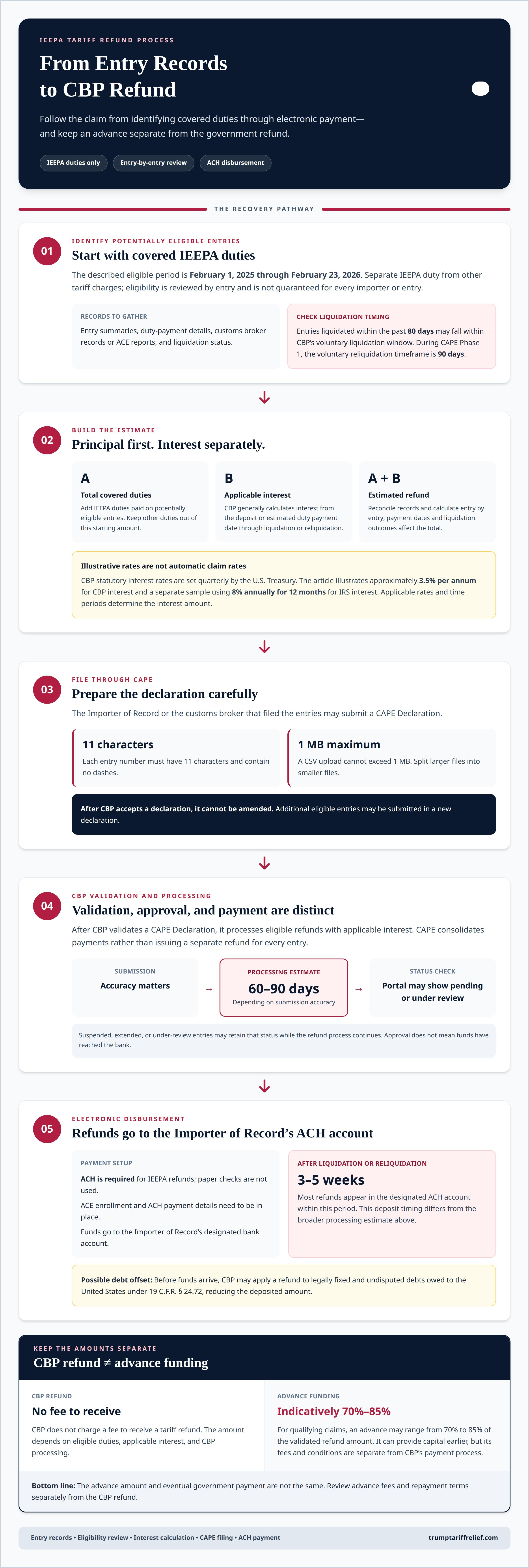
A tariff refund advance is separate from the refund CBP eventually disburses. For qualifying claims, indicative advances may range from 70% to 85% of the validated refund amount, while CBP charges no fee to receive the refund. IEEPA tariff refund advance funding can provide earlier access to capital, but the amount advanced and the eventual government payment are not the same thing.
If you’ve paid IEEPA duties, it’s reasonable to want a clear estimate before deciding what to do next. The refund depends on which duties and entries qualify, the amounts paid, and applicable interest; an advance also involves fees that affect how much capital you receive.
This guide explains how to estimate a potential refund, what to consider about advance funding, and how the recovery process works. You’ll see how eligibility, documentation, filings, and payment arrangements fit together, so you can weigh the potential value and practical steps.
Key Takeaways
- Separate the potential CBP refund from any advance, then assess how eligibility and documentation shape each amount.
- Build a refund estimate from IEEPA duties paid and applicable interest, using entry-level records to support the calculation.
- Understand how electronic processing, liquidation status, and payment setup affect the path from filing to disbursement.
- Preserve potential refund rights by tracking liquidation dates and the applicable protest deadline.
Are there any fees or charges to receive a tariff refund?
CBP does not charge a fee to receive a tariff refund. Advance funding is separate: it may provide capital before government disbursement, but the agreement can include fees and conditions. Consider those terms separately from CBP’s refund process.
The Supreme Court of the United States struck down IEEPA tariffs in a 6-3 decision on February 20, 2026. That ruling supports the refund process, but each entry still requires eligibility review and CBP processing. It does not establish that every importer or entry will receive a refund.
Refund eligibility centers on IEEPA duties, not every tariff paid on imported goods. The described eligible period runs from February 1, 2025, through February 23, 2026. Importers should distinguish IEEPA duty from other tariff charges when estimating a claim. Entry summaries and duty records help identify which amounts relate to the covered tariffs.
Liquidation status affects the route. Entries liquidated within the past 80 days may fall within CBP’s voluntary liquidation window. During CAPE Phase 1, the voluntary reliquidation timeframe is 90 days. Entries that are suspended, extended, or under review may retain that status while the refund process continues. Phase 1 launched on April 20, 2026, and was expected to cover approximately 63% of affected entries, representing nearly $127 billion of $166 billion in IEEPA tariffs.
An advance may provide capital sooner than waiting for CBP to disburse a refund, while a conventional loan creates a separate borrowing obligation. Compare any advance agreement’s fees and repayment terms with the timing and cost of borrowing.
The ruling described here is the key court development; CBP’s entry-by-entry processing remains central. A protest may matter for certain liquidation situations, so timing and entry status shape the next step.
Small businesses may have eligible entries. The criteria described focus on IEEPA duties and entry records, not business size or state. The process is federal, so eligibility depends on CBP entry details rather than state-specific rules.
If a claim is delayed or denied, expected funds may not arrive on schedule. A change in the legal position could also affect recovery. The terms of any advance agreement determine how that uncertainty is handled.
How do I calculate what my refund might be?
Start with the IEEPA duties paid on potentially eligible entries, then estimate statutory interest separately. CBP generally calculates interest from the deposit or estimated duty payment date through liquidation or reliquidation. Because the total depends on the amounts and dates for each entry, applying one rate across every shipment can produce a misleading estimate.
Build the estimate from customs entry records, duty payment details, and liquidation status. A customs broker’s records or ACE reports can help connect each entry to the IEEPA duty paid. Separate covered IEEPA amounts from other duties, then group entries by payment and liquidation dates. Entries near the 80-day voluntary liquidation window may have a different processing status, but that window does not replace the interest calculation period.
CBP statutory interest rates are set quarterly by the U.S. Treasury. One illustration estimates CBP interest at approximately 3.5% per annum. A separate sample uses an 8% annual rate for 12 months to estimate IRS interest. These are illustrative assumptions, not a rate to apply automatically to every entry. The applicable rate and time period determine the interest amount.
Treat the duty amount as the starting principal, not the final refund. Interest depends on the relevant payment dates and the liquidation or reliquidation outcome. Accurate matching of these records is essential to the recovery process.
For a defensible estimate, reconcile entry summaries with payment records, identify eligible IEEPA amounts, and calculate interest entry by entry. Keep principal and interest separate. This helps you compare the estimated government refund with an advance offer, which may treat validated amounts differently under its terms.
What happens when CBP disburses the refund?
After CBP validates a CAPE Declaration, it processes eligible refunds with applicable interest. CAPE consolidates payments rather than issuing a separate refund for every entry. Processing typically takes 60 to 90 days, depending on submission accuracy. The claim’s status matters: validation, approval, and payment are distinct stages, so approval does not mean funds have already reached the bank.
CBP requires IEEPA refunds to be paid electronically through ACH. The all-electronic refund system took effect on February 6, 2026, so importers need ACE enrollment and ACH payment details in place. Funds go to the Importer of Record’s designated bank account. Paper checks are not used. Initial IEEPA tariff refund payments began arriving as early as May 12, 2026.
Once an entry is liquidated or reliquidated, most refunds appear in the designated ACH account 3 to 5 weeks later. That deposit timing differs from the broader processing estimate, which depends partly on accurate submission data. If the ACE Portal shows a pending or under-review status, the entry may not yet have reached disbursement. Suspended, extended, or under-review entries can retain that status until resolved.
For CAPE submissions, the Importer of Record or the customs broker that filed the entries may submit the declaration. Each entry number must contain 11 characters without dashes. A CSV upload cannot exceed 1 MB; larger files must be split into smaller files. After CBP accepts a declaration, it cannot be amended, though additional eligible entries may go in a new declaration.
Before funds arrive, CBP may apply a refund to legally fixed and undisputed debts owed to the United States under 19 C.F.R. § 24.72. This can reduce the amount deposited. Even when an economic emergency makes timing urgent, track each claim’s portal status and confirm ACH details before expecting payment for duties imposed under IEEPA.
IEEPA tariff refund filing and recovery
Recovery starts with an entry-level record, not a broad estimate of past imports. Match each potentially eligible entry to its customs entry summary, duty payment, and liquidation date. Invoices, CBP Form 7501, and ACE data help connect the goods, importer of record, and IEEPA duties paid. Missing or mismatched records can complicate a filing and delay review.
Liquidation dates matter. U.S. Customs and Border Protection says U.S. importers generally have 180 days from liquidation to file a formal protest to preserve refund rights. That deadline makes entry tracking essential: entries with different liquidation dates may require separate timing decisions. A protest and a CAPE Declaration are distinct filing steps, so the appropriate route depends on the entry’s status.
Filing authority also matters. The Importer of Record, the licensed customs broker that filed the entries, or an attorney may file a protest under 19 U.S.C. § 1514. For a CAPE Declaration, the Importer of Record or the broker that filed those entries may submit it. A broker’s records can help assemble entry summaries and supporting documents, but the filing must correspond to the authorized party and relevant entries.
Before submitting a declaration, reconcile entry numbers and claimed duty amounts against the supporting records. A CAPE Declaration cannot be amended after CBP accepts it. If you identify additional eligible entries later, they can be included in a new declaration. Reviewing all relevant entries before filing is especially important when different brokers handled entries for the same importer.
The practical opportunity is to move from estimated exposure to documented claims: identify entries, establish who can file, organize summaries, and track liquidation deadlines. A request for a tariff eligibility assessment can help organize that recovery work around the records and filing path.
Trump Tariff Relief: IEEPA Tariff Refund Recovery
Trump Tariff Relief helps importers organize potential IEEPA tariff refund claims and pursue recovery. Its services include an eligibility assessment, customs documentation management, and government filings. This support can help when entry summaries, duty records, or liquidation dates need to be assembled and reviewed for a potential claim.
If you’re weighing an advance against waiting for CBP, a documented estimate can clarify the potential claim and the records supporting it. Trump Tariff Relief works on a contingency basis: there is no upfront cost, and the firm is paid only a percentage of funds successfully recovered. A refund is not guaranteed.
Contact Trump Tariff Relief to discuss your IEEPA tariff refund recovery.
Turn Your Refund Estimate Into a Clear Next Step
The decision is not simply whether a refund may be available. Consider whether the timing of a potential recovery fits your business’s cash-flow priorities and how much uncertainty you can manage while CBP processes the claim. Treat an advance as a separate financing decision, not a substitute for a documented claim.
Evaluate IEEPA tariff refund advance funding after considering your estimated claim, supporting records, and expected payment path together. This gives decision-makers a clearer basis for comparing earlier access to capital with waiting for government disbursement. Keep projected recovery distinct from funds actually received.
When you’re ready to move from estimates to an organized next step, contact Trump Tariff Relief. A careful assessment can help you approach the recovery process with greater clarity and move forward on an informed basis.
Frequently Asked Questions
How can I prepare?
To assess IEEPA tariff refund advance funding, gather your company details, estimated tariff payments, import regions, and available customs records. Useful documents include entry summaries, commercial invoices, transportation documents, and duty statements. If records are split between internal files and a broker, note which entries each set covers. Organized records help link claimed duties to specific imports during an eligibility review.
How long does the advance process take?
For qualifying transactions, the typical target is 30-45 days from engagement to a funded advance. That timeline is separate from CBP’s refund processing and depends on claim review, documentation, and funding steps. Complete entry records can support the assessment; unresolved entry details or missing documents can affect how quickly a claim is evaluated. Consider this timing when planning cash flow around potential recovery.
How will I get a refund if these are approved?
Approved IEEPA refunds are paid electronically through the ACE ACH refund process to the Importer of Record’s designated bank account. Make sure ACE enrollment and ACH information are set up for that importer. If the business has changed bank accounts since paying duties, ensure the payment setup reflects the intended account. Government disbursement is separate from any advance arrangement.
Who is eligible for an IEEPA tariff refund, and which entries qualify?
U.S. businesses of any size may be eligible if they paid covered IEEPA duties and can support the entries with import records. The relevant tariff period described here runs from February 1, 2025, through February 23, 2026. Eligibility depends on the specific duties and entry history. Anti-dumping duties and reconciled entries are excluded from the eligibility review.
How do importers file a claim for an IEEPA tariff refund with CBP?
Importers file through the applicable CBP process for each entry’s status, with records linking duties to the import. A CAPE Declaration may be submitted by the Importer of Record or the broker that filed the entries. Organize entry summaries, invoices, transportation documents, and duty statements so the filing accurately reflects the import activity. Keep copies of submitted materials with the related entry records.
What are the deadlines and time limits for requesting IEEPA tariff refunds?
U.S. Customs and Border Protection says importers generally have 180 days from liquidation to file a formal protest and preserve refund rights. The liquidation date is therefore a key record to track for each entry. A CAPE submission and a formal protest are different steps, so don’t assume one filing timeline replaces the other. Review timing entry by entry as records are assembled.
Ready to find out what your business may be owed?
Check My Eligibility